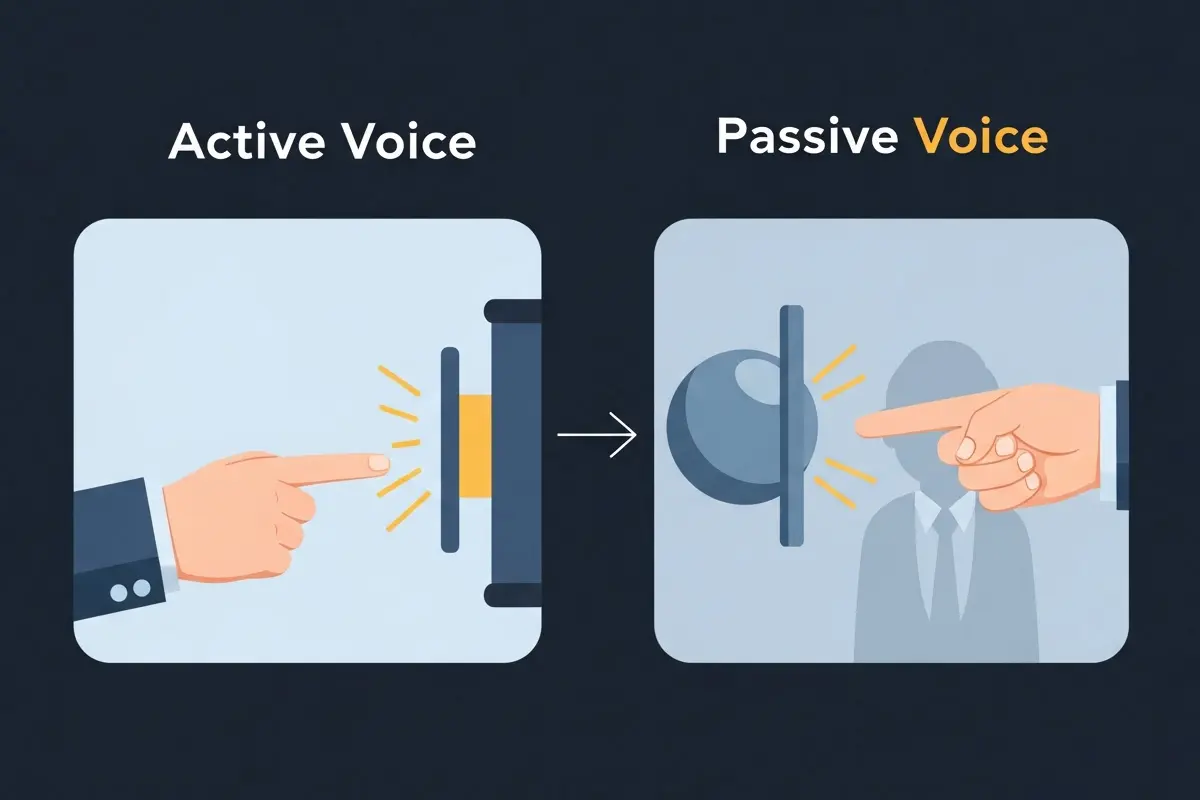
“The chef cooked the meal.”
vs.
“The meal was cooked by the chef.”Same idea — different structure. Can you see why?
Active and Passive Voice Worksheet: Complete Guide with Practice and Answers
Understanding active and passive voice is essential for clear English writing. Whether you’re preparing for exams, improving academic writing, or teaching grammar, knowing when and how to use each voice makes a big difference.
In this guide, you will learn:
- What active and passive voice really mean
- When to use each one
- How to convert between them
- Common mistakes learners make
- A complete active and passive voice worksheet with answers
What Is Active and Passive Voice?
Active Voice
In active voice, the subject performs the action.
Example:
- The teacher explained the lesson.
- She writes a letter.
- The dog chased the ball.
Structure:
Subject + Verb + Object
Active voice is usually:
- Clear
- Direct
- Strong
- Easy to understand
Passive Voice
In passive voice, the subject receives the action.
Example:
- The lesson was explained by the teacher.
- A letter is written by her.
- The ball was chased by the dog.
Structure:
Object + form of “be” + past participle [+ by subject]
Passive voice always uses:
- A form of be
- A past participle
Why Active Voice Is Usually Preferred
Most professional writing prefers active voice because:
- It is shorter
- It sounds confident
- It avoids unnecessary words
- It clearly shows responsibility
Compare:
Passive:
The proposal was approved by the committee.
Active:
The committee approved the proposal.
The active version is clearer and more direct.
When Should You Use Passive Voice?
Passive voice is useful in certain situations.
1️⃣ When the doer is unknown
The window was broken last night.
We don’t know who broke it.
2️⃣ When the action is more important
The experiment was conducted in 2024.
The focus is the experiment, not the person.
3️⃣ In formal or scientific writing
Academic writing often focuses on results rather than the researcher.
Active vs Passive Voice: Tense Comparison Table
| Tense | Active | Passive |
|---|---|---|
| Present Simple | She writes a letter. | A letter is written by her. |
| Past Simple | He built the house. | The house was built by him. |
| Present Perfect | They have finished the work. | The work has been finished by them. |
| Future Simple | We will complete the task. | The task will be completed by us. |
| Present Continuous | She is reading the book. | The book is being read by her. |
Notice: Passive voice always requires a correct form of be.
How to Convert Active to Passive
Step 1: Identify the object
Step 2: Move the object to subject position
Step 3: Add correct form of “be”
Step 4: Add past participle
Step 5 (Optional): Add “by + subject”
Example:
Active:
The manager approved the plan.
Passive:
The plan was approved by the manager.
Active and Passive Voice Worksheet
Part A — Identify the Voice
Write Active or Passive:
- The homework was completed by Sarah.
- The students solved the problem.
- The room is cleaned every morning.
- We watched the movie last night.
- The cake was baked by Grandma.
Part B — Convert to Passive Voice
- The manager approved the plan.
- She writes emails every day.
- They are building a bridge.
- We have finished the project.
- The company will launch a new product.
Part C — Convert to Active Voice
- The song was written by Adele.
- The homework was corrected by the teacher.
- A new policy has been introduced by the school.
- The meal is being prepared by the chef.
- The documents will be signed by the director.
Answer Key
Part A Answers
- Passive
- Active
- Passive
- Active
- Passive
Part B Answers
- The plan was approved by the manager.
- Emails are written by her every day.
- A bridge is being built by them.
- The project has been finished by us.
- A new product will be launched by the company.
Part C Answers
- Adele wrote the song.
- The teacher corrected the homework.
- The school introduced a new policy.
- The chef is preparing the meal.
- The director will sign the documents.
Common Mistakes Learners Make
❌ Forgetting tense agreement
Wrong:
The car is drive by Tom.
Correct:
The car is driven by Tom.
❌ Forgetting “being” in continuous passive
Wrong:
The house is built.
Correct:
The house is being built.
❌ Overusing passive voice
Too much passive voice makes writing unclear.
Weak:
The decision was made by the team.
Better:
The team made the decision.
Teaching Tips for Educators
If you are using this worksheet in class:
- Start with identification before conversion
- Use color coding for subject, verb, object
- Practice tense transformation separately
- Ask students to rewrite short paragraphs
Students understand voice better when they see sentence structure visually.
Why Mastering Voice Matters
Understanding active and passive voice improves:
- Academic essays
- Business communication
- IELTS writing
- Research reports
- Professional emails
The core rule is simple:
✔ Active voice → subject performs the action
✔ Passive voice → subject receives the action
Once you recognize the pattern, conversion becomes easy.
Final Thoughts
This active and passive voice worksheet gives you:
- Clear explanations
- Structured rules
- Tense comparison
- Practice exercises
- Complete answer key
Grammar improves through practice. Work through the exercises carefully, and try rewriting your own sentences in both voices.
For more structured grammar lessons and speaking practice tools, explore our full English learning section:
Master structure, and clarity follows.