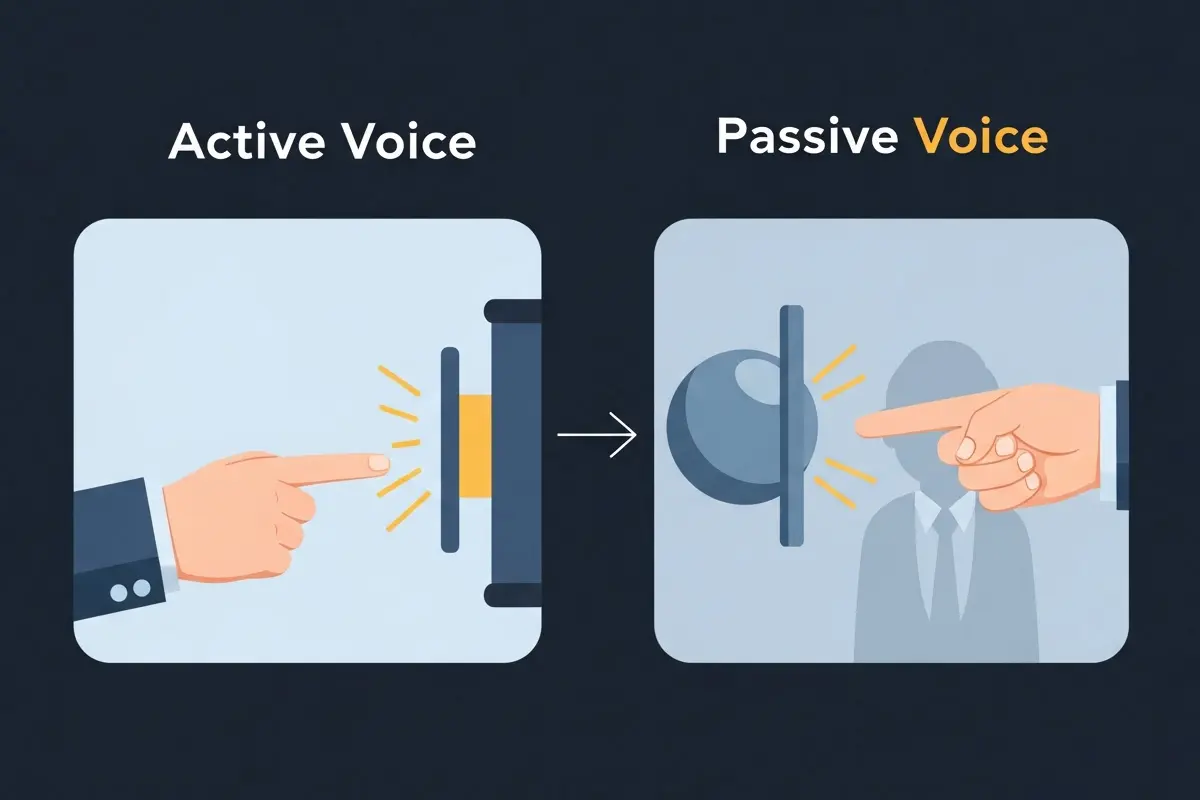
A lot of learners understand the idea of active and passive voice when they see one example.
Then they try to change a sentence by themselves and suddenly get stuck.
For example:
- The chef cooked the meal.
- The meal was cooked by the chef.
The meaning is almost the same, but the structure changes in a very specific way.
That is why active and passive voice is easier to learn through guided sentence practice than through definitions alone.
This worksheet-style guide is built for that kind of practice.
You will learn:
- what active and passive voice mean
- when each one is useful
- how to change one into the other
- which tenses work in passive voice
- and how to practice without guessing
TL;DR
- active voice means the subject does the action
- passive voice means the subject receives the action
- passive voice usually uses be + past participle
- active voice is usually clearer and more direct
- passive voice is useful when the doer is unknown, unimportant, or less important than the action
- the best way to learn this topic is with sentence conversion practice
What is active voice?
In active voice, the subject performs the action.
Examples
- The teacher explained the lesson.
- She writes emails every day.
- The dog chased the ball.
Basic pattern
subject + verb + object
That structure is usually the easiest one for learners to understand and use.
Active voice is common because it feels:
- clear
- direct
- natural
- shorter than passive voice in many cases
What is passive voice?
In passive voice, the subject receives the action.
Examples
- The lesson was explained by the teacher.
- Emails are written every day.
- The ball was chased by the dog.
Basic pattern
object + be + past participle + optional by-phrase
The passive voice often includes:
- a form of be
- a past participle
- sometimes by + doer
The doer is optional because sometimes it is not needed.
Active vs passive voice: the core difference
The real difference is not the event.
The real difference is focus.
Active voice focuses on the doer
- The committee approved the proposal.
Passive voice focuses on the receiver or result
- The proposal was approved by the committee.
Both sentences describe the same event.
But they guide the reader’s attention differently.
Why active voice is usually preferred
In most everyday writing, active voice is better because it is easier to understand.
Compare
Passive:
- The decision was made by the manager.
Active:
- The manager made the decision.
The active version is:
- shorter
- more direct
- easier to process
That is why active voice is often preferred in:
- business writing
- emails
- instructions
- everyday communication
- strong academic writing
When passive voice is useful
Passive voice is not wrong.
It is useful in specific situations.
1. When the doer is unknown
- The window was broken last night.
We do not know who broke it.
2. When the action matters more than the doer
- The experiment was conducted in 2024.
The focus is the experiment, not the researcher.
3. When the doer is obvious or unimportant
- English is spoken in many countries.
The exact speakers are not the focus.
4. In formal, academic, or scientific writing
Passive voice is common when the writer wants to emphasize:
- process
- result
- method
- object of study
That does not mean passive voice is always better in formal writing. It just appears more often there than in casual conversation.
How to recognize passive voice
A sentence is usually passive when:
- the subject receives the action
- there is a form of be
- the main verb is a past participle
Examples
- The cake was baked by my grandmother.
- The work has been finished.
- The room is cleaned every morning.
A quick test: Ask yourself:
Is the subject doing the action, or receiving it?
If the subject receives the action, you are probably looking at passive voice.
Tense comparison: active and passive voice
Here are some of the most useful tense patterns.
| Tense | Active | Passive |
|---|---|---|
| Present Simple | She writes the report. | The report is written by her. |
| Past Simple | They built the house. | The house was built by them. |
| Present Continuous | She is reading the book. | The book is being read by her. |
| Present Perfect | We have finished the work. | The work has been finished by us. |
| Future Simple | They will complete the task. | The task will be completed by them. |
A useful thing to notice:
Passive voice keeps the tense, but changes the structure.
That is why learners need to pay attention not only to the past participle, but also to the correct form of be.
How to change active voice into passive voice
This is the part learners usually need most.
Use these steps.
Step 1: Find the object in the active sentence
Example:
- The manager approved the plan.
Object:
- the plan
Step 2: Move that object into the subject position
- The plan…
Step 3: Choose the correct form of be
The original tense is past simple, so use was.
- The plan was…
Step 4: Add the past participle
- The plan was approved…
Step 5: Add the doer if needed
- The plan was approved by the manager.
That gives you the full passive sentence.
A quick example set
Active
- She writes emails.
Passive
- Emails are written by her.
Active
- The company will launch a new product.
Passive
- A new product will be launched by the company.
This step-by-step method is much easier than trying to “feel” the answer immediately.
Active and Passive Voice Worksheet
Part A — Identify the voice
Write Active or Passive.
- The homework was completed by Sarah.
- The students solved the problem.
- The room is cleaned every morning.
- We watched the movie last night.
- The cake was baked by Grandma.
- The team won the match.
- The documents were signed yesterday.
- My brother fixed the bike.
- The meal is being prepared.
- The teacher praised the class.
Part B — Change active to passive
- The manager approved the plan.
- She writes emails every day.
- They are building a bridge.
- We have finished the project.
- The company will launch a new product.
- The police arrested the suspect.
- My friend sent the message.
- The chef prepared the meal.
- The school changed the schedule.
- The students will clean the classroom.
Part C — Change passive to active
- The song was written by Adele.
- The homework was corrected by the teacher.
- A new policy has been introduced by the school.
- The meal is being prepared by the chef.
- The documents will be signed by the director.
- The road was closed by the police.
- The letter was sent by Maria.
- The room is cleaned by the staff every morning.
- The match was won by the home team.
- The project has been completed by the engineers.
Part D — Choose the better sentence
Choose the sentence that sounds more natural in normal everyday English.
A. The email was sent by John.
B. John sent the email.
A. The road was blocked by snow.
B. Snow blocked the road.
A. The test was completed by the students.
B. The students completed the test.
A. The window was broken last night.
B. Someone broke the window last night.
A. A new vaccine was developed in 2024.
B. Scientists developed a new vaccine in 2024.
Answer Key
Part A Answers
- Passive
- Active
- Passive
- Active
- Passive
- Active
- Passive
- Active
- Passive
- Active
Part B Answers
- The plan was approved by the manager.
- Emails are written by her every day.
- A bridge is being built by them.
- The project has been finished by us.
- A new product will be launched by the company.
- The suspect was arrested by the police.
- The message was sent by my friend.
- The meal was prepared by the chef.
- The schedule was changed by the school.
- The classroom will be cleaned by the students.
Part C Answers
- Adele wrote the song.
- The teacher corrected the homework.
- The school has introduced a new policy.
- The chef is preparing the meal.
- The director will sign the documents.
- The police closed the road.
- Maria sent the letter.
- The staff clean the room every morning.
- The home team won the match.
- The engineers have completed the project.
Part D Suggested Answers
- B is more natural in everyday English.
- B is more direct, but A is also natural.
- B is usually more natural.
- A is better if the doer is unknown.
- Both work, but A is common in scientific or formal contexts.
Common mistakes learners make
1. Forgetting the past participle
Wrong:
- The car was drive by Tom.
Correct:
- The car was driven by Tom.
Passive voice needs a form of be plus the past participle, not the base verb.
2. Forgetting the correct tense of be
Wrong:
- The project is finished yesterday.
Correct:
- The project was finished yesterday.
The tense still matters in passive voice.
3. Forgetting being in continuous passive forms
Wrong:
- The house is built now.
Correct:
- The house is being built now.
If the original sentence is continuous, the passive usually needs being.
4. Overusing passive voice
Passive voice is useful, but too much of it makes writing sound heavy.
Weak:
- The report was written by the team, and the decision was made by the manager.
Better:
- The team wrote the report, and the manager made the decision.
A quick self-check routine
When you write a sentence, ask:
- Who is doing the action?
- What receives the action?
- Do I want the reader to focus on the doer or the receiver?
If you want the focus on the doer, active voice is usually better.
If the receiver or result matters more, passive voice may be the better choice.
Teaching tips for classroom use
If you are using this as a worksheet with students, a simple order works well:
1. Start with identification
Let students mark sentences as active or passive first.
2. Highlight sentence parts
Use colors for:
- subject
- verb
- object
3. Practice one tense at a time
Do not mix all passive tense forms too early.
4. Compare meaning, not only structure
Ask:
- Why is passive used here?
- Is active clearer here?
That helps students understand purpose, not only form.
Why this grammar point matters
Understanding active and passive voice helps with:
- academic writing
- exam writing
- workplace English
- clearer essays
- more natural sentence choice
It also helps learners understand why some English sentences sound:
- stronger
- weaker
- more formal
- more distant
- more objective
That is useful far beyond one worksheet.
If you are building a stronger grammar foundation overall, this topic pairs well with How to Learn English Grammar Step by Step and Essential English Grammar in Use: Complete Guide.
Final Thoughts
Active and passive voice is not only a grammar exercise.
It is really about focus.
- active voice focuses on the doer
- passive voice focuses on the action or the receiver
Once you understand that, sentence conversion becomes much easier.
So do not just memorize the formula.
Practice asking:
- who does the action?
- who receives the action?
- what should the sentence emphasize?
That is what makes this grammar point start to feel natural.