TL;DR
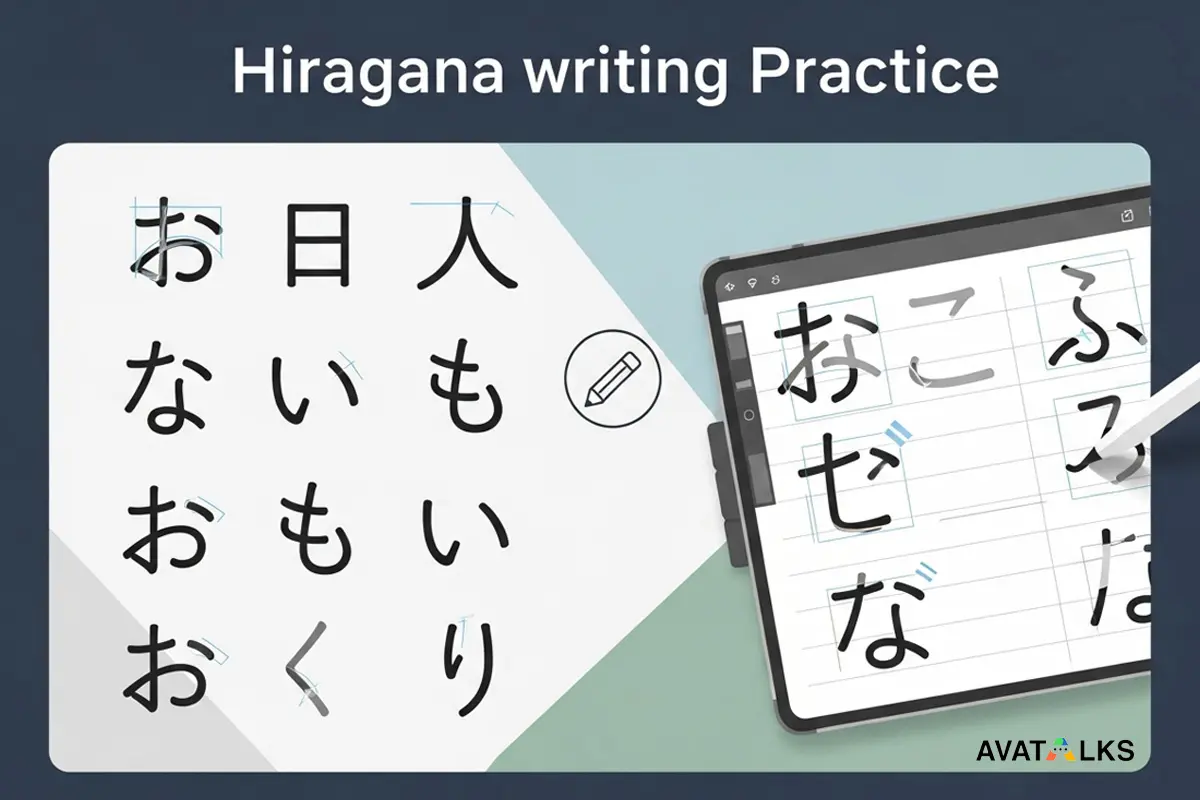
If your hiragana looks messy, inconsistent, or easy to confuse, the problem is usually how you practice — not how much.
What actually works:
- Follow correct stroke order
- Focus on the most confusing characters first
- Use a short daily routine: trace → copy → write from memory
You do not need to write each character 100 times.
Hiragana Practice Online
Practice all hiragana with guided audio, stroke order, and writing mode — built to match the drills in this article.
Back to main guide →Why Hiragana Writing Feels Hard (And Why It Shouldn’t)
Most learners struggle because they:
- copy characters without understanding stroke order
- rush through writing without reviewing
- practice all characters instead of the confusing ones
Good hiragana writing is about consistent motion, not artistic beauty.
Once your hand learns the movement, the shape follows.
The 3 Writing Principles You Must Follow
These rules fix most writing problems immediately.
1. Stroke order matters more than shape
Correct stroke order:
- keeps characters balanced
- makes writing faster
- helps recognition when reading handwritten Japanese
Wrong order creates messy spacing — even if the shape looks “okay.”
2. Smooth beats perfect
Do not aim for pretty characters.
Aim for:
- smooth motion
- same direction every time
- consistent size
Neatness improves naturally with repetition.
3. Write fewer characters, more carefully
Five focused characters beat twenty rushed ones.
Live Practice for Writing Hiragana
Hiragana — Basic 46
あ (a)
い (i)
う (u)
え (e)
お (o)
か (ka)
き (ki)
く (ku)
け (ke)
こ (ko)
さ (sa)
し (shi)
す (su)
せ (se)
そ (so)
た (ta)
ち (chi)
つ (tsu)
て (te)
と (to)
な (na)
に (ni)
ぬ (nu)
ね (ne)
の (no)
は (ha)
ひ (hi)
ふ (fu)
へ (he)
ほ (ho)
ま (ma)
み (mi)
む (mu)
め (me)
も (mo)
や (ya)
ゆ (yu)
よ (yo)
ら (ra)
り (ri)
る (ru)
れ (re)
ろ (ro)
わ (wa)
を (o)
ん (n)
The Most Commonly Written-Wrong Hiragana
If you only fix these, your writing improves fast.
High-confusion characters
- ぬ / め / れ
- ね
- あ
- き
- さ
Why they cause trouble
- similar curves
- crossing strokes
- small angle differences
These should be your daily priority list.
The 10-Minute Hiragana Writing Routine
This is the most time-efficient way to practice.
Step 1: Trace (2 minutes)
- Trace each character 2 times
- Follow stroke order carefully
- Say the sound once while tracing
Step 2: Copy (4 minutes)
- Write while looking at a model
- Focus on spacing and direction
- Do not rush
Step 3: Write from memory (4 minutes)
- Hide the model
- Write once from memory
- Compare and correct
That’s it.
Five characters per session is enough.
How Often Should You Practice?
Daily short sessions work best.
Recommended schedule
- 10 minutes per day
- 5–6 characters
- review yesterday’s characters once
Writing every day for a week beats one long session.
Common Hiragana Writing Mistakes (And Fixes)
Mistake: Writing without stroke order
Fix: Watch stroke animation once before writing
Mistake: Characters look different every time
Fix: Slow down and keep direction consistent
Mistake: Mixing similar characters
Fix: Practice confusing pairs side by side (ぬ vs め)
How Writing Helps Reading (Yes, It Does)
Even if you mostly read and type:
- writing trains character recognition
- stroke order improves memory
- similar characters become easier to tell apart
You don’t need perfect handwriting. You need familiar movement.
Practice These Characters First (Today’s List)
If you want a simple starting point:
- ぬ
- め
- れ
- ね
- あ
Write each using the 10-minute routine above.
What to Practice After This
Once writing feels stable:
- practice full hiragana rows
- add dakuten (が / ざ / だ)
- combine writing with pronunciation drills
This connects directly to the full hiragana system.
👉 Continue here: Hiragana Practice Online
Final Takeaway
Good hiragana writing is not about talent.
It’s about:
- correct order
- slow repetition
- short daily practice
Fix the basics once, and your writing stays clean forever.