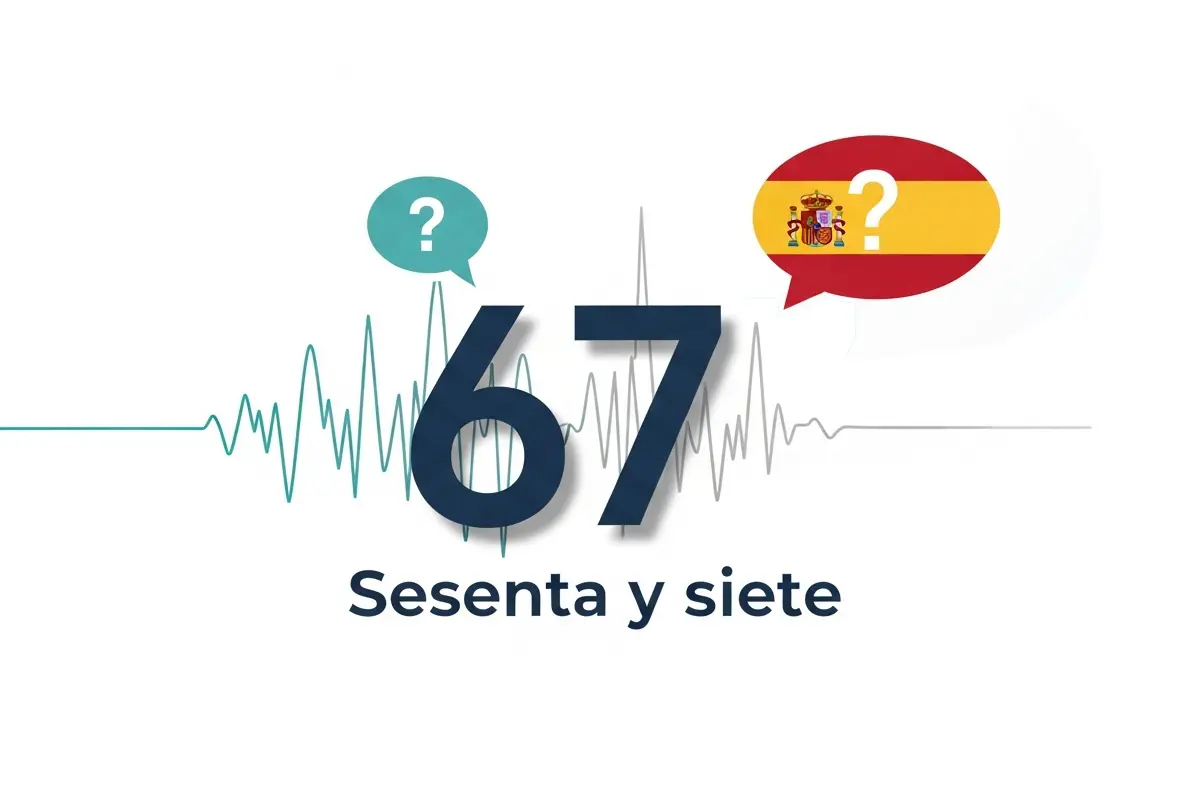
TL;DR — How Do You Say 67 in Spanish?
- 67 in Spanish is sesenta y siete
- It literally means “sixty and seven”
- Pronunciation: seh-SEN-ta ee SYEH-teh
- Spanish numbers from 31–99 follow a clear pattern
- Learning numbers helps with prices, dates, age, and daily conversation
How Do You Say 67 in Spanish? (Short Answer)
67 in Spanish is sesenta y siete.
Spanish forms this number by combining sesenta (60) + y (and) + siete (7).
This simple structure is why many learners quickly master Spanish numbers once they understand the pattern.
If you want to see how this pattern works across the entire number system, our guide:
Numbers in Spanish 1–100 with pronunciation
Learn all numbers in Spanish from 1–100 with pronunciation, spelling rules, examples, and patterns beginner learners can rely on.
Read Now →What Is the Spanish Word for 67?
The Spanish word for 67 is:
sesenta y siete
Breakdown:
- sesenta = sixty
- y = and
- siete = seven
Takeaway: Spanish builds many numbers by joining tens + “y” + ones.
How Do You Pronounce 67 in Spanish?
Sesenta y siete is pronounced:
seh-SEN-ta ee SYEH-teh
Pronunciation tips:
- The “s” is always soft
- The “y” sounds like “ee”
- Stress falls on SEN in sesenta
If you can say siete (7), you’re already halfway there.
Why Is “Sesenta y Siete” Written This Way?
Spanish numbers between 31 and 99 follow a logical structure:
Examples:
- 42 → cuarenta y dos
- 58 → cincuenta y ocho
- 67 → sesenta y siete
- 91 → noventa y uno
Takeaway: Once you learn the tens, the rest are predictable.
When Do You Use 67 in Spanish in Real Life?
You’ll use sesenta y siete in everyday situations like:
- Prices
- Cuesta sesenta y siete euros.
- Age
- Tiene sesenta y siete años.
- Dates or quantities
- Hay sesenta y siete estudiantes.
Numbers appear constantly in real Spanish, not just in textbooks.
Is 67 Written Differently in Spain vs Latin America?
No. Sesenta y siete is written and understood the same way across all Spanish-speaking countries.
The only difference may be pronunciation of certain letters, but the number itself never changes.
Why Is “How Do You Say 67 in Spanish” Trending?
This type of query is popular because:
- Students search specific homework questions
- Voice assistants return number-based answers
- Social platforms (TikTok, Shorts) boost number searches
- Numbers are common People Also Ask queries
These searches are fast, high-intent, and ideal for featured snippets.
How Do Spanish Numbers Work from 60 to 69?
Here’s a quick reference:
| Number | Spanish |
|---|---|
| 60 | sesenta |
| 61 | sesenta y uno |
| 62 | sesenta y dos |
| 63 | sesenta y tres |
| 64 | sesenta y cuatro |
| 65 | sesenta y cinco |
| 66 | sesenta y seis |
| 67 | sesenta y siete |
| 68 | sesenta y ocho |
| 69 | sesenta y nueve |
Takeaway: Learn one pattern, unlock ten numbers.
Do You Always Use “Y” in Spanish Numbers?
Yes — for numbers between 31 and 99, Spanish uses “y” between tens and ones.
The only major exception is 16–29, which follow a different pattern (diecisiete, veintidós, etc.).
Common Mistakes Learners Make with 67 in Spanish
- ❌ Saying sesenta siete (missing y)
- ❌ Pronouncing y like English “why”
- ❌ Stressing the wrong syllable
Correct form: ✅ sesenta y siete
How Can You Practice Spanish Numbers Faster?
The best way to learn numbers like 67 is:
- Say them out loud
- Use them in sentences
- Practice in context (prices, age, time)
Short, daily practice beats memorization.
FAQ — How Do You Say 67 in Spanish?
How do you say 67 in Spanish?
You say sesenta y siete.
What does sesenta y siete mean?
It literally means sixty and seven.
Is 67 written the same in all Spanish-speaking countries?
Yes. The spelling is identical everywhere.
How do you pronounce sesenta y siete?
It’s pronounced seh-SEN-ta ee SYEH-teh.
Do Spanish numbers always use “y”?
Numbers from 31 to 99 use y between tens and ones.
Is it important to learn Spanish numbers early?
Yes. Numbers are essential for shopping, travel, time, age, and daily conversation.
Why do people search for specific numbers in Spanish?
Specific number searches are common for homework, travel, prices, dates, and voice-assistant queries where users want fast, exact answers.
Final Thoughts
If you’re wondering how do you say 67 in Spanish, the answer is simple:
sesenta y siete
Once you understand the pattern, Spanish numbers become one of the easiest parts of the language.
Small questions like this build confidence — and confidence builds fluency.