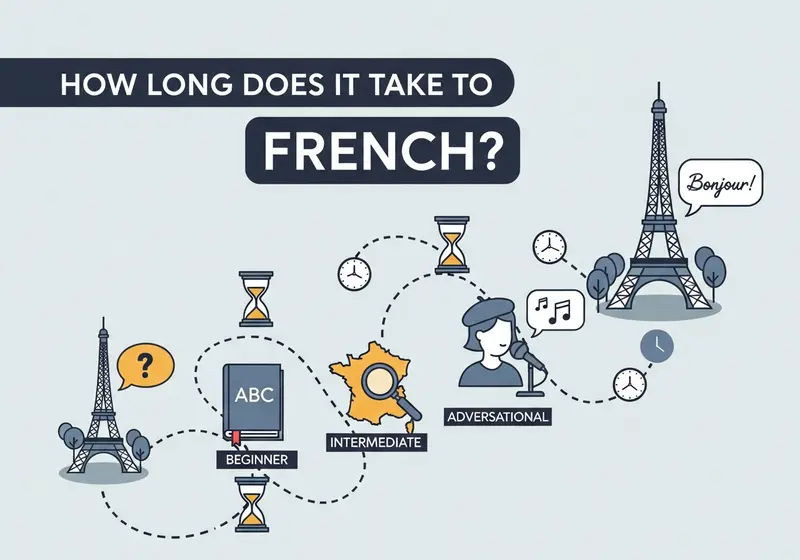
TL;DR
- Most English speakers can start handling very simple French in 1 to 3 months if they practice consistently.
- Getting to comfortable everyday French usually takes around 6 to 12 months.
- Reaching independent conversation and work-ready French often takes 12 to 24 months or more, depending on speaking practice and feedback.
- French often feels fast at the beginning, then slower later. That is normal.
- The biggest shortcut is not “more studying.” It is better practice: useful phrases, regular speaking, and repeated correction.
How long does it take to learn French fluently?
There is no single timeline for learning French fluently, because fluency is not one fixed target.
For one learner, fluency means being able to handle a trip to Paris without panic. For another, it means chatting comfortably with French speakers. For someone else, it means working in French, reading widely, or sounding polished in longer conversations.
That is why answers online can sound contradictory. Some people say French moves quickly. Others say it takes years. Both can be true, depending on the level of French they are talking about.
French often feels encouraging at the beginning, especially for English speakers, because a lot of the vocabulary looks familiar. But later, progress slows down for many learners because French also asks you to manage pronunciation, silent letters, listening speed, liaisons, and more natural sentence flow.
So the most useful question is not just:
How long does it take to learn French fluently?
It is:
How long does it take to reach the kind of French I personally want to use in real life?
A practical answer by goal
This is the most useful way to think about the timeline.
| Your goal | What it usually means in real life | Typical timeline with steady practice |
|---|---|---|
| Survival French | greetings, directions, cafés, hotels, simple needs | 1 to 3 months |
| Everyday French | short conversations, daily routines, plans, simple opinions | 3 to 9 months |
| Comfortable conversational French | longer exchanges, fewer pauses, better listening control | 6 to 12 months |
| Independent French | travel, work meetings, reading everyday content, following most conversations | 12 to 24 months |
| Advanced French | nuance, abstract topics, professional or academic accuracy | 2 to 4+ years |
This is why vague goals create frustration. If your real goal is “I want to get through a trip,” your timeline is much shorter than if your goal is “I want to work in French.”
A realistic timeline by level
The CEFR framework describes language ability across levels from A1 to C2. That framework is useful because it reminds learners that progress is gradual, not all-or-nothing. See the official CEFR framework overview.
| Milestone | What you can usually do | Typical timeline |
|---|---|---|
| A0 → A1 | understand and use basic greetings, introductions, simple needs | 2 to 6 weeks |
| A1 → A2 | handle simple daily situations, ask and answer common questions | 2 to 4 months |
| A2 → B1 | hold conversations with pauses, explain plans and opinions simply | 6 to 12 months |
| B1 → B2 | speak more comfortably, follow more media, deal with work or travel more naturally | 12 to 24 months |
| C1+ | discuss abstract topics, write clearly, handle nuance and complexity | 2 to 4+ years |
These are not promises. They are practical ranges.
What the official estimates actually mean
The U.S. Foreign Service Institute places French among the languages relatively accessible to English speakers and gives an estimate of about 600 to 750 class hours to reach a professional working level. See the official Foreign Service Institute language training page.
That estimate is useful, but learners often misunderstand it.
It does not mean:
- 600 hours for near-native French
- 600 hours with random app use
- 600 hours without speaking
It is closer to:
- structured learning
- regular correction
- consistent study
- a fairly serious target
So the most useful interpretation is this:
French can move quickly to a functional level, but reaching reliable independent use takes hundreds of good hours, not just exposure.
Why French feels fast, then slow
This is one of the most important things to understand.
At the start, French often feels rewarding because English speakers quickly recognize:
- familiar vocabulary
- familiar sentence patterns
- many international words
But later, progress slows because learners start hitting the real bottlenecks:
- pronunciation
- listening speed
- gender agreement
- verb variation
- natural phrasing
- confidence under pressure
So if you feel like French was “easy for two months and harder after that,” that does not mean you are failing. It usually means you have moved past the beginner illusion and into real learning.
The 5 biggest factors that decide your timeline
1. Your goal
The fastest way to get discouraged is to use the word fluent without defining it.
These are not the same goal:
- “I want to order food and ask directions.”
- “I want to date in French.”
- “I want to work in French.”
- “I want to read novels naturally.”
Your timeline changes immediately when your goal changes.
2. How often you speak
Reading and listening matter, but speaking is what changes the speed of progress most dramatically.
Many learners can recognize French much earlier than they can produce it. They know the phrase when they see it, but freeze when they try to say it.
That gap usually closes faster with:
- short speaking sessions
- repeated topics
- one or two corrections at a time
3. Your pronunciation strategy
French pronunciation is one of the main reasons learners feel slower than expected.
The problem is not that every sound is impossible. The problem is that small sound mistakes stack up:
- silent endings
- nasal vowels
- liaisons
- rhythm
- French vowel contrasts
You do not need a perfect accent. But clear pronunciation saves time because people understand you faster, and you understand yourself better too.
4. Your weekly consistency
Twenty minutes a day is often stronger than two long sessions on the weekend.
That is because French improves through repeated contact, not occasional intensity.
5. Your feedback loop
Practice without correction feels productive, but it often hardens mistakes.
Even a small feedback loop helps:
- one pronunciation fix
- one grammar fix
- one better phrase
That is enough to make the next repetition better.
Three realistic French study paths
Path 1: Busy learner
20 minutes a day
Best for people with work, children, or low mental bandwidth.
A simple split:
- 8 minutes listening
- 7 minutes speaking
- 5 minutes review
Expected result:
- basic survival French in a few months
- visible speaking growth if you stay consistent
Path 2: Steady learner
45 to 60 minutes a day
Best for serious learners who want steady momentum.
A useful split:
- 15 minutes listening
- 15 minutes speaking
- 15 minutes reading or phrase work
- 10 to 15 minutes review or writing
Expected result:
- everyday French in 6 to 12 months
- stronger chance of reaching B1-level habits
Path 3: Short sprint
90 minutes a day for 8 to 12 weeks
Best for a trip, relocation, or urgent push.
This only works if the time is balanced:
- real listening
- speaking output
- correction
- repetition
If all 90 minutes go into passive study, you will feel busy without becoming much more usable.
Weekly practice vs likely outcome
| Weekly practice | What it usually feels like | Likely result |
|---|---|---|
| 1 to 2 hours | slow, easy to forget, lots of re-starting | progress exists, but weak momentum |
| 4 to 6 hours | steady and realistic | clear beginner to lower-intermediate growth |
| 7 to 10 hours | strong momentum | real conversation ability within months |
| 12+ hours | fast progress if balanced well | major jumps, especially with speaking |
Consistency matters more than heroic study days.
A better way to measure French progress
Most learners ask the wrong question:
Am I fluent yet?
That question is too vague to help.
These questions are better:
- Can I speak for 60 seconds about my day?
- Can I order something politely without switching to English?
- Can I understand the topic of a short clip?
- Can I ask a follow-up question naturally?
- Can I repeat the same topic more smoothly the second time?
These checkpoints show real progress much earlier.
The Avatalks-style progress model that works best
This is the most useful pattern we keep seeing for learners who actually get faster.
Step 1: pick one real topic
Examples:
- cafés
- introductions
- travel
- work
- hobbies
- weekend plans
Step 2: learn sentence frames, not random word lists
Examples:
- Je voudrais…
- Est-ce que je peux… ?
- Je pense que…
- Je vais…
- J’aime… parce que…
Sentence frames build usable speech faster than isolated vocabulary.
Step 3: speak the same topic twice
This is one of the most underrated accelerators.
The first round is usually hesitant.
The second round is usually cleaner, faster, and more confident.
That second attempt is where a lot of progress becomes visible.
Step 4: fix one thing only
Not ten things. One thing.
For example:
- one sound
- one verb form
- one smoother phrase
Then repeat.
That is how practice becomes measurable improvement.
A simple French timeline you can actually use
Here is a plain-English version.
In 1 month
You can often learn:
- greetings
- introductions
- numbers
- basic food and travel phrases
- a few speaking frames
In 3 months
With consistent speaking practice, many learners can:
- handle basic exchanges
- ask simple questions
- talk about daily routines
- survive simple travel situations
In 6 months
Many consistent learners can:
- hold short conversations
- explain preferences
- understand more predictable spoken French
- recover better when they get stuck
In 12 months
Strong, steady learners often reach:
- everyday speaking comfort
- more flexible listening
- better control over pronunciation and structure
- more independent use of French
Why some learners take longer than expected
“I understand more than I can say”
Very common. This usually means too much input and not enough speaking.
“I keep forgetting words”
Often this means the words were learned alone, not inside phrases.
“French speakers talk too fast”
Also normal. Listening improves faster when you repeat short clips instead of always moving to new ones.
“I study a lot but don’t feel fluent”
That often means the study is broad but not repetitive enough. Depth beats novelty.
Tips that actually speed up French
- Speak earlier than feels comfortable.
- Reuse the same topic more than once.
- Learn phrase patterns, not only vocabulary lists.
- Train one pronunciation target at a time.
- Write tiny summaries, not long essays.
- Keep one daily French habit stable.
If you want help with pronunciation, start with our French pronunciation tool.
If you want a broader view of speaking-focused study, see our guide to AI language learning.
FAQ — How Long Does It Take to Learn French?
How long does it take to learn French as a beginner?
Many beginners can reach simple real-life French in about 1 to 3 months if they practice consistently and speak regularly.
How many hours does it take to learn French?
The Foreign Service Institute estimates about 600 to 750 class hours for professional working proficiency in French for English speakers, but real-world timelines vary a lot depending on speaking, correction, and consistency. See the official FSI page.
Can I become fluent in French in 3 months?
You can become functional in 3 months, especially for travel and simple conversation. But stronger independent French usually takes longer.
Why is French easier to read than to speak?
French shares a lot of vocabulary with English, so reading often feels easier at first. Speaking is harder because pronunciation and real-time production require more active control.
How long does it take to reach B1 or B2 in French?
For many steady learners:
- B1 often takes around 6 to 12 months
- B2 often takes around 12 to 24 months
Do I need to live in France to learn French quickly?
No. You can progress well without living abroad if you create regular contact with French and speak often.
Final thoughts
French usually takes less time than people fear, but more time than internet shortcuts promise.
The good news is that you do not need years before French becomes useful. You can build usable French much earlier if your practice includes:
- real topics
- repeatable sentence frames
- speaking
- correction
- repetition
So the best answer to how long does it take to learn French fluently is this:
Long enough to require consistency. Short enough to reward you early if you practice the right way.