TL;DR
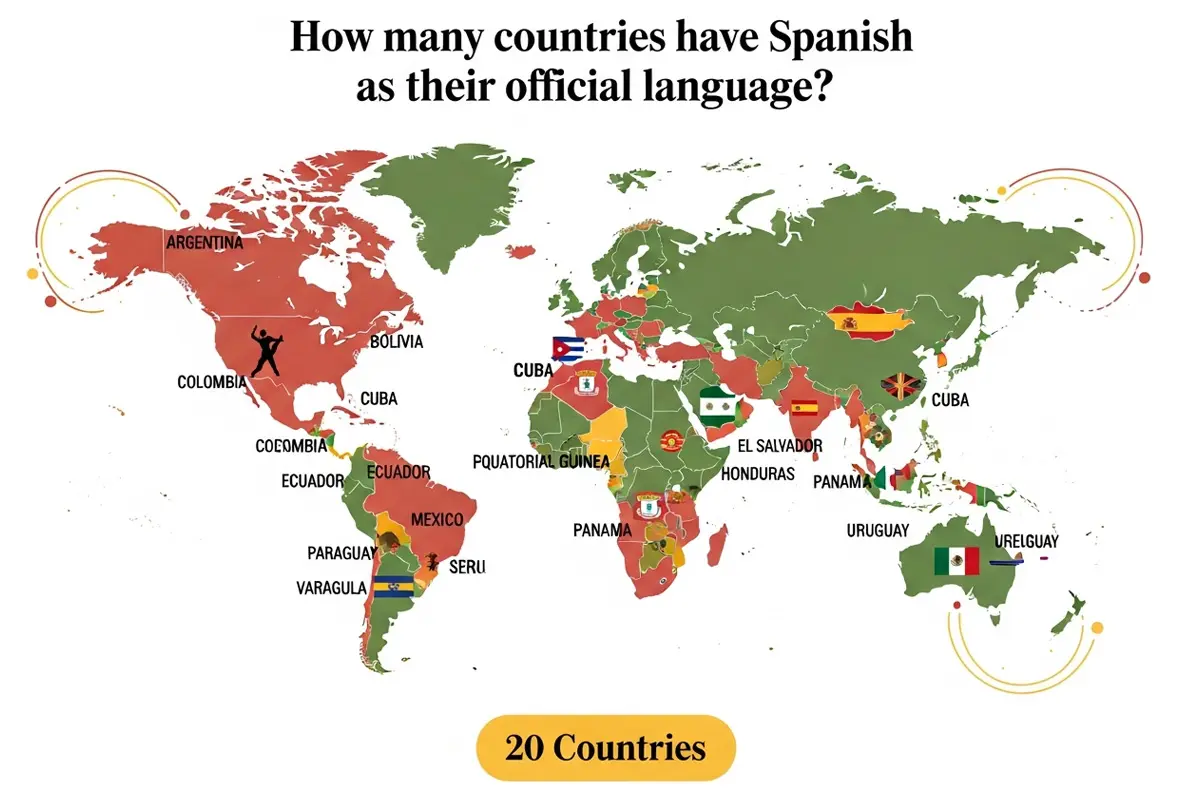
- Spanish is an official language in 20 countries.
- It’s also widely spoken in regions where it is not the national language, including the United States, Belize, Andorra, and Equatorial Guinea (co-official).
- Spanish is the second most spoken native language in the world and continues to grow globally.
- Learning where Spanish is spoken helps travelers, students, and language learners build cultural context.
Table of Contents
Open Table of Contents
- How many countries have Spanish as their official language?
- Full List of Countries Where Spanish Is Official
- Where Spanish Is Widely Spoken (But Not Official)
- Why Is Spanish So Widespread?
- Is Spanish the Same Everywhere?
- Most Populous Spanish-Speaking Countries (Top 5)
- Spanish in the Global Economy
- FAQ: Quick Answers
- ❓ Is Spanish the second most spoken native language in the world?
- ❓ Which Spanish should I learn?
- ❓ Are Spanish and Mexican Spanish the same?
- ❓ Which country has the largest Spanish-speaking population?
- ❓ How many people speak Spanish worldwide?
- ❓ How many Spanish-speaking countries are in South America?
- ❓ Do Spanish-speaking countries have other official or indigenous languages?
- ❓ Is Spanish growing as a global language?
- ❓ Is Spanish widely spoken in the United States?
- What to Learn Next
- Final Takeaway
How many countries have Spanish as their official language?
👉 Spanish is the official language in 20 sovereign countries.
According to the Instituto Cervantes El Español en el Mundo 2024 linguistic report, Spanish is spoken natively by more than 500 million people, making it one of the most widely used global languages.
Full List of Countries Where Spanish Is Official
Here are the 20 countries where Spanish has constitutional or governmental official language status according to wikipedia:
| Region | Country |
|---|---|
| 🇪🇸 Europe | Spain |
| 🌎 North America | Mexico |
| 🌎 Central America | Guatemala, Honduras, El Salvador, Nicaragua, Costa Rica, Panama |
| 🌎 Caribbean | Cuba, Dominican Republic, Puerto Rico* |
| 🌎 South America | Colombia, Venezuela, Ecuador, Peru, Bolivia, Paraguay, Chile, Argentina, Uruguay |
| 🌍 Africa | Equatorial Guinea** |
Notes:
- Puerto Rico*: U.S. territory — Spanish and English are official.
- Equatorial Guinea**: Spanish is co-official with French and Portuguese.
Where Spanish Is Widely Spoken (But Not Official)
Spanish is also widely used in several countries and territories where it does not hold constitutional status:
- United States
- Belize
- Andorra
- Western Sahara
According to the article on Languages of the United States, Spanish is the most widely spoken language in the United States after English and is used by tens of millions of residents at home.
Why Is Spanish So Widespread?
The spread of Spanish began in the late 15th century through exploration and colonization led by Spain. Over time, the language became embedded in:
- education
- law
- literature
- regional identity
A historical overview of how Spanish developed and expanded beyond Europe is summarized in the Spanish language article, including sections on its origins, colonial history, and global distribution.
Today, Spanish remains a linguistic bridge connecting communities across Europe, Latin America, the Caribbean, and Africa.
Is Spanish the Same Everywhere?
Core grammar and spelling remain unified across regions and are coordinated by the Asociación de Academias de la Lengua Española (ASALE) and national academies working together to maintain standard usage.
Reference: Association of Spanish Language Academies overview.
However, pronunciation, rhythm, and vocabulary vary by region. For example:
| Meaning | Spain | Mexico / Latin America |
|---|---|---|
| Bus | autobús | camión (MX), colectivo (AR) |
| Juice | zumo | jugo |
| Computer | ordenador | computadora |
These variations are similar to American vs. British English — different accents, same language.
Most Populous Spanish-Speaking Countries (Top 5)
| Rank | Country | Approximate Native Speakers |
|---|---|---|
| 1 | Mexico | ~126 million |
| 2 | Colombia | ~52 million |
| 3 | Spain | ~48 million |
| 4 | Argentina | ~46 million |
| 5 | Peru | ~34 million |
Population figures draw from the World Bank population database cross-checked with demographic estimates in the Instituto Cervantes El Español en el Mundo reports.
Spanish in the Global Economy
Spanish is an official or working language in key global organizations:
- United Nations — listed among the six official UN languages
- European Union — one of the 24 official EU languages
- Organization of American States
- African Union (regional usage)
The UN official languages overview highlights Spanish alongside English, French, Arabic, Chinese, and Russian as core working languages in international diplomacy.
This diplomatic presence further strengthens Spanish as a language of academia, international cooperation, trade, and culture.
FAQ: Quick Answers
❓ Is Spanish the second most spoken native language in the world?
Yes — Spanish ranks second globally by number of native speakers, according to the El Español en el Mundo demographic reporting from Instituto Cervantes and supporting estimates referenced in the Spanish language overview.
❓ Which Spanish should I learn?
Any standardized Spanish is fine.
Many learners choose Latin American Spanish because it’s widely used in online resources, media, and language-learning platforms.
❓ Are Spanish and Mexican Spanish the same?
Yes — they are the same language with regional variations in vocabulary and pronunciation. Mutual understanding remains strong across all Spanish-speaking regions.
❓ Which country has the largest Spanish-speaking population?
Mexico has the largest population of native Spanish speakers, with more than 126 million speakers, based on demographic estimates from the World Bank database and linguistic estimates referenced in the Instituto Cervantes annual reporting.
❓ How many people speak Spanish worldwide?
Spanish is used by more than 500 million native speakers and over 590 million total speakers worldwide. These totals are referenced in the El Español en el Mundo 2024 edition from Instituto Cervantes.
❓ How many Spanish-speaking countries are in South America?
There are 9 Spanish-speaking countries in South America:
Argentina, Bolivia, Chile, Colombia, Ecuador, Paraguay, Peru, Uruguay, and Venezuela.
❓ Do Spanish-speaking countries have other official or indigenous languages?
Yes. Many Spanish-speaking countries also recognize indigenous or regional languages.
For example:
- 🇧🇴 Bolivia: Quechua, Aymara, Guaraní alongside Spanish
- 🇵🇾 Paraguay: Guaraní and Spanish (both official)
- 🇵🇪 Peru: Quechua and Aymara recognized regionally
These multilingual traditions are documented in the linguistic overview for several countries in the Languages by country index.
❓ Is Spanish growing as a global language?
Yes — Spanish continues to expand due to population growth in Latin America and increasing use worldwide in education, business, and media. Instituto Cervantes reports highlight Spanish as one of the fastest-growing world languages.
❓ Is Spanish widely spoken in the United States?
Yes — Spanish is the most widely spoken language after English in the U.S., and is used by millions of residents at home, according to the summary found on the Languages of the United States reference.
What to Learn Next
If you’re exploring where Spanish is spoken, the next step is learning how it’s used in real communication:
- Spanish greetings and politeness rules
- How to say good morning in Spanish
- Spanish question words for conversation
Final Takeaway
Spanish is the official language in 20 independent countries, and spoken far beyond those borders.
Understanding where Spanish is spoken provides cultural, geographic, and linguistic context — whether you’re learning for travel, school, or global connection.
Spanish is not only limited to one map.
✨ It’s a world language shared across continents.