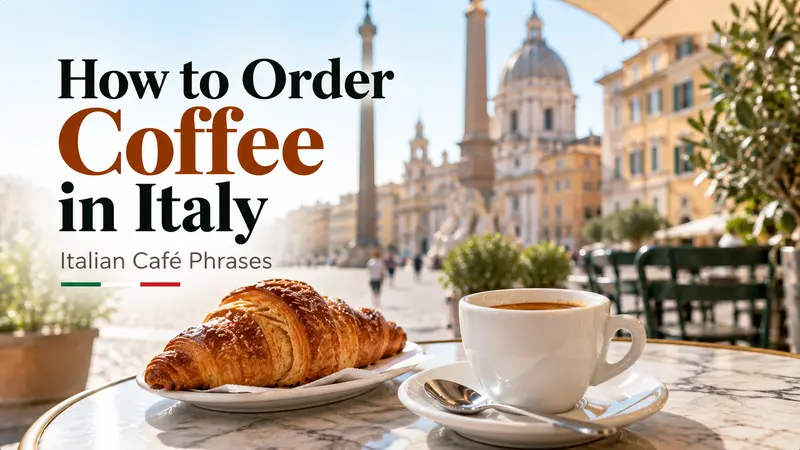
Walk into an Italian bar and say:
Un caffè, per favore.
You’ve just ordered a coffee.
But there is one important detail for visitors:
In Italy, un caffè normally means a small espresso-style coffee, not the large cup of brewed coffee you might expect in some other countries.
Ordering coffee in Italy is not difficult once you understand a few words and customs.
In this guide, you’ll learn how to order caffè, cappuccino, macchiato, caffè americano, and other drinks, plus how to ask for sugar, order at the counter, pay, and understand common questions from the barista.
TL;DR: How to Order Coffee in Italy
The easiest phrase to remember is:
Un caffè, per favore.
A coffee, please.
You can replace caffè with another drink:
Un cappuccino, per favore.
A cappuccino, please.
Or say:
Vorrei un caffè.
I’d like a coffee.
If you remember only three things before entering an Italian bar, remember:
- un caffè usually gets you an espresso-style coffee
- latte means milk
- per favore means please
Those three points prevent several common tourist mistakes.
First: What Does Bar Mean in Italy?
Before ordering, there is an Italian word you need to understand:
bar
An Italian bar is not necessarily what an English speaker imagines when hearing the word.
It can be a place where people stop for:
- coffee
- cappuccino
- pastries
- breakfast
- sandwiches
- soft drinks
- aperitivi
- alcoholic drinks
Coffee is an especially important part of everyday bar culture.
You may see people walk in, order an espresso, drink it standing at the counter, and leave within a few minutes.
So if someone in Italy says:
Andiamo al bar.
it can simply mean:
Let’s go to the café/bar.
Essential Italian Coffee Vocabulary
You don’t need to memorize every possible coffee variation.
Start with these:
| Italian | Meaning |
|---|---|
| caffè | coffee, normally an espresso-style coffee when ordering |
| espresso | espresso |
| cappuccino | espresso with steamed/frothed milk |
| caffè macchiato | coffee “stained” with a little milk |
| latte macchiato | milk “stained” with coffee |
| caffè americano | espresso with more hot water |
| caffè lungo | a longer coffee |
| caffè ristretto | a shorter, concentrated coffee |
| caffè decaffeinato | decaffeinated coffee |
| caffè corretto | coffee with a small amount of liquor |
| latte | milk |
| zucchero | sugar |
| acqua | water |
| tazza | cup |
| bicchiere | glass |
| bancone | counter |
| cassa | cash register |
The most important word is:
caffè
Notice the accent on è.
What Happens If You Order “Un Caffè”?
If you say:
Un caffè, per favore.
you normally don’t need to add espresso.
In an Italian bar, caffè commonly refers to the small, concentrated coffee visitors recognize as espresso.
So this:
Un caffè, per favore.
is a natural basic order.
You can certainly use the word espresso, especially when distinguishing the drink from other types of coffee, but don’t be surprised when Italians simply order un caffè.
Three Easy Ways to Order Coffee in Italian
You don’t need a complicated sentence.
1. Un caffè, per favore
Un caffè, per favore.
A coffee, please.
This is short and useful.
2. Vorrei un caffè
Vorrei un caffè.
I’d like a coffee.
Vorrei is a very useful word for travelers.
It means:
I would like
You can reuse it in restaurants, shops, bakeries, and many other situations.
3. Prendo un caffè
You may also say:
Prendo un caffè.
Literally, this is something like:
I’ll have a coffee.
For a beginner, Vorrei… and …per favore are especially easy patterns to reuse.
How to Order a Cappuccino
This one is easy:
Un cappuccino, per favore.
A cappuccino, please.
You could also say:
Vorrei un cappuccino.
I’d like a cappuccino.
Cappuccino is strongly associated with breakfast in Italy, often alongside a pastry. Italy’s official tourism site describes coffee as a common denominator of Italian breakfast traditions, while the exact breakfast habits vary considerably by region.
That doesn’t mean a visitor is forbidden from ordering cappuccino later in the day.
Think of the morning association as a cultural habit, not a law.
Don’t Order Just “Latte” If You Want Coffee
This is one of the most useful warnings for English-speaking visitors.
In Italian:
latte
means:
milk
So if you simply ask for:
Un latte, per favore.
you are asking for milk.
If you want coffee with milk, depending on the drink you want, you might order:
un caffè latte
or:
un latte macchiato
For example:
Un caffè latte, per favore.
This is a small vocabulary difference that can save you from an unexpected order.
Caffè Macchiato vs Latte Macchiato
These two names contain almost the same words, but the drinks are not the same.
macchiato comes from a word meaning stained or marked.
Caffè macchiato
caffè macchiato
is coffee with a small amount of milk.
Latte macchiato
latte macchiato
is mostly milk with coffee added to it.
An easy memory trick is to look at the first word:
caffè macchiato → coffee is the base
latte macchiato → milk is the base
What If You Want a Larger, Milder Coffee?
If you’re used to a larger cup of coffee, you may want:
un caffè americano
To order:
Un caffè americano, per favore.
You may also encounter:
caffè lungo
A lungo is not simply another name for an Americano. The preparation and resulting strength differ.
If you specifically want an Americano-style drink, ask for caffè americano rather than assuming lungo is identical.
How to Order Decaf Coffee
The full expression is:
caffè decaffeinato
but you may also hear:
deca
For a straightforward order:
Un caffè decaffeinato, per favore.
A decaf coffee, please.
How to Ask for Sugar
Sugar is:
zucchero
To ask for sugar:
Posso avere dello zucchero?
Can I have some sugar?
Another useful phrase is:
Senza zucchero.
Without sugar.
And:
Poco zucchero.
A little sugar.
At the Counter: What Does Al Banco Mean?
A very useful phrase in Italian coffee culture is:
al banco
which means:
at the counter
It is common to see people drink a quick coffee standing at the counter.
Eataly describes al banco as a typical way of enjoying coffee in Italy.
The alternative is sitting at a table:
al tavolo
at the table
You might be asked:
Al banco o al tavolo?
At the counter or at a table?
You can simply answer:
Al banco, grazie.
or:
Al tavolo, grazie.
Do You Pay Before or After Ordering?
There is no single workflow you should assume at every Italian bar.
Depending on the establishment, you may:
- pay at the cash register first and take the receipt to the counter
- order at the counter and pay afterward
- order and pay through table service
Look at what other customers are doing or ask.
A useful question is:
Pago qui?
Do I pay here?
You may also need the word:
cassa
cash register / checkout
If someone tells you:
Alla cassa.
they are directing you to the cash register.
How to Ask to Pay by Card
To ask whether you can pay by card:
Posso pagare con la carta?
Can I pay by card?
Italy’s official tourism site notes that major credit cards are widely used alongside cash, with smartphone payments also available in larger centers.
The useful vocabulary is:
pagare
to pay
and:
carta
card
How to Order Two Coffees
To order two coffees:
Due caffè, per favore.
Two coffees, please.
Notice something useful:
The singular is:
un caffè
and the plural remains:
due caffè
The form caffè does not change.
You can also order two different drinks:
Un caffè e un cappuccino, per favore.
One coffee and one cappuccino, please.
Add a Cornetto for an Italian Breakfast
If you’re ordering coffee in the morning, you may also want a pastry.
A useful word is:
cornetto
You could order:
Un cappuccino e un cornetto, per favore.
A cappuccino and a cornetto, please.
Breakfast terminology varies regionally too. In different parts of Italy, you may encounter different names and different local pastries, so don’t expect every bar in the country to have an identical menu.
A Realistic Italian Coffee Bar Conversation
Now let’s put the phrases together.
Ordering at the Counter
Barista: Buongiorno.
Good morning.
Customer: Buongiorno. Vorrei un caffè e un cappuccino, per favore.
Good morning. I’d like a coffee and a cappuccino, please.
Barista: Al banco o al tavolo?
At the counter or at a table?
Customer: Al banco, grazie.
At the counter, thank you.
Barista: Altro?
Anything else?
Customer: No, grazie.
No, thank you.
A beginner does not need to produce long sentences.
If you understand:
Al banco o al tavolo?
and:
Altro?
you can already handle two common follow-up questions.
Useful Words the Barista Might Say
Your order is only half of the conversation.
You also need to recognize what comes back.
| Italian | Meaning |
|---|---|
| Buongiorno | Good morning / good day |
| Prego | Please / go ahead / you’re welcome, depending on context |
| Altro? | Anything else? |
| Basta così? | Is that all? |
| Al banco? | At the counter? |
| Al tavolo? | At a table? |
| Lo zucchero? | Sugar? |
| Lo scontrino | receipt |
| La cassa | cash register |
| Grazie | thank you |
One especially useful phrase is:
Basta così.
In an ordering context, it means:
That’s all.
What If You Don’t Understand?
You don’t need perfect Italian to recover from a difficult interaction.
Say:
Può ripetere, per favore?
Could you repeat that, please?
Or:
Più lentamente, per favore.
More slowly, please.
If you can see the item you want, you can also point and say:
Questo, per favore.
This one, please.
These recovery phrases are often more useful to a traveler than memorizing another ten coffee names.
Five Common Mistakes to Avoid
1. Asking for “a latte”
If you say:
latte
you are saying:
milk
If you want a coffee drink, ask for caffè latte or latte macchiato, depending on what you want.
2. Assuming caffè Means a Large Brewed Coffee
In the context of an Italian bar, ordering un caffè normally gets you a small espresso-style coffee.
If you want something closer to an Americano, order:
un caffè americano
3. Treating Cappuccino After Breakfast as Forbidden
You may hear that Italians “never” drink cappuccino after a particular hour.
That’s too absolute.
Cappuccino is strongly associated with breakfast and morning habits, but a café can still serve one later. Think of this as a cultural convention rather than a rule that tourists must obey.
4. Assuming Every Bar Has the Same Payment System
Don’t panic if you see people paying before ordering in one bar and afterward in another.
Watch the flow or simply ask:
Pago qui?
5. Forgetting to Greet the Barista
Before jumping directly into your order, a simple:
Buongiorno
is useful and polite.
Later in the day, you may use:
Buonasera
Your 30-Second Italian Coffee Survival Kit
If you’re traveling tomorrow, you don’t need to memorize this entire guide.
Learn these six phrases:
Buongiorno
Good morning.
Un caffè, per favore
A coffee, please.
Vorrei un cappuccino
I’d like a cappuccino.
Al banco, grazie
At the counter, thank you.
Basta così
That’s all.
Posso pagare con la carta
Can I pay by card?
Practice them aloud a few times before entering a café.
The goal isn’t to sound like a native speaker.
The goal is to make the interaction easy.
Practice: Build Your Own Coffee Order
Use this simple formula:
Vorrei + drink + per favore
Start with:
Vorrei un caffè.
Then replace the drink.
Cappuccino
Vorrei un cappuccino.
Americano
Vorrei un caffè americano.
Decaf
Vorrei un caffè decaffeinato.
Coffee and a pastry
Vorrei un caffè e un cornetto.
Now try saying each one without looking at the Italian.
That kind of active recall is much more useful than simply rereading a vocabulary list.
FAQ
How do I order a coffee in Italy?
A simple and natural phrase is:
Un caffè, per favore.
You can also say:
Vorrei un caffè.
Both are useful for beginners.
What do Italians mean by un caffè?
At an Italian bar, un caffè normally refers to a small espresso-style coffee.
You usually don’t need to explicitly say espresso when ordering an ordinary caffè.
How do I order an Americano in Italy?
Say:
Un caffè americano, per favore.
How do I order a cappuccino in Italian?
Say:
Un cappuccino, per favore.
or:
Vorrei un cappuccino.
Can I order cappuccino after 11 a.m. in Italy?
Yes. Cappuccino is culturally associated with breakfast and morning drinking, but it isn’t prohibited later in the day. If you want one, you can order one.
Does latte mean coffee in Italian?
No.
Latte means milk.
If you want a milk-and-coffee drink, specify the drink, such as caffè latte or latte macchiato.
What does al banco mean?
Al banco means at the counter.
It is common to drink a quick coffee standing at the bar counter.
What does al tavolo mean?
Al tavolo means at the table.
If someone asks:
Al banco o al tavolo?
they are asking whether you want to have your order at the counter or at a table.
How do I ask to pay by card in Italian?
Say:
Posso pagare con la carta?
This means:
Can I pay by card?
How do I say “that’s all” when ordering?
Say:
Basta così.
This is useful when the barista asks whether you want anything else.
Final Thoughts
You don’t need advanced Italian to order coffee in Italy.
Start with one sentence:
Un caffè, per favore.
Then learn the small distinctions that make the experience easier:
caffè normally gets you an espresso-style coffee.
latte means milk.
al banco means at the counter.
al tavolo means at the table.
Vorrei… gives you an easy way to say what you’d like.
And if you don’t understand the response:
Può ripetere, per favore?
Once you can use those phrases, ordering coffee stops being a vocabulary exercise and becomes something much more useful: your first short, real conversation in Italian.