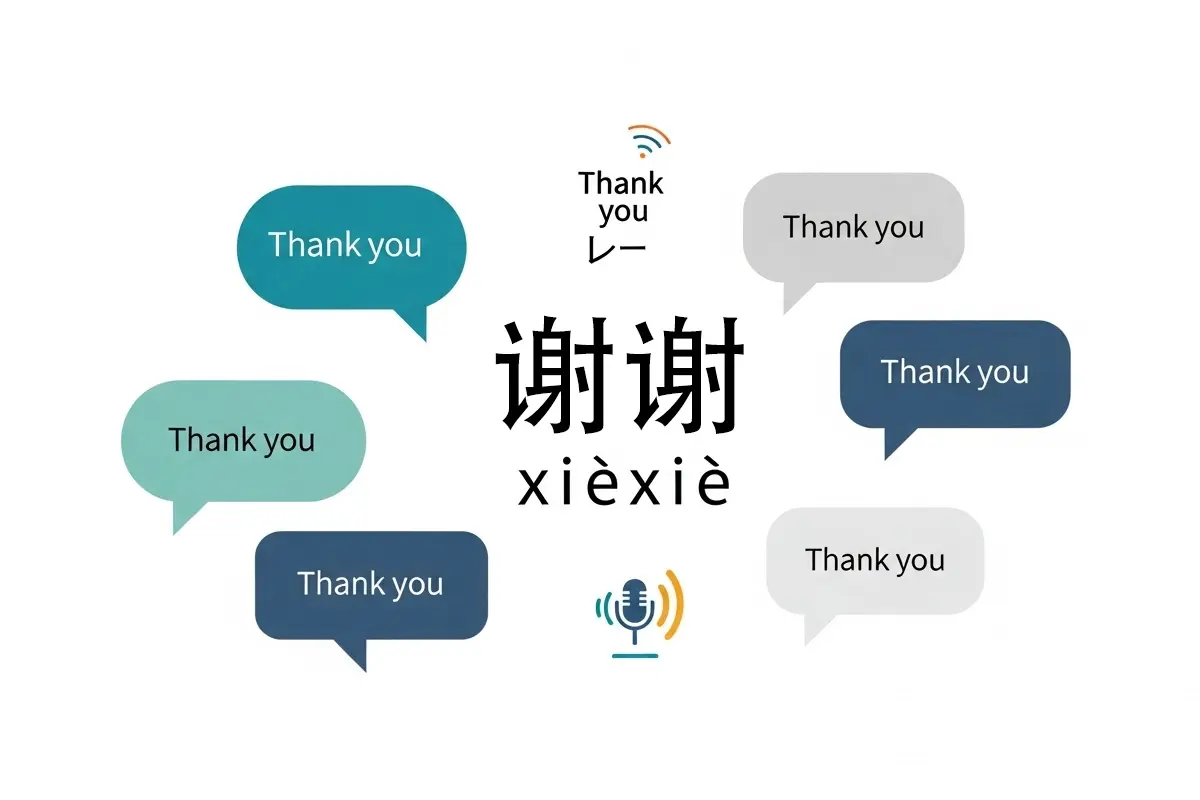
TL;DR — How to Say Thank You in Mandarin
- The standard way to say thank you in Mandarin is 谢谢 (xièxie).
- For “thank you very much,” use 非常感谢 (fēicháng gǎnxiè) or 谢谢你 (xièxie nǐ) depending on context.
- For formal situations, 感谢您 (gǎnxiè nín) is a safe, respectful choice.
- The most common reply is 不客气 (bú kèqì) (“You’re welcome / don’t mention it”).
- Tones matter: xièxie is 4th tone + neutral tone in real speech (many learners miss this).
How to Say Thank You in Mandarin
The most common way to say “thank you” in Mandarin is:
谢谢 (xièxie)
Characters: 谢谢
Pinyin: xièxie
Meaning: Thank you / Thanks
Quick pronunciation note (the one that fixes most “accent” issues)
Textbooks often write xièxie = 4th tone + 4th tone, but in natural speech it’s usually:
- xiè (4th tone, falling)
- xie (neutral tone, light and quick)
That’s why native speech sounds like “xiè-xie” (strong + soft), not two equally heavy syllables.
If you’re building tone confidence, start here: Mastering Chinese Pinyin.
Why “Thank You” Works Differently in Mandarin
Many English speakers say “thank you” constantly—especially for small routine actions. Mandarin is polite too, but politeness often shows up as modesty, reciprocity, or reducing someone’s “trouble,” not repeating 谢谢 many times.
At Avatalks, we often see learners do the “English habit” in Mandarin—saying 谢谢 for everything—then feel confused when native speakers respond with “no need” phrases like 不用谢. That doesn’t mean you were rude. It usually means the situation is close, casual, or “not a big deal.”
If you’re still deciding what “Mandarin” means compared to other Chinese varieties, this helps: Mandarin vs Chinese: Key Differences.
“Thank You” in Mandarin Text (Copy/Paste)
If you searched for how do you say thank you in Mandarin text, here are the exact characters you can copy:
- 谢谢 (Thanks / Thank you)
- 谢谢你 (Thank you — to you)
- 非常感谢 (Thank you very much)
- 感谢您 (Thank you — formal/respectful)
- 多谢 (Many thanks)
Tip: If you’re texting someone older or in a work setting, 感谢您 looks more respectful than a casual 谢谢.
“How Do You Say Thank You in Mandarin in English?”
Here are practical English spellings you’ll see online:
- xièxie (pinyin with tone marks)
- xiexie (plain pinyin)
- shieh-shieh (approximate English sound)
If you want to sound natural, don’t focus on “shieh-shieh.” Focus on the rhythm: strong first syllable, lighter second syllable.
“How Do You Say Thank You in Mandarin Audio?”
The fastest improvement comes from hearing it, copying it, and then checking yourself.
A simple practice loop we recommend (and many Avatalks learners use):
- Play the audio once
- Repeat immediately (don’t think too much)
- Record yourself (even 10 seconds)
- Compare: is your first syllable falling? is your second syllable light?
You already have audio + avatar mouth movement above. If you want more tone drills, try our pronunciation tool: Avatalks Character Pronunciation Tool
Variations of “Thank You” in Mandarin
Mandarin has several polite variations of 谢谢 that fit different contexts:
| Chinese Phrase | Pinyin | English Meaning | When to Use |
|---|---|---|---|
| 谢谢 | xièxie | Thank you | Everyday gratitude |
| 谢谢你 | xièxie nǐ | Thank you (to you) | When thanking someone personally |
| 多谢 | duōxiè | Many thanks | More formal or in writing |
| 非常感谢 | fēicháng gǎnxiè | Thank you very much | Deep or heartfelt gratitude |
| 万分感谢 | wànfēn gǎnxiè | Thanks a million | Strong emotional gratitude |
| 感谢您 | gǎnxiè nín | Thank you (very polite, respectful form) | When addressing elders or officials |
These variations help tailor your politeness level to match the social hierarchy — an essential part of communication in Mandarin-speaking regions.
If you’re planning to study Mandarin more deeply, our post on the Best Online Chinese Course breaks down which platforms best reinforce pronunciation, tones, and polite expressions.
“Thank you very much” in Chinese (the most natural choices)
If your goal is thank you very much in Chinese, use one of these:
- 非常感谢 (fēicháng gǎnxiè) — safe, clear, widely used
- 真的很谢谢你 (zhēn de hěn xièxie nǐ) — more emotional/personal
- 太感谢了 (tài gǎnxiè le) — warm, spoken, friendly
Thank You in Chinese Formal (Work, Clients, Elders)
If you searched thank you in Chinese formal, here are practical “don’t embarrass yourself” options:
- 感谢您 (gǎnxiè nín) — “Thank you” with respectful 您
- 非常感谢您的帮助 (fēicháng gǎnxiè nín de bāngzhù) — “Thank you very much for your help”
- 感谢您的支持 (gǎnxiè nín de zhīchí) — “Thank you for your support”
- 辛苦了 (xīnkǔ le) — not exactly “thank you,” but very useful to appreciate someone’s effort/work
Real-life tip: In workplaces, you’ll often hear 辛苦了 after someone finishes a task. It’s like “thanks for your hard work.” Many learners find this phrase instantly improves how “local” they sound.
How to Reply When Someone Thanks You
If someone says 谢谢, the most common replies are:
| Reply | Pinyin | English | Tone |
|---|---|---|---|
| 不客气 | bú kèqì | You’re welcome / don’t mention it | Standard |
| 不用谢 | bú yòng xiè | No need to thank me | Modest |
| 没关系 | méi guānxi | No problem | Casual |
| 小意思 | xiǎo yìsi | It’s nothing | Friendly / informal |
The #1 reply you should memorize
不客气 (bú kèqì) is the safest in almost every situation.
When Not to Say 谢谢 (So You Don’t Sound Overly Formal)
This confuses a lot of learners.
In Mandarin, you may skip 谢谢 when:
- it’s family or very close friends
- it’s routine inside the home (passing food, pouring tea)
- the other person is doing “their role” (depending on context)
Instead, people often show gratitude by:
- returning a favor later
- offering food or help
- using softening phrases like 麻烦你了 (thanks for the trouble)
At Avatalks, we’ve noticed learners feel more confident once they stop trying to translate English politeness directly—and start learning Chinese “relationship politeness” (warmth + modesty + balance).
“Thank You in Chinese Cantonese” (Quick Note)
If you searched thank you in Chinese Cantonese, that’s a different spoken language variety than Mandarin.
Common Cantonese thank-you phrases include:
- 多謝 (do1 ze6) — for gifts / bigger thanks
- 唔該 (m4 goi1) — for help/service (like “thanks” + “please” vibes)
Mandarin and Cantonese share some characters, but pronunciation and usage differ. If your goal is Mandarin, focus on 谢谢 / 感谢 first.
“Thank You in Chinese Google Translate” — A Quick Warning
Google Translate is useful, but for short polite phrases it can miss:
- formality level (你 vs 您)
- natural rhythm (neutral tone)
- context (service vs gift thanks)
If you want the “human” version, learn:
- 谢谢 (general thanks)
- 麻烦你了 (thanks for the trouble/help)
- 辛苦了 (thanks for your effort)
Those three cover a huge portion of real life.
A “Funny” Way to Say Thank You in Mandarin
If you searched how do you say thank you in Mandarin funny, here are playful options you might hear with friends:
- 谢啦!(xiè la!) — casual “thanks!” (friendly, light)
- 太给力了!(tài gěilì le!) — “that’s awesome / you’re the best!” vibe
- 你太好了!(nǐ tài hǎo le!) — “you’re so nice!”
Use these only with people you already have a relaxed relationship with. They can sound strange in formal contexts.
Mini Practice: 4 Real-Life Scenarios
1) Someone holds the door
- 谢谢!(xièxie!)
2) A friend helps you move boxes
- 太感谢了!(tài gǎnxiè le!)
3) You email a client
- 感谢您的支持。(gǎnxiè nín de zhīchí.)
4) Someone says 谢谢 to you
- 不客气。(bú kèqì.)
If you want to practice these aloud without pressure, Learn more in our guide to AI language learning.
FAQ — How to Say Thank You in Mandarin
What is the most common way to say thank you in Mandarin?
谢谢 (xièxie) is the standard phrase for “thank you” in Mandarin.
How do you say thank you very much in Chinese?
Use 非常感谢 (fēicháng gǎnxiè) or 太感谢了 (tài gǎnxiè le) depending on how formal the situation is.
What is the formal way to say thank you in Mandarin?
感谢您 (gǎnxiè nín) is a common formal option, especially for elders, clients, and officials.
How do you reply to thank you in Mandarin?
The most common reply is 不客气 (bú kèqì), meaning “you’re welcome / don’t mention it.”
Is 谢谢 always used in family situations?
Not always. In close relationships, saying 谢谢 for small routine actions can sound distant. People often show gratitude through actions or softer phrases like 麻烦你了.
Final Notes (What Helps Learners Most)
If you remember only one thing, remember this:
Mandarin gratitude is not just words—it’s tone + timing + relationship.
Start with 谢谢, then add:
- 非常感谢 (strong gratitude)
- 感谢您 (formal respect)
- 不客气 (reply)
And practice it out loud until it feels automatic.