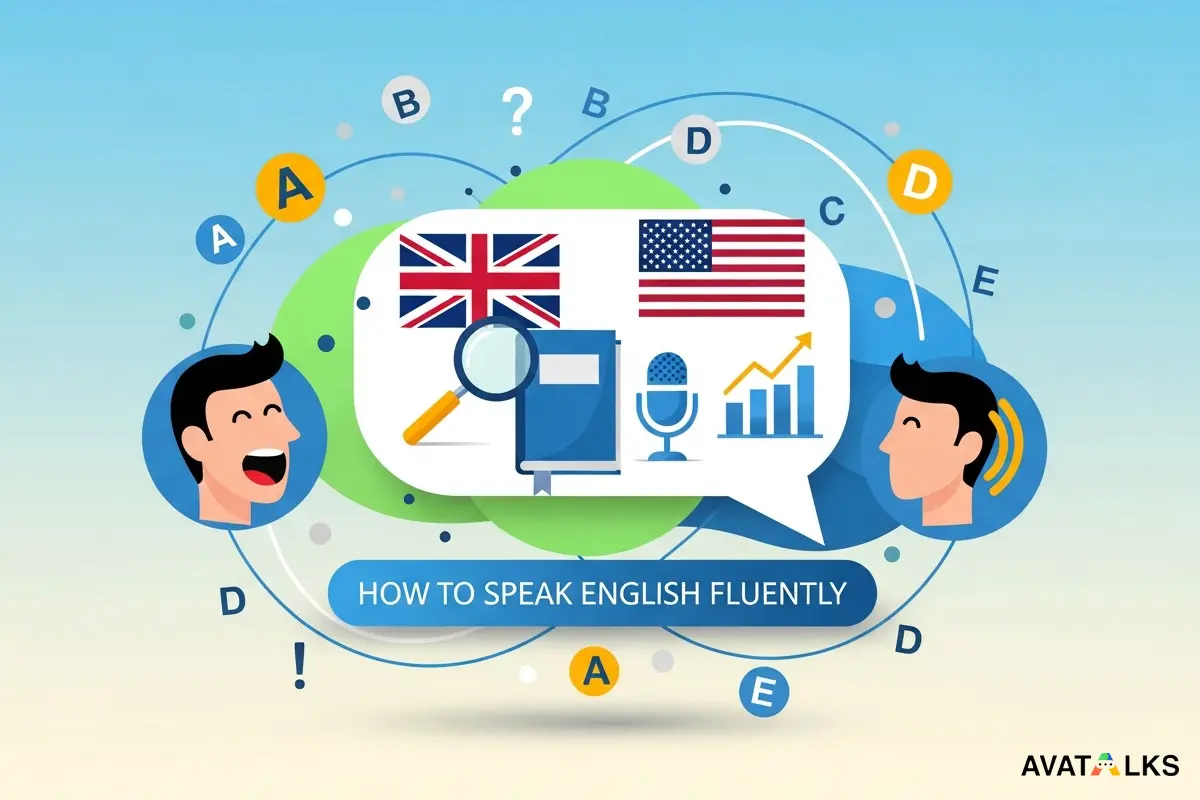
How to Speak English Fluently — The Real, Practical Way
Most learners ask the same question:
How to speak english fluently without living abroad or having a partner?
Fluency is not magic.
It’s a system of input → output → feedback → repeat.
This guide gives you:
- a daily routine that actually builds fluency
- exercises you can do alone at home
- pronunciation + rhythm training
- ways to sound natural, not robotic
- a path similar to a “fluent english speaking course” — but free and simple
English Speaking Practice HUB
The full roadmap: dialogues library, ESL questions, speaking topics, and step-by-step improvement plans.
Back to the hub →What Fluency Really Means
Fluency is not perfect grammar.
It means:
- you speak without long pauses
- ideas come out in full sentences
- listeners understand you easily
- you can react in real time
You don’t need advanced vocabulary first.
You need smooth output habits.
The Input + Output Formula
1) Input — Feed Your Brain (10 minutes)
Choose ONE:
- a short dialogue
- a 1-minute video
- 10 sentences from a podcast
- a page from graded readers
Focus on:
- stress (important words)
- pauses
- intonation
❌ Don’t just read silently
✅ Listen + notice rhythm
2) Output — Speak First, Think Later (10 minutes)
Do one of these:
- shadow the audio twice
- retell what you heard
- answer 5 questions aloud
- role-play both sides
This is where fluency is born.
3) Feedback — Fix One Thing (2 minutes)
Record yourself → replay once → fix:
- one sound
- one grammar habit
- one filler word
Not 10 things. Only one.
Daily Routine to Speak English Fluently
15-Minute Plan
- Shadow (3 min) – copy a dialogue
- Free talk (5 min) – speak about your day
- Question drill (5 min) – answer 5 questions
- Replay (2 min) – fix one mistake
Do this for 14 days and your speaking will change.
English Speaking Practice Without Partner
(Alone or at Home)
You don’t need anyone to practice.
Solo Method A — Role-Play
- Read A
- Answer as B
- Switch roles
- Change one line
Solo Method B — 30-Second Bursts
Talk for 30 seconds about:
- your morning
- your job
- a movie
- your plan tomorrow
Repeat 3 times, faster each round.
Solo Method C — Shadow + Change
- Shadow a sentence
- Change 2 words
- Say it again
This trains real-time thinking.
Self-talk is another simple way to turn passive English into active speaking practice. English fluency coach Richard explores this idea in “Talking to Yourself in English,” explaining how speaking to yourself can help bridge the gap between understanding English and actually producing it.
How to Practice English Speaking Alone or at Home
Exercise 1 — The Expand Trick
Start simple:
“I like coffee.”
Expand:
“I like coffee because it helps me relax in the morning.”
Add example:
“For example, I drink it before work.”
Exercise 2 — Opinion → Reason → Example
Use this frame:
- I think…
- because…
- for example…
Works for any topic.
Exercise 3 — Rhythm Training
Copy:
- movie lines
- short YouTube clips
- podcast intros
Don’t chase accent.
Chase clear rhythm.
Pronunciation for Fluency (Not Perfection)
Focus on 3 Things
- Word stress
- sentence stress
- linking sounds
Example:
- “I want to go” → I wanna go
Small changes = big fluency.
Common Blocks & Fixes
“I translate in my head”
➡ Use shorter sentences
➡ Speak before perfect grammar
“I speak too slowly”
➡ Do speed rounds
➡ 30 seconds non-stop
“I forget words”
➡ Paraphrase
➡ Use simple alternatives
14-Day Fluency Plan
Day 1–3
- shadow 1 dialogue daily
- 5 questions aloud
Day 4–7
- add 30-second bursts
- record once
Day 8–10
- retell a story
- focus on stress
Day 11–14
- 3 minutes free talk
- fix one habit
If You Want a Course-Style Path
A good fluent english speaking course should include:
- daily output tasks
- shadowing material
- feedback loops
- real conversation practice
You can copy this structure yourself using the routine above.
How Avatalks Can Help
- Pick a topic or dialogue
- Speak out loud
- Get instant feedback
- Repeat tomorrow
FAQ
How to speak english fluently at home?
Use the Input + Output method: shadow → speak → record → fix one mistake daily.
Can I become fluent without a partner?
Yes. Role-play, shadowing, and self-recording are enough to build fluency.
How many minutes a day?
15 minutes daily beats 2 hours once a week.
Should I focus on grammar?
Only fix grammar after you speak, not before.
Final Rule
Fluency grows from speaking every day, not reading about speaking.
- Speak →
- Replay →
- Fix one thing →
- Repeat tomorrow.
That is how to speak english fluently — for real.