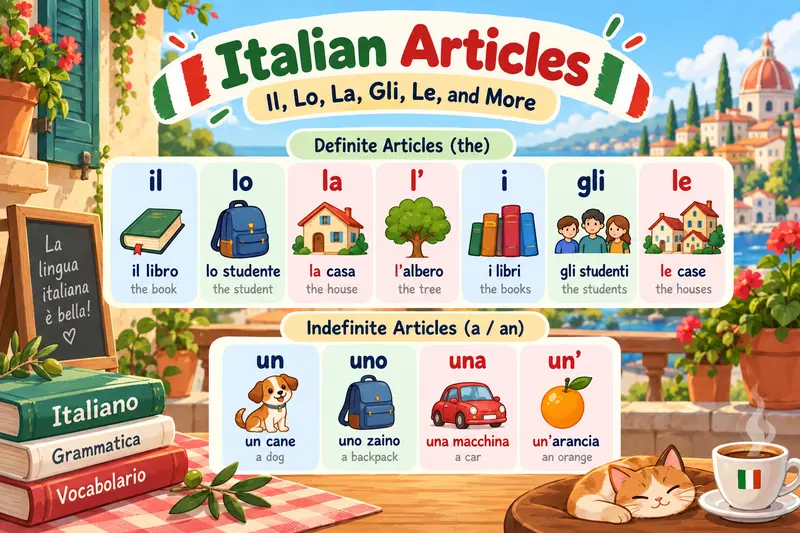
If you’ve ever wondered why Italians say il libro but lo studente, you’re not alone. Italian articles can seem confusing at first because English uses just one definite article, “the,” while Italian has several forms.
The good news is that choosing the correct article becomes much easier once you understand three things: gender, number, and the sound at the beginning of the next word.
For example, il ragazzo means “the boy,” while la ragazza means “the girl.” But Italian also uses lo studente and l’amico, even though both nouns are masculine.
Why?
Because Italian articles don’t depend on gender alone. The first sound of the noun also matters.
In this guide, you’ll learn how to use il, lo, la, l’, i, gli, le, un, uno, una, and un’, with clear explanations, pronunciation examples, common mistakes, and exercises to help you remember the rules.
Italian Articles: Quick Answer
Italian articles are small words placed before nouns.
They tell us whether we’re talking about something specific or something more general.
There are two main types:
- Definite articles: the equivalent of “the.”
- Indefinite articles: the equivalent of “a” or “an.”
Here’s a quick overview.
Italian Definite Articles
| Gender | Singular | Plural | Example |
|---|---|---|---|
| Masculine | il | i | il libro → i libri |
| Masculine | lo | gli | lo studente → gli studenti |
| Masculine | l’ | gli | l’amico → gli amici |
| Feminine | la | le | la casa → le case |
| Feminine | l’ | le | l’amica → le amiche |
Italian Indefinite Articles
| Gender | Article | Example | English |
|---|---|---|---|
| Masculine | un | un libro | a book |
| Masculine | uno | uno studente | a student |
| Feminine | una | una casa | a house |
| Feminine | un’ | un’amica | a female friend |
The most important thing to remember is that Italian articles must agree with the noun’s grammatical gender and number.
You also need to consider the sound that follows the article.
Let’s explore each rule.
What Are Articles in Italian?
Articles are words that introduce nouns.
In English, we use:
- The book
- A book
- The house
- A house
Italian works similarly, but its articles change depending on the noun.
For example:
Il libro
The book.
Un libro
A book.
The difference is similar to English.
Il libro refers to a particular book.
Un libro introduces a book without identifying a specific one.
Consider these sentences:
Ho comprato un libro.
I bought a book.
Il libro è interessante.
The book is interesting.
In the first sentence, the book is introduced.
In the second, we’re talking about a particular book.
This distinction is useful because it explains why Italian has both definite and indefinite articles.
Italian Definite Articles: Il, Lo, La, L’, I, Gli, Le
Definite articles are used when referring to a specific person, object, or concept.
Italian has seven definite article forms:
Il, lo, la, l’, i, gli, le.
These forms depend on:
- Whether the noun is masculine or feminine.
- Whether the noun is singular or plural.
- Whether the noun begins with a vowel or certain consonant combinations.
Let’s start with masculine nouns.
When to Use Il in Italian
Il is a masculine singular definite article.
It’s used before most masculine singular nouns that begin with a consonant.
Examples:
| Italian | English |
|---|---|
| il libro | the book |
| il ragazzo | the boy |
| il tavolo | the table |
| il cane | the dog |
| il telefono | the telephone |
Il ragazzo
The boy.
In a sentence:
Il ragazzo studia italiano.
The boy studies Italian.
When Not to Use Il
You cannot use il before every masculine noun.
For example:
Incorrect:
Il studente
Correct:
Lo studente
The student.
This happens because studente begins with s followed by another consonant.
That brings us to the next article.
When to Use Lo in Italian
Lo is a masculine singular definite article used before certain sounds.
The most important cases include:
- s + consonant: studente, sport, specchio
- z: zaino, zio
- gn: gnomo
- ps: psicologo
- pn: pneumatico
- x: xilofono
- i pronounced like English y: iogurt
Examples:
| Italian | English |
|---|---|
| lo studente | the student |
| lo sport | the sport |
| lo zaino | the backpack |
| lo zio | the uncle |
| lo psicologo | the psychologist |
| lo gnomo | the gnome |
Lo studente
The student.
Lo zaino
The backpack.
Lo psicologo
The psychologist.
A Simple Way to Remember Lo
Think of lo as the article used before certain consonant sounds or combinations that don’t normally take il.
For example:
- il ragazzo
- lo studente
- il cane
- lo zaino
Don’t try to memorize every possible word immediately.
Instead, learn the rule and practice with common examples.
When to Use L’ in Italian
L’ is used before singular nouns that begin with a vowel.
It can be masculine or feminine.
For example:
L’amico
The male friend.
L’amica
The female friend.
Other examples:
| Italian | English | Gender |
|---|---|---|
| l’amico | the male friend | Masculine |
| l’amica | the female friend | Feminine |
| l’albero | the tree | Masculine |
| l’acqua | the water | Feminine |
| l’ombrello | the umbrella | Masculine |
| l’isola | the island | Feminine |
Notice that the written article looks identical for masculine and feminine nouns.
The noun itself determines the gender.
Why Is There an Apostrophe?
The apostrophe shows that a vowel has been removed.
For example:
lo amico becomes l’amico.
la amica becomes l’amica.
This process is called elision.
It helps the words flow together naturally in speech.
When to Use La in Italian
La is the feminine singular definite article.
It’s used before most feminine singular nouns beginning with a consonant.
Examples:
| Italian | English |
|---|---|
| la casa | the house |
| la ragazza | the girl |
| la scuola | the school |
| la macchina | the car |
| la famiglia | the family |
La casa
The house.
La ragazza
The girl.
In a sentence:
La casa è grande.
The house is big.
When a feminine singular noun begins with a vowel, use l’ instead.
For example:
- la casa
- l’amica
- la scuola
- l’isola
Unlike masculine articles, feminine la is used before consonant combinations such as s + consonant.
That’s why Italians say:
La scuola
Not:
Lo scuola.
Italian Plural Articles: I, Gli, and Le
Once you understand the singular forms, the plural articles become easier.
Italian has three main plural definite articles:
I, gli, le.
Let’s examine them individually.
When to Use I in Italian
I is the masculine plural form of il.
Examples:
| Singular | Plural | English |
|---|---|---|
| il libro | i libri | the books |
| il ragazzo | i ragazzi | the boys |
| il tavolo | i tavoli | the tables |
| il cane | i cani | the dogs |
I libri
The books.
In a sentence:
I ragazzi giocano.
The boys are playing.
The important pattern is:
Il → I
But this doesn’t apply to every masculine noun.
For nouns that use lo or masculine l’, the plural article is generally gli.
When to Use Gli in Italian
Gli is the masculine plural article used with nouns that take lo or masculine l’ in the singular.
Examples:
| Singular | Plural | English |
|---|---|---|
| lo studente | gli studenti | the students |
| lo zaino | gli zaini | the backpacks |
| lo psicologo | gli psicologi | the psychologists |
| l’amico | gli amici | the male friends |
| l’albero | gli alberi | the trees |
Gli studenti
The students.
Gli amici
The male friends or a mixed-gender group of friends.
How to Pronounce Gli
The sound represented by gli can be difficult for English speakers.
In words such as gli and famiglia, it typically represents the palatal lateral sound /ʎ/.
There isn’t an exact equivalent in standard English.
A useful starting point is to listen carefully and imitate the sound rather than treating gli as the English word “glee.”
For more pronunciation guidance, see our Italian pronunciation guide.
When to Use Le in Italian
Le is the feminine plural definite article.
It replaces both la and feminine l’.
Examples:
| Singular | Plural | English |
|---|---|---|
| la casa | le case | the houses |
| la ragazza | le ragazze | the girls |
| la scuola | le scuole | the schools |
| l’amica | le amiche | the female friends |
| l’isola | le isole | the islands |
Le case
The houses.
Le amiche
The female friends.
Notice that le remains unchanged before vowels.
You say:
Le amiche
Not:
L’amiche.
The apostrophe form l’ is singular.
Italian Definite Articles: Complete Comparison Table
Here’s a summary of the rules.
| Article | Gender | Number | Used Before | Example |
|---|---|---|---|---|
| il | Masculine | Singular | Most consonants | il libro |
| lo | Masculine | Singular | s + consonant, z, gn, ps, and certain other sounds | lo studente |
| l’ | Masculine | Singular | Vowels | l’amico |
| la | Feminine | Singular | Consonants | la casa |
| l’ | Feminine | Singular | Vowels | l’amica |
| i | Masculine | Plural | Nouns that take il | i libri |
| gli | Masculine | Plural | Nouns that take lo or masculine l’ | gli studenti |
| le | Feminine | Plural | All feminine plural nouns | le case |
Learning tip: Memorize articles together with nouns.
Instead of learning only libro, learn il libro.
Instead of learning only studente, learn lo studente.
This helps you remember both the noun’s gender and the correct article pattern.
Italian Indefinite Articles: Un, Uno, Una, Un’
Now let’s look at indefinite articles.
In English, we use a and an.
Italian has four common singular indefinite article forms:
Un, uno, una, un’.
They follow rules similar to the definite articles.
When to Use Un in Italian
Un is used before most masculine singular nouns.
Examples:
| Italian | English |
|---|---|
| un libro | a book |
| un ragazzo | a boy |
| un cane | a dog |
| un amico | a male friend |
| un albero | a tree |
Un amico
A male friend.
Notice something important:
Un amico does not have an apostrophe.
This is one of the most common mistakes beginners make.
Why?
Because masculine un is already a shortened form of uno.
You don’t add an apostrophe when using un before a masculine noun beginning with a vowel.
Correct:
Un amico
Incorrect:
Un’amico
We’ll compare this with feminine un’ shortly.
When to Use Uno in Italian
Uno is used before masculine singular nouns that begin with the same special sounds that require lo.
Examples:
| Italian | English |
|---|---|
| uno studente | a student |
| uno zaino | a backpack |
| uno psicologo | a psychologist |
| uno gnomo | a gnome |
| uno sport | a sport |
Uno studente
A student.
Uno zaino
A backpack.
Compare:
- il libro → un libro
- lo studente → uno studente
- lo zaino → uno zaino
- l’amico → un amico
The patterns are closely related.
When to Use Una in Italian
Una is the feminine singular indefinite article used before nouns beginning with a consonant.
Examples:
| Italian | English |
|---|---|
| una casa | a house |
| una ragazza | a girl |
| una macchina | a car |
| una scuola | a school |
| una famiglia | a family |
Una casa
A house.
Una ragazza
A girl.
When the feminine noun begins with a vowel, una normally becomes un’.
When to Use Un’ in Italian
Un’ is used before feminine singular nouns beginning with a vowel.
Examples:
| Italian | English |
|---|---|
| un’amica | a female friend |
| un’isola | an island |
| un’idea | an idea |
| un’arancia | an orange |
| un’ora | an hour |
Un’amica
A female friend.
Un’idea
An idea.
The apostrophe indicates that the final vowel of una has been removed.
Compare:
Un amico — A male friend.
Un’amica — A female friend.
This small difference is extremely important in written Italian.
Un vs Un’: The Rule You Must Remember
Here’s a quick comparison.
| Noun | Gender | Correct Form |
|---|---|---|
| amico | Masculine | un amico |
| amica | Feminine | un’amica |
| albero | Masculine | un albero |
| isola | Feminine | un’isola |
| uomo | Masculine | un uomo |
| idea | Feminine | un’idea |
Remember:
Masculine un + vowel → no apostrophe.
Feminine un’ + vowel → apostrophe.
This is one of the simplest ways to avoid a very common Italian spelling error.
Do Italian Indefinite Articles Have Plural Forms?
Italian doesn’t have a direct plural equivalent of the English indefinite article a.
Instead, Italian can use partitive articles or other expressions to refer to an unspecified quantity.
For example:
Dei libri
Some books.
Degli studenti
Some students.
Delle case
Some houses.
These forms resemble combinations of di with definite articles.
| Singular Example | Possible Plural Expression |
|---|---|
| un libro | dei libri |
| uno studente | degli studenti |
| una casa | delle case |
| un’amica | delle amiche |
However, Italian can also use plural nouns without an article in many contexts.
For example:
Ho comprato libri.
I bought books.
Or:
Ho comprato dei libri.
I bought some books.
Both are possible, depending on the meaning and context.
For beginners, the important point is that un, uno, una, and un’ are singular forms.
How to Choose the Correct Italian Article
When you’re unsure which article to use, follow this simple process.
Step 1: Identify the Noun’s Gender
Is the noun masculine or feminine?
For example:
Libro is masculine.
Casa is feminine.
Step 2: Identify Singular or Plural
Are you talking about one thing or several?
For example:
- libro → libri
- casa → case
Step 3: Check the First Sound
Does the noun begin with:
- An ordinary consonant?
- A vowel?
- A special consonant combination such as s + consonant?
This determines which article form to choose.
Step 4: Decide Whether the Noun Is Specific
Are you saying “the book” or “a book”?
Compare:
- il libro — the book
- un libro — a book
- la casa — the house
- una casa — a house
Let’s put the process into practice.
Example 1: Libro
Libro is masculine, singular, and begins with an ordinary consonant.
Therefore:
Il libro
Or:
Un libro
Example 2: Studente
Studente is masculine, singular, and begins with s + consonant.
Therefore:
Lo studente
Or:
Uno studente
Example 3: Amica
Amica is feminine, singular, and begins with a vowel.
Therefore:
L’amica
Or:
Un’amica
Once you can follow these steps, article selection becomes much more predictable.
Italian Articles in Everyday Sentences
Understanding the rules is useful, but using articles in real sentences is even more important.
Here are several practical examples.
Example 1: Talking About a Book
Ho un libro interessante
I have an interesting book.
The noun libro is masculine singular, so we use un.
Example 2: Talking About School
La scuola è vicino a casa
The school is close to home.
Scuola is feminine singular, so we use la.
Example 3: Talking About Friends
Gli amici sono importanti
Friends are important.
Amici is masculine plural, so we use gli.
Example 4: Introducing Someone
Lei è un’amica
She is a friend.
Amica is feminine singular and begins with a vowel.
Therefore, we use un’.
Example 5: Talking About a Student
Lo studente parla italiano
The student speaks Italian.
Studente begins with s + consonant, so the article is lo.
These examples show how articles work naturally in complete sentences.
Italian Articles and Prepositions
One important feature of Italian grammar is that some prepositions combine with definite articles.
These combinations are called articulated prepositions, or preposizioni articolate.
For example:
Di + il = del
A + il = al
In + il = nel
Consider:
Il libro del ragazzo.
The boy’s book.
Vado al mercato.
I’m going to the market.
Il gatto è nel giardino.
The cat is in the garden.
These combinations are extremely common in Italian.
However, they deserve their own detailed explanation.
If you’d like to understand how prepositions and articles work together, see our guide to Italian prepositions.
Common Mistakes with Italian Articles
Let’s review some of the mistakes that beginners make most often.
Mistake 1: Using Il Before Studente
Incorrect:
Il studente
Correct:
Lo studente
Why?
Because studente begins with s + consonant.
Mistake 2: Using I Instead of Gli
Incorrect:
I studenti
Correct:
Gli studenti
The plural of lo studente is gli studenti.
Mistake 3: Using Un’ with Masculine Nouns
Incorrect:
Un’amico
Correct:
Un amico
The masculine indefinite article un doesn’t take an apostrophe.
Mistake 4: Forgetting the Apostrophe with Feminine Nouns
Incorrect:
Un amica
Correct:
Un’amica
The feminine indefinite article becomes un’ before a vowel.
Mistake 5: Using L’ with Plural Nouns
Incorrect:
L’amiche
Correct:
Le amiche
The article l’ is singular.
Mistake 6: Assuming Every Word Ending in A Is Feminine
Many Italian nouns ending in -a are feminine, but not all.
For example:
Il problema
The problem.
Il programma
The program.
Both are masculine.
Similarly, some nouns ending in -e can be masculine or feminine.
For example:
- il cane — the dog
- la notte — the night
The safest approach is to learn nouns together with their articles.
Mistake 7: Translating English Articles Directly
Italian and English don’t always use articles in exactly the same situations.
For example:
Mi piace il caffè.
I like coffee.
Italian often uses a definite article when discussing something in a general sense.
English frequently omits it.
This is why learning articles through full sentences is more useful than translating isolated words.
Practice Exercises: Choose the Correct Italian Article
Now let’s test what you’ve learned.
Try answering each question before checking the solutions.
Exercise 1: Definite Articles
Choose the correct definite article.
- ___ libro
- ___ studente
- ___ casa
- ___ amico
- ___ zaino
- ___ libri
- ___ studenti
- ___ ragazze
- ___ amiche
- ___ alberi
Answers
- il libro
- lo studente
- la casa
- l’amico
- lo zaino
- i libri
- gli studenti
- le ragazze
- le amiche
- gli alberi
Exercise 2: Indefinite Articles
Choose un, uno, una, or un’.
- ___ ragazzo
- ___ studente
- ___ amica
- ___ casa
- ___ zaino
- ___ idea
- ___ libro
- ___ isola
- ___ psicologo
- ___ famiglia
Answers
- un ragazzo
- uno studente
- un’amica
- una casa
- uno zaino
- un’idea
- un libro
- un’isola
- uno psicologo
- una famiglia
Exercise 3: Correct the Mistakes
Find and correct the article mistakes.
- Il studente è italiano.
- Ho un’amico.
- I zaini sono grandi.
- L’amiche sono simpatiche.
- Ho comprato un isola.
Answers
- Lo studente è italiano.
- Ho un amico.
- Gli zaini sono grandi.
- Le amiche sono simpatiche.
- Ho comprato un’isola.
In the final sentence, un’isola is grammatically correct, although buying an island is an unusual everyday example.
Exercise 4: Translate into Italian
Translate the following expressions.
- The book
- A female friend
- The students
- A backpack
- The houses
- An idea
- The male friends
- A school
Answers
- Il libro
- Un’amica
- Gli studenti
- Uno zaino
- Le case
- Un’idea
- Gli amici
- Una scuola
If you made mistakes, return to the corresponding rule and practice a few more examples.
A Five-Day Plan to Master Italian Articles
You don’t need to memorize every rule in one sitting.
A short, structured practice plan can make the process easier.
Day 1: Learn Il and La
Start with ordinary masculine and feminine singular nouns.
Examples:
- il libro
- il cane
- la casa
- la scuola
Practice saying each noun with its article.
Day 2: Learn Lo and L’
Focus on special consonant combinations and vowels.
Examples:
- lo studente
- lo zaino
- l’amico
- l’amica
Pay attention to the sounds at the beginning of each noun.
Day 3: Learn the Plural Articles
Practice changing singular nouns into plural forms.
Examples:
- il libro → i libri
- lo studente → gli studenti
- la casa → le case
- l’amica → le amiche
Day 4: Learn Indefinite Articles
Focus on:
- un
- uno
- una
- un’
Spend extra time practicing the difference between un amico and un’amica.
Day 5: Practice Complete Sentences
Write five short sentences using different articles.
For example:
Ho un libro.
I have a book.
La casa è grande.
The house is big.
Gli studenti parlano italiano.
The students speak Italian.
Read each sentence aloud.
Then try creating new sentences without looking at your notes.
For additional vocabulary to use in these exercises, explore our basic Italian words guide.
Frequently Asked Questions About Italian Articles
How many definite articles are there in Italian?
Italian has seven definite article forms:
Il, lo, la, l’, i, gli, le.
The correct form depends on the noun’s gender, number, and initial sound.
What is the difference between Il and Lo?
Both are masculine singular definite articles.
Il is used before most consonants.
Lo is used before certain sounds, including s + consonant and z.
For example:
- il libro
- lo studente
- lo zaino
When do you use Gli instead of I?
Use gli for masculine plural nouns that take lo or masculine l’ in the singular.
For example:
- lo studente → gli studenti
- l’amico → gli amici
Use i for masculine plural nouns that take il in the singular.
For example:
- il libro → i libri
What is the difference between Un and Uno?
Both are masculine singular indefinite articles.
Use un before most masculine nouns.
Use uno before the special sounds that require lo.
For example:
- un libro
- un amico
- uno studente
- uno zaino
What is the difference between Un and Un’?
Un is used with masculine nouns.
Un’ is used with feminine singular nouns beginning with a vowel.
For example:
- un amico
- un’amica
Why is Un Amico written without an apostrophe?
Because masculine un is a shortened form of uno.
It doesn’t require an apostrophe before a vowel.
The apostrophe is used with feminine un’, which comes from una.
Is L’ masculine or feminine?
It can be either.
For example:
- l’amico — masculine
- l’amica — feminine
The noun determines the gender.
What is the plural of L’?
It depends on the noun’s gender.
Masculine:
l’amico → gli amici
Feminine:
l’amica → le amiche
Do Italian articles always match the noun’s ending?
No.
Although many masculine nouns end in -o and many feminine nouns end in -a, there are exceptions.
For example:
- il problema — masculine
- la mano — feminine
It’s better to learn each noun together with its article.
Do you always need an article before an Italian noun?
No.
Italian sometimes omits articles, depending on the grammatical structure and meaning.
For example:
Parlo italiano.
I speak Italian.
Ho comprato libri.
I bought books.
However, articles are common and essential in many everyday expressions.
How can I memorize Italian articles faster?
Learn nouns together with their articles.
Instead of memorizing casa, memorize la casa.
Instead of memorizing studente, memorize lo studente.
Then practice changing singular forms into plural forms and using the nouns in short sentences.
Key Takeaways
Italian articles become much easier once you understand their patterns.
Remember these essential rules:
- Il is used before most masculine singular nouns beginning with consonants.
- Lo is used before certain masculine consonant sounds and combinations.
- La is used before feminine singular nouns beginning with consonants.
- L’ is used before masculine or feminine singular nouns beginning with vowels.
- I is the plural of il.
- Gli is the plural of lo and masculine l’.
- Le is used with feminine plural nouns.
- Un and uno are masculine indefinite articles.
- Una and un’ are feminine indefinite articles.
- Un amico has no apostrophe, but un’amica does.
The most effective way to remember these rules is to practice them with real nouns and complete sentences.
Final Thoughts
Learning Italian articles is an important step toward building grammatically correct sentences.
At first, remembering when to use il, lo, la, or gli may feel challenging. But the system becomes much more predictable once you recognize the relationship between gender, number, and pronunciation.
Start with simple examples such as il libro and la casa. Then move on to special forms such as lo studente and l’amico.
Finally, practice using articles in everyday sentences.
With regular practice, you’ll gradually begin choosing the correct articles without having to think through every rule.