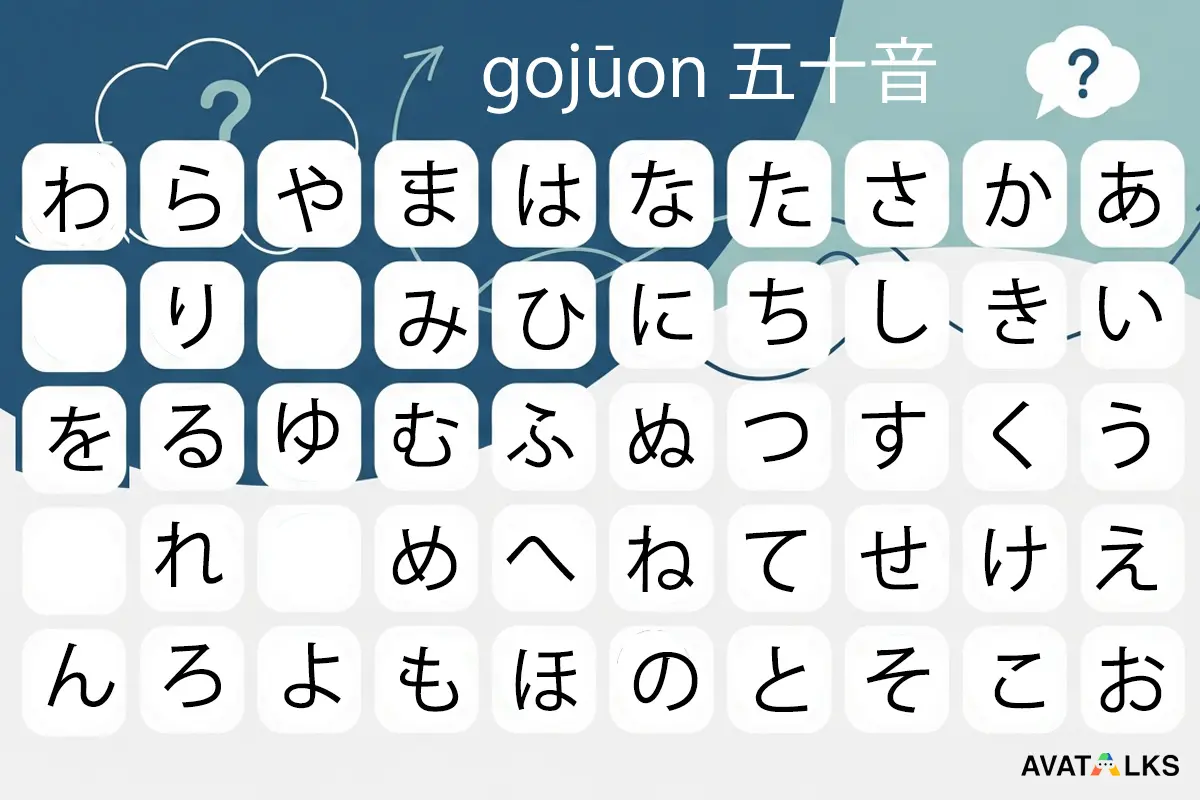
The kana order gojūon (五十音) is the backbone of Japanese writing systems.
It organizes hiragana and katakana into a predictable sound grid used for dictionaries, textbooks, keyboards, and grammar explanations.
If you learn the gojūon once, you stop treating kana as “46 random symbols” and start seeing a system you can practice by row, recall under pressure, and use for lookups in real Japanese language study.

What the Gojūon Is (And Why It Exists)
A gojūon table (also called gojūonzu / 五十音図) lays out kana as:
- 5 vowel columns: a / i / u / e / o
- consonant rows: (no consonant), k, s, t, n, h, m, y, r, w
- plus ん at the end
It matters because it powers everyday tasks:
- Dictionary order and indexes
- Keyboard layouts (the kana grid you tap)
- Grammar naming (rows/columns used in verb explanations)
Think of it like a “map.” If you know the map, you can learn faster and navigate faster.
How the Grid Works (Rows + Columns)
Japanese uses specific terms for the grid:
- Rows = 行 (gyō)
Example: か行 (ka-gyō) → か / き / く / け / こ - Columns = 段 (dan)
Example: あ段 (a-dan) → あ / か / さ / た / な / は / ま / や / ら / わ
This is one reason gojūon is so helpful for grammar: teachers can say “move to the a-dan” or “this verb is in the ka-gyō” and it instantly makes sense.
Quick reminder: Japanese kana represent whole beats (mora). There isn’t a native kana for a consonant alone—so rows are named with か, not “k.”
The Core Gojūon Table (Hiragana)
Here’s the core “by-row” practice view (the one most learners use first):
| a | i | u | e | o | |
|---|---|---|---|---|---|
| ( ) | あ | い | う | え | お |
| k | か | き | く | け | こ |
| s | さ | し | す | せ | そ |
| t | た | ち | つ | て | と |
| n | な | に | ぬ | ね | の |
| h | は | ひ | ふ | へ | ほ |
| m | ま | み | む | め | も |
| y | や | ゆ | よ | ||
| r | ら | り | る | れ | ろ |
| w | わ | を | |||
| ん |
Katakana follows the exact same grid.
So learning the order once pays off twice.
Gojūon vs Iroha Ordering
Before gojūon became the practical standard, Japanese also used iroha ordering—a traditional poem-based sequence (いろはにほへと…).
Where you might still see iroha ordering today:
- traditional lists and naming schemes
- older documents
- cultural references
For modern learners, gojūon wins because it matches the sound system and works cleanly with modern indexing.
How Dictionaries Sort Kana (Gojūon-jun)
You’ll see the phrase gojūon-jun / 五十音順 meaning “sorted in gojūon order.”
Three sorting rules that help you stop getting confused:
1) Base kana comes first, then modifications
In the は row, the common order is:
- は (base) → ば (dakuten) → ぱ (handakuten)
So dictionary-style grouping often flows like:
はばぱ → ひびぴ → ふぶぷ → へべぺ → ほぼぽ
2) Small kana are treated like their full-size versions
A small ゃゅょ is sorted as if it were やゆよ (the “smallness” doesn’t jump it to a new place).
That’s why charts and indexes tend to keep “small” forms next to their normal forms.
3) ん is treated as the last item
Like “Z” in alphabetical order, ん usually comes after other kana in sorting.
These rules matter even if you never use a paper dictionary—because apps, indexes, and many learning materials follow the same logic.
Practice Strategy: By Row vs By Column
By rows (recommended first)
Practice like this:
- あいうえお
- かきくけこ
- さしすせそ …
Why it works:
- smoother rhythm
- easier recall
- matches how most beginners learn
By columns (great for lookup + grammar)
Practice like this:
- あかさたなはまやらわ
- いきしちにひみり
- うくすつぬふむゆる …
Why it helps:
- faster dictionary navigation
- clearer “a-dan / i-dan” grammar explanations
- better typing intuition on kana keyboards
Best approach: start with rows → add columns → mix both.
A 14-Day Plan (15 Minutes/Day)
This plan builds row-fluency first, then adds column skill.
Daily routine (15 minutes)
- Row read (1 row × 10 reps)
- Row write (same row × 5 reps)
- Column scan (1 vowel column × 2 slow passes)
- Random recall (10 kana, mixed)
Days 1–3: Vowels + K/S rows
- あいうえお
- かきくけこ
- さしすせそ
Days 4–6: T/N rows
- たちつてと
- なにぬねの
Tip: give extra time to ち (chi) and つ (tsu).
Days 7–9: H/M/Y rows
- はひふへほ
- まみむめも
- や ゆ よ
Days 10–12: R/W + ん
- らりるれろ
- わ を
- ん
Days 13–14: Mixed speed + columns
- Read the full table
- Then do 2 column passes (a-dan, i-dan, u-dan…)
- Finish with random recall
Memory Methods That Don’t Feel Like Memorizing
1) Row anchors (the “skeleton”)
Memorize just the row initials:
A – K – S – T – N – H – M – Y – R – W (+ ん)
Then fill each row with a/i/u/e/o.
2) Sound families
Your brain remembers patterns better than single symbols:
- K family: かきくけこ
- S family: さしすせそ
- T family: たちつてと
3) Timed rows
Set a timer and aim for “clean + fast”:
- one row under 5 seconds
- whole table under 40 seconds
Speed builds automatic recognition.
Common Mistakes (And How to Fix Them)
Mistake 1: Using English vowel order
Japanese vowels are a i u e o (not a e i o u).
Fix: chant a-i-u-e-o at the start of every session.
Mistake 2: Practicing only random charts
Random practice builds recognition, but without structure you lose:
- row fluency
- column intuition
- grammar readiness
Fix: do rows first, then random.
Mistake 3: Forgetting this includes katakana too
Katakana is not a separate “new order.” It’s the same map with different symbols.
Fix: after day 7, start a light katakana mirror session (2–3 minutes/day).
A Quick Note on “Fifty Sounds”
Historically the name implies “50,” but modern Japanese doesn’t perfectly match that number.
Some old kana (like ゐ / ゑ) disappeared, and ん sits outside the neat grid.
You don’t need the history to learn effectively—just know the grid is a learning tool, not a perfect physics model of sound.
Practice With Avatalks
Use the tool to turn the gojūon into muscle memory:
- Select Japanese (Kana)
- Drill by rows first
- Add column review after week one
- Finish with random recall
FAQ
Is gojūon order used in modern dictionaries?
Yes. Many indexes and dictionary lists follow gojūon-jun (五十音順).
Should beginners learn rows or columns first?
Rows first for fluency, columns later for lookup + grammar.
Does iroha still matter?
Mostly cultural and historical. It’s useful to recognize, but gojūon is the practical default.
Do dakuten, yoon, and small っ change the order?
They don’t replace the core order—they layer on top of it.
Next Steps
Back to Learn Japanese Kana →
Complete roadmap for hiragana + katakana.
Kana Extras Overview →
Dakuten, yoon, small tsu, long vowels.
Dakuten & Handakuten →
か→が, は→ぱ (sound marks and drills).
Yoon Combinations →
きゃ/しゅ/りょ (small ゃゅょ).
Small っ / ッ (Sokuon) →
The pause that doubles consonants (がっこう, カップ).
Final Advice
Treat the kana order gojuon as a practice sequence, not a trivia fact.
Do this for two weeks:
- read one row
- write one row
- scan one column
- finish with random recall
And the grid becomes automatic—like the alphabet in your native language.
Happy practicing 五十音! 🇯🇵