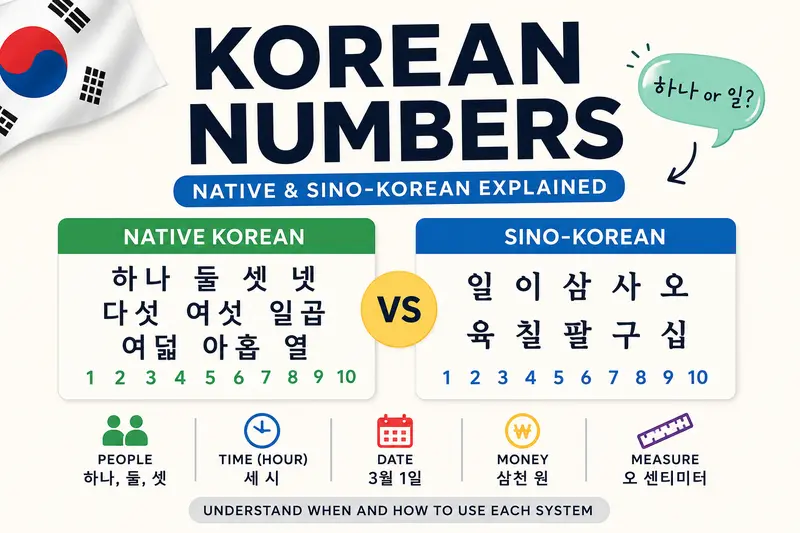
Korean numbers seem confusing for one simple reason: Korean uses two number systems.
The number one can be either 하나 or 일. Three can be 셋 or 삼. Ten can be 열 or 십.
These words are not interchangeable. The correct form depends on what you are counting or describing.
For example:
- 세 명 means three people.
- 삼 분 means three minutes.
- 세 시 means three o’clock.
- 삼천 원 means 3,000 won.
The good news is that each system has clear patterns. Once you connect the numbers to real situations—such as ordering food, telling the time, saying your age, or reading a price—the distinction becomes much easier.
This guide teaches both systems with individual audio, pronunciation help, number-building patterns, and practical examples.
Table of Contents
Open Table of Contents
- The two Korean number systems
- Native Korean numbers from 1 to 10
- Native Korean numbers from 11 to 19
- Native Korean tens from 20 to 90
- How Native Korean numbers change before counters
- Sino-Korean numbers from 0 to 10
- Sino-Korean numbers from 11 to 19
- Sino-Korean numbers from 20 to 99
- Common Sino-Korean numbers
- Sino-Korean numbers from 100 upward
- Understanding 만 (10,000)
- Practice reading large numbers
- When to use Native vs. Sino-Korean numbers
- Everyday examples
- Common beginner mistakes
- Memory tips
- Quick quiz
- Frequently asked questions
- Why does Korean have two number systems?
- Should beginners learn Native or Sino-Korean numbers first?
- Do Koreans use both number systems in everyday life?
- Which Korean number system is used for age?
- Which Korean number system is used for money?
- How do you say zero in Korean?
- Are Native Korean numbers used above 100?
- Why do 하나, 둘, 셋, and 넷 change before counters?
- Final thoughts
The two Korean number systems
The two systems are:
- Native Korean numbers
- Sino-Korean numbers
Native Korean numbers are Korean’s traditional number words. Sino-Korean numbers entered Korean through Classical Chinese and are now an ordinary part of modern Korean.
Here are the first ten numbers side by side:
| Number | Native Korean | Sino-Korean |
|---|---|---|
| 1 | 하나 | 일 |
| 2 | 둘 | 이 |
| 3 | 셋 | 삼 |
| 4 | 넷 | 사 |
| 5 | 다섯 | 오 |
| 6 | 여섯 | 육 |
| 7 | 일곱 | 칠 |
| 8 | 여덟 | 팔 |
| 9 | 아홉 | 구 |
| 10 | 열 | 십 |
You should learn the two sequences separately rather than mixing them.
Native Korean:
하나, 둘, 셋, 넷, 다섯, 여섯, 일곱, 여덟, 아홉, 열
Sino-Korean:
일, 이, 삼, 사, 오, 육, 칠, 팔, 구, 십
A useful starting rule is:
Use Native Korean numbers mainly for counted quantities, age, and hours. Use Sino-Korean numbers mainly for dates, money, minutes, measurements, identifiers, and large numbers.
There are exceptions, but this rule gives beginners a reliable foundation.
Native Korean numbers from 1 to 10
Native Korean numbers are commonly used when counting people, animals, objects, books, drinks, and other everyday quantities.
| Number | Korean | Romanization | Listen |
|---|---|---|---|
| 1 | 하나 | hana | |
| 2 | 둘 | dul | |
| 3 | 셋 | set | |
| 4 | 넷 | net | |
| 5 | 다섯 | daseot | |
| 6 | 여섯 | yeoseot | |
| 7 | 일곱 | ilgop | |
| 8 | 여덟 | yeodeol | |
| 9 | 아홉 | ahop | |
| 10 | 열 | yeol |
Romanization is a temporary pronunciation aid. Listen to the Korean audio and gradually rely on Hangul instead of reading the English letters.
Pronunciation notes
The final consonants in 다섯, 여섯, 일곱, and 여덟 should not be followed by an extra vowel.
For example, avoid turning 다섯 into something like “da-seo-see.” Its final sound is short and unreleased.
여덟 also looks more complicated than it sounds. In ordinary pronunciation, it is close to 여덜. You do not need to force every written consonant into the spoken word.
Native Korean numbers from 11 to 19
The Native Korean word for ten is 열.
To form 11 through 19, place another number after 열:
| Number | Korean | Romanization | Listen |
|---|---|---|---|
| 11 | 열하나 | yeolhana | |
| 12 | 열둘 | yeoldul | |
| 13 | 열셋 | yeolset | |
| 14 | 열넷 | yeolnet | |
| 15 | 열다섯 | yeoldaseot | |
| 16 | 열여섯 | yeolyeoseot | |
| 17 | 열일곱 | yeolilgop | |
| 18 | 열여덟 | yeolyeodeol | |
| 19 | 열아홉 | yeolahop |
The pattern is regular:
열 + 하나 = 열하나
열 + 둘 = 열둘
열 + 다섯 = 열다섯
Unlike English, Korean does not need unrelated forms equivalent to eleven and twelve.
Native Korean tens from 20 to 90
Native Korean has a separate word for each multiple of ten.
| Number | Korean | Romanization | Listen |
|---|---|---|---|
| 10 | 열 | yeol | |
| 20 | 스물 | seumul | |
| 30 | 서른 | seoreun | |
| 40 | 마흔 | maheun | |
| 50 | 쉰 | swin | |
| 60 | 예순 | yesun | |
| 70 | 일흔 | ilheun | |
| 80 | 여든 | yeodeun | |
| 90 | 아흔 | aheun |
These words need to be memorized, but you do not need to memorize every number from 21 to 99 separately.
Once you know the tens and the numbers from one to nine, combine them:
| Number | Structure | Korean | Listen |
|---|---|---|---|
| 21 | 20 + 1 | 스물하나 | |
| 22 | 20 + 2 | 스물둘 | |
| 25 | 20 + 5 | 스물다섯 | |
| 31 | 30 + 1 | 서른하나 | |
| 34 | 30 + 4 | 서른넷 | |
| 47 | 40 + 7 | 마흔일곱 | |
| 58 | 50 + 8 | 쉰여덟 | |
| 66 | 60 + 6 | 예순여섯 | |
| 73 | 70 + 3 | 일흔셋 | |
| 89 | 80 + 9 | 여든아홉 | |
| 99 | 90 + 9 | 아흔아홉 |
For example:
스물 + 다섯 = 스물다섯
마흔 + 둘 = 마흔둘
일흔 + 여덟 = 일흔여덟
Modern Korean normally switches to Sino-Korean numbers at 100 and above.
How Native Korean numbers change before counters
Korean commonly places a counter after a number. A counter is a word used for a category of person or thing, such as people, animals, books, or cups.
Five Native Korean numbers change form directly before most counters:
| Basic form | Before a counter | Meaning |
|---|---|---|
| 하나 | 한 | one |
| 둘 | 두 | two |
| 셋 | 세 | three |
| 넷 | 네 | four |
| 스물 | 스무 | twenty |
Use the full form when the number stands alone:
하나 주세요.
Please give me one.
Use the shortened form before a counter:
한 개 주세요.
Please give me one item.
Other examples include:
| Meaning | Natural Korean | Listen |
|---|---|---|
| one person | 한 명 | |
| two items | 두 개 | |
| three o’clock | 세 시 | |
| four animals | 네 마리 | |
| twenty years old | 스무 살 |
The change also applies when a larger number ends in one, two, three, or four:
| Standalone | Before a counter | Example |
|---|---|---|
| 스물하나 | 스물한 | 스물한 살 — 21 years old |
| 스물둘 | 스물두 | 스물두 명 — 22 people |
| 서른셋 | 서른세 | 서른세 개 — 33 items |
| 마흔넷 | 마흔네 | 마흔네 마리 — 44 animals |
Twenty follows a special rule:
스무 살 — 20 years old
but:
스물한 살 — 21 years old
Do not say 스무한 살. The form 스무 is used only when twenty appears directly before the counter.
Sino-Korean numbers from 0 to 10
The Sino-Korean system is especially regular. Once you know its basic digits and place-value units, you can construct numbers into the millions and beyond.
| Number | Korean | Romanization | Listen |
|---|---|---|---|
| 0 | 영 | yeong | |
| 0 | 공 | gong | |
| 1 | 일 | il | |
| 2 | 이 | i | |
| 3 | 삼 | sam | |
| 4 | 사 | sa | |
| 5 | 오 | o | |
| 6 | 육 | yuk | |
| 7 | 칠 | chil | |
| 8 | 팔 | pal | |
| 9 | 구 | gu | |
| 10 | 십 | sip |
Is zero 영 or 공?
Both 영 and 공 mean zero, but they tend to appear in different situations.
Use 영 commonly for:
- mathematics
- decimal values
- temperatures
- scores
- the numerical value zero
Examples:
영 도
zero degrees
영 점 오
zero point five
Use 공 commonly when reading individual digits in:
- phone numbers
- codes
- identification numbers
- serial numbers
For example, the mobile prefix 010 is read:
공일공
Actual usage can overlap, but this distinction works well for beginners.
Sino-Korean numbers from 11 to 19
The word for ten is 십. Add the next digit after it:
| Number | Korean | Structure | Listen |
|---|---|---|---|
| 11 | 십일 | 10 + 1 | |
| 12 | 십이 | 10 + 2 | |
| 13 | 십삼 | 10 + 3 | |
| 14 | 십사 | 10 + 4 | |
| 15 | 십오 | 10 + 5 | |
| 16 | 십육 | 10 + 6 | |
| 17 | 십칠 | 10 + 7 | |
| 18 | 십팔 | 10 + 8 | |
| 19 | 십구 | 10 + 9 |
십육 is written 십육, but in natural speech you will often hear it pronounced closer to 심뉵. Don’t worry if you cannot reproduce every pronunciation change immediately. Learn the written form first, then improve your listening through repeated exposure.
Sino-Korean numbers from 20 to 99
Unlike Native Korean numbers, Sino-Korean numbers follow a very regular pattern.
Simply place the digit before 십 (ten).
Multiples of ten
| Number | Korean | Structure | Listen |
|---|---|---|---|
| 20 | 이십 | 2 × 10 | |
| 30 | 삼십 | 3 × 10 | |
| 40 | 사십 | 4 × 10 | |
| 50 | 오십 | 5 × 10 | |
| 60 | 육십 | 6 × 10 | |
| 70 | 칠십 | 7 × 10 | |
| 80 | 팔십 | 8 × 10 | |
| 90 | 구십 | 9 × 10 |
Creating other numbers is straightforward.
For example:
- 21 = 이십일
- 34 = 삼십사
- 58 = 오십팔
- 76 = 칠십육
- 99 = 구십구
Once you know the digits from 1 to 10, you can build almost every Sino-Korean number without memorizing separate vocabulary.
Common Sino-Korean numbers
These are some numbers you’ll encounter frequently in everyday Korean.
| Number | Korean | Listen |
|---|---|---|
| 21 | 이십일 | |
| 25 | 이십오 | |
| 30 | 삼십 | |
| 45 | 사십오 | |
| 50 | 오십 | |
| 68 | 육십팔 | |
| 75 | 칠십오 | |
| 88 | 팔십팔 | |
| 99 | 구십구 |
Sino-Korean numbers from 100 upward
Another advantage of the Sino-Korean system is that larger numbers remain very logical.
| Number | Korean | Listen |
|---|---|---|
| 100 | 백 | |
| 1,000 | 천 | |
| 10,000 | 만 | |
| 100,000 | 십만 | |
| 1,000,000 | 백만 | |
| 10,000,000 | 천만 | |
| 100,000,000 | 억 |
Understanding 만 (10,000)
One of the biggest surprises for English speakers is that Korean groups large numbers by 10,000 instead of 1,000.
English counts like this:
| English | Value |
|---|---|
| Thousand | 1,000 |
| Million | 1,000,000 |
| Billion | 1,000,000,000 |
Korean counts like this:
| Korean | Value |
|---|---|
| 만 | 10,000 |
| 억 | 100,000,000 |
| 조 | 1,000,000,000,000 |
This means:
| Korean | English |
|---|---|
| 만 | 10 thousand |
| 십만 | 100 thousand |
| 백만 | 1 million |
| 천만 | 10 million |
| 일억 | 100 million |
Understanding 만 early makes reading Korean prices much easier.
Practice reading large numbers
Can you read these?
| Number | Korean | Listen |
|---|---|---|
| 123 | 백이십삼 | |
| 365 | 삼백육십오 | |
| 2,026 | 이천이십육 | |
| 10,000 | 만 | |
| 35,000 | 삼만 오천 | |
| 1,000,000 | 백만 |
By this point, you’ve learned both Korean number systems.
The next question is the one every beginner asks:
Which number system should I use?
Fortunately, the answer is much easier than most people expect.
When to use Native vs. Sino-Korean numbers
The easiest way to remember Korean numbers is to associate each system with everyday situations instead of memorizing abstract grammar rules.
The table below summarizes the most common uses you’ll encounter.
| Situation | Native Korean | Sino-Korean | Example | Listen |
|---|---|---|---|---|
| People | ✅ | 세 명 | ||
| General objects | ✅ | 두 개 | ||
| Animals | ✅ | 네 마리 | ||
| Books | ✅ | 다섯 권 | ||
| Cups & drinks | ✅ | 한 잔 | ||
| Age | ✅ | 스물다섯 살 | ||
| Hours | ✅ | 세 시 | ||
| Minutes | ✅ | 십오 분 | ||
| Dates | ✅ | 칠월 십팔일 | ||
| Years | ✅ | 이천이십육 년 | ||
| Money | ✅ | 오천 원 | ||
| Phone numbers | ✅ | 공일공 | ||
| Floor numbers | ✅ | 삼 층 | ||
| Mathematics | ✅ | 이 더하기 삼 |
Instead of memorizing dozens of rules, try to remember these situations. After seeing the same patterns several times, choosing the correct number system becomes almost automatic.
Everyday examples
Introducing yourself
Age uses Native Korean numbers.
A: 몇 살이에요?
B: 스물다섯 살이에요.
Ordering at a café
Countable objects usually use Native Korean numbers.
아메리카노 두 잔 주세요.
Two Americanos, please.
Asking the price
Prices always use Sino-Korean numbers.
이거 얼마예요?
오천 원이에요.
Asking the time
Hours use Native Korean numbers, while minutes use Sino-Korean numbers.
지금 몇 시예요?
세 시 십오 분이에요.
Talking about your birthday
Calendar dates use Sino-Korean numbers.
생일이 언제예요?
칠월 십팔일이에요.
Giving your phone number
Phone numbers are read digit by digit using the Sino-Korean system.
공일공-일이삼사-오육칠팔
Common beginner mistakes
❌ Using the wrong system for money
Incorrect:
다섯천 원
Correct:
오천 원
❌ Forgetting shortened Native Korean forms
Incorrect:
하나 명
Correct:
한 명
Incorrect:
둘 개
Correct:
두 개
Incorrect:
셋 시
Correct:
세 시
❌ Using Native Korean numbers for minutes
Incorrect:
세 시 열다섯 분
Correct:
세 시 십오 분
Remember:
- Hours → Native Korean
- Minutes → Sino-Korean
❌ Reading a phone number as one large number
The number:
1234
is read differently depending on the situation.
A price:
천이백삼십사 원
A phone number:
일이삼사
The context changes how the digits are read.
Memory tips
If you feel overwhelmed by two number systems, don’t try to memorize every rule at once.
Instead:
- Think people and things → Native Korean.
- Think numbers on paper (money, dates, phone numbers, math) → Sino-Korean.
Then practice using complete phrases rather than isolated words.
For example, instead of memorizing:
- 셋
- 삼
Practice:
- 세 명
- 세 시
- 삼천 원
- 삼월
- 삼 층
Learning complete phrases will help you speak naturally much sooner.
Quick quiz
Choose the correct answer before revealing it.
1. Three people
- A. 삼 명
- B. 세 명
✅ Answer: B
2. 5,000 won
- A. 다섯천 원
- B. 오천 원
✅ Answer: B
3. 2:30
- A. 두 시 삼십 분
- B. 이 시 서른 분
✅ Answer: A
4. Twenty years old
- A. 스무 살
- B. 이십 살
✅ Answer: A
5. July 18
- A. 칠월 십팔일
- B. 일곱 월 열여덟 일
✅ Answer: A
Frequently asked questions
Why does Korean have two number systems?
Modern Korean uses both Native Korean and Sino-Korean numbers because the language developed with two numerical traditions.
Native Korean numbers are the language’s traditional counting words. Sino-Korean numbers came from Chinese and became deeply integrated into Korean over time.
Today, neither system is optional. Native Korean numbers commonly appear with counters, age, and hours, while Sino-Korean numbers are used for money, dates, minutes, measurements, and larger values.
Should beginners learn Native or Sino-Korean numbers first?
Start by learning both systems from 1 to 10.
After that, connect each system to a few practical situations:
- Native Korean for people, objects, age, and hours
- Sino-Korean for money, dates, minutes, and phone numbers
This is more effective than memorizing two long number charts without knowing when to use them.
Do Koreans use both number systems in everyday life?
Yes. Korean speakers use both systems every day, sometimes within the same expression.
For example:
세 시 십오 분
3:15
The hour 세 uses the Native Korean system, while the minutes 십오 use the Sino-Korean system.
Another example is:
사과 세 개에 오천 원이에요.
Three apples cost 5,000 won.
The quantity 세 개 is Native Korean, while the price 오천 원 is Sino-Korean.
Which Korean number system is used for age?
Everyday conversation normally uses Native Korean numbers with 살.
For example:
스물다섯 살이에요.
I am 25 years old.
Formal notices, documents, news reports, and age restrictions often use Sino-Korean numbers with 세.
For example:
25세 이상
Age 25 or older
A useful distinction is:
- 스물다섯 살 for ordinary conversation
- 25세 for formal or written information
Which Korean number system is used for money?
Money and prices use Sino-Korean numbers.
For example:
- 천 원 — 1,000 won
- 오천 원 — 5,000 won
- 삼만 원 — 30,000 won
- 백만 원 — 1,000,000 won
Native Korean numbers are not used to build prices. Therefore, 5,000 won is 오천 원, not 다섯천 원.
How do you say zero in Korean?
Korean commonly uses both 영 and 공 for zero.
Use 영 for the numerical value zero, including mathematics, temperatures, decimals, and scores.
영 도
zero degrees
Use 공 when reading individual digits in phone numbers, codes, and identification numbers.
공일공
010
The distinction is not absolute in every situation, but it is a reliable rule for beginners.
Are Native Korean numbers used above 100?
Native Korean number words are generally used only up to 99 in modern everyday Korean.
For 100 and larger values, Korean normally uses the Sino-Korean system:
- 백 — 100
- 천 — 1,000
- 만 — 10,000
- 억 — 100,000,000
Even below 100, the situation still determines which system you need. For example, 25 years old is 스물다섯 살, but 25 minutes is 이십오 분.
Why do 하나, 둘, 셋, and 넷 change before counters?
Several Native Korean numbers have shortened forms when they appear directly before counters.
- 하나 → 한
- 둘 → 두
- 셋 → 세
- 넷 → 네
- 스물 → 스무
For example:
한 명
one person
두 개
two items
세 시
three o’clock
네 마리
four animals
These shortened forms are a normal part of Korean grammar and should be learned together with common counters.
Final thoughts
Korean numbers feel difficult at first because learners have to choose between two systems. The key is not to memorize every possible number expression at once, but to connect each system with the situations where it naturally appears.
Use Native Korean numbers for common counted quantities, age, and hours. Use Sino-Korean numbers for money, dates, minutes, phone numbers, measurements, and larger values.
Practice complete expressions such as:
- 두 명 — two people
- 세 시 — three o’clock
- 십오 분 — 15 minutes
- 오천 원 — 5,000 won
- 칠월 십팔일 — July 18
The more often you hear and use these phrases in context, the less you will need to stop and think about which system is correct.
Start with the numbers you use most often in daily life. Once those patterns become familiar, counting in Korean becomes much more natural.