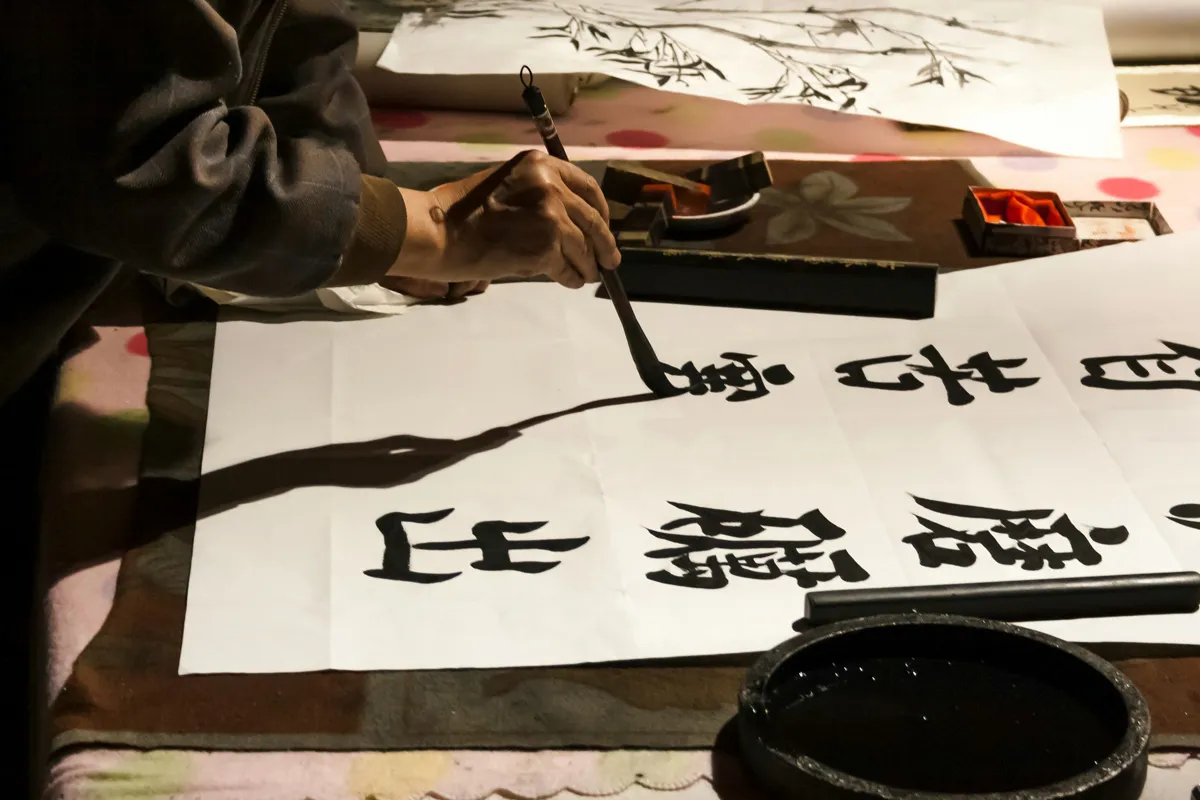
Photo by Marco Zuppone on Unsplash
Learning Chinese writing looks intimidating at first because Chinese does not use an alphabet. Instead, it uses characters, and each character has to be written with the right shape, balance, and stroke order.
That sounds like a lot. But beginners usually do better once they stop asking, “How do I memorize thousands of symbols?” and start asking better questions:
- What should I learn first?
- Do I need handwriting or just recognition?
- How do radicals and stroke order actually help?
- What is the most efficient way to practice?
This guide answers those questions directly. It focuses on how to start writing Chinese in a practical way, not on romanticizing the script or overwhelming you with history.
TL;DR
- Chinese writing uses characters (Hanzi / 汉字), not letters.
- Chinese characters are commonly described as logographic, with characters linked to units of meaning rather than alphabet-style sound spelling. A concise overview is in Britannica’s article on Chinese writing.
- Stroke order matters because it makes characters easier to write, recognize, and remember. Taiwan’s Ministry of Education provides a public stroke order resource.
- Radicals help learners notice meaning patterns across characters. If you are starting with simplified Chinese, it is often more useful to study radicals through real characters and guided practice than to memorize a long list in isolation.
- Beginners do best when they learn:
- basic strokes
- a small set of common radicals
- simple high-frequency characters
- short words and sentences
- If your goal is reading and typing only, you may not need beautiful handwriting. But learning to write by hand still improves recognition and memory for many learners.
What does it mean to learn Chinese writing?
To learn Chinese writing means learning how to:
- recognize characters
- understand their parts
- write them in the correct order
- remember them well enough to use them in words and sentences
That is different from just learning pinyin.
Pinyin helps with pronunciation, but it is not the writing system itself. If you want to read signs, menus, messages, books, subtitles, or notes written by native speakers, you need characters.
What makes Chinese writing different from alphabet writing?
English writing builds words from letters. Chinese writing builds words from characters.
Britannica describes Chinese writing as fundamentally logographic, meaning that the script represents meaningful units rather than alphabet-style sound segments. See Chinese writing on Britannica.
A very simple beginner view looks like this:
- 人 = person
- 口 = mouth
- 人口 = population
This does not mean every character is a whole word in the same way. But it does explain why Chinese writing feels different from alphabet-based languages.
Do you need to learn handwriting if you mainly want to speak Chinese?
Not always.
This is where many beginners waste time because they follow advice that does not match their real goal.
If your goal is mostly speaking and listening
You can delay deep handwriting practice and focus first on:
If your goal is reading and daily literacy
You should learn:
- common characters
- stroke order basics
- radicals
- enough handwriting to reinforce memory
If your goal is exams, school, or long-term literacy
You should definitely practice writing by hand, because it strengthens:
- recognition
- recall
- character structure awareness
- long-term retention
So the right answer is not “everyone must master calligraphy first.”
The right answer is: match your writing practice to your real goal.
Simplified or traditional characters: which should you learn?
This is one of the first practical decisions Chinese learners need to make.
Simplified Chinese
Used mainly in:
- Mainland China
- Singapore
Traditional Chinese
Used mainly in:
- Taiwan
- Hong Kong
- many heritage and overseas communities
Both systems are real Chinese writing systems. The best starting point depends on where you want to use Chinese most often. Check our post Difference Between Traditional and Simplified Chinese to learn more.
The practical rule
Pick the system based on your real goal.
| Your main goal | Better starting choice |
|---|---|
| Mainland China travel, work, apps, media | Simplified |
| Taiwan study, Taiwan life, traditional text exposure | Traditional |
| No strong regional need yet | Simplified is often the easiest starting point for most beginners |
If you are starting with simplified characters, our tool to Practice the Chinese Writing System is a good place to begin with character structure and radicals.
Do not try to learn both systems equally from day one. That usually slows beginners down.
What are the first things you should learn in Chinese writing?
A practical beginner order is:
- basic strokes
- stroke order habits
- common radicals
- high-frequency characters
- short everyday words
- short sentences
That order works because it helps you see structure instead of memorizing random shapes.
Stroke order: why it matters more than beginners think
Stroke order is not just a school rule. It helps you:
- write more neatly
- remember characters more accurately
- spot the internal structure faster
- use handwriting input more successfully
Stroke order matters in both simplified and traditional Chinese because it helps you write more clearly, remember characters better, and recognize character structure faster.
If you are learning simplified Chinese and want a practical starting point, you can use our tool to Practice the Chinese Writing System. For general stroke-order reference, public educational resources such as the Taiwan Ministry of Education’s stroke order database are also useful for checking character structure.
Core stroke order rules
These are the patterns beginners usually learn first:
- top to bottom
- left to right
- horizontal before vertical
- outside before inside
- close the frame last
You do not need to memorize every exception at the beginning. But you do need to build the habit of checking stroke order early.
Radicals: the fastest way to stop seeing characters as random
Radicals are recurring components that help learners notice meaning patterns across characters.
Cambridge’s Student Grammar of Chinese describes radicals as semantic parts that can indicate a broad category of meaning. See the chapter summary on words and Chinese characters.
For learners who want a more practical starting point, our tool to Practice the Chinese Writing System helps you explore radicals and character structure in a way that is more useful for actual study than memorizing a long radical list all at once.
Here are a few useful examples:
| Radical | Basic meaning | Example characters |
|---|---|---|
| 氵 | water | 河, 海, 洗 |
| 艹 | grass / plant | 花, 草, 茶 |
| 人 / 亻 | person | 你, 他, 住 |
| 女 | woman | 妈, 姐, 妹 |
| 口 | mouth | 吃, 喝, 告 |
This does not mean radicals give you the full meaning every time. But they often make characters easier to group and remember.
The most useful beginner mindset: characters are built, not random
A lot of beginners fail because they treat every character like a separate drawing.
A better mindset is:
- characters have parts
- parts repeat
- stroke order follows patterns
- many characters become easier once you notice families
For example:
- 妈 includes the 女 radical
- 姐 includes the 女 radical
- 妹 includes the 女 radical
Once you notice the repeating component, the writing system stops feeling completely chaotic.
What tools do you actually need?
You do not need expensive tools to start.
Enough for most beginners
- squared or grid paper
- a pen or pencil
- a reliable dictionary app
- a stroke order reference
- a spaced repetition tool
Useful digital tools
- handwriting dictionaries
- character animation tools
- flashcards
- writing practice apps
A good free public stroke-order reference is the Taiwan MOE site above. For dictionary and learner workflow, many students use commercial tools like Pleco or Skritter, but your real requirement is simpler: you need a way to check stroke order and review consistently.If you are learning simplified Chinese, our tool to Practice the Chinese Writing System is a practical way to explore radicals and character structure while studying real characters.
The best way to learn Chinese writing as a beginner
The most efficient method is small-volume, high-frequency practice.
A simple 20-minute routine
1. Review 5 old characters
Do not start with new material every day.
2. Learn 3 to 5 new characters
Write each one carefully, not quickly.
3. Check stroke order
Do this immediately, before mistakes become habit.
4. Group by theme or component
For example:
- 我, 你, 他
- 妈, 姐, 妹
- 日, 月, 明
5. Write one short sentence
This makes the characters useful, not isolated.
That kind of routine is much stronger than copying one character 100 times without context.
Sample beginner characters worth writing first
These are more useful than rare or poetic characters because they appear constantly in beginner Chinese.
| Character | Meaning | Pinyin | Why it matters |
|---|---|---|---|
| 我 | I / me | wǒ | essential pronoun |
| 你 | you | nǐ | essential pronoun |
| 他 | he / him | tā | essential pronoun |
| 是 | to be | shì | basic sentence building |
| 不 | not | bù | basic negation |
| 人 | person | rén | high-frequency building block |
| 大 | big | dà | common adjective |
| 小 | small | xiǎo | common adjective |
| 学 | study / learn | xué | appears in school, student, learning |
| 中 | middle / China (in compounds) | zhōng | very common component |
A better first writing challenge than random copying
Instead of writing disconnected characters, start with short useful lines.
Examples:
- 我是学生。
- 你好吗?
- 他不是老师。
- 我喜欢中国菜。
This gives you:
- character practice
- grammar exposure
- sentence-level memory
That is much better than learning shape without use.
Common mistakes beginners make
1. Relying only on pinyin
Pinyin helps pronunciation, but it does not replace character knowledge.
2. Ignoring stroke order
This makes writing messier and memory weaker.
3. Learning too many characters at once
Three to five new characters a day is often enough at the start.
4. Treating every character as isolated
Use radicals and character families to reduce memory load.
5. Writing without reading
Writing and recognition should reinforce each other.
How long does it take to learn Chinese writing?
There is no single number, but the U.S. Foreign Service Institute places Mandarin Chinese in the hardest category for English speakers, with about 2,200 class hours for professional working proficiency. See the official State Department training page on foreign language training.
That estimate is for a high level, not for beginner literacy.
A more practical learner view looks like this:
| Goal | Rough character range | Typical learner result |
|---|---|---|
| Early beginner writing | 100 to 300 characters | basic handwriting, short phrases, stronger recognition |
| Functional beginner literacy | 500 to 1,000 characters | simple reading, useful daily writing |
| Broader reading comfort | 1,500 to 2,500+ characters | much stronger reading and writing range |
| Advanced literacy | 3,000+ characters | much wider real-world coverage |
The important point is this:
you do not need thousands of characters before Chinese writing becomes useful.
A practical weekly plan for learning Chinese writing
Week 1 to 2
Focus on:
- basic strokes
- stroke order rules
- 20 to 30 high-frequency characters
Week 3 to 4
Add:
- radicals
- pronouns
- basic verbs
- short sentence copying
Month 2 to 3
Move into:
- short themed word groups
- daily writing review
- simple dictation
- basic reading and rewriting
This is a much better beginner path than trying to “master all Hanzi fundamentals” first.
FAQ: Learn Chinese Writing
Do I need to learn Chinese writing if I only want to speak?
Not strictly, but even limited writing practice usually improves recognition and long-term memory. If your goal is pure conversation, you can delay deep handwriting, but character knowledge still helps.
Is Chinese writing logographic?
Chinese writing is widely described as logographic, with characters connected to units of meaning rather than an alphabet of letters. Britannica gives a concise explanation in its overview of Chinese writing.
Should I learn simplified or traditional characters first?
Choose based on your real goal. Simplified is better for Mainland China and Singapore. Traditional is better for Taiwan and Hong Kong contexts.
How many Chinese characters do I need to know to start reading?
You can start recognizing very basic materials with a few hundred characters, and many learners begin to feel more functional somewhere around 500 to 1,000 characters.
Does stroke order really matter?
Yes. It helps with neat writing, memory, recognition, and handwriting input. A good public reference is the Taiwan MOE stroke order site.
What should I learn first when starting Chinese writing?
Most beginners should start with:
- basic strokes
- stroke order
- a small group of common radicals
- high-frequency characters
- short everyday words and sentences
That order makes Chinese writing feel much more structured and manageable.
A practical next step for simplified Chinese learners
If you want to move from reading about Hanzi to actually studying them, the best next step is to practice structure, radicals, and character families in a focused way.
A simple place to start is our tool to Practice the Chinese Writing System. It works especially well for learners starting with simplified Chinese who want a clearer feel for how characters are built.
Final thoughts
Learning Chinese writing is hard in one specific way: it asks you to build visual memory, stroke habits, and character awareness at the same time.
But it is also easier than beginners often fear once you stop treating characters as random art.
Start with:
- a small number of characters
- correct stroke order
- common radicals
- short useful sentences
That is how Chinese writing starts to feel learnable.
Chinese writing becomes much easier once you stop treating characters as isolated shapes and start learning them as a structured system.