TL;DR — Quick Summary
- The origin of Chinese characters dates back over 3,000 years to oracle-bone inscriptions.
- Early characters were pictographs representing real-world objects, later evolving into ideographs and phonetic compounds.
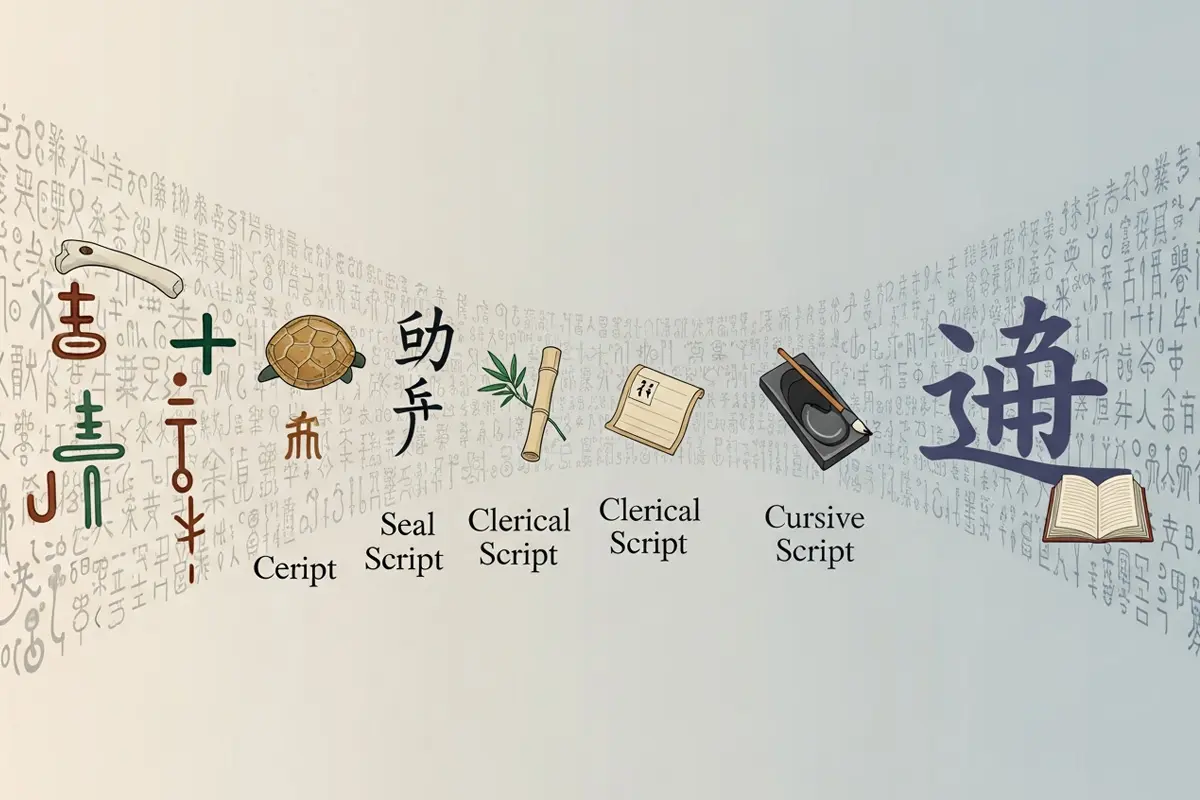
- The script developed through major stages: Oracle Bone → Bronze → Seal → Clerical → Regular → Simplified.
- Chinese characters are among the world’s oldest continuously used writing systems, playing a central role in East Asian culture.
- Understanding their evolution helps learners grasp how meaning, form, and sound connect in Mandarin Chinese.
What Is the Origin and Evolution of Chinese Characters?
The origin and evolution of Chinese characters trace back to around 1200 BCE, during the Shang dynasty, when scribes carved symbols onto bones and shells used for divination. As detailed in Wikipedia’s article on Oracle Bone Script, these early inscriptions mark the beginning of Chinese written history.
Over time, the pictorial symbols evolved into a logographic system, where each character represents a word or morpheme. This allowed different Chinese dialects to share a common written form despite variations in pronunciation.
How Did Chinese Characters Begin?
Archaeological discoveries in Anyang, the last Shang capital, reveal engraved turtle shells and ox bones used in royal divination rituals — known as oracle-bone inscriptions (甲骨文 jiǎgǔwén). According to History of Information’s archive, these carvings are the earliest examples of a functional writing system in East Asia.
For instance, the character for “sun” (日) began as a circle with a dot in the center ☉, and “moon” (月) appeared as a crescent 🌙. These pictographs gradually became standardized symbols, forming the visual foundation of modern written Chinese.
Major Stages in the Evolution of Chinese Characters
Over the centuries, Chinese writing evolved through six major historical phases, each reflecting shifts in technology, politics, and aesthetics.
| Period | Script Type | Example | Notes |
|---|---|---|---|
| Shang Dynasty (~1200–1045 BCE) | Oracle Bone Script | 日, 月, 馬 | The earliest pictographs used for divination. |
| Zhou Dynasty (1045–256 BCE) | Bronze Script | 國, 王 | Found on bronze vessels; forms became more ornate. |
| Qin Dynasty (221–206 BCE) | Small Seal Script (小篆) | 山, 魚 | Standardized by Emperor Qin Shi Huang to unify the empire. |
| Han Dynasty (206 BCE–220 CE) | Clerical Script (隸書) | 書, 學 | Developed for efficient brush writing on bamboo and silk. |
| Wei–Tang Period (220–907 CE) | Regular Script (楷書) | 中, 和 | Evolved into the basis of modern Chinese handwriting. |
| Modern Era (20th century–now) | Simplified Script (简体字) | 学, 爱 | Reduced stroke counts to improve literacy. |
As explained in Fiveable’s overview of early Chinese writing, these stages show how writing shifted from sacred ritual carvings to a standardized communication system.
Why Did Chinese Characters Evolve?
Chinese characters evolved for practical and cultural reasons:
- Cultural expansion — A unified script allowed communication across diverse regions and dialects.
- Technological change — The transition from bone carving to brush and paper encouraged simplification of strokes.
- Political reform — Centralized governments, from the Qin dynasty’s standardization to 20th-century literacy campaigns, shaped script reforms.
According to Rutgers University’s research on ancient Chinese writing, over 50,000 characters are known today, though only about 3,500–4,000 are commonly used — a testament to centuries of refinement and standardization.
The Structure and Logic Behind Chinese Characters
The structure of Chinese characters combines sound, meaning, and visual form. Linguists categorize them under the “Six Principles of Chinese Writing (六书 liùshū)” — a framework summarized by Britannica’s entry on Chinese writing.
| Type | Description | Example | Notes |
|---|---|---|---|
| Pictographs (象形) | Direct depictions of objects | 山 (mountain), 木 (tree) | Drawings of real objects |
| Ideographs (指事) | Abstract indicators | 上 (up), 下 (down) | Represent abstract ideas |
| Compound Ideographs (会意) | Combined meanings | 休 (person + tree = rest) | Combine two ideas into one meaning |
| Phono-semantic Compounds (形声) | Sound + meaning parts | 河 (water radical + sound hé) | Represent sound and sense together |
| Derived Characters (转注) | Related forms | 老 & 考 | Share radical and meaning |
| Borrowed Characters (假借) | Phonetic borrowing | 来 (borrowed from “wheat”) | Used for sound regardless of meaning |
Most modern characters are phono-semantic compounds, a structure that balances pronunciation cues with semantic information.
Cultural Significance and Calligraphic Art
Chinese writing has always been more than communication — it is a spiritual and artistic practice.
As described by the Smithsonian’s Asian Art Museum, early inscriptions served ritual purposes before evolving into a form of artistic expression.
Calligraphy (书法 shūfǎ) embodies balance, rhythm, and emotion. Masters like Wang Xizhi (王羲之) transformed written language into visual art, shaping East Asia’s aesthetic traditions. Characters such as 和 (harmony) and 愛 (love) remain cultural symbols representing unity and compassion.
Modern Adaptations: From Ink to Digital Code
The story of Chinese characters continues into the digital era. Standardized Unicode encoding enables seamless global use of thousands of Chinese characters. Simplified Chinese supports efficient literacy across mainland China, while Traditional Chinese thrives in Taiwan, Hong Kong, and overseas Chinese communities.
This coexistence illustrates how the origin and evolution of Chinese characters bridges ancient heritage with modern communication.
How the Evolution Shapes Modern Learning
For learners, understanding evolution deepens comprehension:
- Recognizing radicals reveals how meanings interconnect.
- Knowing the history improves recall and pattern recognition.
- Studying both Simplified and Traditional forms enhances cultural literacy.
In essence, learning Chinese characters means learning 3,000 years of human thought and design condensed into written form.
FAQs About the Origin and Evolution of Chinese Characters
When did Chinese writing first appear?
Chinese writing appeared around 1200 BCE during the Shang dynasty, as confirmed by archaeological studies of oracle-bone inscriptions.
How many characters exist today?
More than 50,000 have been documented, though only about 3,500–4,000 are in daily use according to Oxford Language Institute research.
Are Chinese characters pictographs?
Originally yes, but most modern characters are phono-semantic compounds combining sound and meaning, as noted by Britannica.
Why are Traditional and Simplified characters different?
Simplified forms were developed in the 1950s to reduce stroke count and make reading easier, while Traditional forms preserve classical aesthetics.
Do other East Asian languages use Chinese characters?
Yes. Japanese Kanji and historical Korean Hanja both stem from ancient Chinese writing systems, demonstrating the regional influence of this script.
Related Lessons You’ll Love
- Difference Between Traditional and Simplified Chinese
- Most Common Chinese Characters for Beginners
- How to Say Hello in Chinese
- And in Chinese Characters (和, 与, 跟 Explained)
References
- Britannica – Chinese Writing: Characteristics and History
- Smithsonian Asian Art Museum – Oracle Bone Script and Early Calligraphy
- History of Information – The Earliest Writing in China
- Rutgers University – Chinese Writing from 5000 B.C. to Present
- Fiveable – Development of Chinese Writing: Oracle Bones to Characters