TL;DR
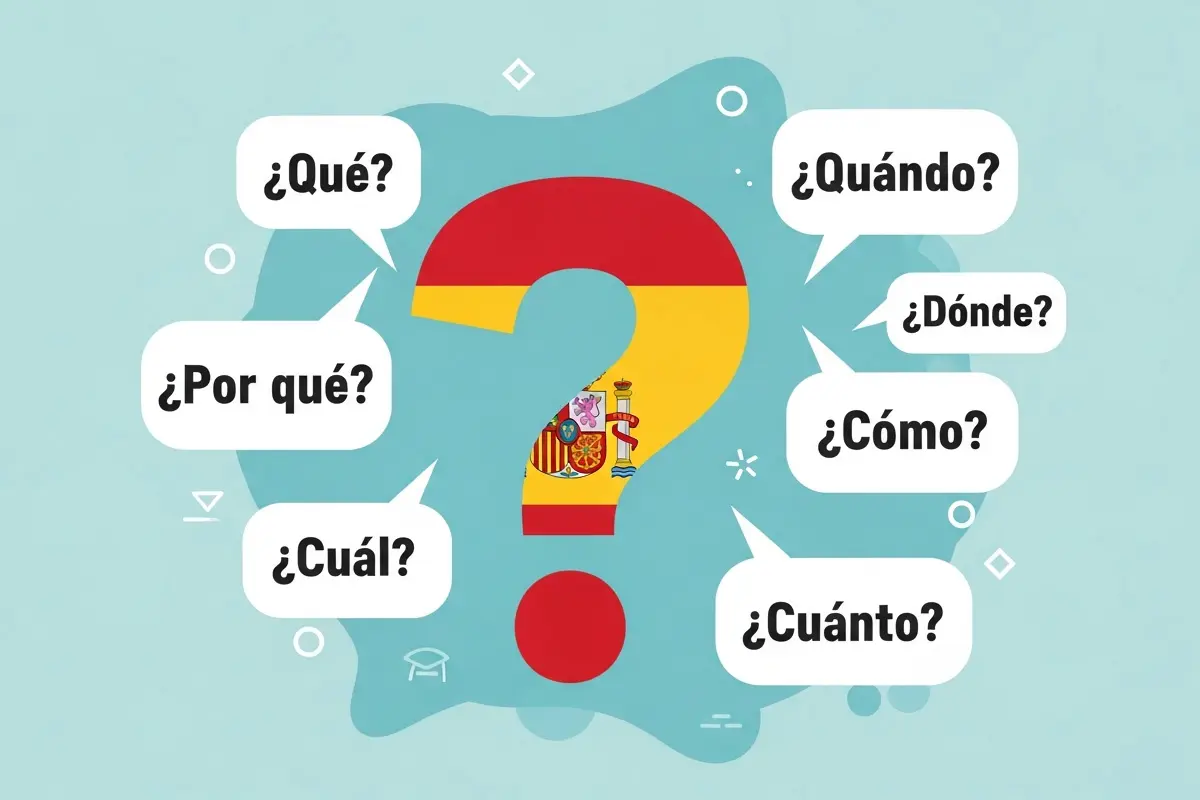
- Spanish uses interrogative words like qué, cuál, quién, cuándo, dónde, por qué to form questions.
- Spanish question words usually include an accent mark and begin with an upside down question mark (¿).
- Learning them makes it easier to ask follow-up questions like ¿Cuál es tu nombre?, ¿Dónde está…?, or ¿Qué hora es?
- Using plural forms like quiénes, cuáles, or cuánto/cuánta/cuántos/cuántas helps make your Spanish sound natural.
Table of Contents
Open Table of Contents
- What are the question words in Spanish?
- Quick Reference Table of Common Spanish Question Words
- Why do Spanish question words have accents?
- Common Real-Life Phrases with Spanish Question Words
- Q&A: Common Confusions Learners Have
- Conversation Practice Examples
- Mini Quiz: Fill in the correct question word
- Tips for Remembering Spanish Question Words
- Conclusion
What are the question words in Spanish?
Question words in Spanish are words used to ask for information such as what, why, when, and where.
They are essential for conversations, travel, and real communication—not just memorizing phrases.
According to the Real Academia Española (RAE) — the official authority for the Spanish language — these interrogatives are used to gather unknown information in a sentence. Spanish questions also use the special punctuation rule of an upside down question mark (¿) at the beginning and a regular one (?) at the end.
The Spanish Royal Grammar confirms this rule.
Quick Reference Table of Common Spanish Question Words
| Spanish Word | Meaning | Used to Ask About | Example |
|---|---|---|---|
| ¿Qué? | What? | Things, ideas | ¿Qué haces? — What are you doing? |
| ¿Cuál? / ¿Cuáles? | Which? | Choices & preferences | ¿Cuál de estos prefieres? — Which of these do you prefer? |
| ¿Quién? / ¿Quiénes? | Who? | People (singular/plural form) | ¿Quién es ella? — Who is she? |
| ¿Dónde? | Where? | Place or direction | ¿Dónde está el baño? — Where is the bathroom? |
| ¿Cuándo? | When? | Time | ¿Cuándo es la reunión? — When is the meeting? |
| ¿Por qué? | Why? | Reasons | ¿Por qué estás cansado? — Why are you tired? |
| ¿Cómo? | How? | Condition or method | ¿Cómo te llamas? — What’s your name? |
| ¿Cuánto/a/os/as? | How much/many? | Quantities, prices | ¿Cuánto cuesta? — How much does it cost? |
Why do Spanish question words have accents?
Spanish uses accents on interrogative words to mark that they are being used as a question or exclamation rather than a neutral statement. The Real Academia Española states that words like qué, cuál/es, quién/es, cómo, cuánto/a/os/as, cuándo, dónde and similar require a tilde diacrítica when they introduce direct or indirect questions or exclamations.
Examples that change meaning:
- porque = because
- por qué = why?
- como = like/as
- cómo = how?
- cuando = when (statement)
- cuándo = when? (question)
Because of this rule, accent marks (and the Spanish convention of the upside-down question mark (¿)) are essential to differentiate between statements and questions in Spanish writing and comprehension.
Common Real-Life Phrases with Spanish Question Words
Here are useful examples you’ll hear in everyday conversation:
- ¿Dónde está…? — Where is…?
- ¿Cuál es tu nombre? — What is your name?
- ¿Qué hora es? — What time is it?
- ¿Cuándo es la fiesta? — When is the party?
- ¿Te gusta el café? — Do you like coffee?
- ¿Cuál de estos quieres? — Which of these do you want?
These are some of the most common Spanish questions used by travelers and beginners.
Q&A: Common Confusions Learners Have
Qué vs. Cuál — when do I use each?
Use qué when asking for a definition.
Use cuál/cuáles when choosing from known options.
- ¿Qué es esto? — What is this?
- ¿Cuál es tu comida favorita? — Which is your favorite food?
Do Spanish questions always start with an upside down question mark?
Yes. Spanish requires ¿ at the beginning and ? at the end.
This is standard punctuation across all Spanish-speaking countries.
Are plural forms like “quiénes” and “cuáles” common?
Yes — especially when asking about multiple people or things.
Examples:
- ¿Quiénes son tus amigos? — Who are your friends?
- ¿Cuáles son tus planes? — What are your plans?
Conversation Practice Examples
Try reading these aloud for fluency:
A: ¿Cómo te llamas?
B: Soy Sam. ¿Y tú?
A: ¿Cuál de estos cafés prefieres?
B: El latte.
A: ¿Por qué estás estudiando español?
B: Porque me gusta viajar.
Mini Quiz: Fill in the correct question word
| Answer | Question Word |
|---|---|
| Porque tengo sueño | ___ |
| En Barcelona | ___ |
| Diez euros | ___ |
| El azul | ___ |
Possible answers: ¿Dónde?, ¿Cuánto?, ¿Por qué?, ¿Cuál?
Tips for Remembering Spanish Question Words
- Group patterns: qué and cuál, cuánto/cuánta/cuántos/cuántas, quién/quiénes.
- Practice with real questions, not just vocabulary lists.
- Listen to native speakers — word order and tone repeat consistently.
For more context, see our guide to Spanish greetings to improve your early conversation flow.
Conclusion
Learning the question words in Spanish gives you the power to ask, interact, and understand—not just memorize phrases. Once you can ask things like ¿Dónde está…?, ¿Cuál prefieres?, ¿Por qué?, or ¿Cuánto cuesta?, everyday conversations become more natural and meaningful.
These interrogative words also help you express curiosity and build real social connections. Whether you’re asking qué música te gusta, cuál es tu comida favorita, or cuándo es tu próxima clase, the structure becomes familiar with use. With time, the upside-down question mark (¿), accent marks (qué, cómo, cuándo, por qué), and plural forms like quiénes and cuáles will feel automatic rather than something to think about.
Use these Spanish question words often—in travel, casual conversation, study exercises, or language apps. The more you practice, the faster Spanish transitions from vocabulary lists to confident communication.