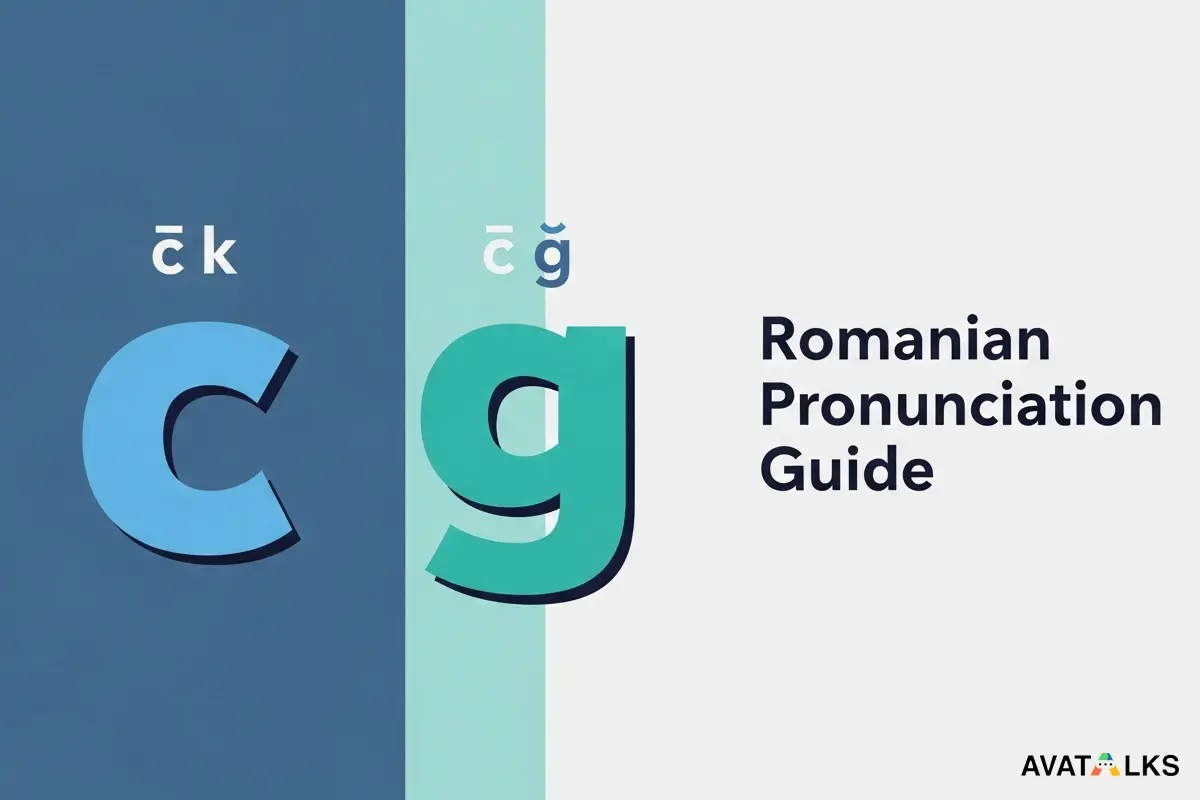
TL;DR
- In Romanian, the letters C and G change sound depending on the vowel that follows.
- Before e / i, they are soft:
- ce / ci → /t͡ʃ/ (like ch in church)
- ge / gi → /d͡ʒ/ (like j in judge)
- Before a / o / u or a consonant, they are hard:
- ca / co / cu → /k/
- ga / go / gu → /g/
- Romanian spelling is predictable once you know this rule.
If you’re unsure how to pronounce ce, ci, ge, or gi, this page gives you everything you need.
Romanian alphabet pronunciation hub
If you want the full system behind these sounds, see the Romanian alphabet pronunciation hub
Explore the practice hub →Why Romanian C and G pronunciation confuses learners
Many learners of the Romanian language come from English or other Romance languages. At first glance, Romanian looks familiar. But then you see words like:
- ceai
- cină
- geri
- gară
And suddenly, you’re unsure how to pronounce Romanian correctly.
The good news? Romanian C and G pronunciation follows clear, mechanical rules. There are very few exceptions, and once you master them, reading Romanian words becomes much easier than English.
Rule chart: Romanian C and G pronunciation
The core rule (save this)
| Letter | Before e / i | Sound | Example | Before a / o / u | Sound | Example |
|---|---|---|---|---|---|---|
| C | ce, ci | /t͡ʃ/ | ceai, cină | ca, co, cu | /k/ | casă, copil, cultură |
| G | ge, gi | /d͡ʒ/ | ger, gimnastică | ga, go, gu | /g/ | gară, gol, gust |
This single table explains about 95% of real-world usage.
Soft vs hard sounds explained simply
Soft C and G (before e / i)
- ce / ci → sounds like “ch”
- ge / gi → sounds like “j”
Examples:
- cer → cher
- cină → chee-nuh
- ger → jer
- gimnastică → jim-nas-ti-cuh
If you see e or i, your brain should automatically switch to the soft sound.
Hard C and G (before a / o / u)
- ca / co / cu → k
- ga / go / gu → g
Examples:
- carte → kar-te
- copil → ko-peel
- gară → ga-ruh
- gust → goost
No surprises here—these behave like most Romance languages.
Why CH and GH exist in Romanian
You may notice combinations like che, chi, ghe, ghi.
These exist for one reason only:
👉 to keep the hard sound before e / i
Examples
- cheie → ke-ye (not che-ye)
- chitară → ki-ta-ruh
- gheață → gya-tsuh
- ghiocel → gyo-chel
Without h, these would turn soft. Romanian spelling adds h to protect the hard sound.
Example words you’ll see everywhere
Common words with ce / ci
- ce (what)
- ceai (tea)
- cinci (five)
- cer (sky)
Common words with ge / gi
- ger (frost)
- gimnaziu (middle school)
- ginger (loanword, still follows the rule)
Common words with ca / co / cu
- casă (house)
- copil (child)
- curte (yard)
Common words with ga / go / gu
- gară (train station)
- gol (empty)
- gust (taste)
These are high-frequency Romanian words, so mastering them improves comprehension fast.
Edge cases and learner traps
1. Loanwords
Some loanwords keep their original spelling but still follow Romanian pronunciation rules when spoken.
Example:
- golf → still hard g
- cafea → hard c
2. Double consonants don’t change the rule
- accident → ak-si-dent
- agitație → a-ji-ta-tsi-e
The vowel after C/G always decides the sound.
Minimal pairs (hear the difference)
These pairs show how one letter changes everything:
- cer (/t͡ʃ/) vs car (/k/)
- ginere (/d͡ʒ/) vs gară (/g/)
- cină vs cuptor
- gimnastică vs gust
Train your eye to spot the vowel, not the consonant.
Mini quiz (check your understanding)
Choose the correct pronunciation:
- ceapă → /t͡ʃ/ or /k/?
- copil → /t͡ʃ/ or /k/?
- gheață → /d͡ʒ/ or /g/?
- gimnastică → /d͡ʒ/ or /g/?
Answers:
- /t͡ʃ/
- /k/
- /g/
- /d͡ʒ/
If you got all four, you already understand Romanian C and G pronunciation rules.
How this fits into the Romanian alphabet
Romanian pronunciation is often described as phonetic, and this rule proves it.
Once you learn:
- C/G behavior
- Special letters (Ă, Â, Î, Ș, Ț)
You can pronounce most Romanian words correctly on first sight—something English learners can only dream of.
For a full overview, see:
- Romanian alphabet
- Romanian pronunciation rules (C/G)
- Romanian special letters
Final takeaway
Romanian C and G pronunciation is not random.
It’s:
- Vowel-driven
- Consistent
- Learnable in one sitting
Stop guessing. Look at the vowel. Apply the rule.
That’s it.
Once this clicks, reading Romanian words becomes fast, confident, and stress-free.
Next up:
Continue with Romanian consonants pronunciation or return to the Romanian alphabet to build full pronunciation confidence step by step.