TL;DR
English uses “excuse me” and “sorry” in many different situations.
Chinese does not.
Instead, native speakers choose different expressions depending on whether they are:
- apologizing for a mistake,
- getting someone’s attention,
- asking a question,
- walking through a crowd,
- interrupting someone,
- or expressing embarrassment.
Here are the expressions you will use most often.
| Chinese | Pinyin | Meaning | Typical situation |
|---|---|---|---|
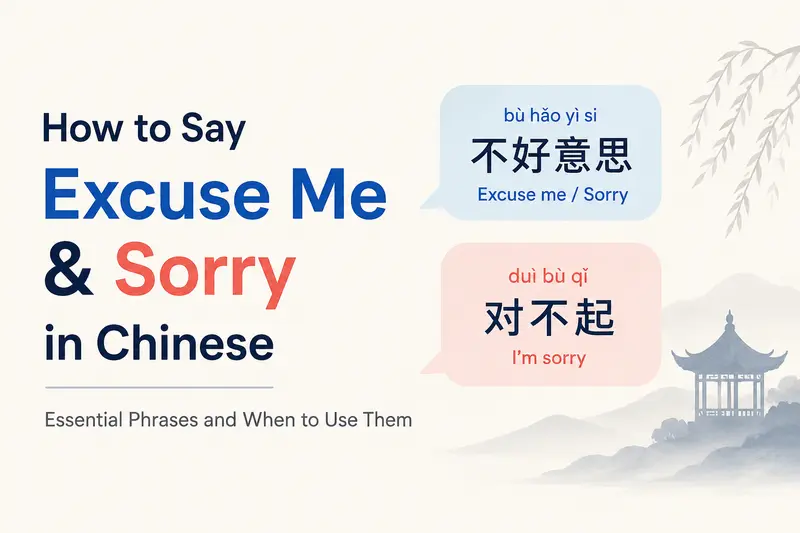
| 对不起 | duì bu qǐ | I’m sorry | A real apology |
| 不好意思 | bù hǎo yì si | Sorry / Excuse me | Everyday apology, embarrassment, getting attention |
| 抱歉 | bào qiàn | I apologize | Formal apology |
| 劳驾 | láo jià | Excuse me | Asking someone for help or a favor |
| 请问 | qǐng wèn | Excuse me | Politely asking a question |
| 借过 | jiè guò | Excuse me | Passing through people |
| 打扰一下 | dǎ rǎo yí xià | Sorry to bother you | Interrupting someone politely |
If you only remember three expressions, start with these:
不好意思!
Excuse me! / Sorry!
对不起。
I’m sorry.
请问……
Excuse me…
These three expressions will cover most situations you encounter while traveling, studying Chinese, or talking with native speakers.
Table of Contents
Open Table of Contents
- Why Chinese has several ways to say “excuse me” and “sorry”
- 对不起 (duì bu qǐ) — “I’m sorry”
- 不好意思 (bù hǎo yì si) — the most useful everyday phrase
- 抱歉 (bào qiàn) — a formal apology
- 劳驾 (láo jià) — Excuse me (may I ask a favor?)
- 请问 (qǐng wèn) — Excuse me, may I ask…
- 借过 (jiè guò) — Excuse me, let me pass
- 打扰一下 (dǎ rǎo yí xià) — Sorry to bother you
- Which expression should you use?
- Common mistakes learners make
- Real-life dialogues
- Practice quiz
- Frequently asked questions
- Final tips for sounding more natural
- Continue learning Chinese
- References
Why Chinese has several ways to say “excuse me” and “sorry”
Many English learners expect a single Chinese word that means both “excuse me” and “sorry.”
Mandarin does not work that way.
Chinese focuses more on why you are speaking than on the literal English translation.
Imagine these situations:
- You accidentally step on someone’s foot.
- You need to squeeze past people on a crowded subway.
- You want to ask a stranger where the train station is.
- You interrupt someone during a meeting.
- You forgot your friend’s birthday.
English speakers might say “Excuse me” or “Sorry” in every one of these situations.
Chinese speakers would probably choose five different expressions.
That is why directly translating English often sounds unnatural.
The good news is that once you understand the purpose of each phrase, choosing the correct one becomes surprisingly easy.
对不起 (duì bu qǐ) — “I’m sorry”
对不起 is the standard way to apologize when you have actually done something wrong.
Think of it as:
I’m sorry.
rather than
Excuse me.
Basic meaning
| Chinese | Pinyin | Meaning |
|---|---|---|
| 对不起 | duì bu qǐ | I’m sorry |
Use it when:
- you hurt someone’s feelings,
- you arrive very late,
- you break something,
- you make a serious mistake,
- you sincerely apologize.
For example:
对不起,我迟到了。
I’m sorry I’m late.
对不起,我忘了。
I’m sorry. I forgot.
真的对不起。
I’m really sorry.
When should you use 对不起?
Native speakers usually use 对不起 when they genuinely feel responsible for a problem.
Examples include:
- forgetting an appointment,
- accidentally hurting someone,
- making a mistake at work,
- disappointing a friend,
- breaking a promise.
Because of this, 对不起 sounds more serious than 不好意思.
Don’t overuse 对不起
One of the biggest beginner mistakes is saying 对不起 every time they want to say “excuse me.”
Imagine walking into a restaurant and saying:
对不起,请问厕所在哪里?
Although people will understand you, it sounds more like:
“I’m sorry… where is the restroom?”
Nothing has happened yet, so there is nothing to apologize for.
A more natural choice would be:
不好意思,请问厕所在哪里?
or simply
请问,厕所在哪里?
We will learn both expressions next.
不好意思 (bù hǎo yì si) — the most useful everyday phrase
If you learn only one polite Chinese expression today, learn 不好意思.
It is one of the most common phrases in everyday Mandarin because it works in many different situations.
Unlike 对不起, which expresses a genuine apology, 不好意思 often means:
- excuse me,
- sorry,
- pardon me,
- I feel embarrassed,
- thank you for your trouble.
Its exact meaning depends entirely on the situation.
Situation 1: Getting someone’s attention
不好意思。
Excuse me.
For example:
不好意思,请问地铁站在哪里?
Excuse me, where is the subway station?
This is probably the sentence travelers use most often in China.
Situation 2: A small apology
Suppose you accidentally bump into someone.
Instead of saying:
对不起!
many native speakers simply say:
不好意思!
It sounds softer and more conversational.
Situation 3: Feeling embarrassed
Chinese speakers also use 不好意思 when they feel slightly embarrassed.
For example:
不好意思,我中文不好。
Sorry, my Chinese isn’t very good.
Or:
不好意思,让你久等了。
Sorry to keep you waiting.
In these situations, 不好意思 feels warmer and less formal than 对不起.
对不起 vs 不好意思
This is the comparison every beginner should remember.
| 对不起 | 不好意思 |
|---|---|
| Serious apology | Light apology or excuse me |
| You made a real mistake | Minor inconvenience or embarrassment |
| More formal | More conversational |
| ”I’m sorry." | "Sorry.” / “Excuse me.” |
Compare these examples.
Someone steps on your foot:
对不起!
A waiter walks by and you want to order:
不好意思!
You forgot your friend’s birthday:
对不起,我忘了。
You want to ask a stranger for directions:
不好意思,请问……
Learning this distinction will immediately make your Chinese sound more natural.
抱歉 (bào qiàn) — a formal apology
抱歉 also means “I’m sorry,” but it sounds more formal than 对不起.
It commonly appears in:
- customer service,
- business emails,
- official announcements,
- public apologies,
- professional conversations.
| Chinese | Meaning |
|---|---|
| 抱歉 | I apologize |
| 很抱歉 | I’m very sorry |
| 非常抱歉 | We sincerely apologize |
For example:
很抱歉,我们今天不能营业。
We’re very sorry. We cannot open today.
非常抱歉,给您带来了不便。
We sincerely apologize for the inconvenience.
Most beginners don’t need to use 抱歉 very often in daily conversation, but you’ll hear it frequently in airports, hotels, stores, company emails, and customer support.
劳驾 (láo jià) — Excuse me (may I ask a favor?)
If you’re asking someone to do something for you, 劳驾 is one of the most polite expressions you can use.
It literally carries the idea of “may I trouble you” or “excuse me for bothering you.”
Unlike 不好意思, which can express embarrassment or a light apology, 劳驾 is almost always used before asking someone for help or a favor.
Common situations
- Asking for directions
- Asking someone to move
- Speaking to a waiter
- Asking a stranger for help
- Getting someone’s attention politely
For example:
劳驾,请问火车站怎么走?
Excuse me, how do I get to the train station?
劳驾,可以帮我一下吗?
Excuse me, could you help me?
劳驾,让一下。
Excuse me, could you move a little?
Is 劳驾 old-fashioned?
Some learners read online that 劳驾 is outdated.
Not really.
While younger Chinese speakers often say 不好意思 or simply 请问, 劳驾 is still completely natural in:
- restaurants
- hotels
- train stations
- taxis
- customer service
- conversations with strangers
It simply sounds a little more polite and respectful.
请问 (qǐng wèn) — Excuse me, may I ask…
One of the first expressions beginners should learn is 请问.
Unlike 劳驾, 请问 is specifically used before asking a question.
Think of it as:
“Excuse me, may I ask…”
rather than simply “Excuse me.”
Common examples
请问,洗手间在哪里?
Excuse me, where is the restroom?
请问,现在几点?
Excuse me, what time is it?
请问,这里可以拍照吗?
Excuse me, may I take pictures here?
You’ll hear 请问 everywhere in China because it sounds polite without being overly formal.
Many native speakers also combine it with 不好意思.
For example:
不好意思,请问附近有银行吗?
Excuse me, is there a bank nearby?
This combination sounds especially natural when approaching a stranger.
借过 (jiè guò) — Excuse me, let me pass
When you need to walk through a crowd, don’t say 对不起.
Instead, Chinese speakers usually say:
借过。
It literally means:
“May I pass through?”
You’ll hear it frequently in:
- subway stations
- elevators
- shopping malls
- concerts
- busy restaurants
- markets
For example:
借过一下。
Excuse me, let me through.
or
不好意思,借过一下。
Excuse me, may I get through?
Adding 不好意思 makes the sentence sound even friendlier.
打扰一下 (dǎ rǎo yí xià) — Sorry to bother you
Sometimes you need to interrupt someone.
Perhaps someone is:
- talking on the phone,
- working,
- reading,
- eating,
- or having a conversation.
Instead of saying 对不起, Chinese speakers often say:
打扰一下。
It means:
Sorry to bother you.
or
Sorry for interrupting.
Examples:
打扰一下,我可以问个问题吗?
Sorry to bother you. May I ask a question?
打扰一下,请签一下字。
Sorry to interrupt. Please sign here.
Which expression should you use?
After learning all these phrases, beginners often ask:
“How do I know which one to choose?”
The easiest way is to think about your purpose instead of translating English word for word.
| Situation | Best expression |
|---|---|
| You made a serious mistake | 对不起 |
| Small apology or slight embarrassment | 不好意思 |
| Formal apology | 抱歉 |
| Asking a favor | 劳驾 |
| Asking a question | 请问 |
| Walking through people | 借过 |
| Interrupting someone | 打扰一下 |
Once you stop trying to translate “excuse me” directly and instead think about why you’re speaking, choosing the correct Chinese expression becomes much easier.
Common mistakes learners make
❌ Using 对不起 everywhere
Many beginners learn 对不起 first and then use it in every situation.
For example:
对不起,厕所在哪里?
Although people will understand you, it sounds like you’re apologizing before asking a simple question.
A native speaker would usually say:
请问,厕所在哪里?
or
不好意思,请问厕所在哪里?
❌ Saying 请问 after the question
Incorrect:
厕所在哪里,请问?
Natural Chinese places 请问 before the question.
Correct:
请问,厕所在哪里?
❌ Using 借过 when asking for directions
借过 only means:
“Let me pass.”
It is not used to ask strangers questions.
Instead, use:
- 请问
- 劳驾
- 不好意思
Real-life dialogues
Asking for directions
A:
不好意思,请问地铁站在哪里?
B:
一直走,然后左转。
Walking through a crowd
A:
借过一下。
B:
好,请。
Apologizing to a friend
A:
对不起,我迟到了。
B:
没关系,我们进去吧。
Practice quiz
Frequently asked questions
Is 对不起 rude?
No.
对不起 is completely polite and appropriate when you’ve made a genuine mistake.
The only issue is that beginners sometimes use it too often. For everyday situations like asking a question or getting someone’s attention, 不好意思 or 请问 usually sound more natural.
Can 不好意思 mean both “sorry” and “excuse me”?
Yes.
That’s one reason it is one of the most useful expressions in Mandarin.
Depending on the situation, 不好意思 can mean:
- Sorry.
- Excuse me.
- I feel embarrassed.
- Sorry to bother you.
Native speakers use it every day.
What’s the difference between 对不起 and 抱歉?
Both express an apology, but their tone is different.
| 对不起 | 抱歉 |
|---|---|
| Everyday apology | Formal apology |
| Spoken conversations | Business or official situations |
| Friends, family, strangers | Emails, announcements, customer service |
If you’re unsure, 对不起 is usually the safer choice in daily conversation.
Should I say 劳驾 or 请问?
They are similar but not identical.
Use 请问 when introducing a question.
Use 劳驾 when politely asking someone to do something for you.
Sometimes native speakers combine them.
For example:
劳驾,请问附近有银行吗?
What do people in China use most often?
For everyday conversations, these are probably the expressions you’ll hear most frequently.
| Situation | Natural expression |
|---|---|
| Light apology | 不好意思 |
| Serious apology | 对不起 |
| Asking a question | 请问 |
| Walking through people | 借过 |
If you’re traveling in China, mastering these four expressions will help you handle most polite interactions confidently.
Final tips for sounding more natural
Instead of memorizing English translations, try connecting each expression to a specific situation.
Remember these simple rules:
- 对不起 → You made a genuine mistake.
- 不好意思 → A light apology, embarrassment, or getting someone’s attention.
- 抱歉 → A formal apology.
- 请问 → Asking a question politely.
- 劳驾 → Asking someone for help or a favor.
- 借过 → Walking through a crowd.
- 打扰一下 → Politely interrupting someone.
Once you think about why you’re speaking instead of translating word for word from English, choosing the correct expression becomes much easier.
Like any language skill, the best way to remember these phrases is to hear and use them repeatedly. Try reading each example aloud, listening to the audio, and practicing them in realistic situations. Before long, expressions like 不好意思, 请问, and 借过 will become second nature whenever you speak Mandarin.
Continue learning Chinese
Ready to expand your Mandarin vocabulary? These beginner-friendly guides can help you sound more natural in everyday conversations:
- Hello in Chinese
- How Are You in Mandarin
- How to Say bye bye in Mandarin
- Good Morning in Mandarin Chinese
- Chinese Pinyin Explained
- Pinyin Tone Marks Explained
As your vocabulary grows, you’ll find that Chinese politeness is less about translating individual English words and more about choosing the right expression for each situation. Mastering that habit is an important step toward sounding like a confident Mandarin speaker.