TL;DR
- Days of the week in Spanish are usually lowercase (lunes, martes, miércoles…) unless they begin a sentence or form part of a proper name. The RAE states that days of the week are written with lowercase initial letters in normal use.
- For a specific day, Spanish commonly uses el: el lunes, el martes…
- For a repeated routine, Spanish commonly uses the plural with article: los lunes, los martes…
- miércoles and sábado carry written accents, and those accents should be kept in standard writing.
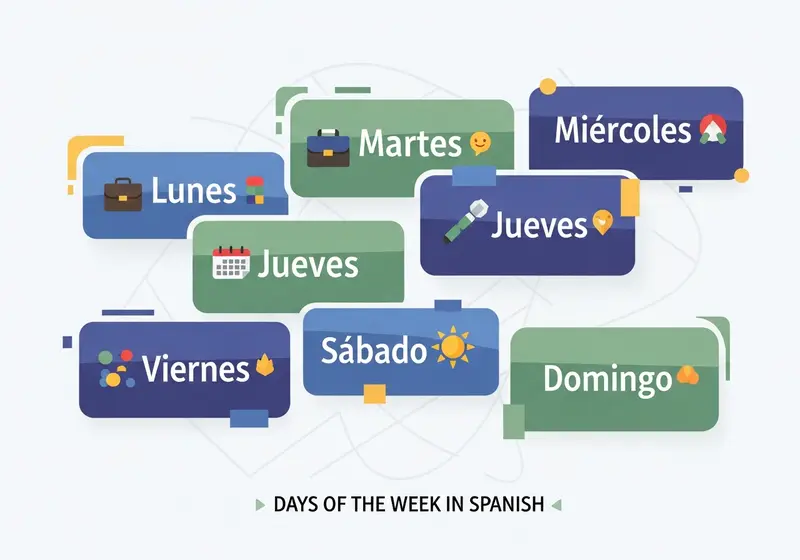
The days of the week in Spanish (full list)
| English | Spanish | Common short form |
|---|---|---|
| Monday | lunes | lun. |
| Tuesday | martes | mar. |
| Wednesday | miércoles | mié. |
| Thursday | jueves | jue. |
| Friday | viernes | vie. |
| Saturday | sábado | sáb. |
| Sunday | domingo | dom. |
Quick note on capitalization: In standard Spanish writing, weekday names are normally lowercase: lunes, martes, miércoles… The Royal Spanish Academy (RAE) gives this rule explicitly in its orthography guidance. See: RAE — uso de minúsculas en días de la semana.
The #1 question you’ll use
- ¿Qué día es hoy? = What day is it today?
- ¿Qué día es mañana? = What day is tomorrow?
- ¿Qué día te viene bien? = What day works for you?
Answers:
- Hoy es lunes. = Today is Monday.
- Mañana es viernes. = Tomorrow is Friday.
“El lunes” vs “Los lunes” (this is the real grammar)
Spanish often uses an article with days.
Use el + day for one specific day
- El lunes tengo examen. = On Monday I have an exam.
- Nos vemos el viernes. = See you on Friday.
Use los + day for a repeated routine
- Los lunes estudio inglés. = On Mondays I study English.
- Los sábados trabajo. = On Saturdays I work.
If you remember only one thing, remember this:
- el lunes = on a specific Monday / on Monday (in context)
- los lunes = on Mondays / every Monday
Saying “on + day” in Spanish (common patterns)
You’ll hear these a lot:
- el lunes = on Monday
- este lunes = this Monday
- el próximo lunes = next Monday
- el lunes por la mañana = Monday morning
- el viernes por la noche = Friday night
Examples:
- Este miércoles tengo una entrevista. = This Wednesday I have an interview.
- El próximo martes no puedo. = I can’t next Tuesday.
Weekend words that matter
- el fin de semana = the weekend
- los fines de semana = on weekends (habit)
Examples:
- ¿Qué haces el fin de semana? = What are you doing this weekend?
- Los fines de semana descanso. = On weekends I rest.
A simple weekly planning mini-dialogue
A:
¿Qué día te viene bien?
What day works for you?
B:
El jueves puedo. ¿Y tú?
I can do Thursday. How about you?
A:
Perfecto. Nos vemos el jueves.
Perfect. See you on Thursday.
Quick practice (2 minutes)
Say these out loud:
- Today is Monday.
- I study on Tuesdays.
- See you on Friday.
- This Wednesday I have class.
- On weekends I work.
Sample answers:
- Hoy es lunes.
- Los martes estudio.
- Nos vemos el viernes.
- Este miércoles tengo clase.
- Los fines de semana trabajo.
FAQ — Days of the week in Spanish
Should days of the week be capitalized in Spanish?
Usually no—they’re typically written in lowercase unless they begin a sentence (same idea as months).
Why do Spanish speakers say “el lunes”?
It’s a normal Spanish pattern: days often behave like nouns in scheduling phrases. Use el for a specific day and los for a repeated routine.
Which days have accents?
Commonly: miércoles, sábado (and the accent matters in writing).