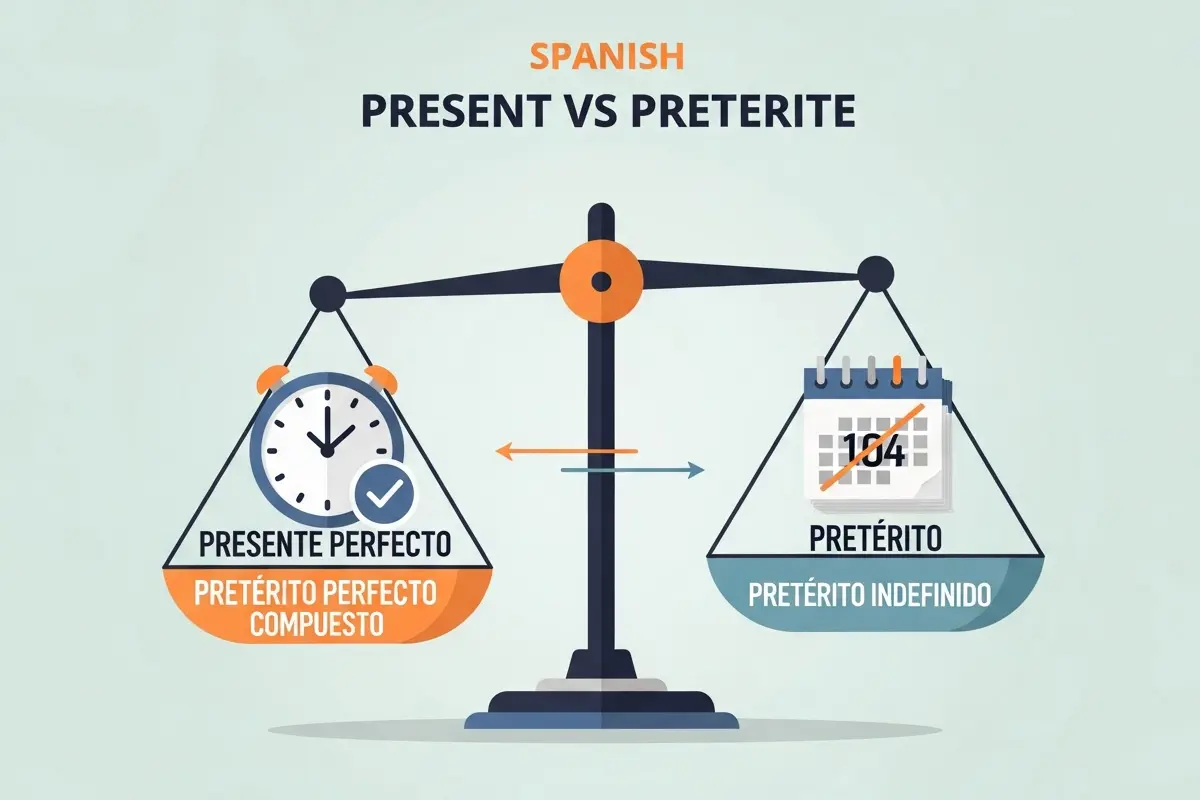
TL;DR — Spanish Present Perfect vs Preterite Practice
- Both tenses describe past actions, but they express different relationships to the present
- Spanish spoken in Spain uses the present perfect more frequently for recent time frames
- Most Latin American varieties prefer the preterite, even for events that happened today
- Learners often struggle because English tense usage does not align cleanly with Spanish
- Effective practice should always include regional context, not isolated rules
Spanish Present Perfect vs Preterite Practice — Quick Answer
Spanish present perfect vs preterite practice helps learners understand when Spanish speakers describe a past action as still connected to the present versus clearly completed.
In Spain, recent or current-time actions often use the present perfect (he comido), while in much of Latin America, the preterite (comí) is commonly used in the same situations.
This difference reflects established regional usage rather than personal style.
Spanish Present Perfect vs Preterite Practice Exercises
Choose the option that sounds most natural for the specified region.
👇 Do more Spanish Past Perfect Practice:
Use había + participle for past actions completed before another event.
What Is the Real Difference Between These Two Tenses?
The key difference is not simply “recent versus distant past,” but how the speaker frames the action in relation to the present moment.
This distinction is subtle and is a frequent source of confusion for learners.
Present Perfect (Pretérito Perfecto)
Form:
haber (present tense) + past participle
he comido, has visto, hemos hablado
Core idea:
- The action occurred before now
- The speaker considers it relevant to the present situation
Examples:
- Hoy he hablado con mi jefe.
- ¿Ya has comido?
Preterite (Pretérito Indefinido)
Form:
simple past conjugation
hablé, comiste, vimos
Core idea:
- The action is viewed as completed
- The speaker treats it as finished and separate from the present
Examples:
- Ayer hablé con mi jefe.
- Comí a las dos.
Why Do Learners Struggle With Spanish Present Perfect vs Preterite?
One reason is that English often allows flexibility where Spanish requires a choice.
Many learners are introduced to simplified explanations such as:
“Present perfect equals recent past.”
In real usage, this guideline often breaks down.
Common learner patterns include:
- Overusing he comido because it feels more advanced
- Translating English present perfect forms directly into Spanish
- Applying textbook rules without considering regional norms
Spanish tense selection frequently reflects speaker perspective, not just a timeline.
Spain vs Latin America: A Regional Pattern
Present Perfect Usage in Spain
In Spain, the present perfect is commonly used for time periods that are understood to include the present.
Typical expressions include:
- hoy (today)
- esta semana (this week)
- este mes (this month)
- ya / todavía no
Examples:
- Hoy he comido tarde.
- Esta semana hemos tenido muchas reuniones.
This pattern is described in reference works by institutions such as the Real Academia Española, which note the tense’s connection to the current time frame.
Preterite Usage in Latin America
In much of Latin America, speakers often use the preterite in the same situations.
Examples:
- Hoy comí tarde.
- Esta semana tuvimos muchas reuniones.
This usage is fully standard and widely accepted across Latin American varieties of Spanish.
Does the Meaning Change Between Regions?
The underlying meaning remains the same; what changes is the tense that sounds most natural.
What differs:
- Preferred tense choice
- Native speaker expectations
What remains constant:
- The event itself
- The time reference
- The speaker’s intention
For example:
- Hoy comí sounds natural in Mexico
- Hoy he comido sounds more typical in Spain
How Should Learners Decide Which Tense to Use?
A Practical Perspective
Instead of focusing only on time markers, it can be helpful to consider the speaker’s viewpoint.
A useful question is:
Is the action being presented as part of the current situation, or as completed and closed?
This approach aligns more closely with how native speakers make tense choices.
Situations Where Usage May Vary
Spanish does not always behave in predictable patterns.
Learners may notice:
- ¿Ya comiste? (Latin America) vs ¿Ya has comido? (Spain)
- News reports often favor the preterite for clarity
- Spoken language tends to follow habitual regional usage rather than textbook rules
For this reason, spanish present perfect vs preterite practice is most effective when examples include context and region.
Comparison Table: Spain vs Latin America
| Situation | Spain | Latin America |
|---|---|---|
| Today | he trabajado | trabajé |
| This week | hemos hablado | hablamos |
| Recent events | present perfect | preterite |
| Finished time | preterite | preterite |
This table reflects common tendencies, not strict rules.
How to Practice This Distinction Over Time
Effective long-term strategies include:
- Listening to Spanish from different regions
- Noting which tense appears in similar situations
- Practicing explanations, not just answers
- Accepting variation as part of the language
Developing comfort with both forms takes exposure and time.
Final Takeaway
Spanish present perfect vs preterite practice becomes easier when learners focus less on rigid rules and more on how speakers frame past events.
Understanding speaker perspective and regional habit leads to more natural and consistent usage over time.