TL;DR
- Spanish simple future describes what will happen later.
- Spanish future perfect describes what will already be completed by a future time.
- The simple future focuses on events, while the future perfect focuses on completion.
- Both tenses can express probability, but at different time levels.
- Choosing the correct tense depends on timing, certainty, and perspective.
Spanish Simple Future vs Future Perfect Tense — What’s the Difference?
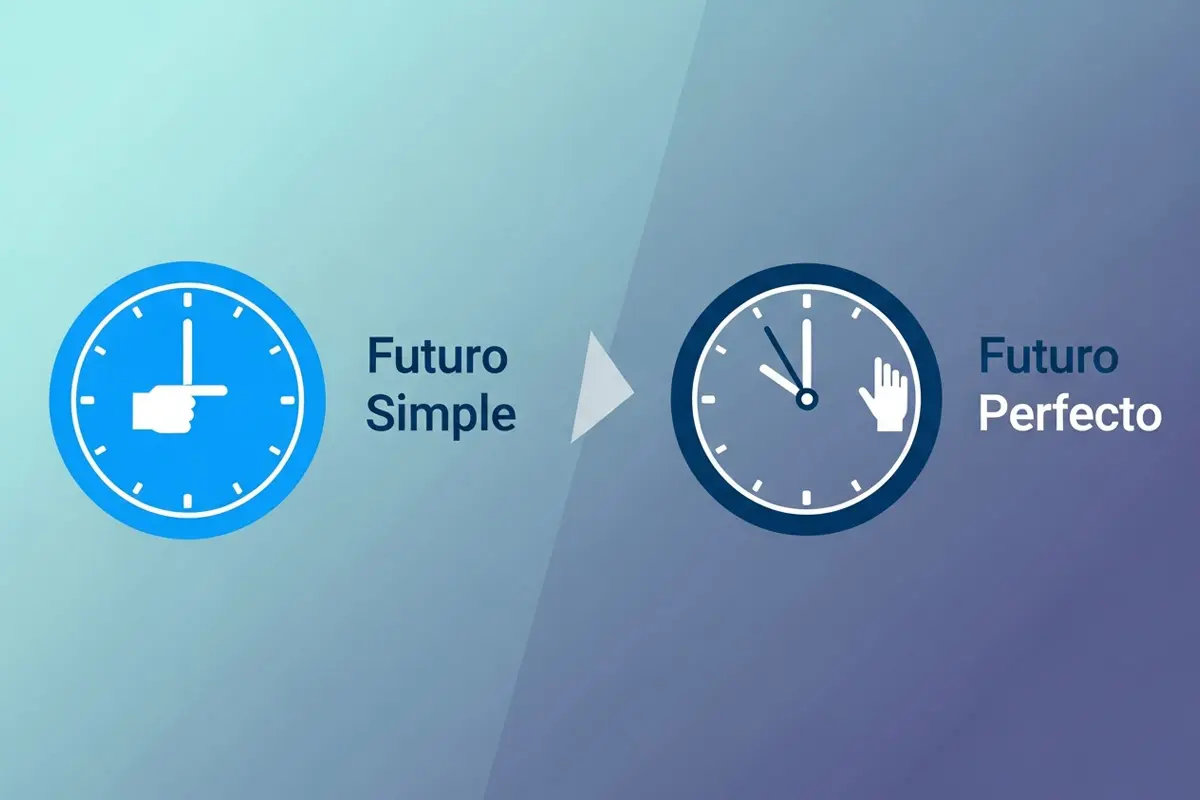
The difference between Spanish simple future vs future perfect tense is perspective.
The simple future talks about actions that will occur, while the future perfect talks about actions that will have already happened by a specific future moment.
This distinction is not about difficulty — it’s about how you frame time.
What Is the Spanish Simple Future Tense?
The Spanish simple future tense expresses actions, events, or states that will happen in the future.
It answers the question: What will happen?
Examples:
- Viajaré mañana. (I will travel tomorrow.)
- Te llamaré luego. (I will call you later.)
- Habrá una reunión. (There will be a meeting.)
The simple future is part of the core tenses in Spanish and appears frequently in writing, predictions, promises, and formal speech.
For formation details, see Conjugation for Future Tense in Spanish.
What Is the Spanish Future Perfect Tense?
The Spanish future perfect tense expresses an action that will already be completed before a specific point in the future.
It answers the question: What will have happened by then?
Examples:
- Para mañana, habré terminado el informe.
(By tomorrow, I will have finished the report.) - Para las ocho, ya habrán salido.
(By eight o’clock, they will have left.)
This tense combines future tense in Spanish with a past viewpoint.
How Do You Form the Simple Future vs Future Perfect?
Simple Future Structure
Infinitive + future endings
Example:
- hablar → hablaré
- comer → comerás
- vivir → viviremos
The endings are identical for -ar, -er, and -ir verbs, making this one of the most regular tenses in Spanish.
Future Perfect Structure
haber (future tense) + past participle
Example:
- habré hablado
- habrás comido
- habremos vivido
This structure signals that the action is already completed relative to a future reference point.
When Should You Use the Simple Future Instead of the Future Perfect?
Use the simple future when the focus is on the action itself — not its completion.
Typical uses:
- Predictions: Lloverá mañana.
- Promises: Te ayudaré.
- Assumptions about the present: Estará en casa.
If completion is not emphasized, the simple future is the correct choice.
When Is the Future Perfect the Better Choice?
Use the future perfect when the action must be finished before another future moment.
Common signals:
- para + time
- ya
- dentro de
Examples:
- Para el viernes, habremos decidido.
- Dentro de un año, me habré graduado.
This tense creates a future snapshot looking backward.
Can Both Tenses Express Probability?
Yes — but at different time levels.
-
Simple future expresses probability about the present:
¿Dónde estará Juan? (Where might Juan be?) -
Future perfect expresses probability about the recent past:
Habrá llegado ya. (He has probably arrived.)
This distinction is explained in traditional grammar references such as the Nueva gramática de la lengua española (RAE/ASALE).
Side-by-Side Comparison
| Feature | Simple Future | Future Perfect |
|---|---|---|
| Focus | action | completed action |
| Time view | forward | future looking backward |
| Structure | infinitive + ending | haber (future) + participle |
| Example | Saldré. | Habré salido. |
| Probability use | present | past |
Same Situation, Different Meaning
| Sentence | Meaning |
|---|---|
| Terminaré el trabajo. | I will finish the work. |
| Habré terminado el trabajo. | I will have finished the work (by then). |
The difference is not grammar — it’s timing and perspective.
Common Learner Mistakes to Avoid
- ❌ Using future perfect without a future reference point
- ❌ Using simple future when completion is implied
- ❌ Forgetting haber in the future perfect
If you’re still mastering future structures, review Spanish Future Tense Stem-Changing Rules for irregular patterns that appear in both tenses.
How This Connects to Other Spanish Tenses?
Understanding this contrast becomes easier once you see the full tense system.
A helpful overview is available in Tenses in Spanish Chart: Full Guide.
Seeing tenses together clarifies why Spanish separates action timing from action completion.
FAQ
❓ Is the future perfect tense common in everyday Spanish?
It appears less often than the simple future, but it is common in formal speech, writing, and when expressing deadlines or expectations.
❓ Can the future perfect replace the simple future?
No — they are not interchangeable. The future perfect always implies completion before a future moment.
❓ Do both tenses use irregular verbs?
Yes. Irregular future stems appear in haber, tener, hacer, decir, and others in both tenses.
❓ Is the future perfect similar to English?
Yes — it closely matches English structures like “will have finished”, making it conceptually easier for English speakers.
Final Takeaway
The difference between Spanish simple future vs future perfect tense lies in perspective, not complexity.
Use the simple future to say what will happen.
Use the future perfect to say what will already be done by then.
Once you learn to spot completion vs action, choosing the correct tense becomes natural — and your Spanish instantly sounds more precise.