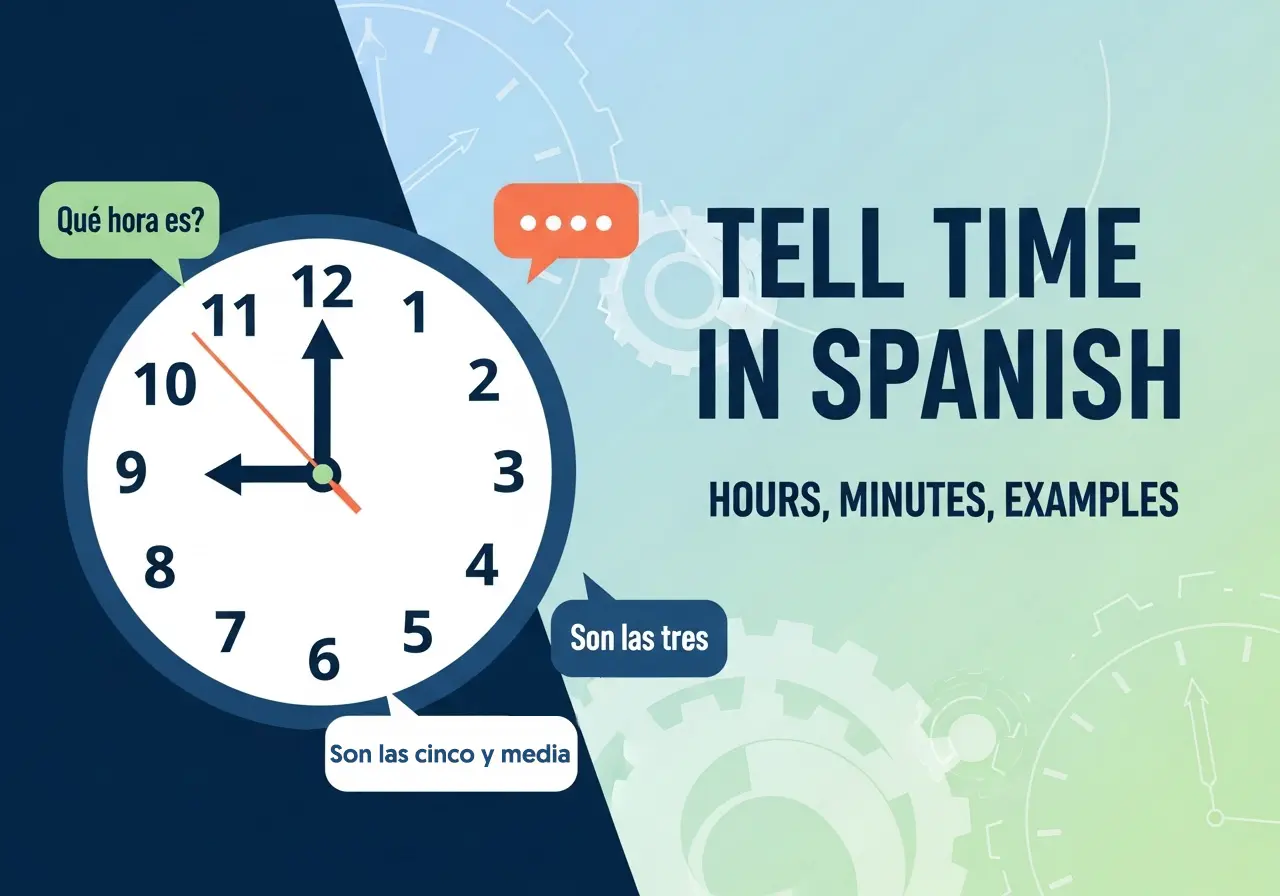
If you can tell the time in Spanish, you instantly get more independent: catching trains, booking appointments, meeting friends, and understanding schedules.
Spanish time is simpler than it looks. You mainly need:
- one question (¿Qué hora es?)
- one structure (Son las… / Es la…)
- and a few “time words” like y cuarto, y media, and menos diez.
This guide shows the patterns, gives you lots of examples, and helps you avoid the most common mistakes.
TL;DR
- Ask: ¿Qué hora es? (What time is it?)
- 1 o’clock uses singular: Es la una.
- All other hours use plural: Son las dos/tres/cuatro…
- Minutes: y cinco / y diez / y cuarto / y media
- “To” time: menos cinco / menos cuarto
- Mediodía = noon, medianoche = midnight.
- Written times commonly use 12:30. In some contexts you may also see 12.30, depending on publisher/style.
The #1 question: “What time is it?” in Spanish
Use either one:
- ¿Qué hora es? (most common)
- ¿Qué horas son? (also used, but less common)
Quick answers:
- Es la una. (It’s 1:00)
- Son las dos. (It’s 2:00)
- Son las nueve y media. (It’s 9:30)
The core rule: “Es la” vs “Son las”
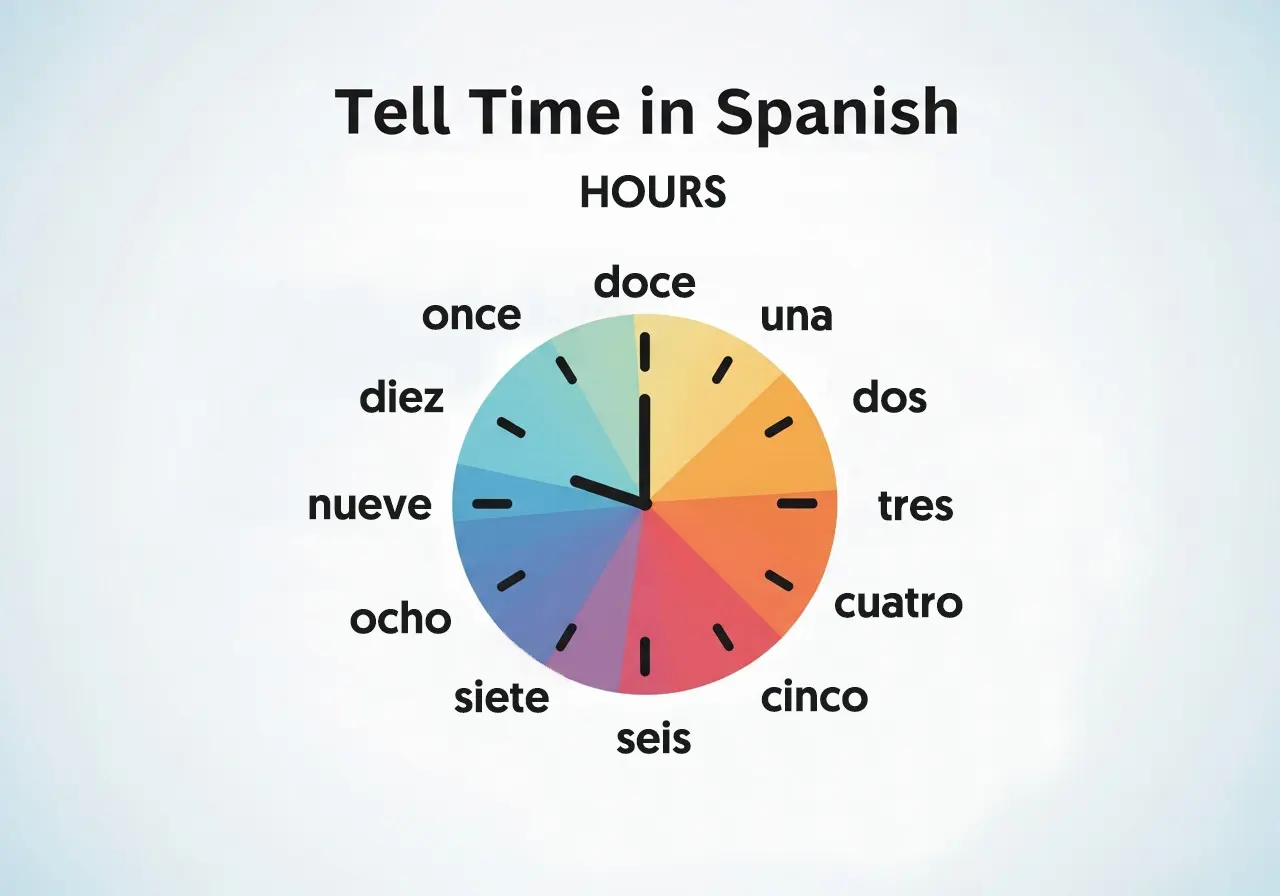
Spanish treats “one o’clock” as singular and everything else as plural.
Full “o’clock” list in Spanish (1:00–12:00)
Es la… (only for 1:00)
- Es la una. = It’s one o’clock.
Son las… (for 2:00–12:00)
- Son las dos. = It’s two o’clock.
- Son las tres. = It’s three o’clock.
- Son las cuatro. = It’s four o’clock.
- Son las cinco. = It’s five o’clock.
- Son las seis. = It’s six o’clock.
- Son las siete. = It’s seven o’clock.
- Son las ocho. = It’s eight o’clock.
- Son las nueve. = It’s nine o’clock.
- Son las diez. = It’s ten o’clock.
- Son las once. = It’s eleven o’clock.
- Son las doce. = It’s twelve o’clock.
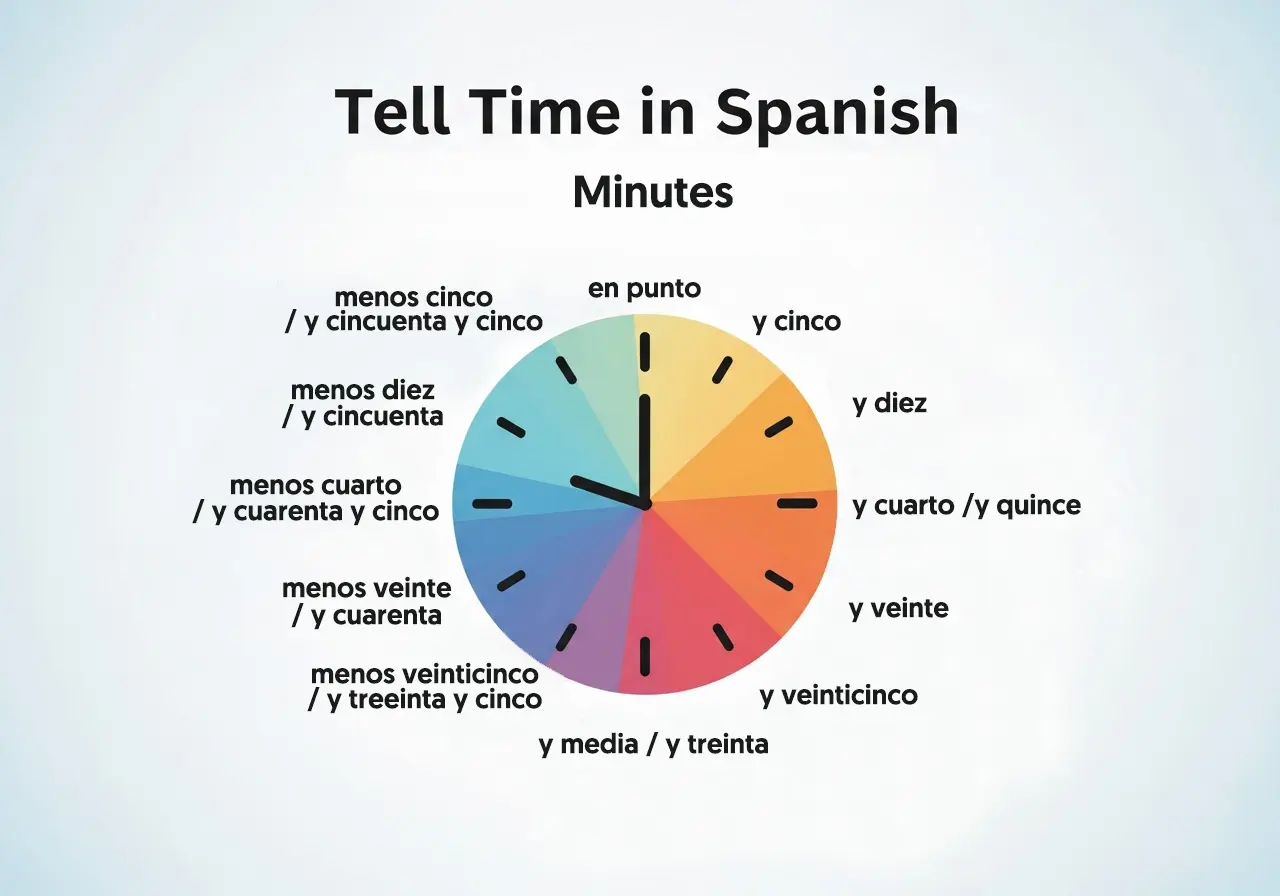
Full pattern: hour + minutes
1) Exact hour
- Son las seis. (6:00)
- Es la una. (1:00)
2) Minutes “past” the hour (y…)
- Son las seis y cinco. (6:05)
- Son las seis y diez. (6:10)
- Son las seis y cuarto. (6:15)
- Son las seis y veinte. (6:20)
- Son las seis y media. (6:30)
3) Minutes “to” the next hour (menos…)
- Son las siete menos cinco. (6:55)
- Son las siete menos diez. (6:50)
- Son las siete menos cuarto. (6:45)
Quick cheat sheet: the most useful time phrases
| Spanish | Meaning | Example |
|---|---|---|
| en punto | exactly | Son las ocho en punto. |
| y cuarto | :15 | Son las tres y cuarto. |
| y media | :30 | Son las nueve y media. |
| menos cuarto | :45 | Son las dos menos cuarto. |
| de la mañana | AM morning | a las 7 de la mañana |
| de la tarde | afternoon | a las 5 de la tarde |
| de la noche | evening/night | a las 9 de la noche |
Noon and midnight (these matter!)
Two words unlock a lot of schedule talk:
- mediodía = noon
- medianoche = midnight
Examples:
- a mediodía / al mediodía = at noon
- a medianoche = at midnight
How to say “at…” (for schedules)
Use a la / a las:
- a la una (at 1:00)
- a las dos (at 2:00)
- a las seis y media (at 6:30)
- a las ocho en punto (at exactly 8:00)
Useful sentences:
- La clase es a las nueve. (The class is at 9:00.)
- La reunión es a las cuatro y cuarto. (The meeting is at 4:15.)
- ¿A qué hora es? (What time is it at?)
24-hour vs 12-hour time (what you’ll actually see)
In schedules (tickets, clinics, airports), you’ll often see the 24-hour clock:
- 14:30 = 2:30 PM
- 08:10 = 8:10 AM
In conversation, people often use de la mañana / de la tarde / de la noche:
- Son las dos y media de la tarde. (2:30 PM)
- Son las ocho de la mañana. (8:00 AM)
Practice: test yourself (answers below)
Write or say these in Spanish:
- 1:00
- 2:15
- 4:30
- 7:45
- 11:10
- 12:00 (noon)
- 12:00 (midnight)
- “The train is at 8:05.”
- “What time is the interview?”
- “It’s 6:50.”
Answers
- Es la una.
- Son las dos y cuarto.
- Son las cuatro y media.
- Son las ocho menos cuarto.
- Son las once y diez.
- Es mediodía / Son las doce.
- Es medianoche / Son las doce .
- El tren es a las ocho y cinco.
- ¿A qué hora es la entrevista?
- Son las siete menos diez.
FAQ — Time in Spanish
Do people say ¿Qué hora es? or ¿Qué horas son?
Both exist. ¿Qué hora es? is the safest default.
Is “12:00” always Son las doce?
You can say Son las doce, but when meaning matters, use:
- mediodía (noon)
- medianoche (midnight)
Is it okay to say seis cuarenta?
Some speakers do in casual speech, but the safest learner-friendly forms are:
- Son las seis y cuarenta
- or Son las siete menos veinte
How do I write the time correctly?
Common writing uses 12:30 (and sometimes 12.30 depending on style). In Spanish style guidance, both appear in formal contexts.
What to learn next
If you want time to feel easier, pair it with numbers practice (because minutes are numbers):
References
-
The Real Academia Española’s Diccionario panhispánico de dudas entries for mediodía and medianoche (usage notes and accepted forms):
-
The Real Academia Española’s Diccionario panhispánico de dudas entry on hora (time notation and related usage):