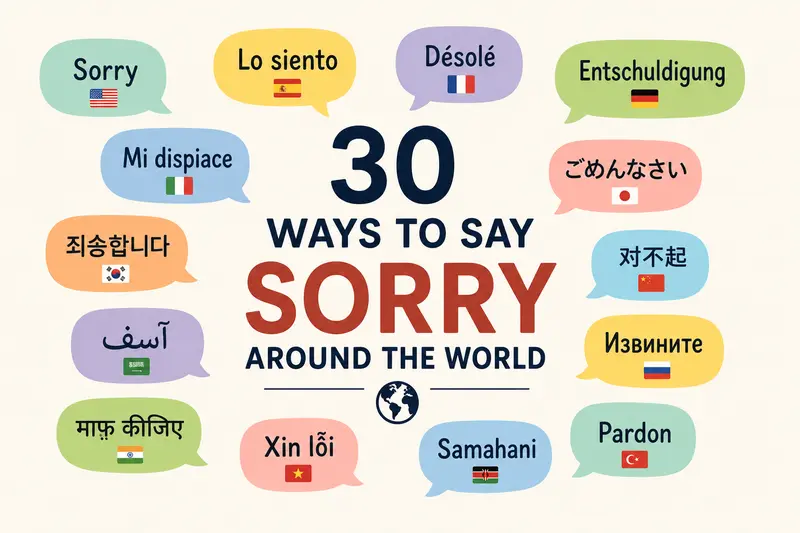
Sorry is one of the first words people look up in a new language, and for good reason.
You need it when you bump into someone, arrive late, make a mistake, misunderstand a question, or want to sound more polite in daily conversation. It is a small word, but it carries a lot of social meaning.
The interesting part is that not every language uses apology words in exactly the same way. In some places, the common phrase is close to “I’m sorry.” In others, it may feel more like “excuse me,” “forgive me,” or “I made a mistake.”
This guide gives you 30 ways to say sorry around the world in a simple, practical format. It is not a deep grammar lesson. It is a fast way to learn real apology words across many languages and notice a few cultural patterns along the way.
TL;DR
If you want the short version, here are a few of the most useful ones:
- English — Sorry
- Spanish — Lo siento / Perdón
- French — Désolé / Pardon
- German — Entschuldigung / Es tut mir leid
- Italian — Mi dispiace / Scusa
- Portuguese — Desculpa / Desculpe
- Japanese — ごめんなさい
- Korean — 죄송합니다 / 미안해요
- Mandarin Chinese — 对不起
- Arabic — آسف / آسفة
- Russian — Извините
- Hindi — माफ़ कीजिए
Some are better for serious apologies. Some are better for small everyday situations. That is part of what makes them interesting.
Why apology words are worth learning early
A lot of beginner vocabulary lists focus on greetings first, and that makes sense. But apology phrases are just as useful because they help you survive real interaction.
They help when you:
- interrupt someone
- make a mistake
- ask for repetition
- move through a crowd
- need to sound more respectful
They also teach something deeper: politeness is not universal. Different languages organize respect in different ways.
If you are curious about one language in more detail, for example Korean, this topic also connects naturally with how to say sorry in Korean with cultural context.
30 ways to say sorry around the world
1. English — Sorry
Phrase: Sorry
Use: Everyday apology, small mistakes, quick politeness
English speakers use sorry constantly. It can mean:
- I made a mistake
- excuse me
- I feel bad about that
- I want to sound polite
That flexibility is one reason English learners hear it so often.
2. Spanish — Lo siento / Perdón
Phrases: Lo siento, Perdón
Use: Lo siento for real apologies, Perdón for smaller interruptions
- Lo siento = I’m sorry
- Perdón = sorry / pardon / excuse me
If you step on someone’s foot, Perdón works well.
If you are apologizing more sincerely, Lo siento is stronger.
3. French — Désolé / Pardon
Phrases: Désolé / Désolée, Pardon
Use: Désolé for apology, Pardon for excuse me / sorry
French often separates the functions:
- Pardon for quick social situations
- Désolé for a more direct apology
If the speaker is female, you often see désolée in writing.
4. German — Entschuldigung / Es tut mir leid
Phrases: Entschuldigung, Es tut mir leid
Use: Entschuldigung for excuse me / sorry, Es tut mir leid for stronger apology
German has a useful distinction here:
- Entschuldigung is common and practical
- Es tut mir leid feels more serious, closer to “I’m really sorry”
5. Italian — Mi dispiace / Scusa
Phrases: Mi dispiace, Scusa / Scusi
Use: Mi dispiace for sympathy or apology, Scusa for excuse me / sorry
- Scusa is informal
- Scusi is more polite
- Mi dispiace often feels more emotional, like “I’m sorry to hear that” or “I’m sorry about that”
6. Portuguese — Desculpa / Desculpe
Phrases: Desculpa, Desculpe
Use: apology or excuse me, with formality difference
- Desculpa is informal
- Desculpe is more polite
This is one of those languages where formality matters a lot in everyday interaction.
7. Dutch — Sorry / Het spijt me
Phrases: Sorry, Het spijt me
Use: sorry for casual use, het spijt me for stronger apology
Dutch speakers often use sorry in casual speech, especially in modern everyday life.
Het spijt me is closer to “I’m sorry” in a fuller sense.
8. Swedish — Förlåt
Phrase: Förlåt
Use: sorry, excuse me, apology
This is the standard Swedish word most learners start with. It works in many situations, from small mistakes to real apologies.
9. Norwegian — Unnskyld / Beklager
Phrases: Unnskyld, Beklager
Use: Unnskyld for excuse me / sorry, Beklager for stronger apology
A useful rough rule:
- Unnskyld = everyday
- Beklager = more formal or more serious
10. Danish — Undskyld
Phrase: Undskyld
Use: sorry, excuse me
This is the everyday Danish apology word and a very useful survival phrase.
11. Finnish — Anteeksi
Phrase: Anteeksi
Use: sorry, excuse me, pardon
Finnish uses anteeksi in a very practical way. It can help you apologize, interrupt politely, or ask someone to repeat something.
12. Polish — Przepraszam
Phrase: Przepraszam
Use: sorry, excuse me
This is the key Polish apology word. It is one of those high-value travel phrases that does a lot of work in daily life.
13. Czech — Promiňte / Promiň
Phrases: Promiňte, Promiň
Use: polite and informal forms
- Promiňte is more polite
- Promiň is informal
Like many European languages, Czech marks social distance through the form you choose.
14. Hungarian — Bocsánat / Sajnálom
Phrases: Bocsánat, Sajnálom
Use: Bocsánat for excuse me / sorry, Sajnálom for “I’m sorry”
This is another nice split:
- Bocsánat for quick everyday situations
- Sajnálom for stronger feeling
15. Greek — Συγγνώμη
Phrase: Συγγνώμη
Use: sorry, excuse me
This is the main Greek apology word and one of the most useful polite expressions to know.
16. Turkish — Özür dilerim / Pardon
Phrases: Özür dilerim, Pardon
Use: özür dilerim for apology, pardon for excuse me
- Özür dilerim = I apologize
- Pardon = excuse me / sorry
You can already see a repeating pattern across languages: one form for serious apology, another for quick social repair.
17. Russian — Извините / Прости
Phrases: Извините, Прости
Use: polite and informal forms
- Извините = polite / formal
- Прости = informal, singular
Russian learners should notice the social difference here early.
18. Ukrainian — Вибачте / Пробач
Phrases: Вибачте, Пробач
Use: polite and informal apology
Again, there is a useful distinction:
- Вибачте is polite
- Пробач is more informal
19. Arabic — آسف / آسفة / عفوًا
Phrases: آسف, آسفة, عفوًا
Use: apology and excuse-me style use
- آسف is commonly used by a male speaker
- آسفة by a female speaker
- عفوًا can work more like excuse me / pardon in many situations
Arabic is broad and regional, so usage can vary, but these are useful starting points.
20. Hebrew — סליחה
Phrase: סליחה
Use: sorry, excuse me
This is one of those very practical words that can cover both apology and polite interruption.
21. Persian — ببخشید / متأسفم
Phrases: ببخشید, متأسفم
Use: bebakhshid for excuse me / pardon, mota’assefam for “I’m sorry”
A familiar pattern appears again:
- one phrase for social politeness
- one phrase for stronger emotional apology
22. Hindi — माफ़ कीजिए / सॉरी
Phrases: माफ़ कीजिए, सॉरी
Use: formal apology and common casual borrowing
- माफ़ कीजिए is a polite apology
- सॉरी is also widely heard in casual modern speech
That blend of native phrase plus English borrowing is common in many languages today.
23. Bengali — দুঃখিত / মাফ করবেন
Phrases: দুঃখিত, মাফ করবেন
Use: apology and polite excuse-me style use
These forms can vary by tone and situation, but both are useful beginner-level ways to express apology or politeness.
24. Thai — ขอโทษ
Phrase: ขอโทษ
Use: sorry, excuse me
This is the main Thai apology word and an essential phrase for learners and travelers.
25. Vietnamese — Xin lỗi
Phrase: Xin lỗi
Use: sorry, excuse me
This is one of the most important Vietnamese politeness phrases and appears in many daily situations.
26. Indonesian — Maaf
Phrase: Maaf
Use: sorry, excuse me, forgiveness
This is a very useful all-purpose apology word in Indonesian and one of the first polite expressions many learners study.
27. Japanese — ごめんなさい / すみません
Phrases: ごめんなさい, すみません
Use: gomen nasai for apology, sumimasen for sorry / excuse me / thank you in some contexts
Japanese is especially interesting here.
- ごめんなさい feels more directly apologetic
- すみません is extremely flexible and can mean sorry, excuse me, or even something close to “thanks for the trouble”
That kind of overlap teaches a lot about how politeness works in Japanese.
28. Korean — 죄송합니다 / 미안해요
Phrases: 죄송합니다, 미안해요
Use: formal and everyday apology
- 죄송합니다 is formal and respectful
- 미안해요 is softer and more everyday
Korean learners need to notice speech level quickly, because apology language changes with formality.
For a deeper guide, see how to say sorry in Korean with cultural context.
29. Mandarin Chinese — 对不起 / 不好意思
Phrases: 对不起, 不好意思
Use: apology vs embarrassment / polite social sorry
- 对不起 = I’m sorry
- 不好意思 often feels softer, like excuse me, sorry, or “I feel a bit embarrassed”
That difference matters in real conversation.
30. Swahili — Samahani
Phrase: Samahani
Use: sorry, excuse me, pardon
This is the core Swahili apology word and a very practical everyday phrase.
What these apology phrases have in common
Even though the words look very different, a few patterns appear again and again.
1. Many languages separate small sorry from serious sorry
You can see that in:
- Spanish: Perdón vs Lo siento
- German: Entschuldigung vs Es tut mir leid
- Japanese: すみません vs ごめんなさい
- Korean: 미안해요 vs 죄송합니다
2. Formality matters a lot
In many languages, apologizing to:
- a friend
- a stranger
- an older person
- a teacher or boss
may require different wording.
3. “Sorry” often overlaps with “excuse me”
That happens in many languages, including:
- French
- German
- Finnish
- Hebrew
- Thai
- Vietnamese
- Japanese
That overlap is useful to notice because it tells you apology language is not only about guilt. It is also about social smoothness.
Which apology words are best for travelers?
If you only want travel-level survival phrases, focus on words that can do more than one job.
Some especially practical ones are:
- Pardon
- Entschuldigung
- Anteeksi
- Xin lỗi
- Sumimasen
- Samahani
These often help with both apology and polite interruption.
How to learn these faster
Trying to memorize 30 apology words as one giant list is not the best method.
A better way is to group them by function.
Group 1: excuse me / everyday sorry
- Perdón
- Pardon
- Entschuldigung
- Anteeksi
- すみません
- 不好意思
Group 2: stronger apology
- Lo siento
- Es tut mir leid
- Mi dispiace
- ごめんなさい
- 죄송합니다
- 对不起
Group 3: polite vs informal pairs
- Scusa / Scusi
- Izvinite / Prosti
- Promiňte / Promiň
- 미안해요 / 죄송합니다
That makes the system easier to remember.
FAQ
Is there one universal way to say sorry in every language?
No. Many languages have more than one apology phrase depending on formality, seriousness, or whether you mean “excuse me” instead of “I’m sorry.”
Do some languages use apology words more often than others?
Yes. Some cultures use apology-style phrases very frequently in daily interaction, while others may sound more direct or use different politeness strategies.
Is “excuse me” the same as “sorry” in many languages?
Often yes, at least partly. In many languages, the most common everyday apology word also covers interruption, politeness, or asking someone to move.
What should beginners learn first?
Start with the most common everyday phrase, then learn the stronger apology form later.
Final thoughts
Learning 30 ways to say sorry around the world is not just a fun language list.
It shows you something important: politeness is built differently in different languages, but the human need is the same. People everywhere need a way to repair small social moments, show respect, and admit mistakes.
That is why apology words are worth learning early.
They are short.
They are useful.
And they often teach more culture than people expect.