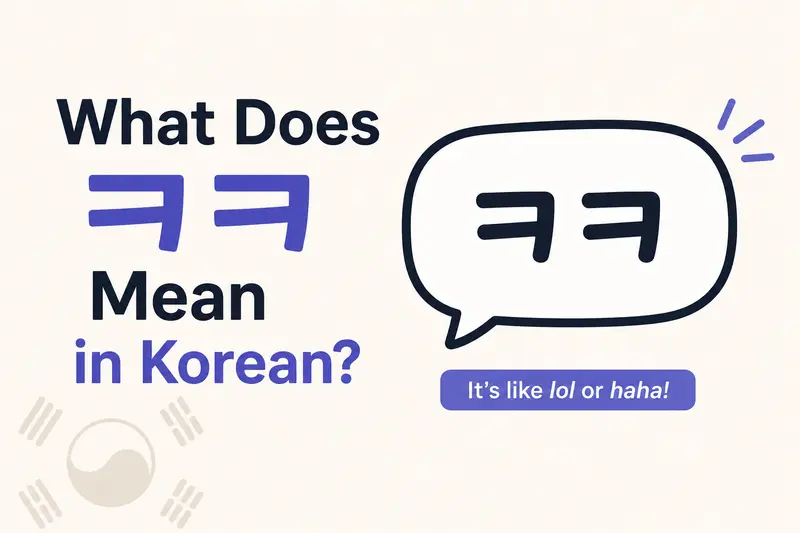
If you have watched Korean dramas, read Korean comments, or texted with Korean speakers, you have probably seen this:
ㅋㅋ
At first, it looks confusing. It is not a full word. It is not standard textbook Korean. But in real life, it is everywhere.
The short answer is simple: ㅋㅋ is one of the most common ways to show laughter in Korean text. In many situations, it works a bit like lol, haha, or a soft laugh in English.
But the real meaning depends on:
- how many ㅋ characters someone uses
- the tone of the conversation
- whether they use ㅋㅋ, ㅎㅎ, or something else
- and how friendly or casual the situation is
This guide explains what ㅋㅋ means in Korean, how people actually use it, and how to avoid sounding awkward when you use it yourself.
TL;DR
- ㅋㅋ shows laughter in Korean text
- It is often similar to lol, haha, or a light laugh
- More letters usually mean stronger laughter: ㅋ → ㅋㅋ → ㅋㅋㅋ
- It is casual, not formal
- ㅎㅎ is usually softer or warmer than ㅋㅋ
- You should not use ㅋㅋ in formal messages to teachers, bosses, or strangers
What does ㅋㅋ mean in Korean?
ㅋㅋ is a Korean texting laugh.
It comes from the Korean consonant ㅋ, which is the first sound in words like 크크 or 키득키득, both of which can suggest laughing or giggling sounds.
In real use, people type:
- ㅋ
- ㅋㅋ
- ㅋㅋㅋ
- ㅋㅋㅋㅋ
All of these show laughter, but the feeling changes a little depending on how many are used.
A rough English comparison looks like this:
| Korean | Rough English feeling |
|---|---|
| ㅋ | heh / lol |
| ㅋㅋ | haha / lol |
| ㅋㅋㅋ | hahaha |
| ㅋㅋㅋㅋ | stronger laughter / that’s really funny |
This is why ㅋㅋ is not best translated as only one English word. Sometimes it feels like lol. Sometimes it feels more like haha.
Why do Koreans use ㅋㅋ instead of a full word?
Because it is fast, casual, and natural in text.
English speakers often type:
- lol
- haha
- lmao
Korean speakers often type:
- ㅋㅋ
- ㅋㅋㅋ
- ㅎㅎ
- ㅎㅎㅎ
So ㅋㅋ is part of digital conversation style, not formal written Korean.
It helps show:
- laughter
- friendliness
- teasing
- light embarrassment
- that something is not too serious
Without it, a message can sometimes feel flatter or colder.
How do you pronounce ㅋㅋ?
In normal texting, people usually do not read each ㅋ one by one.
Instead, the feeling behind it is closer to:
- a short laugh
- a soft “keke”
- or just silent written laughter
If you had to explain it out loud, you might hear people describe it loosely like:
- ke ke
- kekeke
But in daily life, it is mainly a text symbol, not something people formally pronounce.
What is the difference between ㅋㅋ and ㅎㅎ?
This is one of the most important parts.
Both ㅋㅋ and ㅎㅎ show laughter, but they often feel slightly different.
ㅋㅋ
Usually feels:
- more playful
- more casual
- more internet-like
- sometimes more teasing or dry
ㅎㅎ
Usually feels:
- softer
- lighter
- warmer
- sometimes more polite or gentle
A simple way to think about it:
- ㅋㅋ = sharper laugh
- ㅎㅎ = softer smile-laugh
Example
-
진짜 웃겨 ㅋㅋ
That’s really funny lol -
아 그렇구나 ㅎㅎ
Ah, I see haha
The second one feels softer and less sharp.
Is ㅋㅋ the same as lol?
Not exactly, but it is often close.
Sometimes ㅋㅋ works like lol because it softens a sentence.
For example:
- 뭐야 ㅋㅋ
What is that lol
But in other cases, it feels more like haha:
- 너 진짜 웃기다 ㅋㅋㅋ
You’re seriously funny hahaha
So the best answer is:
ㅋㅋ overlaps with both “lol” and “haha,” depending on context.
How many ㅋ should you use?
This matters more than beginners expect.
1. ㅋ
Very light.
Can feel dry, playful, or even slightly sarcastic depending on context.
2. ㅋㅋ
Very common.
Safe for casual texting with friends.
3. ㅋㅋㅋ
Stronger laughter.
Still normal and common.
4. ㅋㅋㅋㅋ
Even stronger.
Good for real amusement, but too much can start to look exaggerated.
A useful beginner rule:
- ㅋㅋ and ㅋㅋㅋ are the safest everyday choices in casual chat
When do people use ㅋㅋ in real conversations?
People use it when they want to make a message feel more relaxed or more human.
Common situations:
- reacting to something funny
- teasing a friend
- making a sentence sound less serious
- replying casually
- showing “I’m laughing” without writing a full sentence
Examples
1. Light reaction
- 진짜? ㅋㅋ
Really? lol
2. Teasing
- 너 또 늦었네 ㅋㅋ
You’re late again lol
3. Real laughter
- 그거 너무 웃기다 ㅋㅋㅋ
That’s so funny hahaha
Can ㅋㅋ sound rude?
Sometimes yes.
That is why context matters.
Because ㅋㅋ can make a sentence feel lighter, it can also sound:
- dismissive
- sarcastic
- like you are not taking something seriously
For example, if someone shares bad news and you reply with ㅋㅋ, that would feel strange or rude.
So even though ㅋㅋ is common, it is not automatic. It needs the right tone.
When should you not use ㅋㅋ?
Avoid it in formal or respectful situations.
That includes messages to:
- teachers
- bosses
- clients
- older strangers
- formal customer support
- serious conversations
In those situations, ㅋㅋ can make you sound too casual.
If you are still learning Korean politeness levels, this also connects well with thank you in Korean: how to say it correctly because both topics depend on tone and relationship.
Is ㅋㅋ only used by young people?
No. It is strongly associated with texting and internet culture, but many adults use it too in casual messages.
The bigger issue is not age. It is:
- closeness
- context
- formality
So yes, adults use ㅋㅋ, but usually not in formal messages.
What about ㅠㅠ and ㅜㅜ?
These are different from ㅋㅋ, but learners often meet them together.
- ㅠㅠ / ㅜㅜ = crying face / sadness
- ㅋㅋ / ㅎㅎ = laughter
So if you see:
- ㅋㅋ → laughing
- ㅠㅠ → sad / crying / emotional
These are part of the same texting culture, but they express opposite feelings.
Does ㅋㅋ appear in spoken Korean?
Not really in the same way.
People do not normally say “double-kieuk” in conversation the way they type it. It is mostly a written texting signal.
In spoken Korean, laughter is shown with real laughter, tone, or words, not by literally saying ㅋㅋ as if it were standard speech.
That is why learners should think of ㅋㅋ as a text habit, not a grammar structure.
Common mistakes learners make
1. Using ㅋㅋ in formal situations
This is the biggest mistake.
It may feel friendly, but it is too casual for formal or respectful messages.
2. Thinking ㅋㅋ always means exactly “lol”
It can mean lol, but sometimes it feels more like:
- haha
- heh
- playful laughter
- a softener at the end of a sentence
3. Overusing it
If every message ends in ㅋㅋㅋㅋㅋㅋ, it can feel unnatural.
Too much can make your tone look forced.
4. Missing the difference between ㅋㅋ and ㅎㅎ
They are similar, but not identical.
If you want to sound more natural, learn the feeling difference early.
How to use ㅋㅋ naturally as a beginner
A safe beginner method is simple:
Use ㅋㅋ when:
- texting friends
- reacting casually
- answering something funny
- making a message softer
Avoid ㅋㅋ when:
- speaking to someone you should respect
- writing formal Korean
- replying to serious news
- you are not sure about the tone
Good beginner examples
- 진짜? ㅋㅋ
- 맞아 ㅋㅋ
- 너무 웃겨 ㅋㅋㅋ
These are short, natural, and common.
Mini comparison chart
| Text form | Feeling |
|---|---|
| ㅋ | very light laugh, sometimes dry |
| ㅋㅋ | casual laugh, very common |
| ㅋㅋㅋ | stronger laughter |
| ㅎㅎ | softer, gentler laugh |
| ㅎㅎㅎ | warmer, friendlier laugh |
FAQ
What does ㅋㅋ mean in Korean texting?
It means laughter, similar to lol or haha in English.
Is ㅋㅋ rude?
Not by itself, but it can sound rude if the situation is serious or if you use it with the wrong person.
What is the difference between ㅋㅋ and ㅎㅎ?
ㅋㅋ usually feels more playful or sharper, while ㅎㅎ usually feels softer and gentler.
Can I use ㅋㅋ with my teacher?
Usually no. It is too casual for that kind of relationship.
Is ㅋㅋ the same as haha?
Sometimes yes, but not always. It can overlap with both haha and lol depending on context.
Final thoughts
If you want the simplest answer to what does ㅋㅋ mean in Korean, it is this:
It is a casual way to show laughter in text.
But the more useful answer is that ㅋㅋ also carries tone.
It can make a message feel:
- lighter
- friendlier
- funnier
- more casual
That is why it matters.
It is not just internet decoration. It is part of how Korean speakers shape emotion in text.
Once you understand ㅋㅋ, ㅎㅎ, and when not to use them, Korean messages start to feel much more readable and much more natural.