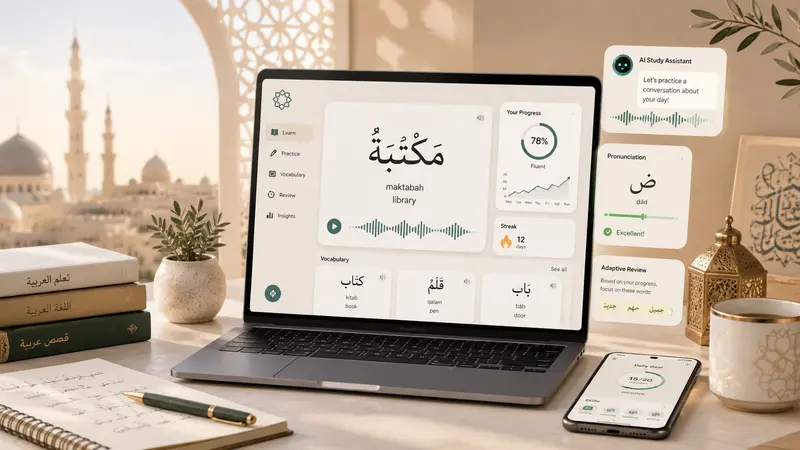
Learning Arabic with AI sounds promising, but most learners are really asking a simpler question:
Can it actually help with the parts that make Arabic hard?
That usually means:
- learning the script
- hearing and repeating unfamiliar sounds
- understanding grammar more clearly
- and getting enough practice without feeling overwhelmed
This guide focuses on those practical questions, so you can see where AI helps, where it falls short, and how to use it in a way that actually supports your Arabic progress.
TL;DR
AI can be genuinely useful for learning Arabic, but it works best when you use it for the right jobs.
The strongest uses are:
- learning the Arabic script
- getting repeated pronunciation practice
- checking short sentences and grammar
- drilling vocabulary with feedback
- practicing basic conversation without pressure
The weakest use is treating AI like a full replacement for real Arabic input or human correction.
A good rule is simple:
use AI for repetition, feedback, and guided practice — not as your only source of Arabic.
Why Arabic works well with AI-assisted learning
Arabic creates a few challenges that make AI support especially useful.
1. The script is new for many learners
If you come from English or another Latin-script language, Arabic means learning:
- a different writing system
- right-to-left reading
- letter shapes that change by position
- short vowels that are often not fully written in everyday text
That is the kind of thing AI can help with through repeated guided practice.
2. Pronunciation needs repetition
Arabic includes sounds that many learners do not already have, such as:
- ع
- ح
- ق
- emphatic consonants like ص and ط
These sounds are hard to fix through reading alone. They improve much faster with repeated listening, imitation, and correction.
3. Arabic has diglossia
This is one of the biggest reasons learners get confused.
Many learners want to study both:
- Modern Standard Arabic
- and one spoken dialect
AI can help here because it can explain the difference clearly and let you practice one track at a time instead of mixing everything together.
What AI is actually good at for Arabic learners
This is where the topic becomes useful.
Script and letter recognition
AI tools are good at helping beginners:
- recognize Arabic letters
- match letter shapes in different positions
- connect sound to symbol
- repeat the same set until it feels automatic
If you are starting from zero, this is one of the best first uses of AI.
Pronunciation drilling
AI can be helpful when you want to:
- hear a sound repeatedly
- compare similar letters
- practice short words
- slow things down without embarrassment
- repeat the same phrase many times
This matters in Arabic because many learners need more repetition than a normal class gives them.
Grammar explanation
Arabic grammar can feel dense if you learn it only through textbooks.
AI is useful here because you can ask:
- “Explain this verb pattern in simple English.”
- “Why is this adjective feminine?”
- “Show me three easier examples.”
- “Rewrite this sentence in beginner Arabic.”
That kind of back-and-forth can save time when grammar feels too abstract.
Low-pressure conversation practice
For many learners, Arabic speaking practice is not blocked by lack of motivation. It is blocked by hesitation.
AI helps because it gives you:
- unlimited retries
- no social pressure
- instant responses
- easy topic changes
- simple role-play
This does not replace real people, but it does make the jump to real conversation much easier.
What AI is not so good at
This part matters just as much as the benefits.
It can mix registers or dialects
A learner may ask for “Arabic,” but that can mean:
- Modern Standard Arabic
- Egyptian Arabic
- Levantine Arabic
- Gulf Arabic
- another variety
If you do not specify which one you want, AI may give you mixed output.
It can sound more correct than natural
Some AI-generated Arabic is grammatically clean but not the most natural thing a person would say in real life.
This is why short, practical prompts work better than vague ones.
It can hide uncertainty too well
AI may answer confidently even when a phrase is region-specific, too formal, or slightly off.
That means you should use AI as a practice partner, not as an unquestioned authority.
How Avatalks makes AI learning Arabic more practical
A lot of Arabic learners do better when they stop trying to piece together too many different tools.
Avatalks works best when you use it as a structured practice environment for script, pronunciation, lessons, and speaking.
Learn Arabic characters the right way
Mastering the Arabic alphabet is the first real step for most beginners.
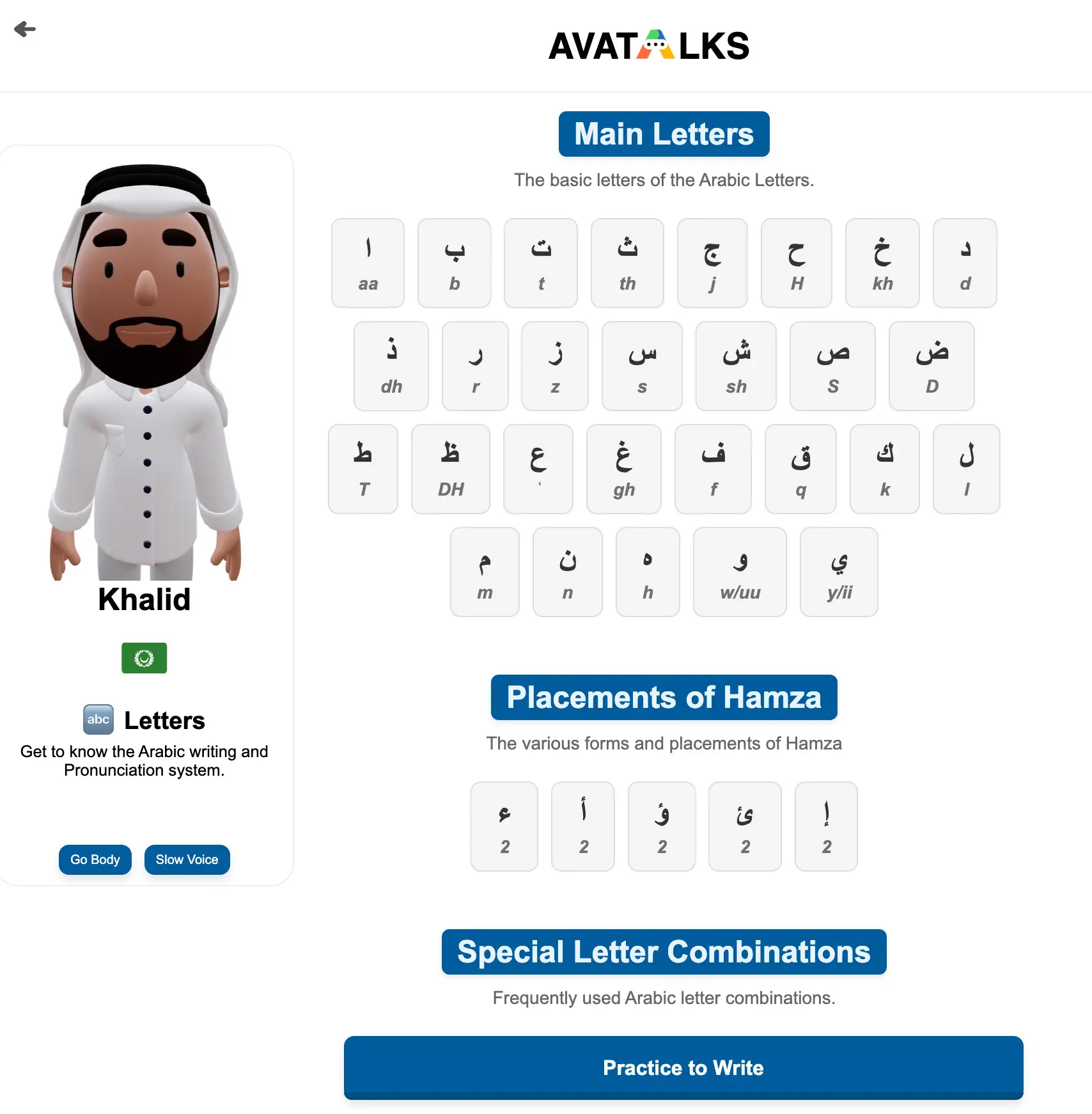
With Avatalks, you can:
- learn Arabic letters in a more visual way
- connect each character to its sound
- practice recognition more actively
- build a stronger script foundation before moving into full reading
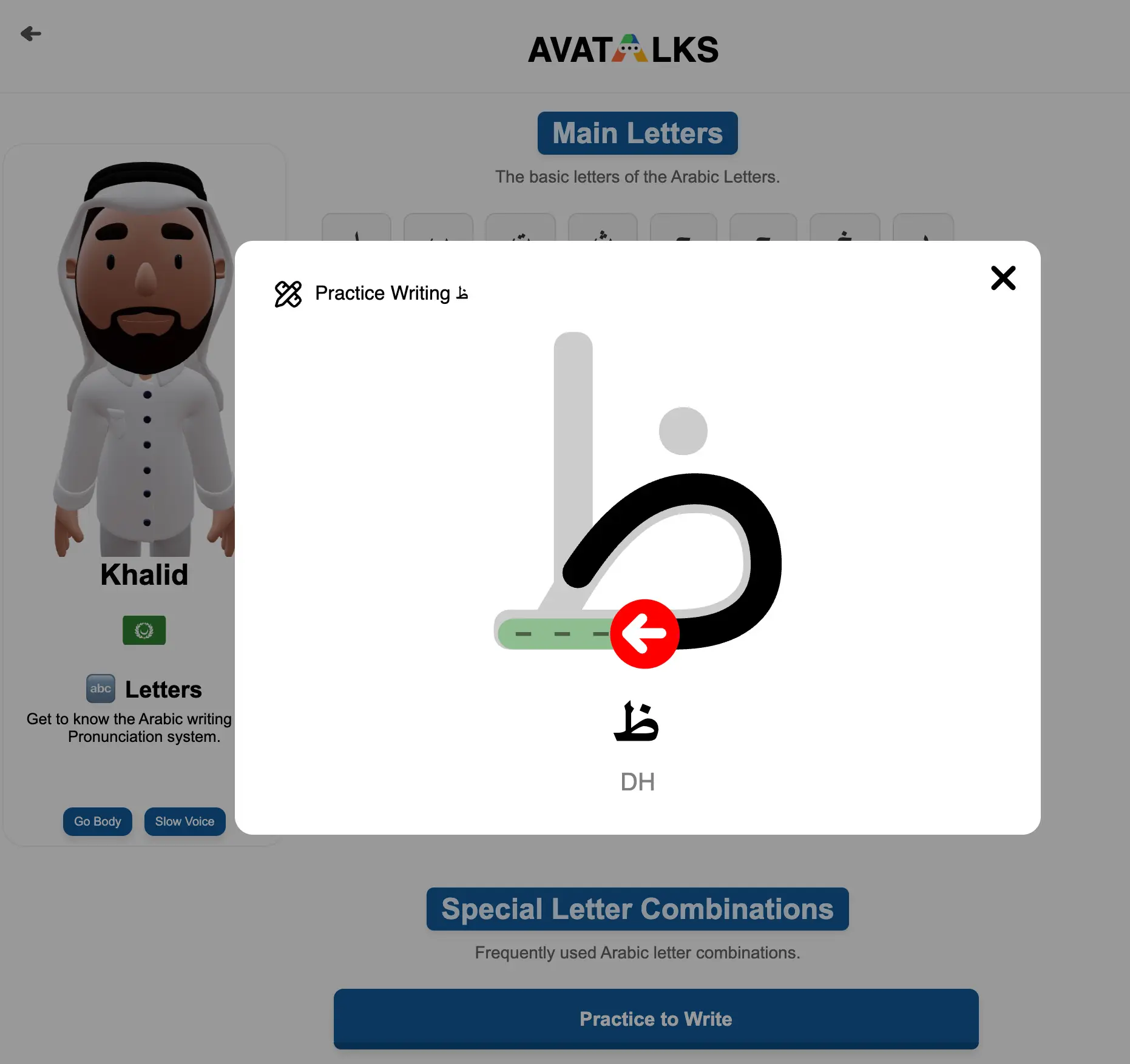
👉 Try the Arabic character tool
Smart Arabic lessons that build on each other
You do not have to memorize disconnected phrases.
With Avatalks, your learning can include:
- Arabic character lessons
- grammar practice
- listening work
- reading practice
- gradual lesson progression
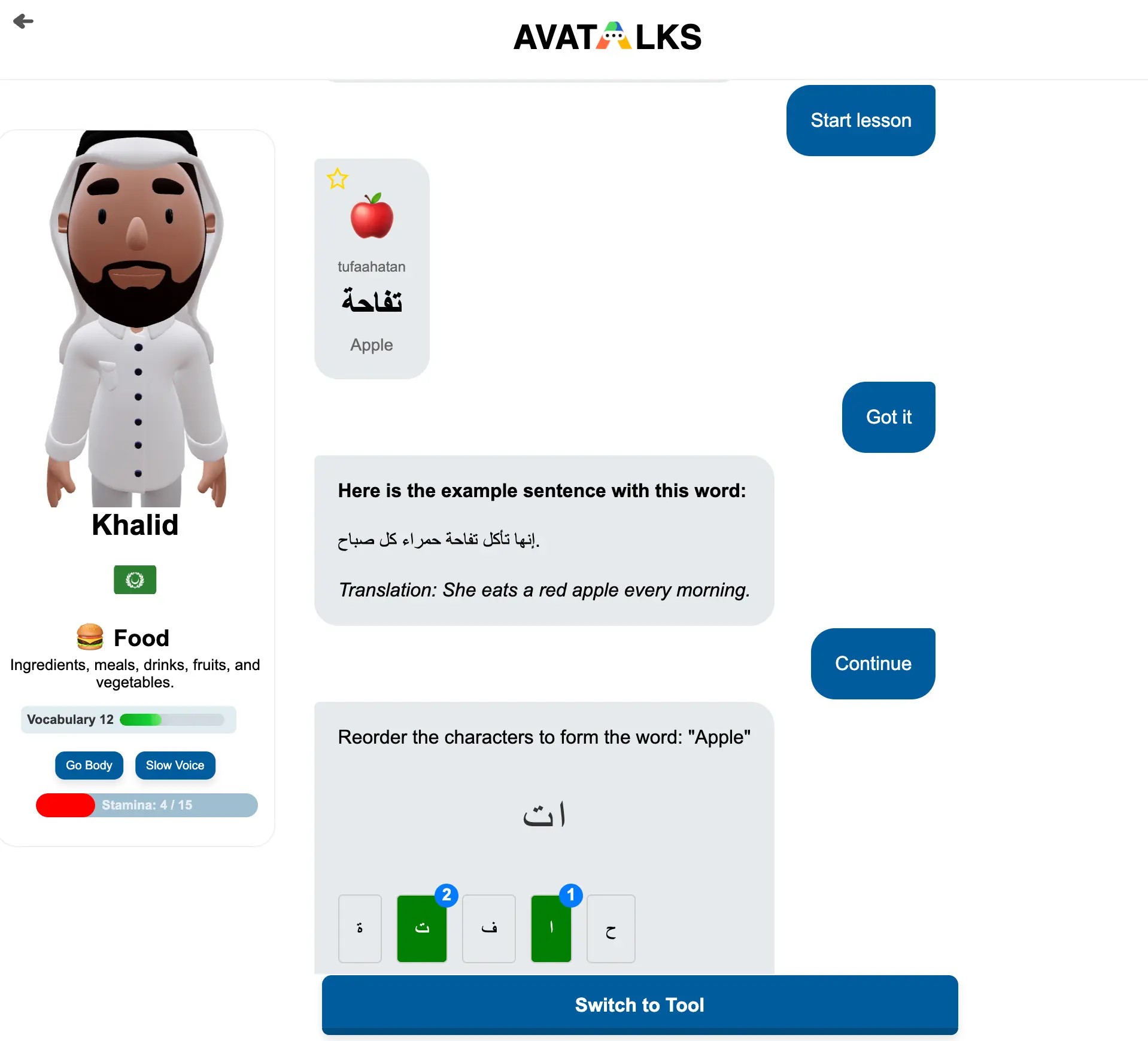
That matters in Arabic because learners usually need a clearer progression than “just chat and hope it sticks.”
Practice real conversation with AI
One of the biggest advantages of AI is that it lets you use Arabic actively before you feel fully ready.
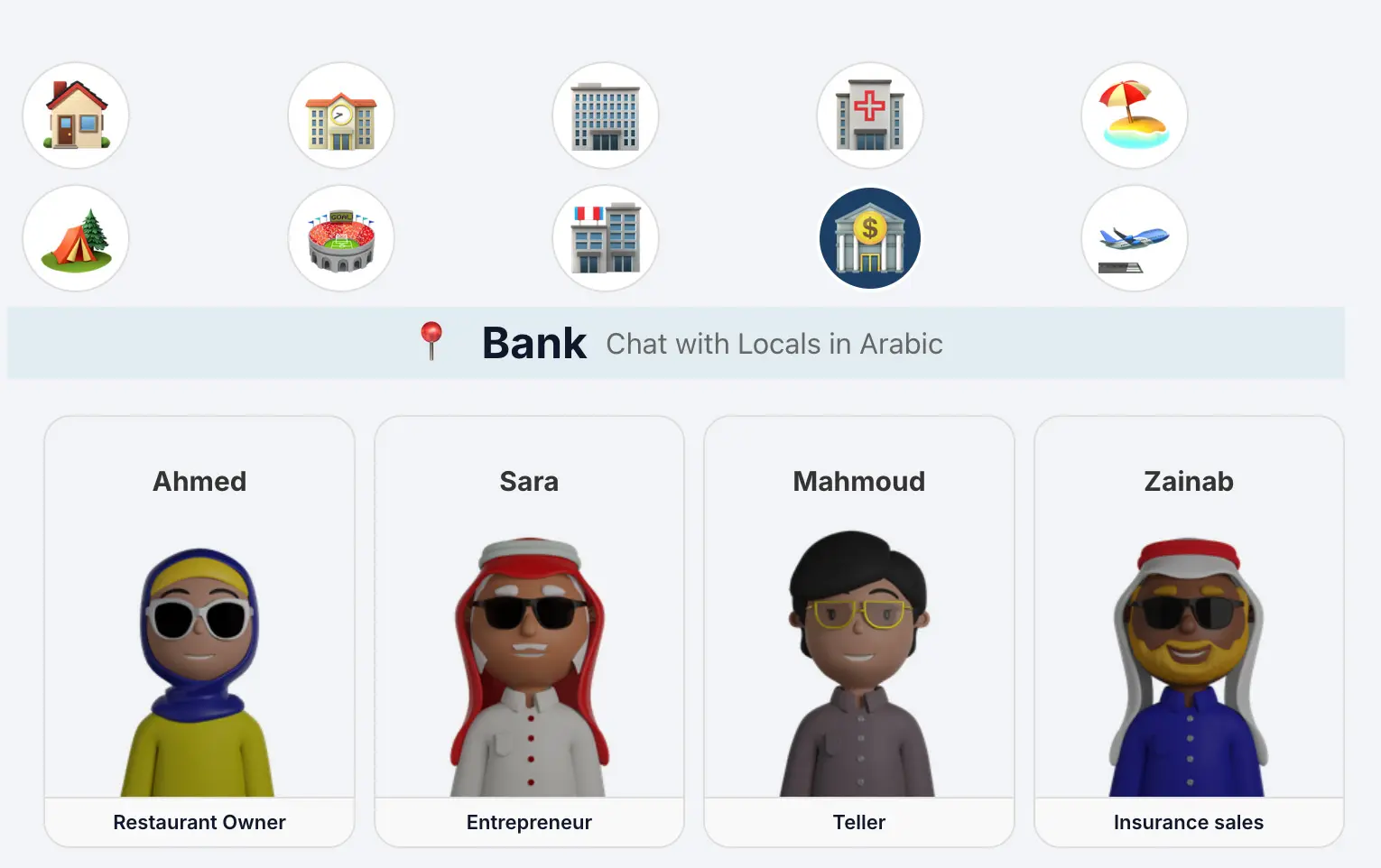
You can use that kind of practice to:
- ask simple questions
- review daily phrases
- test vocabulary in context
- build speaking confidence
- repeat corrected versions immediately
That kind of repetition is especially useful if you are learning on your own.
The smartest way to use AI for learning Arabic
A lot of learners use AI badly because they ask it to “teach me Arabic” in a very broad way.
A better method is to assign AI a specific role.
1. Use AI to build your script foundation
Your first stage should be:
- letters
- sounds
- joining forms
- very short words
- simple reading
2. Pick one Arabic track early
Do not stay vague for too long.
Choose:
- Modern Standard Arabic if your goal is reading, formal Arabic, media, or a broad foundation
- one spoken dialect if your goal is conversation in a specific region
This decision removes a lot of confusion.
3. Ask AI for short, controlled output
Better prompts:
- “Give me 5 beginner sentences in MSA using today’s vocabulary.”
- “Explain this Arabic sentence word by word.”
- “Correct my pronunciation target words: باب، قلب، مدرسة.”
- “Give me a beginner dialogue in Egyptian Arabic at a café.”
Worse prompts:
- “Teach me Arabic.”
- “Make me fluent in Arabic.”
- “Give me random Arabic phrases.”
The more specific you are, the more useful AI becomes.
4. Use AI for correction, not just generation
Many learners only ask AI to produce more content.
That is not enough.
A stronger loop is:
- write or say something
- get correction
- compare your version to the improved version
- repeat
That feedback loop is where AI becomes much more powerful.
A simple AI study plan for Arabic learners
This is a realistic daily plan that makes better use of AI than passive scrolling.
10 minutes: script or reading
- review letters
- read short words
- notice position changes
- practice common patterns
10 minutes: pronunciation
- repeat 5–10 target words
- contrast difficult sounds
- ask for minimal pairs
- imitate slowly, then naturally
10 minutes: grammar or sentence building
- create 3–5 short sentences
- get corrections
- rewrite them correctly
10 minutes: speaking or chat
- answer one simple daily-life prompt
- role-play a basic situation
- repeat the corrected version out loud
That is enough to build momentum without turning AI into entertainment instead of study.
Final thoughts
AI can make Arabic feel much more approachable, but only if you use it in a focused way.
The biggest advantage is not that AI magically makes Arabic easy. It is that AI gives you more chances to practice the parts learners usually avoid:
- repeating sounds
- reading script
- testing grammar
- speaking without fear
- correcting mistakes immediately
That is where real progress happens.
If you use AI as a structured practice tool instead of a novelty, it can become one of the most useful parts of your Arabic learning routine.