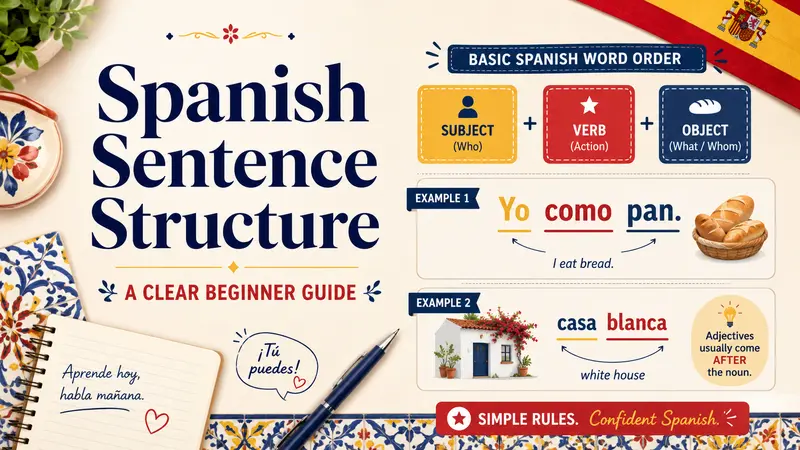
If you are learning Spanish sentence structure, the first thing to know is that Spanish is not random.
It does have a clear neutral pattern:
Subject + Verb + Object
That means a lot of beginner Spanish starts in a familiar way.
But Spanish also does a few things differently from English:
- it often drops the subject
- adjectives usually come after the noun
- no goes before the verb
- object pronouns usually go before a conjugated verb
Those are the patterns that matter most at the beginning.
This guide stays focused on those core sentence-building rules, so you can make clear Spanish sentences without getting buried in advanced grammar too early.
TL;DR
The most useful beginner rule is:
Spanish usually starts with Subject + Verb + Object.
Example:
- Yo como manzanas. = I eat apples.
But Spanish often drops the subject:
- Como manzanas.
Then learn these four patterns next:
- adjectives usually go after the noun
- no goes before the verb
- yes/no questions often keep the same order as statements
- object pronouns usually go before a conjugated verb
The basic Spanish sentence structure
The most neutral word order in Spanish is:
Subject + Verb + Object
Example:
- Juan come manzanas.
- Juan = subject
- come = verb
- manzanas = object
This is the basic pattern most beginners should learn first.
More examples
- Ana estudia español.
- Nosotros compramos pan.
- Ellos leen libros.
If you can build this pattern comfortably, you already have a strong base.
Spanish often drops the subject
This is one of the biggest differences from English.
In English, you usually need the subject:
- I speak Spanish.
In Spanish, the verb ending often already shows who the subject is:
- Hablo español.
Both are correct:
- Yo hablo español.
- Hablo español.
But the second version is often more natural in everyday Spanish.
Examples
- Como pan. = I eat bread.
- Vivimos en Madrid. = We live in Madrid.
- Tiene sueño. = He / she / you formal is sleepy.
If you want to understand why this works, our guide to present tense Spanish is a helpful next step.
Adjectives usually come after the noun
English often uses:
- adjective + noun
Spanish usually prefers:
- noun + adjective
Examples
- un coche rojo = a red car
- una casa grande = a big house
- un libro interesante = an interesting book
This is one of the first structure shifts beginners need to get used to.
As a beginner, the safest rule is simple:
put the noun first, then the adjective
How negatives work in Spanish
Spanish negation is very direct.
To make a sentence negative, put no before the verb.
Examples
- No quiero café. = I do not want coffee.
- No estudio francés. = I do not study French.
- Ella no vive aquí. = She does not live here.
That is one of the most useful sentence patterns in the language, because you will use it constantly.
Double negatives are normal in Spanish
This can feel strange for English speakers, but it is normal Spanish.
Examples
- No veo nada. = I do not see anything.
- No vino nadie. = Nobody came.
- No tengo nunca tiempo. = I never have time.
Do not try to force English logic here. Spanish handles this pattern differently.
How questions work in Spanish
Spanish does not usually need helper verbs like do or does.
English:
- Do you speak Spanish?
Spanish:
- ¿Hablas español?
That makes question structure simpler than many beginners expect.
Yes/no questions
A yes/no question often looks almost the same as a statement, but with question marks and spoken question intonation.
- Hablas español. = You speak Spanish.
- ¿Hablas español? = Do you speak Spanish?
Question words
Spanish also uses question words like:
- qué
- dónde
- cuándo
- cómo
- por qué
Examples
- ¿Dónde vives? = Where do you live?
- ¿Qué haces? = What are you doing?
- ¿Cuándo llega el tren? = When does the train arrive?
If you want a fuller list, see question words in Spanish.
Object pronouns usually go before a conjugated verb
This is another major difference from English.
English:
- I see her.
Spanish:
- La veo.
In Spanish, the object pronoun usually comes before a conjugated verb.
Examples
- Lo tengo. = I have it.
- La conozco. = I know her.
- Le doy el libro. = I give him / her the book.
With infinitives and commands
Pronouns can also attach to the end of infinitives, gerunds, and affirmative commands.
Examples
- Voy a hacerlo. = I am going to do it.
- Estoy leyéndolo. = I am reading it.
- Hazlo. = Do it.
If this topic feels confusing, our pages on Spanish pronoun chart and Spanish pronoun placement practice go deeper.
Word order can change, but beginners should stay simple
Spanish does allow flexible word order in some cases.
For example:
- A María la vi ayer.
- Manzanas come Juan.
These structures can be correct, but they are not the best place to begin.
For most learners, the smartest rule is:
start with the neutral order first
That means:
- subject + verb + object
- noun + adjective
- no + verb
- pronoun + verb
This gives you clear, natural Spanish much faster.
A quick chart of the main patterns
| Pattern | Spanish example | English meaning |
|---|---|---|
| Subject + Verb + Object | Ella come arroz. | She eats rice. |
| Subject omitted | Hablo español. | I speak Spanish. |
| Noun + adjective | Un coche rojo. | A red car. |
| Negative | No quiero ir. | I do not want to go. |
| Question | ¿Tienes hambre? | Are you hungry? |
| Object pronoun before verb | Lo veo. | I see him / it. |
Real sentence examples
These are the types of sentences worth practicing first.
Basic statement
- Nosotros compramos pan.
- We buy bread.
Subject omitted
- Compramos pan.
- We buy bread.
With adjective
- Compramos pan fresco.
- We buy fresh bread.
Negative
- No compramos pan hoy.
- We are not buying bread today.
Question
- ¿Compran pan aquí?
- Do they buy bread here?
Object pronoun
- Lo compramos aquí.
- We buy it here.
Common beginner mistakes
1. Keeping the subject in every sentence
Spanish allows subject pronouns, but it often does not need them.
2. Putting adjectives before the noun every time
English speakers naturally want to do this, but Spanish usually prefers noun + adjective.
3. Translating English question structure directly
Spanish does not usually need extra helper verbs like do or does.
4. Putting object pronouns after conjugated verbs
English order feels natural at first, but Spanish usually places the pronoun before the conjugated verb.
5. Trying advanced word order too early
Stay with the neutral sentence pattern first.
How to practice Spanish sentence structure
A simple way to practice is to build one sentence and then change it step by step.
Step 1
Start with:
- subject + verb + object
Example:
- Yo leo libros.
Step 2
Drop the subject:
- Leo libros.
Step 3
Add an adjective:
- Leo libros interesantes.
Step 4
Make it negative:
- No leo libros interesantes.
Step 5
Turn it into a question:
- ¿Lees libros interesantes?
This kind of small transformation practice helps much more than trying to memorize isolated rules.
FAQ
Is Spanish sentence structure always subject + verb + object?
No, but SVO is the most useful neutral pattern for beginners and the best place to start.
Do I always need subject pronouns in Spanish?
No. Spanish often drops the subject because the verb form already identifies it.
Do adjectives come before or after nouns in Spanish?
Usually after the noun.
How do negatives work in Spanish?
Put no before the verb.
Where do object pronouns go in Spanish?
Usually before a conjugated verb, but attached to infinitives, gerunds, and affirmative commands.
Final thoughts
Spanish sentence structure gets much easier once you stop trying to learn everything at once.
Start with the patterns that show up every day:
- subject + verb + object
- dropped subjects
- noun + adjective
- no before the verb
- pronouns before a conjugated verb
That is enough to build a lot of real Spanish.
Once those patterns start to feel normal, longer and more flexible sentences become much less intimidating.