TL;DR
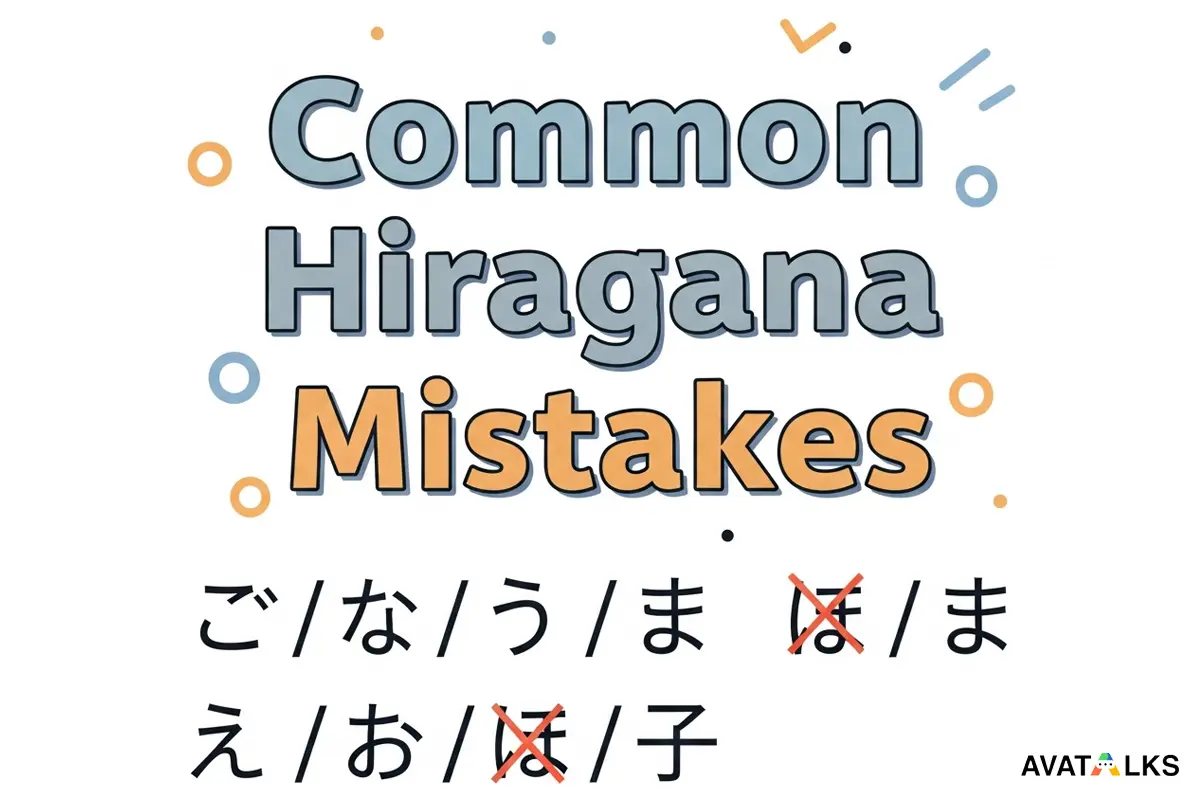
- Many common hiragana mistakes come from similar-looking characters.
- Pronunciation errors often come from English habits, not Japanese rules.
- Fix mistakes with listen → mouth shape → write → repeat drills.
- Use contrast practice to retrain your brain fast.
Hiragana Practice Online
Practice every hiragana character with audio, mouth-shape guidance, and writing mode. Fix mistakes with real drills.
Go to practice hub →Why Common Hiragana Mistakes Happen
When you learn Japanese, hiragana feels simple at first.
But many learners struggle with look-alike characters and subtle pronunciation differences.
The problem is not memory.
It’s pattern confusion.
Native speakers see each hiragana character as a movement pattern, not a picture.
You must train the same way, especially if your goal is accurate Japanese writing.
Most common mistakes happen because beginners treat hiragana as drawings instead of motion-based symbols.
12 Common Hiragana Mistakes (Look-Alike Chart)
Below are the most confusing pairs in Japanese hiragana.
These pairs cause reading and japanese writing errors for beginners and even intermediate learners.
1️⃣ ぬ vs め vs れ
Why confusing: Similar loops and strokes.
Fix tip:
- ぬ has a loop + tail
- め has a loop + hook
- れ has a straight tail
Practice drill:
Write each 5× while saying the sound.
2️⃣ さ vs ち
Why confusing: Both have crossing strokes.
Fix tip:
- さ has a long curve
- ち has a straight vertical stroke
3️⃣ る vs ろ
Why confusing: Only one stroke difference.
Fix tip:
- る ends with a loop
- ろ is box-like
4️⃣ い vs こ
Why confusing: Two simple strokes vs two lines.
Fix tip:
- い = two separate strokes
- こ = connected box shape
5️⃣ は vs ほ
Why confusing: Extra stroke.
Fix tip:
- ほ has a small middle stroke
6️⃣ ま vs ほ
Why confusing: Multiple strokes.
Fix tip:
- ま has two horizontal lines
7️⃣ た vs な
Why confusing: Similar curve shape.
Fix tip:
- た has a vertical line
8️⃣ す vs む
Why confusing: Tail direction.
Fix tip:
- す tail curves upward
- む tail loops inward
9️⃣ し vs つ (pronunciation mistake)
Why confusing: English romaji habits.
Fix tip:
- し = soft airflow
- つ = rounded lips + soft ts
🔟 ふ vs ほ (pronunciation + writing)
Why confusing: Similar sound to English “fu”.
Fix tip:
- ふ = air through lips, not strong F
1️⃣1️⃣ ら vs り
Why confusing: Tiny stroke difference.
Fix tip:
- ら has a tail
- り has two vertical strokes
1️⃣2️⃣ ね vs れ
Why confusing: Similar flow.
Fix tip:
- ね has a loop at the end
Why These Mistakes Are So Hard to Fix
Your brain stores visual shortcuts, not correct motion patterns.
So when two characters look similar, your brain merges them.
This is why japanese writing practice is critical.
Writing forces your brain to remember stroke order + direction, which prevents confusion.
If you only read hiragana, these common mistakes will never fully disappear.
How Native Speakers Avoid These Mistakes
A native speaker does not think “this looks like a picture.”
They think stroke motion + sound pattern.
To learn Japanese effectively, you must:
- Say the sound while writing
- Watch mouth shape while listening
- Practice contrast pairs side-by-side
- Write slowly before writing fast
This rewires your brain faster than memorization.
The 4-Step Fix Method (Use Daily)
This is the step to learn any confusing hiragana:
Step 1 — Listen
Play the audio once.
Step 2 — Watch Mouth Shape
Check lip and tongue position.
Step 3 — Write
Write the character 3–5 times slowly.
Step 4 — Contrast
Write the confusing pair side-by-side.
Repeat this loop for 5 minutes daily.
Quick Practice List (Use the Tool)
Practice these mistake pairs today:
- ぬ / め / れ
- さ / ち
- る / ろ
- い / こ
- は / ほ
- し / つ
👉 Open the tool and drill each pair for 2 minutes
Common Learning Mistakes (Beyond Writing)
These are common mistakes beginners make when learning hiragana:
- Memorizing charts without writing
- Using romaji too long
- Skipping daily review
- Writing fast before writing correctly
- Ignoring stroke order in japanese writing
Avoid these and your progress doubles.
A 5-Minute Daily Fix Routine
Use this routine to eliminate hiragana confusion:
- Pick one confusing pair
- Listen to both sounds
- Write each character 5×
- Alternate writing them line by line
- Read them out loud once
Do this daily and mistakes disappear within a week.
How Long Until You Stop Confusing Characters?
If you practice contrast pairs:
- 3 days: visual recognition improves
- 7 days: reading becomes automatic
- 14 days: writing stabilizes
- 30 days: mistakes nearly disappear
Consistency matters more than speed.
Next Step in Your Hiragana Journey
Once you fix common hiragana mistakes:
- Learn katakana
- Add dakuten sounds
- Start reading real Japanese words
- Practice full japanese writing sentences
👉 Return to the main guide: Hiragana Practice Online
Final Takeaway
Common hiragana mistakes are normal.
Everyone makes them—even advanced learners.
The secret is contrast practice + speaking while writing.
Fix these 12 pairs, and your Japanese reading and japanese writing will feel effortless.