Imagine putting on a Spanish vocabulary recording before bed and waking up knowing dozens of new words.
It sounds ideal. Eight hours of language learning without actually studying.
But does learning languages in your sleep really work?
The short answer is:
You cannot realistically learn a new language simply by playing lessons while you sleep. But sleep can help your brain strengthen language material you learned while awake.
That distinction matters.
Research on sleep and new-word learning suggests that sleep plays an important role in memory consolidation. A systematic review and meta-analysis of 25 studies involving 1,396 participants found that sleep generally benefited new-word learning compared with wakefulness.
Some experiments have also found that replaying sounds or words connected to material people had already studied can improve later recall.
That is very different from becoming fluent by listening to a language overnight.
So rather than asking:
“Can I learn Spanish while I’m asleep?”
a more useful question is:
“Can sleep help me remember the Spanish I studied while I was awake?”
For that question, the evidence is much more encouraging.
TL;DR: Does Learning a Language in Your Sleep Work?
Not in the way most people imagine.
You are unlikely to learn vocabulary, grammar, pronunciation, and conversation skills simply by leaving a language lesson playing while you sleep.
What research does support is more limited:
- Sleep can help consolidate memories formed while you are awake.
- Sleeping after studying may help newly learned words stick.
- Some experiments suggest that replaying cues connected to previously learned vocabulary during sleep can improve later recall.
- The sleeping brain can process some new information under experimental conditions, but this does not mean you can consciously learn a usable language while asleep.
- Audio that repeatedly wakes you or interferes with your sleep may defeat the purpose.
So the practical takeaway is simple:

Study while awake. Let sleep help your brain consolidate what you learned.
If you want to experiment with audio during sleep, think of it as a possible memory aid, not a replacement for studying.
Can You Actually Learn a Language While Sleeping?
The idea is often called sleep learning or hypnopaedia.
The popular version goes something like this:
- Put on headphones.
- Play foreign-language vocabulary all night.
- Let your subconscious absorb the language.
- Wake up knowing words you never studied.
Unfortunately, research does not support this as a practical way to learn a language.
Your sleeping brain is not simply an awake brain with your eyes closed.
During sleep, your brain moves through different stages and carries out processes involved in memory and learning. But that does not give you the same ability to deliberately learn complex new information that you have while awake.
Listening to:
bonjour = hello
merci = thank you
fromage = cheese
for eight hours while unconscious is therefore not equivalent to spending eight hours actively learning French.
There is, however, a much more interesting part of the story.
Your brain continues working with memories after you fall asleep.
And that can benefit language learning.
What Sleep Actually Does for Language Learning
Think about language learning as having at least two stages.
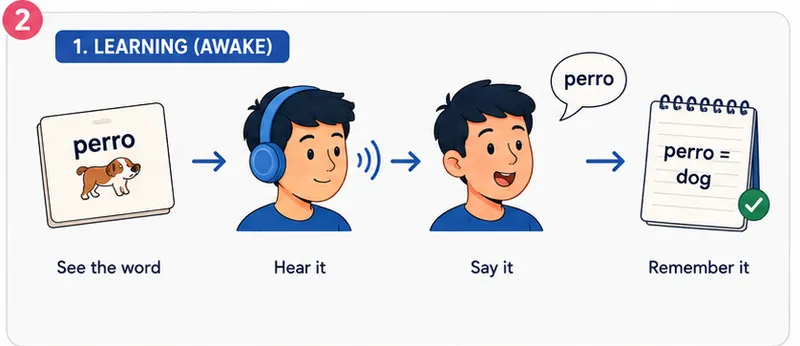
Stage 1: Learning
While awake, you encounter something new.
For example, you learn that the Spanish word:
perro
means:
dog
You hear the pronunciation, repeat the word, retrieve its meaning, and perhaps use it in a sentence.
Your brain has now begun forming a new memory.
Stage 2: Consolidation
Learning does not necessarily end when you close the textbook.
During subsequent sleep, recently acquired information can undergo memory consolidation.
In simple terms, consolidation helps newly formed memories become more stable.
Research specifically examining sleep and novel-word learning has found an overall advantage for sleep over wakefulness across recall, recognition, and lexical-integration measures.
This helps explain something many learners have experienced:
You study something in the evening, struggle with it, go to sleep, and the next day it somehow feels more familiar.
You did not secretly continue studying all night.
Sleep may have helped consolidate the memory you had already created.

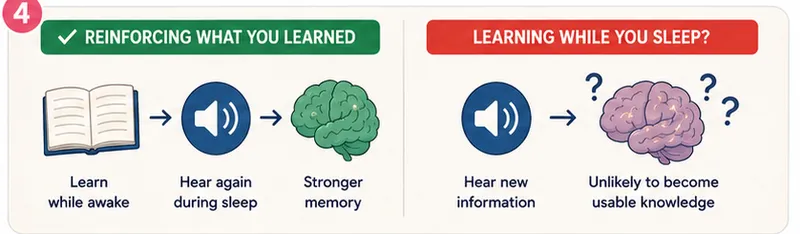
The Most Important Difference: Learning vs. Reinforcing
This is where many claims about “learning while sleeping” become misleading.
There is an important difference between:
learning completely new information during sleep
and:
strengthening information that you learned before going to sleep
The second has much stronger practical support.
One particularly relevant experiment involved German-speaking participants who learned Dutch-German vocabulary pairs before sleeping.
During subsequent NonREM sleep, researchers replayed some of the Dutch words.
After waking, participants were better at recalling the German translations of the words that had been replayed than the words that had not.
You can read the original study, Boosting Vocabulary Learning by Verbal Cueing During Sleep, published in Cerebral Cortex.
But notice what happened before the participants went to sleep:
They learned the vocabulary.
The sleeping participants were not hearing a completely unfamiliar language lesson and waking up knowing Dutch.
Instead, sleep-time cues appeared to help reactivate memories that had already been formed.
This type of technique is known as targeted memory reactivation, or TMR.
What Is Targeted Memory Reactivation?
Targeted memory reactivation sounds complicated, but the basic idea is straightforward.
First, you learn something while awake.
That information becomes associated with a cue, such as a sound or spoken word.
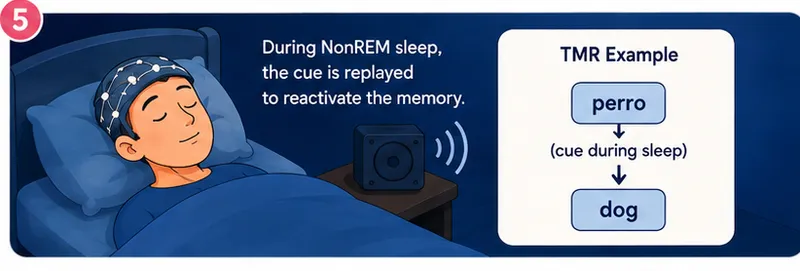
Later, during sleep, the cue is presented again with the aim of reactivating the associated memory.
For language learning, a simplified example might look like this:
While awake:
perro → dog
You study and learn the association.
During sleep:
perro
The previously learned word is played again.
After waking:
Researchers test whether you remember perro better.
The Cerebral Cortex vocabulary experiment found that verbal cueing during NonREM sleep improved later recall for previously learned foreign vocabulary.
That finding is genuinely interesting.
But notice what the experiment does not show:
Play hundreds of unknown foreign words while sleeping → wake up knowing them.
The initial learning still happened while participants were awake.
That is why sleep-assisted memory is a more useful way to think about this research than “learning a language in your sleep.”
Can Your Brain Learn Completely New Words While You Sleep?
This is where the science becomes more surprising.
Researchers have investigated whether the sleeping brain can form associations involving information that was not deliberately learned beforehand.
Some laboratory experiments suggest that a degree of implicit learning can occur during sleep under carefully controlled conditions.
That sounds remarkably close to true sleep learning.
But there is an important limitation:
Implicit learning is not the same thing as consciously knowing usable vocabulary.
Finding a measurable effect on a later test does not mean someone wakes up able to say:
“I learned 50 German words last night.”
Nor does it show that the person can consciously recall the new vocabulary, put it into sentences, understand it in conversation, or use it naturally.
Research into learning during sleep tells us fascinating things about what the sleeping brain can process.
It does not currently give language learners a practical method for learning a language from scratch while unconscious.
Why You Can’t Become Fluent by Playing Language Audio All Night
Language learning is much more than recognizing sounds.
To actually use another language, you need to develop several interconnected abilities.
Vocabulary
You need to learn words and expressions and retrieve them when you need them.
Grammar
You need to understand how those words combine.
Listening
You need to recognize speech at natural speed.
Pronunciation
You need practice producing unfamiliar sounds yourself.
Reading and writing
Depending on the language, you may also need to learn a new writing system.
Conversation
You need to understand another person, retrieve vocabulary quickly, formulate a response, and adapt to context.
These skills require active practice.
Playing an eight-hour Korean lesson while you sleep cannot replace speaking Korean, retrieving vocabulary, reading Hangul, making mistakes, receiving feedback, and using the language in meaningful situations.
Sleep can support learning.
It cannot perform all of that learning for you.
Should You Play Language Audio While You Sleep?
This is probably the most practical question.
Suppose you spend 30 minutes learning 20 new Spanish words before bed.
Should you then leave those words playing quietly all night?
The research on targeted memory reactivation makes the idea tempting, but a laboratory TMR experiment is not the same as pressing play on an eight-hour YouTube vocabulary video.
Researchers can control factors such as:
- which material was learned beforehand
- which cues are replayed
- when those cues are presented
- sleep stage
- audio volume
- whether the participant wakes up
- how memory is tested afterward
You probably cannot reproduce those conditions simply by putting your phone next to your pillow.
So there is currently not enough evidence to recommend playing language lessons all night as a reliable learning technique.
If audio wakes you, fragments your sleep, or simply makes you sleep worse, it may be counterproductive.
Protecting your sleep is more important than squeezing several extra hours of passive audio into the night.
What About Listening Just Before You Fall Asleep?
This is much more practical.
You are still awake, so you can actually:
- pay attention
- understand meanings
- repeat words
- retrieve vocabulary
- notice pronunciation
- make associations
Then you go to sleep soon afterward.
That gives your brain genuine learning material to consolidate.
For example, instead of playing 500 Spanish words throughout the night, spend 15–20 focused minutes before bed reviewing 10–20 words that you actually want to remember.
Test yourself rather than only listening.
Then sleep.
The next morning, try recalling the same words before looking at the answers.
That combines active learning, sleep, and retrieval practice without relying on the idea that unconscious exposure will do the learning for you.
A Better Way to Use Sleep for Language Learning
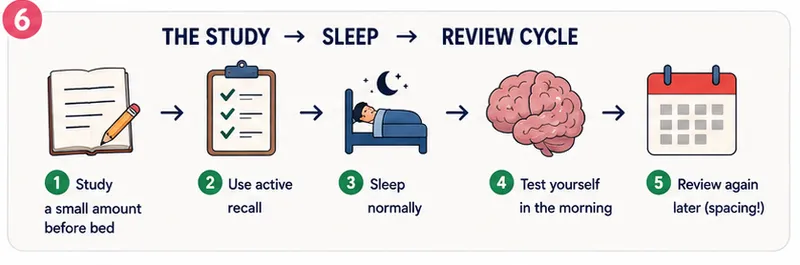
If you want to take advantage of what sleep research actually suggests, try this simple routine.
1. Study a small amount before bed
Choose material that is realistic to remember.
For example:
- 10 new words
- 5 useful phrases
- one short dialogue
- one small grammar pattern
Do not try to cram an entire lesson immediately before sleeping.
2. Use active recall
Do more than listen.
If you are learning:
perro → dog
look away and ask yourself:
“What does perro mean?”
Then reverse it:
“How do I say dog in Spanish?”
Trying to retrieve information strengthens learning much more than repeatedly looking at the answer.
3. Listen to the pronunciation
Connect the written word with its actual sound.
Repeat it aloud if pronunciation is part of your goal.
This creates a richer memory than simply memorizing a translation.
4. Go to sleep normally
You do not need to keep studying until you fall asleep.
And you do not need a language recording playing for eight hours.
Let sleep do what it does naturally.
5. Test yourself the next morning
Before reopening your notes, see what you remember.
For example:
perro = ?
house = ?
¿Cómo estás? = ?
Anything you cannot recall becomes material for your next review.
This gives you something much more useful than a vague feeling that you “heard Spanish all night.”
You can actually measure what you remembered.
Sleep Works Better With Spaced Review
One good night’s sleep does not permanently store every new word.
Language memories still fade.
That is why sleep works best as part of a larger learning cycle:
learn → sleep → recall → review later
Suppose you learn 15 French words tonight.
Review them tomorrow.
Then revisit difficult words a few days later.
Then again after a longer interval.
This combines sleep-dependent consolidation with spaced practice and retrieval.
If you want to understand why spacing your reviews matters, see our guide to the spacing effect.
The important point is that sleep should be part of your learning system—not the learning system itself.
Is Studying Before Bed Better Than Studying in the Morning?
Not necessarily for everyone or for every learning task.
Research showing benefits from sleep does not mean that everyone should move all language study to 11 p.m.
The important idea is that sleep after learning can support consolidation.
Your best study time still depends on when you can:
- concentrate
- practice consistently
- actively recall information
- speak and listen attentively
If you are exhausted at night, a focused morning lesson may be far more productive than forcing yourself through vocabulary immediately before bed.
You could also learn earlier in the day and review briefly in the evening.
Consistency matters more than finding a supposedly perfect minute to study.
What About Naps?
You do not necessarily need a full night’s sleep for researchers to study sleep-dependent memory processes.
Sleep and memory experiments also use naps.
For a language learner, however, this does not mean you need to schedule a nap after every vocabulary session.
Think of the research more broadly:
Rest and sleep are part of learning, not wasted time between study sessions.
Studying for five exhausted hours is not automatically better than studying effectively and then getting adequate sleep.
Can Sleep Improve Pronunciation?
Sleep may help consolidate memories related to learning, but pronunciation still requires awake practice.
You need to hear distinctions between sounds and learn how to produce them.
That requires coordination between perception and physical speech movements.
For example, listening to French pronunciation while unconscious cannot tell you whether your own pronunciation is correct.
You need to speak.
The same applies to languages with sounds that are unfamiliar to you.
Listen while awake.
Repeat them.
Compare your pronunciation.
Get feedback.
Then let sleep support the learning you have already done.
Common Myths About Learning Languages in Your Sleep
Myth 1: Eight hours of sleep audio equals eight hours of studying
It does not.
Passive exposure while unconscious is not equivalent to focused learning.
Myth 2: Your subconscious remembers everything it hears
The sleeping brain can respond to sensory information, but that does not mean everything playing in your room becomes a retrievable memory.
Myth 3: You can learn thousands of vocabulary words without studying
There is no good evidence that playing unknown vocabulary overnight will give you conscious command of thousands of new words.
Myth 4: Sleep has nothing to do with language learning
This goes too far in the other direction.
Sleep is relevant to memory consolidation, and research specifically on novel-word learning has found benefits of sleep compared with wakefulness.
So the answer is not:
“Sleep learning is fake, therefore sleep doesn’t matter.”
A better conclusion is:
Sleep helps learning, but it does not replace learning.
So, Is Sleep Learning Worth Trying?
If by “sleep learning” you mean:
playing completely unfamiliar lessons all night and expecting to learn a language
I would not build your study plan around it.
If you mean:
learning while awake, sleeping well, and using sleep to support memory consolidation
then yes—that should absolutely be part of your language-learning routine.
Targeted memory reactivation is scientifically interesting, and future research may eventually produce more practical learning tools based on it.
But for an ordinary learner today, the proven fundamentals remain much less exciting:
pay attention, retrieve what you learned, review it over time, use the language, and sleep well.
They require more effort than putting on headphones and going to bed.
They also give you something sleep audio alone cannot:
the ability to actually use the language.
Frequently Asked Questions
Can you learn a language while sleeping?
Not in the usual sense of learning a new language from scratch.
Sleep can support memory consolidation, but simply playing unfamiliar language lessons while you are unconscious is not a proven substitute for active study.
Can you learn new vocabulary in your sleep?
There is experimental evidence that the sleeping brain can process some new information under specific conditions.
However, this is very different from consciously learning and recalling useful vocabulary.
Research provides stronger practical support for sleep helping consolidate vocabulary that was learned while awake.
Does listening to vocabulary while sleeping help?
Possibly under carefully controlled conditions when the vocabulary has already been learned.
Research on targeted memory reactivation has found memory benefits from replaying previously learned vocabulary during NonREM sleep.
That does not mean leaving a general vocabulary recording playing all night will produce the same effect.
Should I listen to a language while I sleep?
You do not need to.
If you enjoy quiet audio and it does not interfere with your sleep, you may choose to experiment with it, but do not count those hours as active study.
Prioritize good sleep and focused learning while awake.
Is it good to study a language before bed?
It can be.
Studying or reviewing vocabulary before sleep gives your brain recently learned material that may benefit from subsequent consolidation.
The quality of your studying still matters, though. Active recall is more useful than simply leaving a lesson playing in the background.
Can I become fluent by listening to Spanish while sleeping?
No evidence shows that you can become fluent in Spanish—or another language—simply by listening while asleep.
Fluency requires vocabulary, grammar, listening comprehension, pronunciation, retrieval, and real language use.
Those require substantial awake practice.
Does sleep help you remember vocabulary?
Yes, there is meaningful evidence that sleep can benefit new-word learning and consolidation.
A systematic review and meta-analysis of 25 studies found an overall benefit of sleep compared with wakefulness for novel-word learning.
Final Thoughts
So, does learning languages in your sleep work?
Not as a shortcut to learning a language without studying.
But the relationship between sleep and language learning is real.
Sleep can help consolidate newly learned information, and experiments with targeted memory reactivation suggest that replaying carefully selected cues during sleep can sometimes strengthen previously learned vocabulary.
The practical lesson is much simpler than the headline:
Learn while you’re awake. Sleep well. Test yourself after you wake up. Review again later.
Instead of trying to turn eight hours of sleep into eight hours of studying, make your waking study more effective and give your brain the sleep it needs to consolidate what you learned.
That may not sound as magical as becoming fluent overnight.
But it is much closer to what the science actually supports.