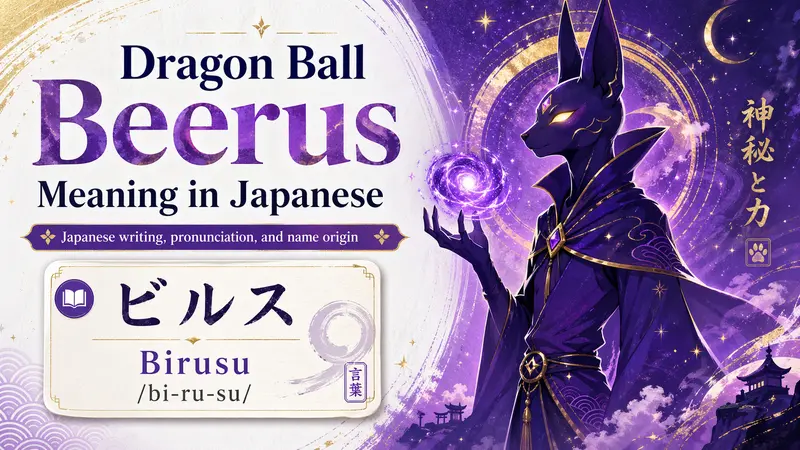
Beerus is one of those anime names that sounds memorable right away, but becomes more interesting when you look at it in Japanese.
In Dragon Ball, Beerus is written ビルス. At first glance, it looks like a simple katakana name with no deeper meaning. But the story behind it is more layered than that. The name is tied to ビールス, an older Japanese form of “virus,” and it is also connected to later comments from Akira Toriyama that linked it to beer instead.
That mix is exactly why fans still ask what Beerus means in Japanese.
It also makes Beerus a useful example for Japanese learners, because the name touches on katakana, loanwords, sound changes, and anime wordplay all at once.
In this guide, we will look at how ビルス is written, where the name seems to come from, why people connect it to both virus and beer, and what Japanese learners can actually take from it.
TL;DR
Beerus is written ビルス in Japanese. ビルス is not a normal everyday Japanese word, but the name is closely tied to ビールス, an older Japanese word for “virus.” Later, Akira Toriyama said he had understood the name as a beer-based pun instead, which helped shape the beer-and-whisky naming joke around Beerus and Whis.
How Beerus is written in Japanese
Beerus is written in Japanese as:
ビルス
Birusu
On official Dragon Ball pages, he is also described as:
破壊神ビルス
Hakaishin Birusu
“God of Destruction Beerus”
You can see that directly on the Dragon Ball Official Site character feature.
This is useful for Japanese learners because it shows two different things at once:
- ビルス is the character name in katakana
- 破壊神 is the title, meaning “God of Destruction”
So if you were hoping that ビルス itself means “destruction” or “god” in Japanese, it does not. That meaning comes from 破壊神, not from ビルス.
Does ビルス have a literal meaning in Japanese?
Not in the way a normal Japanese word does.
For example, words like 神 mean “god” and 破壊 means “destruction.” But ビルス is a stylized katakana name, not an everyday noun used in ordinary Japanese writing. The key dictionary link is not ビルス by itself, but ビールス, an older Japanese form meaning “virus.” You can see that in Kotobank’s entry for ビールス.
That distinction matters.
So the best answer is:
Beerus does not have a plain literal Japanese meaning, but the name is tied to a Japanese loanword for “virus.”
Where did the name Beerus come from?
The name Beerus appears to have started from ビールス, an older Japanese form of the word “virus.” Japanese dictionaries still record ビールス with that meaning, which is why many fans connect Beerus’s name to virus rather than to an ordinary Japanese word. You can see that in Kotobank’s entry for ビールス.
The story becomes more interesting because Akira Toriyama later said he had understood the name differently. In the widely cited 2013 interview reproduction, he explained that he thought the name was based on beer, which then led him to name Beerus’s attendant Whis after whisky. See that explanation in the interview repost.
So the cleanest answer is this:
- the original source appears to be virus
- Toriyama later understood it as beer
- that misunderstanding helped shape the later beer / whisky naming joke around Beerus and Whis
That is why fans often see both explanations online. They are not completely separate stories. They are two parts of the same naming history.
Why the name sounds different in Japanese
For learners, this is also a useful katakana example.
Japanese often adapts foreign sounds to fit its own sound system. That is why Beerus becomes ビルス, read as Birusu.
This is normal in Japanese:
- extra vowel sounds may appear
- English-style consonant endings get adjusted
- fantasy names are often written in katakana
So even if an English-speaking fan expects “Beer-us,” the Japanese form is still ビルス, not a direct letter-for-letter copy of English spelling.
What Beerus means for Japanese learners
This is where the topic becomes more useful than anime trivia.
If you are learning Japanese, Beerus is a good example of how anime names can teach you:
- how katakana works
- how loanwords shift in sound
- how names are sometimes based on puns
- how titles and names are separate in Japanese
For example:
- ビルス = Beerus, the name
- 破壊神 = God of Destruction, the title
That makes the full phrase 破壊神ビルス easier to understand.
Instead of seeing one long fantasy label, you can break it into parts.
If you enjoy this kind of anime-and-language topic, our guide to Japanese honorifics for beginners is another good next read.
Common mistakes people make about Beerus’s meaning
1. Thinking ビルス is a normal Japanese word
It is not a plain everyday word like 犬 or 山. It is a katakana character name. The relevant dictionary connection is ビールス, not ビルス used as a normal household word.
2. Thinking the answer is only “beer”
That is too simple. Toriyama’s own explanation points to a misunderstanding of an apparent virus source, which then created the beer / whisky naming line.
3. Thinking ビルス means “God of Destruction”
That is also not right. “God of Destruction” comes from 破壊神, while ビルス is the name. The official wording appears on the Dragon Ball Official Site.
FAQ
What is Beerus in Japanese?
Beerus is written ビルス in Japanese. On official Dragon Ball pages, he is also labeled 破壊神ビルス, meaning “God of Destruction Beerus.” See the official character feature.
Does Beerus mean virus in Japanese?
Not exactly in a direct dictionary way. ビルス itself is the character name, but it is tied to ビールス, an older Japanese loanword meaning “virus.” See Kotobank’s ビールス entry.
Why is Beerus connected to beer?
Because Toriyama said he misunderstood the original source and thought the name was related to beer, which then led him to name Whis after whisky. That explanation appears in the widely circulated 2013 interview reproduction.
What does 破壊神ビルス mean?
It means God of Destruction Beerus. 破壊神 is the title, and ビルス is the name.
Final thoughts
The meaning of Beerus in Japanese is interesting because the answer is not just one neat word.
It is a mix of:
- katakana naming
- old loanword history
- anime wordplay
- and Toriyama’s own naming twist
That makes Beerus a good example of something anime fans often discover sooner or later:
a name can look simple on the surface, but the story behind it can reveal a lot about how Japanese, loanwords, and pop-culture naming actually work.