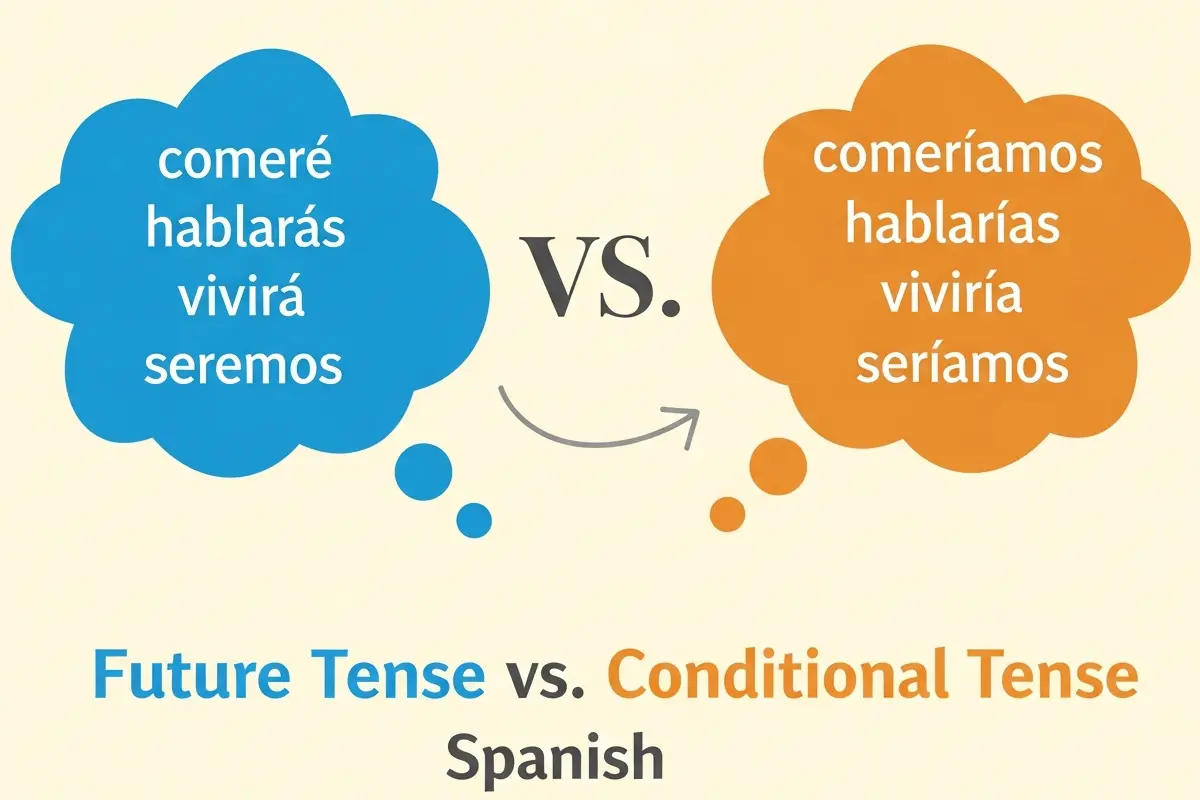
If you are confused by the future tense and the conditional tense in Spanish, the good news is that the difference is actually very simple at the core.
The future tense answers:
- what will happen
The conditional tense answers:
- what would happen
That is the main contrast.
The reason learners mix them up is that both tenses are built in a very similar way, and they even share the same irregular stems.
This guide focuses on the part that matters most:
- what each tense means
- when to use each one
- how to recognize them quickly
- and how to stop confusing them in real sentences
TL;DR
The simplest rule is:
- future tense = what will happen
- conditional tense = what would happen
Examples:
- Iré mañana. = I will go tomorrow.
- Iría si pudiera. = I would go if I could.
Both tenses:
- use the infinitive as the base
- share the same irregular stems
- but take different endings
The core difference
Here is the shortest way to understand it:
Future tense
Use it for:
- future actions
- predictions
- promises
- probability about the present
Example:
- Mañana estudiaré. = I will study tomorrow.
Conditional tense
Use it for:
- hypothetical actions
- polite requests
- wishes
- probability about the past
Example:
- Estudiaría más si tuviera tiempo. = I would study more if I had time.
So the contrast is not only grammar.
It is also about certainty vs possibility.
Future tense: what it usually expresses
The Spanish future tense often expresses things the speaker sees as real, expected, or projected forward.
1. Future actions
- Llegaré temprano. = I will arrive early.
- Comeremos después. = We will eat later.
2. Predictions
- Lloverá mañana. = It will rain tomorrow.
- Habrá mucha gente. = There will be many people.
3. Promises or decisions
- Te llamaré esta noche. = I will call you tonight.
- Lo haré mañana. = I will do it tomorrow.
4. Probability about the present
This is a very common use in Spanish.
- Estará en casa. = He is probably at home.
- Serán las ocho. = It must be eight o’clock.
If that last use still feels unfamiliar, our guide on when to use the future tense in Spanish for probability explains it step by step.
Conditional tense: what it usually expresses
The conditional tense often expresses something imagined, softened, or dependent on another condition.
1. Hypothetical actions
- Iría contigo. = I would go with you.
- Compraríamos una casa si pudiéramos. = We would buy a house if we could.
2. Polite requests
- ¿Podrías ayudarme? = Could you help me?
- ¿Me dirías la verdad? = Would you tell me the truth?
3. Wishes or desires
- Me gustaría viajar más. = I would like to travel more.
- Nos encantaría volver. = We would love to come back.
4. Probability about the past
- Serían las diez cuando salió. = It was probably ten when he left.
- Estaría cansado. = He was probably tired.
So while the future tense can guess about the present, the conditional can often guess about the past.
The endings: future vs conditional
Both tenses are built from the infinitive.
That is why they look similar.
Future endings
| Subject | Ending |
|---|---|
| yo | -é |
| tú | -ás |
| él / ella / usted | -á |
| nosotros / nosotras | -emos |
| vosotros / vosotras | -éis |
| ellos / ellas / ustedes | -án |
Example with hablar:
- hablaré
- hablarás
- hablará
- hablaremos
- hablaréis
- hablarán
Conditional endings
| Subject | Ending |
|---|---|
| yo | -ía |
| tú | -ías |
| él / ella / usted | -ía |
| nosotros / nosotras | -íamos |
| vosotros / vosotras | -íais |
| ellos / ellas / ustedes | -ían |
Example with hablar:
- hablaría
- hablarías
- hablaría
- hablaríamos
- hablaríais
- hablarían
A good way to remember it is:
- future endings are shorter and sharper
- conditional endings all have -ía in them
Shared irregular stems
This is the part that often confuses learners.
Yes, the future and conditional tenses share the same irregular stems.
| Infinitive | Stem | Future | Conditional |
|---|---|---|---|
| tener | tendr- | tendré | tendría |
| poder | podr- | podré | podría |
| decir | dir- | diré | diría |
| hacer | har- | haré | haría |
| venir | vendr- | vendré | vendría |
| salir | saldr- | saldré | saldría |
| poner | pondr- | pondré | pondría |
That means once you learn the irregular stem once, you can use it in both tenses.
If you want the stem patterns by themselves, see Spanish future tense stem-changing rules and irregular future tense verbs in Spanish.
Side-by-side comparison
These pairs make the difference clearer.
| Future tense | Conditional tense |
|---|---|
| Iré mañana. = I will go tomorrow. | Iría si pudiera. = I would go if I could. |
| Te ayudaré. = I will help you. | Te ayudaría, pero no puedo. = I would help you, but I cannot. |
| Vendrán luego. = They will come later. | Vendrían si tuvieran tiempo. = They would come if they had time. |
| Será difícil. = It will be difficult / It is probably difficult. | Sería difícil. = It would be difficult. |
| Podrá hacerlo. = He will be able to do it / He can probably do it. | Podría hacerlo. = He would be able to do it / He could do it. |
This is the key pattern to notice:
- future = more direct, projected forward
- conditional = more hypothetical, softer, or dependent
When to choose the future tense
Choose the future tense when:
- you are talking about a real future event
- you are making a prediction
- you are giving a promise
- you are guessing about something happening now
Examples
- Mañana llamaré.
- Terminaremos pronto.
- Habrá una reunión.
- Estará en su oficina.
For more sentence-based practice, Spanish future tense example sentences for beginners fits well here.
When to choose the conditional tense
Choose the conditional when:
- the action depends on another condition
- you want to sound more polite
- you are expressing a wish
- you are making a softer statement
- you are guessing about the past
Examples
- Iría contigo si pudiera.
- ¿Podrías repetir eso?
- Me gustaría aprender más.
- Sería una buena idea.
- Estaría enfermo ayer.
One very common learner problem
A lot of learners know this rule in theory:
- future = will
- conditional = would
But still hesitate because English and Spanish do not always match word for word.
For example:
- ¿Podrías ayudarme?
This is conditional, but in natural English it often becomes:
- Could you help me?
not literally:
- Would you be able to help me?
So the best way to learn this tense pair is not only through translation, but through repeated sentence patterns.
Quick practice
Choose the better form.
- Mañana yo ______ temprano.
- Yo ______ más si tuviera tiempo.
- ¿Me ______ ayudar?
- No está aquí. ______ en casa.
- Nosotros ______ encantados de ir.
Answers
- saldré
- estudiaría
- podrías
- estará
- estaríamos
A simple shortcut that works
Ask yourself:
Is this about something real in the future?
Use the future tense.
Is this about something imagined, softer, polite, or conditional?
Use the conditional tense.
That shortcut will solve most beginner and intermediate confusion.
FAQ
What is the main difference between future and conditional in Spanish?
The future tense shows what will happen. The conditional shows what would happen.
Do future and conditional use the same irregular stems?
Yes. Verbs like tener, poder, decir, and hacer use the same irregular stem in both tenses.
Is the conditional only used with if clauses?
No. It is also used for politeness, wishes, suggestions, and probability about the past.
Can the future tense express probability?
Yes. It can show probability or conjecture about the present, such as Estará en casa.
Final thoughts
The difference between the future tense and the conditional tense in Spanish gets much easier once you stop treating them as two random verb charts.
They are closely connected.
They share:
- the same base structure
- the same irregular stems
- and many of the same verbs
What changes is the meaning.
- the future tense points forward
- the conditional tense imagines what could happen
Once that contrast feels clear, the endings stop looking confusing and start feeling logical.