TL;DR
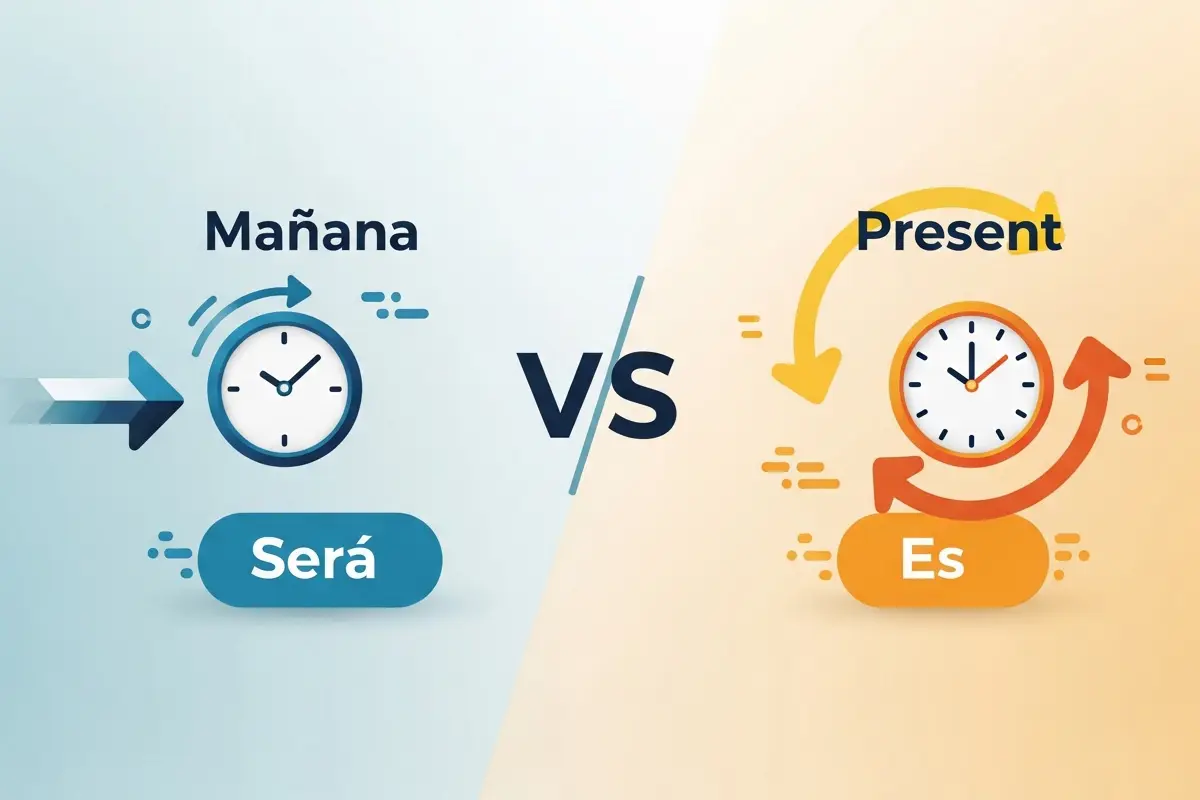
- The present tense describes actions happening now, habits, routines, schedules, or near future plans when context clarifies time.
- The future tense (futuro simple) expresses predictions, intentions, promises, or assumptions about the future.
- Spanish often uses “ir + a + infinitive” instead of the simple future in conversation to talk about the near future.
- Both tenses can describe future actions — the difference is tone, intention, and certainty.
What’s the Difference Between the Future Tense vs Present Tense in Spanish?
The present tense refers to what’s happening now, general truths, routines, or fixed schedules.
The future tense refers to what will happen later, or expresses certainty, prediction, or intention.
Even though both tenses appear in future contexts, their meaning shifts depending on certainty, emotion, context, and verb conjugation form.
When Is the Present Tense Used to Talk About the Future?
Spanish uses the present tense as a future reference when the context already signals a future time.
Common uses include:
- Scheduled events
- Transport timetables
- Appointments
- Near-future plans
Examples:
| Spanish | English |
|---|---|
| Mañana viajo a México. | I travel to Mexico tomorrow. |
| La clase empieza a las ocho. | The class starts at eight. |
| ¿Vienes más tarde? | Are you coming later? |
👉 Time markers like mañana, esta noche, or el próximo lunes allow the present tense to refer to future time.
This structure behaves the same across regular verbs and ar/er/ir verbs.
When Should You Use the Future Tense (Futuro Simple)?
Use the future tense when expressing:
-
Predictions:
Lloverá mañana. -
Promises or decisions:
Te llamaré. -
Probability or uncertainty (present guess):
Estará en casa ahora. -
Formal or written tone:
News, contracts, and announcements frequently use future tense.
| Category | Example | Translation |
|---|---|---|
| Prediction | Habrá tráfico. | There will be traffic. |
| Promise | Lo haré. | I will do it. |
| Guess | Serán las diez. | It’s probably ten. |
| Future plan | Viajaré a Perú el próximo año. | I will travel to Peru next year. |
🧠 Quick rule: If the intention or certainty matters, choose the future tense.
For stems and spelling patterns, see: Spanish Future Tense Stem-Changing Rules.
“Ir + A + Infinitive” vs Future Tense
Spanish has three ways to talk about the future:
| Form | Example | Meaning & Tone |
|---|---|---|
| Present tense | Mañana viajo. | Scheduled / fixed plan |
| Ir + a + infinitive | Voy a viajar mañana. | Near future / conversational |
| Simple future (futuro simple) | Viajaré mañana. | Formal / prediction / intention |
👉 Ir + a + infinitive is the most common structure in spoken modern Spanish.
Authoritative Grammar Notes
According to the Real Academia Española (RAE) and the reference grammar in Diccionario Panhispánico de Dudas, the tenses are defined as:
Presente (indicativo): expresses actions in progress, habitual events, general truths, or future actions determined by context.
Futuro simple: expresses actions that will occur after the moment of speaking, including intentions, forecasts, and suppositions.
Key nuance from RAE:
When expressing probability in the present, the futuro simple does not refer to the future but indicates uncertainty or deduction.
Example:
Estará en casa. (He’s probably at home.)
How to Form Each Tense
Present Tense (Regular -ar Verb)
| Person | Form |
|---|---|
| yo | hablo |
| tú | hablas |
| él/ella/usted | habla |
| nosotros | hablamos |
| vosotros | habláis |
| ellos | hablan |
Future Tense (Futuro Simple)
Infinitive + future tense endings
(Applies to regular verbs across -ar, -er, -ir root verbs.)
| Subject | Ending |
|---|---|
| yo | -é |
| tú | -ás |
| él/ella/usted | -á |
| nosotros | -emos |
| vosotros | -éis |
| ellos/ustedes | -án |
Example:
hablar → hablaré
For irregular stems, see: Irregular Future Tense Verbs in Spanish.
Same Sentence, Different Meaning
| Sentence | Implication |
|---|---|
| Voy mañana. | Plan already decided. |
| Iré mañana. | Promise or new decision. |
| ¿Vienes? | Are you coming? |
| ¿Vendrás? | Will you come? (polite request / uncertainty) |
👉 The meaning shift is emotional, not grammatical.
How Do Tone and Context Influence Spanish Speakers’ Choice?
Spanish speakers don’t always choose a tense based only on grammar — tone, confidence, and emotional context also influence whether someone uses the present tense, ir + a + infinitive, or the futuro simple.
The present tense often feels natural, immediate, and conversational, especially when talking about short-term plans. The near future form (ir + a + infinitive) is common in everyday speech because it sounds personal and intentional.
Meanwhile, the simple future (“hablaré”, “será”, “iremos”) can sound formal, confident, or decisive, which is why it appears frequently in writing, polite requests, and predictions. Understanding these subtle differences helps learners sound fluent—not just grammatically correct—because choosing the right tense in Spanish is also about social intent, verb conjugation patterns, and nuance, not just rules.
Quick Practice
Choose the best option:
- Yo ______ estudiar para el examen. (context: planning aloud)
- Mañana ______ a casa temprano. (formal announcement)
- ¿Qué ______ mañana? (friend asking casually)
Answers at bottom.
FAQ
❓ Can the present tense replace the future tense?
Yes — especially when the future time is clear from context.
❓ Are future tense forms the same across ar/er/ir verbs?
Yes — all regular verbs use the same endings.
❓ Are there irregular rules in the futuro simple?
Yes — the stem changes, but the endings remain regular.
❓ Can the future tense express probability?
Yes — especially for present assumptions.
Final Takeaway
The distinction between the future tense vs present tense in Spanish is not just about time — it’s about intention, tone, and meaning. Once you understand how estudio, voy a estudiar, and estudiaré change intention—not just grammar—you’ll express yourself with clarity and natural flow.
Answer Key
- voy a estudiar
- iré
- vas a hacer / harás / haces