TL;DR
If you want your German speaking to improve, the most useful method is:
- practice short, repeatable speaking situations
- reuse the same topic more than once
- keep the pressure low
- focus on response speed, not perfect grammar every time
- make it enjoyable enough that you will actually come back tomorrow
Fun matters because consistency matters.
And consistency is what turns German from something you can understand into something you can actually speak.
Why German speaking feels harder than German study
A lot of learners think they need more grammar before they can speak.
Usually, that is not the real problem.
The real problem is that speaking asks you to do several things at once:
- remember words
- build the sentence
- place the verb correctly
- respond in real time
That is why even learners who “know” German often freeze in conversation.
A simple example
- Ich gehe heute ins Kino.
- Heute gehe ich ins Kino.
Both are normal German. The meaning is close. But the structure shifts.
That kind of movement is one reason speaking can feel slower than reading.
Why “fun” matters more than people think
A lot of learners treat speaking practice like a test.
That usually leads to:
- hesitation
- self-correction every second
- short sessions that feel exhausting
- giving up after a few days
Fun practice works better because it changes the feeling of the task.
Instead of thinking:
- “I hope I do not make mistakes”
you start thinking:
- “Let me try that again”
- “I can do one more round”
- “That role-play was actually useful”
That shift matters because speaking improves through repetition, not through one perfect attempt.
What actually makes speaking practice effective
Fun alone is not enough.
The best speaking practice usually has four things:
1. A clear situation
You speak better when you know what kind of conversation you are in.
Examples:
- introducing yourself
- ordering food
- asking for directions
- answering simple interview questions
- making weekend plans
2. Repetition
Doing the same scenario again is not boring if the goal is speaking.
It is how your brain stops building every sentence from zero.
3. Low pressure
You need enough safety to try full sentences, not just one-word answers.
4. A small goal
One session should feel like:
- “Today I practiced asking questions” not
- “Today I mastered all spoken German”
That is a huge difference.
The most useful fun German speaking activities
These work well because they are simple, repeatable, and realistic.
1. Role-play the same real-life situation three times
Pick one topic:
- café
- train station
- classroom
- hotel
- supermarket
Round 1:
- say the bare minimum
Round 2:
- say the same thing with one extra detail
Round 3:
- answer faster and more naturally
That one change already makes practice much more useful than random topic switching.
2. Use short question-and-answer drills
Speaking improves fast when you get used to answering common patterns.
Examples:
- Wie heißt du?
- Wo wohnst du?
- Hast du heute Zeit?
- Was machst du am Wochenende?
These short exchanges help with:
- word order
- verb forms
- response speed
- confidence
3. Shadow short spoken lines
Listen to a short German sentence and repeat it immediately.
This is helpful because it trains:
- rhythm
- pronunciation
- sentence flow
- automatic chunks
It is much easier to speak when you have a few natural sentence patterns already in your mouth.
4. Repeat one mini-dialogue instead of chasing variety
Many learners think they need new speaking material every day.
Usually, they need the opposite.
A short dialogue practiced several times often helps more than ten brand-new prompts.
For example:
- Hast du heute Zeit?
- Ja, ich habe heute Abend Zeit.
- Wollen wir ins Kino gehen?
- Ja, gern.
That is enough material for several rounds of speaking practice.
What does not work as well
This is just as important.
Random chatting with no goal
It can be fun, but it often becomes:
- too broad
- too advanced
- too unpredictable
You may survive the conversation without actually improving much.
Studying grammar with no speaking follow-up
Grammar helps, but grammar alone does not build speaking speed.
Constantly changing topics
If every session is totally different, you never get the benefit of repetition.
A fun way to practice: structured conversation tools
One good middle ground is a structured speaking tool that gives you:
- a clear scenario
- repeated opportunities
- a low-pressure environment
- room to answer in your own words
That is why role-play style speaking practice usually works better than open-ended random chat.
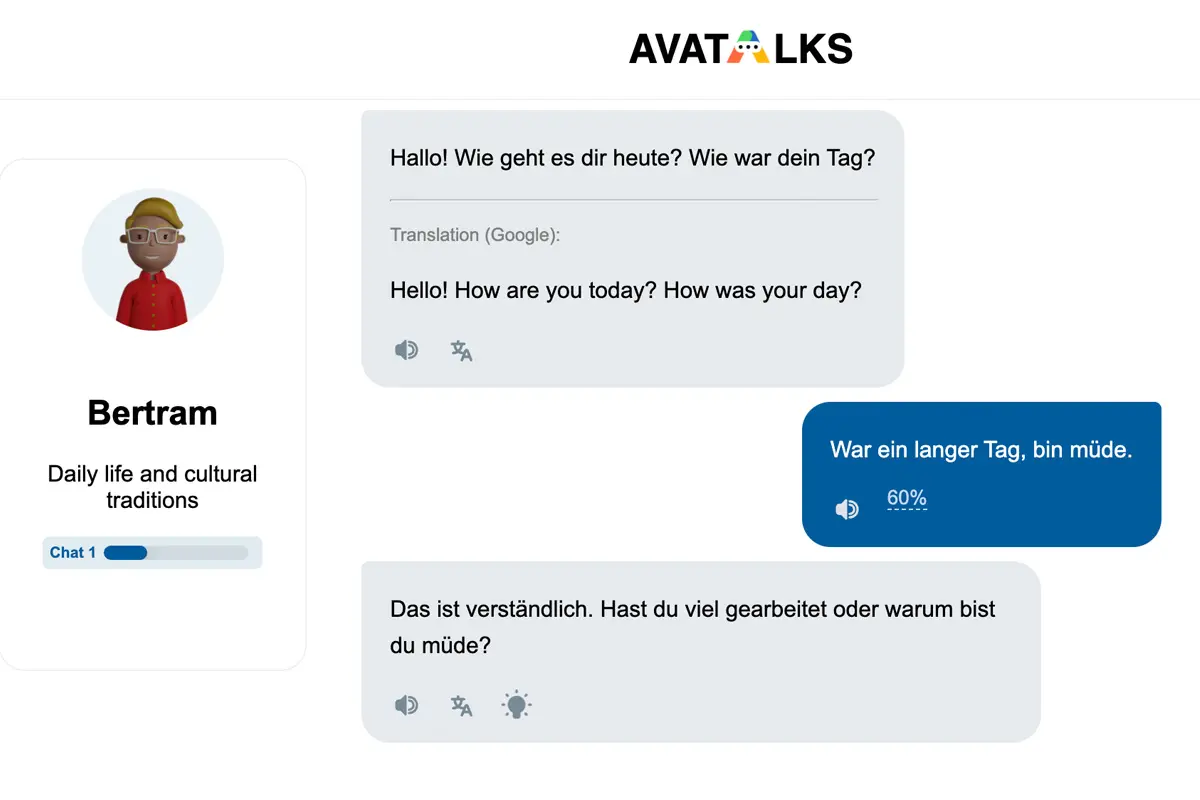
Example: Avatalks chat mode
Avatalks is useful here because it leans toward guided speaking practice instead of unstructured conversation.
What makes that helpful:
- 3D characters make the interaction feel more like a real situation
- the conversation is easier to repeat
- you can practice familiar topics more than once
- it is easier to stay consistent when the session feels interactive instead of abstract
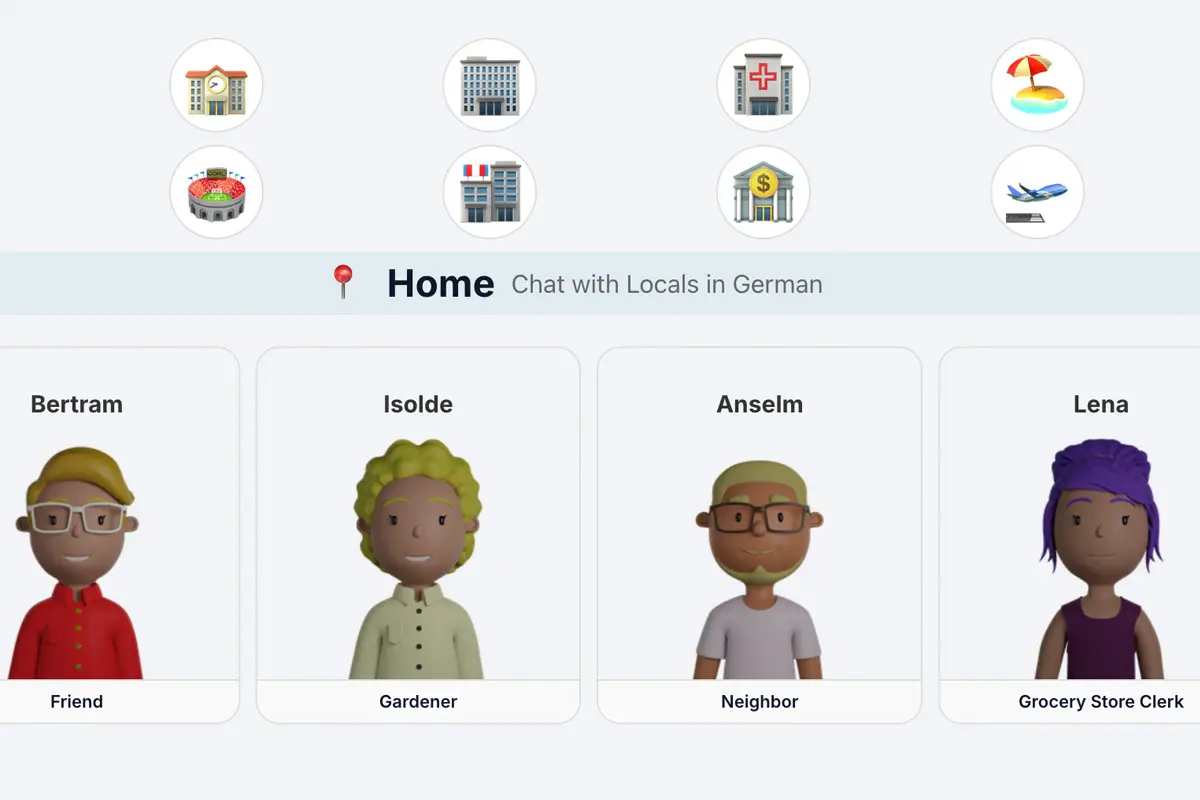
Instead of typing isolated sentences, you can work through small speaking situations like:
- introducing yourself
- answering a question
- asking for help
- reacting to a simple prompt
That kind of practice is more useful because it connects vocabulary, structure, and speaking speed at the same time.
A simple weekly German speaking plan
You do not need long sessions.
You need repeatable ones.
| Day | Focus | Time |
|---|---|---|
| Monday | Introductions and basic answers | 10 min |
| Wednesday | Asking and answering simple questions | 10 min |
| Friday | One role-play situation | 10 min |
| Sunday | Repeat the week’s best scenario | 15 min |
This works because it is small enough to keep doing.
FAQ
What is the best way to practice speaking German?
The most effective method is usually structured, repeatable speaking practice in realistic situations, especially when you revisit the same type of conversation more than once.
Is random conversation enough?
Not always. Random conversation can help, but learners often improve faster when they practice short, familiar scenarios with repetition.
How often should I practice German speaking?
Short sessions several times a week usually work better than one long session. Even 10 minutes can be useful if you actually speak out loud.
Can AI help with German speaking practice?
Yes, especially when it gives you clear scenarios, low-pressure repetition, and a chance to answer in full sentences instead of only reading or translating.
Final thoughts
German speaking gets easier when practice stops feeling like performance and starts feeling like repetition with a purpose.
You do not need a perfect method. You need a method you will actually keep using.
That usually means:
- short sessions
- clear situations
- repeated lines
- low pressure
- just enough fun to make the next session easy to start
If your speaking practice feels natural enough to repeat, it is probably doing more good than you think.