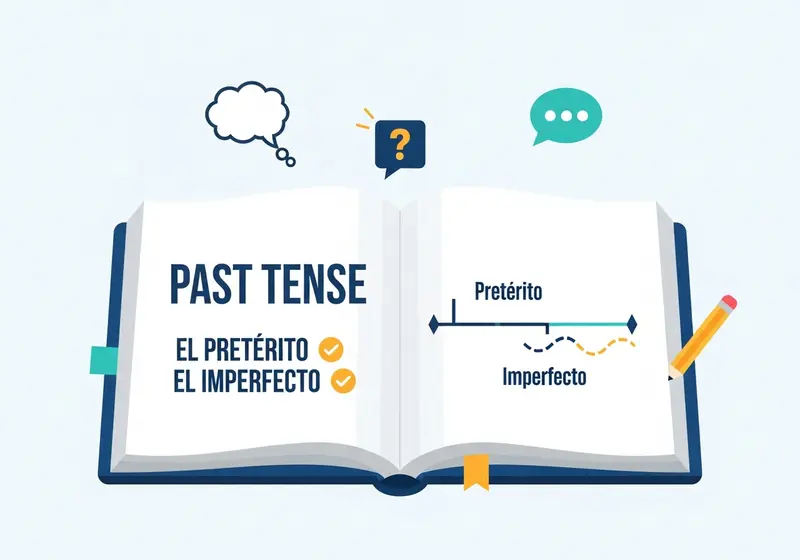
Spanish past tense is where many learners feel stuck — not because it’s complicated, but because it requires choosing the right way to describe the past.
Unlike English, Spanish doesn’t rely on a single past form. Instead, it reflects how an action happened, not just when it happened.
Was it finished? Repeated? Ongoing? Still relevant now?
Once you understand this perspective, Spanish past tense becomes much more logical.
This guide will help you:
- choose the correct tense quickly
- understand real-life usage
- avoid the most common mistakes
TL;DR: The Spanish Past Tense System
If you want a fast answer:
- Finished action → Preterite
- Habit or repeated action → Imperfect
- Background description → Imperfect
- Past connected to the present → Present Perfect
- Action before another past event → Past Perfect
This simple framework solves most confusion.
The Core Idea: How Spanish Sees the Past
English focuses on time.
Spanish focuses on the nature of the action.
That’s why these are different:
- I ate
- I used to eat
- I was eating
In Spanish, each one requires a different tense.
Understanding this concept is more important than memorizing conjugation tables.
Preterite: Finished Actions
Use the preterite when an action is completed and specific.
Examples
- Ayer estudié español
- Llegué a casa a las ocho
- Viví en Madrid por un año
The action is clearly finished, with a defined endpoint.
Quick Conjugation Pattern
| Verb Type | Example |
|---|---|
| -AR | hablé, hablaste, habló |
| -ER | comí, comiste, comió |
| -IR | viví, viviste, vivió |
Must-Know Irregular Verbs
- fui (ser / ir)
- tuve (tener)
- estuve (estar)
- hice (hacer)
- dije (decir)
These appear frequently in everyday Spanish and should be learned early.
Imperfect: Habits and Background
Use the imperfect when describing:
- repeated actions
- ongoing situations
- background context
Examples
- Cuando era niño, jugaba fútbol
- Siempre comíamos juntos
- Estaba lloviendo
The action has no clear beginning or end.
Preterite vs Imperfect (The Key Difference)
This is the most important distinction in Spanish past tense.
Compare:
-
Ayer estudié español
→ completed action -
Cuando era joven, estudiaba español
→ repeated or habitual action
If you want deeper practice on this exact contrast, you can work through this focused guide: Spanish Preterite vs Imperfect Practice.
The Movie Rule (Simple and Effective)
Think of a movie scene:
- Imperfect → background
- Preterite → main events
Example:
- Estaba caminando cuando lo vi
Here:
- estaba caminando = background
- vi = event
This mental model helps you choose the correct tense naturally.
Visual Comparison Table
| Situation | Tense |
|---|---|
| One-time event | Preterite |
| Habit | Imperfect |
| Description | Imperfect |
| Completed action | Preterite |
Present Perfect (Past + Present Connection)
Use this tense when the past still affects the present.
- He estudiado mucho esta semana
- Hemos visto esa película
This tense is more commonly used in Spain than in many Latin American countries.
Past Perfect (Past Before Past)
Used to show sequence between past actions:
- Ya había comido cuando llegaste
- Habían terminado antes
This helps clarify which action happened first.
Time Words That Make It Easier
Certain words strongly suggest which tense to use.
Preterite signals:
- ayer
- anoche
- la semana pasada
- una vez
Imperfect signals:
- siempre
- todos los días
- mientras
- de niño
These clues simplify decision-making when speaking.
Real-Life Story Example
Cuando era niño, vivía en un pueblo pequeño.
Un día, conocí a un turista.
Estaba caminando cuando lo vi.
What’s happening:
- vivía → background
- conocí → specific event
- estaba caminando → ongoing action
- vi → interruption
This is how native speakers naturally combine past tenses.
Mini Practice
Choose the correct tense:
- Ayer ______ (comer) pizza
- Cuando era niño, ______ (jugar) mucho
- Estaba estudiando cuando ______ (llegar)
Answers
- comí
- jugaba
- llegó
If you got these right, you already understand the core system.
How to Practice Effectively
Instead of memorizing charts, focus on real usage:
- describe your daily routine in Spanish
- tell stories about your past
- compare habits vs single events
You can also reinforce this with related grammar topics such as Ser vs Estar Practice.
Structured speaking practice and feedback tools can also help reinforce correct tense usage in real conversations.
Quick Summary
| Use Case | Tense |
|---|---|
| Finished action | Preterite |
| Habit | Imperfect |
| Background | Imperfect |
| Past linked to present | Present Perfect |
| Earlier past | Past Perfect |
FAQs
What is the difference between preterite and imperfect?
Preterite describes completed actions.
Imperfect describes ongoing, repeated, or background actions.
What is the easiest way to learn Spanish past tense?
Focus on understanding when to use each tense, not just memorizing forms.
Do native speakers always follow the rules?
Yes, but naturally. They think in meaning, not grammar rules.
Is Spanish past tense hard?
It may feel difficult at first, but it becomes intuitive once you understand the logic behind it.
Final Thoughts
Spanish past tense is not about memorizing forms — it’s about understanding perspective.
Start with:
- preterite for completed actions
- imperfect for habits and background
Once you can choose the correct tense naturally, everything becomes much easier.
At that point, Spanish stops feeling like a grammar system and starts feeling like real communication.