TL;DR
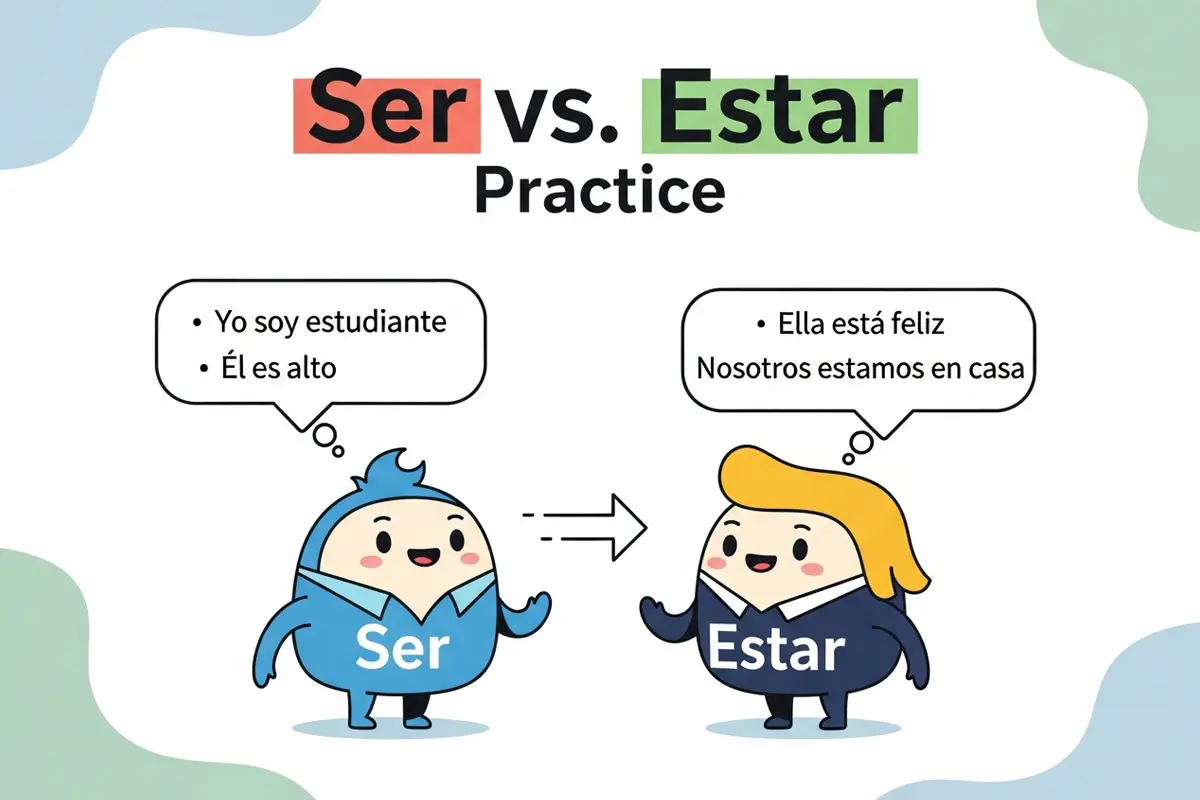
- ser and estar both mean to be, but they are not interchangeable
- use ser for identity, origin, time, and general characteristics
- use estar for location, condition, and how something is right now
- some adjectives change meaning depending on whether you use ser or estar
- the fastest way to improve is with short sentence-based practice, not long grammar lists
Spanish Grammar Practice Hub
If you’re practicing several grammar topics at once, our main Spanish grammar practice hub organizes exercises by topic so you can improve step by step.
Explore the practice hub →If you have studied Spanish for even a short time, you have probably run into this problem:
Why does Spanish have two verbs for to be?
That is exactly why ser vs estar feels so frustrating at first.
English uses one verb and lets context do the work. Spanish does not. Spanish forces you to choose, and that choice changes the meaning.
The good news is that this topic feels much harder before it clicks than after.
Once you stop asking “Which list do I memorize?” and start asking “Am I describing what something is, or how it is right now?”, the pattern becomes much easier to see.
This guide focuses on that kind of practice.
Spanish Ser vs Estar Practice — Short Answer
The shortest useful answer is:
- use ser for what something is
- use estar for how or where something is
That will not solve every advanced edge case, but it covers most beginner and intermediate situations very well.
A simple contrast
- Ella es inteligente. = She is intelligent.
- Ella está cansada. = She is tired.
In the first sentence, you are describing a general characteristic.
In the second, you are describing a current state.
That is the central difference.
Why is ser vs estar so confusing?
The confusion usually comes from one main reason:
English hides a distinction that Spanish makes very explicit.
In English, we say:
- She is tall.
- She is tired.
- She is at home.
- Today is Monday.
Spanish does not treat all of those the same way.
It separates:
- identity
- general qualities
- location
- temporary condition
- time
- result
That is why direct translation often causes mistakes.
The question is not:
- “Which one means to be?”
They both do.
The better question is:
- “What kind of being am I describing?”
When do you use ser?
Use ser for things that describe identity, classification, origin, time, relationships, or a general characteristic.
Common uses of ser
| Use | Example | Meaning |
|---|---|---|
| identity | Soy estudiante. | I am a student. |
| origin | Somos de México. | We are from Mexico. |
| profession | Ella es doctora. | She is a doctor. |
| time/date | Hoy es lunes. | Today is Monday. |
| relationship | Juan es mi hermano. | Juan is my brother. |
| general characteristic | El café es fuerte. | Coffee is strong. |
A helpful way to think about ser is:
ser describes what something is in a general sense.
More examples
- La casa es grande.
- Mi padre es alto.
- Madrid es una ciudad famosa.
- La película es interesante.
These all describe something in a more general or defining way.
If sentence structure still feels shaky, Spanish sentence structure: a clear beginner guide pairs well with this topic.
When do you use estar?
Use estar for location, temporary condition, feelings, and many result states.
Common uses of estar
| Use | Example | Meaning |
|---|---|---|
| location | Estoy en casa. | I am at home. |
| feeling | Estamos cansados. | We are tired. |
| temporary state | El café está frío. | The coffee is cold. |
| result/condition | La puerta está abierta. | The door is open. |
| progressive action | Estoy estudiando. | I am studying. |
A helpful way to think about estar is:
estar describes how something is right now, or where it is.
More examples
- Mi madre está feliz.
- Los niños están en el parque.
- La comida está caliente.
- Estoy ocupado hoy.
These all describe state, condition, or location.
The fastest practical rule
If you want one quick rule that actually helps, use this:
What is it? → usually ser
How is it right now? / Where is it? → usually estar
This is not perfect for every advanced use, but it is the best mental shortcut for most learners.
Compare
- Él es nervioso. = He is a nervous person.
- Él está nervioso. = He is nervous right now.
That one contrast shows why this topic matters so much.
Ser vs estar with adjectives
This is where many learners start to feel lost, because some adjectives change meaning depending on the verb.
That is not random. It happens because the verb changes the type of description.
Common adjective pairs
| Adjective | With ser | With estar |
|---|---|---|
| aburrido | Es aburrido. = He/it is boring. | Está aburrido. = He is bored. |
| listo | Es listo. = He is clever. | Está listo. = He is ready. |
| malo | Es malo. = He is a bad person. | Está malo. = He is sick / it has gone bad. |
| verde | Es verde. = It is green. | Está verde. = It is unripe. |
| rico | Es rico. = He is rich. | Está rico. = It tastes delicious. |
This is one of the biggest reasons learners need real sentence practice, not only summaries.
A simple way to think through the choice
When you are unsure, stop and ask:
1. Am I describing identity or category?
Use ser.
- Es profesora.
- Es español.
- Es mi amiga.
2. Am I describing a current condition?
Use estar.
- Está cansada.
- Está abierta.
- Está enfermo.
3. Am I talking about location?
Use estar.
- Estoy aquí.
- El libro está en la mesa.
4. Am I talking about time or date?
Use ser.
- Es martes.
- Son las tres.
This thinking process is much more useful than memorizing long acronym lists if you never apply them.
Quick ser vs estar practice
Try these before looking at the answers.
- Mi hermano ___ muy simpático.
- Mi hermano ___ en casa ahora.
- La sopa ___ fría.
- La sopa ___ una comida popular aquí.
- Hoy ___ viernes.
- Nosotros ___ cansados después del viaje.
Answers
- es
- está
- está
- es
- es
- estamos
Real-life contrast examples
These kinds of sentence pairs are where the difference becomes clearer.
General quality vs current condition
- El niño es callado. = The boy is quiet.
- El niño está callado. = The boy is being quiet / is quiet right now.
General quality vs result
- La puerta es de madera. = The door is made of wood.
- La puerta está abierta. = The door is open.
Identity vs temporary state
- Ana es feliz. = Ana is a happy person.
- Ana está feliz. = Ana is happy right now.
These contrasts are much more useful than abstract rules because they show meaning in action.
Common mistakes learners make
1. Using estar for identity
Wrong:
- Estoy profesor.
Correct:
- Soy profesor.
Identity, job, and classification usually use ser.
2. Using ser for feelings
Wrong:
- Soy cansado.
Correct:
- Estoy cansado.
Current physical or emotional states usually use estar.
3. Translating directly from English
English uses one verb. Spanish does not.
That is why direct translation often causes the problem.
4. Overusing the “permanent vs temporary” rule
That rule helps, but it is not enough by itself.
For example:
- Madrid está en España.
Location is not “temporary” here, but Spanish still uses estar.
So a better rule is:
- ser = identity, classification, origin, time
- estar = location, condition, state
How to practice ser vs estar effectively
The best practice is short, repeated, and sentence-based.
Good practice routine
- take one noun or person
- describe it with ser
- then describe it with estar
- notice how the meaning changes
Example
- La comida es buena.
- La comida está buena.
Both can be correct, but the feeling changes.
Another useful routine:
- write 5 sentences about yourself using ser
- write 5 more using estar
For example:
With ser
- Soy estudiante.
- Soy de Canadá.
- Soy tranquilo.
With estar
- Estoy en casa.
- Estoy cansado.
- Estoy aprendiendo español.
That kind of contrast practice works much faster than passive reading.
FAQ
What is the main difference between ser and estar?
Ser is usually used for identity, origin, time, and general characteristics. Estar is usually used for location, condition, and how something is right now.
Is ser permanent and estar temporary?
That rule helps at first, but it is not enough for every case. It is better to think in terms of identity/classification versus state/location.
Why is location always estar?
Because Spanish treats location as a state of where something is, not as part of its identity.
Do adjectives change meaning with ser and estar?
Yes. Adjectives like aburrido, listo, malo, verde, and rico often change meaning depending on the verb.
What is the best way to practice ser vs estar?
The best method is sentence-based practice with lots of short contrasts, such as:
- es aburrido
- está aburrido
Final Thoughts
Ser vs estar feels difficult because Spanish forces you to make a distinction that English usually hides.
That is why learners keep making the same mistake: they try to memorize one translation for to be when Spanish is asking a different question.
It is asking:
- What is it? or
- How is it right now?
Once you start thinking that way, the topic gets much easier.
So do not aim to memorize every rule in one sitting.
Aim to get comfortable with short real contrasts:
- es listo / está listo
- es aburrido / está aburrido
- es buena / está buena
That is the kind of Spanish ser vs estar practice that actually sticks.