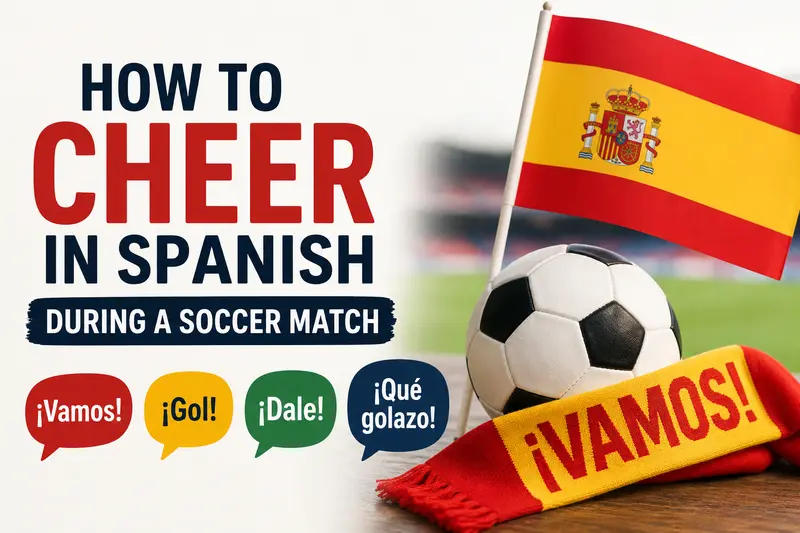
If you watch soccer in Spanish for even a little while, one thing becomes obvious: fans do not sound like a textbook.
They react fast. They yell short phrases. They repeat the same words. And in big moments, nobody stops to build a perfect sentence.
That is why learning how to cheer in Spanish during a soccer match is less about memorizing long lines and more about picking up the quick, real reactions people actually use when:
- their team attacks
- a shot goes wide
- the referee misses a foul
- or a goal changes everything
This guide focuses on practical Spanish you can actually hear and use:
- to cheer
- to react
- to praise
- to complain
- and to follow the emotional rhythm of a match
TL;DR
If you only learn a few soccer cheering phrases in Spanish first, start with these:
- ¡Vamos! = Come on! / Let’s go!
- ¡Dale! = Go on! / Come on!
- ¡Tira! = Shoot!
- ¡Gol! = Goal!
- ¡Qué golazo! = What a great goal!
- ¡Uy! = Oof! / Oh!
- ¡Qué pena! = What a pity! / Too bad!
- ¡Bien! = Good! / Nice!
- ¡Vamos, equipo! = Come on, team!
- ¡Eso es falta! = That’s a foul!
These are short, natural, and easy to use in real match moments.
Why soccer Spanish sounds different from normal textbook Spanish
A lot of beginner Spanish lessons focus on polite, complete sentences.
That makes sense for daily life, but sports language works differently.
During a match, people usually use:
- shorter phrases
- louder commands
- emotional reactions
- repeated words
- casual speech
For example, a textbook might teach:
- Vamos a apoyar al equipo.
But in a real match, fans are much more likely to shout:
- ¡Vamos!
- ¡Dale!
- ¡Vamos, vamos!
That is because soccer language is built for speed, emotion, and instant reaction.
The most useful phrases for cheering in Spanish during a soccer match
1. ¡Vamos!
Meaning: Come on! / Let’s go!
This is one of the safest and most useful cheering phrases in Spanish.
Fans use it when:
- the team needs energy
- a player is pushing forward
- the crowd wants to lift the team
- the match feels tense
Examples
- ¡Vamos!
- ¡Vamos, equipo!
- ¡Vamos, vamos!
This is the first phrase most learners should remember.
2. ¡Dale!
Meaning: Come on! / Go on! / Let’s go!
This is extremely common in many Spanish-speaking soccer contexts.
Fans use it when:
- a player has space
- the team is building an attack
- they want someone to keep going
- they want more intensity
Examples
- ¡Dale, dale!
- ¡Dale, que se puede!
The exact feel of dale can shift a bit by country, but in soccer it is broadly useful and very natural.
3. ¡Tira!
Meaning: Shoot!
This is what fans say when a player should stop hesitating and take the shot.
Fans use it when:
- someone is near the box
- there is a clear chance
- a player keeps passing instead of shooting
Examples
- ¡Tira!
- ¡Tira ya!
This is one of the most practical phrases to know because it comes up constantly in attacking moments.
4. ¡Pásala!
Meaning: Pass it!
Sometimes fans do not want the shot. They want the player to pass.
Fans use it when:
- a teammate is wide open
- a player is holding the ball too long
- the better option is clearly the pass
Examples
- ¡Pásala!
- ¡Pásala, pásala!
This is especially common in tense attacking sequences.
5. ¡Gol!
Meaning: Goal!
Simple, universal, essential.
You will hear this everywhere.
Examples
- ¡Gol!
- ¡Gooooool!
That stretched version is extremely common in live reactions and commentary too.
6. ¡Qué golazo!
Meaning: What a great goal!
A golazo is not just a goal. It is a brilliant goal.
Fans use this when:
- the shot is spectacular
- the goal is from far away
- the finish is especially beautiful
- the moment feels huge
Examples
- ¡Qué golazo!
- ¡Golazo!
This is one of the most fun words in soccer Spanish.
7. ¡Bien!
Meaning: Good! / Nice!
This is a quick reaction to a good play.
Fans say it after:
- a good pass
- a clean tackle
- a solid save
- smart defending
Examples
- ¡Bien!
- ¡Muy bien!
It is simple, but very useful.
8. ¡Uy!
Meaning: Oof! / Oh! / That was close!
This is a classic reaction sound in Spanish.
Fans use it when:
- the shot nearly goes in
- the player just misses
- the pass almost connects
- something dangerous nearly happens
Example
- ¡Uy!
Very short, very natural, very common.
9. ¡Qué pena!
Meaning: What a pity! / Too bad!
This is another common reaction when something almost works but does not.
Fans use it when:
- a shot goes just wide
- a chance is wasted
- a pass is slightly off
- a near goal does not happen
Example
- ¡Qué pena!
This is especially useful because it is also common outside soccer.
10. ¡Vamos, defensa!
Meaning: Come on, defense!
When the team is under pressure, fans often cheer specific parts of the team too.
Examples
- ¡Vamos, defensa!
- ¡Vamos, portero!
This is an easy pattern:
- ¡Vamos + position / player / team!
11. ¡Eso es falta!
Meaning: That’s a foul!
Fans do not only cheer. They complain too.
This is what you say when you think the referee missed a foul.
Examples
- ¡Eso es falta!
- ¡Fue falta!
This is one of the most useful complaint phrases during a match.
12. ¡No fue nada!
Meaning: That was nothing!
Sometimes fans disagree with the referee in the other direction.
They think the tackle was clean.
Example
- ¡No fue nada!
This is useful when the referee gives a foul and you think it was too soft.
13. ¡Árbitro!
Meaning: Ref! / Referee!
Fans shout this all the time, often when they are unhappy.
Examples
- ¡Árbitro!
- ¡Árbitro, por favor!
Usually the meaning depends completely on tone.
14. ¡Vamos, que se puede!
Meaning: Come on, you can do it! / Come on, it’s possible!
This is a strong support phrase when the team needs belief.
Fans use it when:
- the team is behind
- the last minutes are intense
- the crowd wants to push the team emotionally
Example
- ¡Vamos, que se puede!
This feels more motivational than just ¡Vamos!
15. ¡Otra, otra!
Meaning: Another one! / Again!
Fans use this after a good attack or after a goal when they want more.
Example
- ¡Otra, otra!
Short, natural, and energetic.
A few soccer words that help a lot
Even if your focus is cheering phrases, a few key nouns make match Spanish much easier to follow.
| Spanish | Meaning |
|---|---|
| el gol | goal |
| el partido | match |
| el árbitro | referee |
| la falta | foul |
| el penal / el penalti | penalty |
| la defensa | defense |
| el portero / arquero | goalkeeper |
| el delantero | striker / forward |
| el pase | pass |
| el tiro | shot |
These make reactions easier to understand and build.
Mini dialogues: what fans actually sound like
1. Big chance
- A: ¡Dale!
- B: ¡Tira!
- A: ¡Uy, qué pena!
English:
- Come on!
- Shoot!
- Oof, too bad!
2. Goal
- A: ¡Gol!
- B: ¡Qué golazo!
- A: ¡Vamos!
English:
- Goal!
- What a goal!
- Come on!
3. Referee complaint
- A: ¡Eso es falta!
- B: ¡Árbitro!
- A: ¡No fue nada!
English:
- That’s a foul!
- Ref!
- That was nothing!
These are much closer to real fan language than long classroom dialogues.
How to sound more natural when cheering in Spanish
1. Keep it short
Fans usually do not shout full grammatical sentences during live action.
These sound natural:
- ¡Vamos!
- ¡Tira!
- ¡Gol!
- ¡Uy!
2. Repeat when the moment is intense
Repetition is very normal in soccer reactions.
Examples
- ¡Vamos, vamos!
- ¡Dale, dale!
- ¡Tira, tira!
3. Match the emotion
The same phrase can sound supportive, angry, excited, or frustrated depending on:
- tone
- volume
- speed
4. Do not overthink perfect grammar
This is cheering language, not essay Spanish.
Fast, emotional, simple Spanish often sounds more natural here.
Common mistakes learners make
1. Trying to build full textbook sentences
That usually sounds too slow for live match reactions.
2. Translating English cheers word for word
Some direct translations sound unnatural or too formal.
3. Ignoring regional variation
Spanish soccer language can vary by country, but the short core phrases on this page are broadly useful.
4. Learning only nouns, not reactions
Knowing goal, referee, and penalty helps, but the real fun is in the reaction phrases.
How to practice these Spanish soccer cheers
A simple routine works best.
Try this
- Pick 5 phrases from this page.
- Say each one out loud three times.
- Watch a soccer highlight clip.
- Pause after each big moment.
- React using one of the phrases.
That kind of shadow-style reaction practice works well because the phrases are short and emotional.
If you want a broader base first, Spanish Conversation Practice and How to Learn Spanish Fast are good companion guides.
FAQ
What is the easiest way to cheer in Spanish during a soccer match?
The easiest phrase is ¡Vamos! because it is short, natural, and works in almost every match situation.
How do you say “shoot” in Spanish during a game?
A common fan reaction is ¡Tira!
How do you react to a great goal in Spanish?
A very common reaction is ¡Qué golazo!
How do you complain about a foul in Spanish?
You can say ¡Eso es falta! or ¡Fue falta!
Do Spanish-speaking fans use short phrases or full sentences?
Usually short phrases. Soccer reactions are fast, emotional, and repetitive.
Final thoughts
Learning how to cheer in Spanish during a soccer match is a fun way to study a side of Spanish that textbooks often miss.
These phrases are:
- short
- memorable
- emotional
- and connected to real life
That makes them easy to reuse.
You do not need to memorize everything at once.
Start with:
- ¡Vamos!
- ¡Dale!
- ¡Tira!
- ¡Gol!
- ¡Qué golazo!
Once those feel natural, add a few more.
The next time you watch soccer in Spanish, you will understand more than just the score. You will start hearing how fans actually react in the moment.