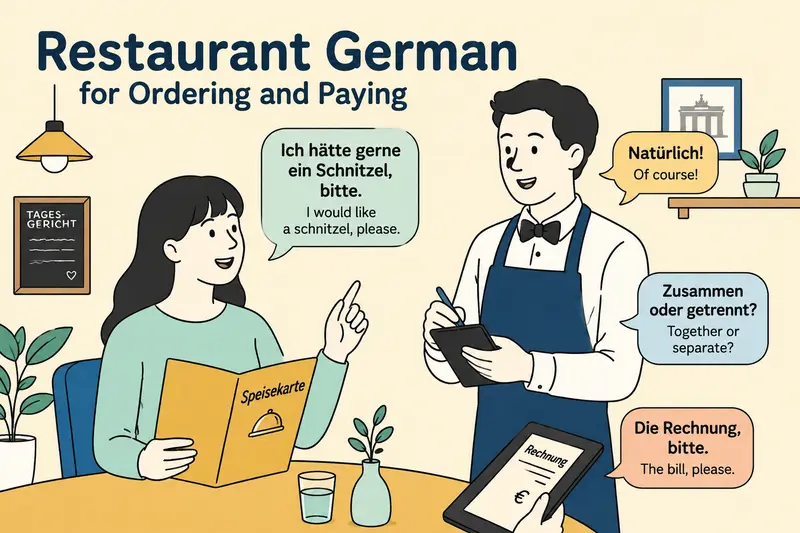
If you travel in Germany, Austria, or the German-speaking part of Switzerland, restaurant German is one of the most useful kinds of German to know.
You do not need perfect grammar to have a good meal. But it helps a lot if you can:
- ask for a table
- understand the most common menu questions
- order politely
- ask for the bill
- pay without awkward confusion
That is what this guide is for.
TL;DR
If you only learn a few restaurant phrases in German, start with these:
- Einen Tisch für zwei, bitte.
- Die Speisekarte, bitte.
- Ich hätte gern…
- Was empfehlen Sie?
- Die Rechnung, bitte.
- Kann ich mit Karte bezahlen?
- Zusammen oder getrennt?
- Stimmt so.
These cover a large part of a normal restaurant visit.
The most useful restaurant German phrases first
If you are in a hurry, memorize these before anything else.
| English | German | Pronunciation |
|---|---|---|
| A table for two, please. | Einen Tisch für zwei, bitte. | |
| The menu, please. | Die Speisekarte, bitte. | |
| I would like… | Ich hätte gern… | |
| What do you recommend? | Was empfehlen Sie? | |
| The bill, please. | Die Rechnung, bitte. | |
| Can I pay by card? | Kann ich mit Karte bezahlen? | |
| Together or separate? | Zusammen oder getrennt? | |
| Keep the change. | Stimmt so. |
How to get a table in German
This is the first real step in a restaurant.
| English | German | Pronunciation |
|---|---|---|
| Do you have a table for one? | Haben Sie einen Tisch für eine Person? | |
| A table for two, please. | Einen Tisch für zwei, bitte. | |
| We have a reservation. | Wir haben eine Reservierung. | |
| Under the name… | Auf den Namen… | |
| Is there a free table? | Ist ein Tisch frei? |
Best phrase to remember here
If you learn only one phrase for this stage, make it:
Einen Tisch für zwei, bitte.
You can easily change zwei to:
- eins
- drei
- vier
How to ask for the menu and understand the basics
Once you sit down, these are the most useful next phrases.
| English | German | Pronunciation |
|---|---|---|
| The menu, please. | Die Speisekarte, bitte. | |
| What do you recommend? | Was empfehlen Sie? | |
| What is today’s special? | Was ist das Tagesgericht? | |
| What is this? | Was ist das? | |
| Is this spicy? | Ist das scharf? | |
| Without meat, please. | Ohne Fleisch, bitte. | |
| I am vegetarian. | Ich bin Vegetarier / Vegetarierin. | |
| I am allergic to… | Ich bin allergisch gegen… |
If basic greeting etiquette still feels shaky, it also helps to review 10 Ways to Say Hello in German before travel situations like this.
How to order food naturally in German
The safest and most natural pattern is usually a polite request, not a direct command.
Best core pattern
Ich hätte gern…
This is one of the most useful restaurant phrases in German because you can use it again and again.
| English | German | Pronunciation |
|---|---|---|
| I would like… | Ich hätte gern… | |
| I’ll have the soup. | Ich hätte gern die Suppe. | |
| I’ll have the chicken. | Ich hätte gern das Hähnchen. | |
| I would like a coffee. | Ich hätte gern einen Kaffee. | |
| And to drink? | Und zum Trinken? | |
| I would like water. | Ich hätte gern Wasser. | |
| Still water | stilles Wasser | |
| Sparkling water | Sprudelwasser |
What to say if there is a problem with the food
This is the part many travel phrase lists forget.
Ordering is easy. Fixing a problem is harder.
| English | German | Pronunciation |
|---|---|---|
| This is not what I ordered. | Das habe ich nicht bestellt. | |
| This is cold. | Das ist kalt. | |
| I ordered without… | Ich habe ohne … bestellt. | |
| I can’t eat this. | Ich kann das nicht essen. | |
| Could you change this, please? | Könnten Sie das bitte ändern? |
How to ask for the bill in German
This is one of the most important parts of a restaurant visit.
The core phrase
Die Rechnung, bitte.
| English | German | Pronunciation |
|---|---|---|
| The bill, please. | Die Rechnung, bitte. | |
| Can I pay? | Kann ich bezahlen? | |
| Can I pay by card? | Kann ich mit Karte bezahlen? | |
| Cash only? | Nur bar? | |
| Together or separate? | Zusammen oder getrennt? | |
| Together, please. | Zusammen, bitte. | |
| Separate, please. | Getrennt, bitte. |
What to say when tipping
A very common phrase here is:
Stimmt so.
This means something like keep the change.
For example:
- the total is 18 euros
- you give 20 euros
- you say Stimmt so
| English | German | Pronunciation |
|---|---|---|
| Keep the change. | Stimmt so. | |
| Make it twenty. | Machen Sie zwanzig. |
A simple restaurant dialogue in German
Here is what a very normal restaurant exchange might sound like.
At the entrance
A: Guten Abend. Haben Sie einen Tisch für zwei?
B: Ja, natürlich. Hier entlang.
Ordering
A: Die Speisekarte, bitte.
B: Natürlich.
A: Was empfehlen Sie?
B: Das Tagesgericht ist sehr gut.
A: Gut, ich hätte gern das Tagesgericht und ein Wasser.
Paying
A: Die Rechnung, bitte.
B: Zusammen oder getrennt?
A: Zusammen, bitte.
B: Das macht achtundzwanzig Euro.
A: Kann ich mit Karte bezahlen?
B: Ja.
A: Stimmt so.
If you want more speaking-style practice beyond fixed travel phrases, German Chat Online: Practice Speaking Every Day and A fun way to do german speaking practice are good follow-ups.
The 12 restaurant German phrases most worth memorizing
If you want a true minimum useful set, start with these:
- Einen Tisch für zwei, bitte.
- Die Speisekarte, bitte.
- Ich hätte gern…
- Was empfehlen Sie?
- Ohne Fleisch, bitte.
- Ich bin allergisch gegen…
- Ist das scharf?
- Die Rechnung, bitte.
- Kann ich bezahlen?
- Kann ich mit Karte bezahlen?
- Zusammen oder getrennt?
- Stimmt so.
That is a much better memorization target than trying to learn fifty restaurant sentences at once.
Common mistakes travelers make in restaurants
1. Learning too many menu nouns and not enough sentence patterns
You do not need thirty dish names first.
You need strong sentence frames like:
- Ich hätte gern…
- Was empfehlen Sie?
- Die Rechnung, bitte.
2. Forgetting formal speech
In restaurants, Sie is usually the safe choice.
If that grammar point still feels unclear, German Pronouns Chart: Beginner-Friendly Guide with Examples helps with the core forms.
3. Knowing how to order, but not how to pay
Many phrase lists stop too early. Real restaurant German also includes:
- asking for the bill
- asking about card payment
- understanding separate payment
- tipping naturally
4. Translating directly instead of using standard travel phrases
Simple, common phrases usually sound more natural than word-for-word translation.
FAQ
What is the most useful German phrase for ordering food?
For most travelers, the most useful phrase is Ich hätte gern… because you can use it with many foods and drinks.
How do you ask for the bill in German?
The standard phrase is Die Rechnung, bitte.
How do you say “Can I pay by card?” in German?
Say Kann ich mit Karte bezahlen?
Is formal German necessary in restaurants?
Yes, usually. In restaurants, Sie is the safer and more polite form when speaking to staff.
How do you say “keep the change” in German?
A common phrase is Stimmt so.
Final thoughts
The value of restaurant German is not that it gives you every possible sentence.
It is that it helps you handle one very common real-life situation with much less stress.
The most useful phrases are the ones that solve actual tasks:
- getting a table
- reading the menu
- ordering clearly
- fixing a problem
- asking for the bill
- paying naturally
If you can do those things in simple German, your restaurant German is already genuinely useful on a real trip.
For a broader next step after restaurants, German Learning Resources to Study Smarter is a good place to keep building.