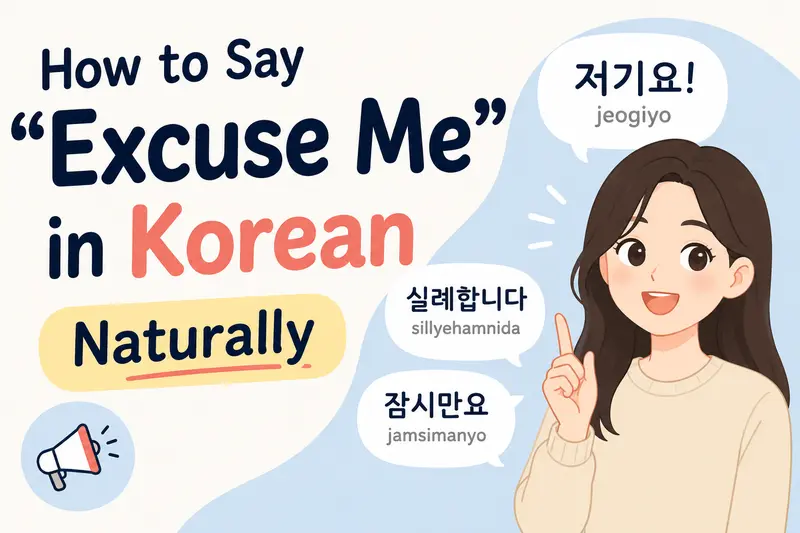
If you’ve learned English, you probably think “excuse me” is just one phrase.
In Korean, things work differently.
Depending on the situation, English speakers use “excuse me” to:
- getting someone’s attention
- politely interrupting
- walking through a crowd
- asking someone to move
- apologizing after bumping into someone
- calling a waiter
- asking someone to repeat themselves
Because of this, there isn’t a single Korean expression that works in every situation.
Instead, Korean has several common expressions, each with its own purpose.
In this guide, you’ll learn when to use 저기요, 실례합니다, 잠시만요, 잠깐만요, and 죄송합니다, so you can sound natural instead of translating directly from English.
TL;DR
If you only remember a few expressions, start with these:
| Situation | Korean |
|---|---|
| Get someone’s attention | 저기요 |
| Politely interrupt | 실례합니다 |
| Passing someone | 잠시만요 |
| Wait a moment | 잠깐만요 |
| Apologize politely | 죄송합니다 |
Each expression has a different job, so choosing the right one makes your Korean sound much more natural.
Korean pronunciation at a glance
Before learning when to use each expression, here’s how they’re pronounced.
| Korean | Romanization | Best use |
|---|---|---|
| 저기요 | jeogiyo | Getting someone’s attention |
| 실례합니다 | sillyehamnida | Politely interrupting |
| 잠시만요 | jamsimanyo | Just a moment / moving through a crowd |
| 잠깐만요 | jamkkanmanyo | Wait a second |
| 죄송합니다 | joesonghamnida | Polite apology |
Is there one Korean phrase for “excuse me”?
No.
This is one of the biggest surprises for beginners.
In English, “excuse me” can be used almost anywhere.
For example:
- Excuse me, where is the station?
- Excuse me, may I sit here?
- Excuse me, I need to get past.
- Excuse me, I didn’t hear you.
- Excuse me! (calling a waiter)
In Korean, these situations usually require different expressions.
Instead of memorizing one translation, think about why you’re saying “excuse me.”
Once you know the purpose, choosing the correct Korean phrase becomes much easier.
저기요 — Getting someone’s attention
The expression you’ll hear most often is:
저기요
It literally means something like:
Excuse me…
or
Hey, over there…
But in real life it simply gets another person’s attention politely.
Common situations include:
- asking a stranger for directions
- calling restaurant staff
- asking a question in a shop
- speaking to someone you’ve never met
Examples:
-
저기요, 서울역이 어디예요?
Excuse me, where is Seoul Station? -
저기요, 이것 좀 도와주세요.
Excuse me, could you help me?
Among all Korean expressions, 저기요 is probably the closest to the English “excuse me.”
How to call a waiter in Korean
Many travelers wonder how to call a waiter in Korea.
Unlike some countries, waving dramatically or shouting “Waiter!” is uncommon.
Instead, people usually say:
저기요
Restaurant staff hear 저기요 every day, so it sounds completely natural.
Culture tip: In Korea, politely saying 저기요! to get a server’s attention is standard restaurant etiquette. Unlike in some Western countries, this isn’t considered rude when said in a normal voice.
For example:
-
저기요!
-
저기요, 주문할게요.
Excuse me, we’d like to order. -
저기요, 계산 부탁드립니다.
Excuse me, we’d like the bill.
If you’re planning to eat out in Korea, this is one of the most useful Korean phrases you can learn.
실례합니다 — A formal “excuse me”
Another important phrase is:
실례합니다
Literally, it means something like:
Excuse my rudeness.
It sounds more formal than 저기요 and is common when:
- entering someone’s office
- interrupting a meeting
- speaking respectfully
- asking permission before disturbing someone
Example:
- 실례합니다. 잠시 이야기할 수 있을까요?
Excuse me. May I speak with you for a moment?
You may also hear it when entering a classroom or someone’s home.
Compared with 저기요, 실례합니다 feels more respectful and professional.
잠시만요 — Excuse me for a moment
Another expression you’ll hear everywhere is:
잠시만요
It literally means:
Just a moment.
Unlike 저기요, which attracts someone’s attention, 잠시만요 usually asks someone to wait or lets people know you’ll only take a moment.
Common situations include:
- walking through a crowded subway
- asking someone to wait
- briefly interrupting a conversation
- moving past people
Examples:
-
잠시만요. Excuse me for a moment.
-
잠시만요, 지나갈게요. Excuse me, I’m coming through.
-
잠시만요, 금방 올게요. Excuse me for a moment. I’ll be right back.
If you’re moving through a crowd, 잠시만요 is much more natural than 저기요.
잠깐만요 — Wait a second
A very similar phrase is:
잠깐만요
It also means:
Just a second.
Compared with 잠시만요, it sounds a little more casual.
You’ll hear it when:
- stopping someone
- asking someone to wait
- answering the phone
- talking with friends
Example:
- 잠깐만요! Wait just a second!
For beginners, both expressions are useful.
A simple rule is:
- 잠시만요 = slightly more polite
- 잠깐만요 = slightly more casual
Both are extremely common in daily conversation.
죄송합니다 — When “excuse me” is actually an apology
Sometimes English speakers say “excuse me” because they’ve accidentally inconvenienced someone.
For example:
- bumping into someone
- stepping on someone’s foot
- interrupting someone unexpectedly
In Korean, the natural expression is often:
죄송합니다
This literally means:
I’m sorry.
It is more polite than 미안합니다 and much more appropriate when speaking to strangers.
Examples:
-
죄송합니다. Excuse me. / I’m sorry.
-
죄송합니다. 길 좀 지나갈게요. Excuse me. I’d like to get through.
Notice that English might use “excuse me,” but Korean often switches to an apology instead.
If you’d like to learn the different levels of apology, see our guide to Sorry in Korean: Which Expression Should You Use?.
How to ask someone to repeat themselves
Sometimes English speakers say:
Excuse me?
when they didn’t hear what someone said.
Korean usually doesn’t use 저기요 or 실례합니다 here.
Instead, you’ll hear expressions like:
- 네?
- 다시 말씀해 주세요.
Examples:
네?
Sorry?
or
Pardon?
This is probably the most common response in everyday conversation.
A more polite version is:
다시 말씀해 주세요.
Could you say that again, please?
These expressions sound much more natural than translating “Excuse me?” directly.
Which Korean expression should you use?
Here’s a quick comparison.
| Situation | Best Korean phrase |
|---|---|
| Get a stranger’s attention | 저기요 |
| Call restaurant staff | 저기요 |
| Interrupt politely | 실례합니다 |
| Enter an office | 실례합니다 |
| Move through a crowd | 잠시만요 |
| Ask someone to wait | 잠시만요 or 잠깐만요 |
| Bump into someone | 죄송합니다 |
| Didn’t hear someone | 네? or 다시 말씀해 주세요. |
Instead of memorizing one translation, remember the situation.
That approach will make your Korean sound much more natural.
Real-life examples
Asking for directions
A: 저기요, 명동역이 어디예요?
B: 저쪽이에요.
Calling a waiter
A: 저기요!
B: 네, 주문하시겠어요?
Walking through a crowd
A: 잠시만요. 지나갈게요.
B: 네.
Entering an office
A: 실례합니다.
B: 들어오세요.
Bumping into someone
A: 죄송합니다!
B: 괜찮아요.
Common beginner mistakes
Using 저기요 for everything
Many beginners learn 저기요 first and then use it in every situation.
While it is useful, it doesn’t replace every English use of “excuse me.”
For example:
- walking through a crowd → 잠시만요
- entering someone’s office → 실례합니다
- apologizing → 죄송합니다
Choosing the right phrase sounds much more natural.
Saying 미안해 to strangers
미안해 is casual.
It’s fine with close friends and family, but not with people you’ve just met.
When speaking politely, 죄송합니다 is a much safer choice.
Forgetting speech levels
Many of these expressions are already polite.
If you’re unsure how Korean politeness works, our guide to Korean Honorifics Explained for Beginners explains when to use polite and formal speech.
Mini cheat sheet
If you’re in a hurry, this table covers the situations you’ll meet most often.
| Situation | Natural Korean |
|---|---|
| Get someone’s attention | 저기요 |
| Call a waiter | 저기요 |
| Enter someone’s office | 실례합니다 |
| Politely interrupt | 실례합니다 |
| Walk through a crowd | 잠시만요 |
| Ask someone to wait | 잠시만요 / 잠깐만요 |
| Apologize after bumping into someone | 죄송합니다 |
| Didn’t hear someone | 네? / 다시 말씀해 주세요. |
You don’t need to memorize every expression immediately. Start with 저기요, 잠시만요, and 죄송합니다. Those three alone cover many everyday situations.
Why this matters when learning Korean
Many beginners try to translate English directly into Korean.
That works for some words, but not for expressions like “excuse me.”
Korean speakers choose different phrases based on the situation:
- Are you trying to get someone’s attention?
- Are you interrupting politely?
- Are you moving through a crowd?
- Are you apologizing?
- Are you asking someone to wait?
Once you begin thinking this way, Korean starts to feel much more natural.
This is true for many common expressions. For example, English says “How are you?” in situations where Koreans often say something completely different. You can learn more in our guide to How to Say “How Are You?” in Korean Naturally.
This distinction between politeness and situation is one reason Korean can feel very different from English. The Korean language uses different speech levels and honorific forms to reflect social relationships, making context an important part of everyday communication.
Common situations travelers encounter
Here are a few examples of when you’ll naturally use these expressions in Korea.
At a restaurant
Call the server by saying:
저기요!
Not:
- Waiter!
- Excuse me!
On the subway
Trying to get off a crowded train?
Say:
잠시만요.
People will usually make space for you.
In a hotel or office
If you’re entering someone’s room or interrupting a conversation:
실례합니다.
This sounds polite and respectful.
After accidentally bumping into someone
Simply say:
죄송합니다.
Most people will respond with:
괜찮아요.
“It’s okay.”
Learn these next
If you’re building practical Korean conversation skills, these guides are a great next step:
- How to Say “How Are You?” in Korean Naturally
- How to Say “Good Night” in Korean Naturally
- How to Say “I Miss You” in Korean Naturally
- Sorry in Korean: Which Expression Should You Use?
- Thank You in Korean: How to Say It Correctly
- Korean Honorifics Explained for Beginners
- Korean Language Learning: Complete Guide
FAQ
How do you say “excuse me” in Korean?
There isn’t a single Korean translation. The most common expressions are 저기요, 실례합니다, 잠시만요, and 죄송합니다, depending on the situation.
What does 저기요 mean?
Literally, 저기요 points to someone or something “over there.” In everyday Korean, however, it functions like a polite “Excuse me” to get another person’s attention.
You’ll hear it frequently in restaurants, shops, and when asking strangers for help.
How do you call a waiter in Korean?
The most natural way is to say 저기요!
This is widely used in restaurants throughout Korea and sounds much more natural than calling out “waiter.”
What’s the difference between 저기요 and 실례합니다?
저기요 is mainly used to get someone’s attention.
실례합니다 is more formal and is used when politely interrupting someone or entering a room.
Should I say 미안해 or 죄송합니다?
If you’re speaking to someone you don’t know well, 죄송합니다 is the safer choice.
미안해 is casual and is usually reserved for friends, family, or people you’re close to.
Is 잠시만요 the same as 잠깐만요?
They’re very similar.
Both mean “just a moment.”
잠시만요 is slightly more polite, while 잠깐만요 sounds a bit more casual in everyday conversation.
Final thoughts
One of the biggest differences between English and Korean is that many everyday expressions depend on the situation rather than having a direct one-to-one translation. rather than having a single direct translation.
“Excuse me” is a perfect example.
Instead of memorizing one Korean phrase, remember the purpose behind what you’re trying to say.
If you want to:
- get someone’s attention, say 저기요
- interrupt politely, use 실례합니다
- move through a crowd, say 잠시만요
- apologize, choose 죄송합니다
Once you connect each expression to a real-life situation instead of translating directly from English, you’ll start recognizing these phrases naturally in restaurants, shops, offices, and everyday conversations.
That’s a much more effective way to learn Korean than memorizing isolated vocabulary lists.