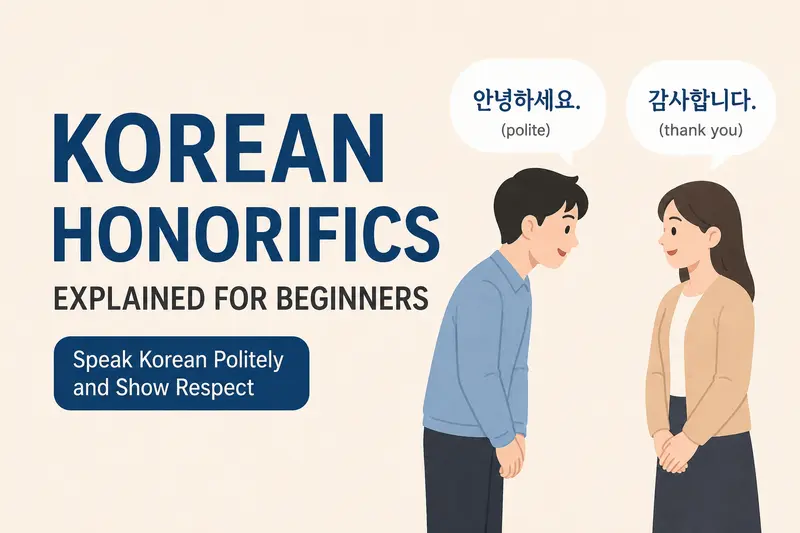
If Korean sometimes feels polite in a way that English does not, honorifics are a big reason why.
Many beginners notice this early. You learn one sentence, then see a slightly different version of the same sentence in a drama, textbook, or real conversation. Suddenly there is:
- a different verb ending
- a different word for the same person
- a different way to say “eat,” “sleep,” or “thank you”
- or a different tone depending on who is speaking to whom
That is not random. It is part of the Korean honorific system.
The good news is that Korean honorifics are easier to understand once you stop thinking of them as “extra grammar” and start thinking of them as relationship language. Korean often marks respect directly in the sentence.
This guide explains Korean honorifics for beginners in a practical way:
- what they are
- why Korean uses them
- how Korean honorifics work
- a useful Korean honorifics list with meanings
- which parts matter first
- and how to avoid the most common beginner mistakes
TL;DR
- Korean honorifics show respect through language
- They affect verb endings, vocabulary, titles, and sentence tone
- You usually need to think about:
- who you are talking to
- who you are talking about
- Beginners should learn these first:
- -요 style for polite everyday speech
- -습니다 style for formal speech
- basic honorific nouns and titles like 선생님
- common honorific verbs like 계시다, 드시다, and 드리다
- When unsure, polite speech is safer than casual speech
What are Korean honorifics?
Korean honorifics are language forms used to show respect.
They can appear in:
- verb endings
- special verbs
- titles
- pronouns
- family terms
- everyday word choice
In simple terms, Korean does not always say the same sentence the same way for every person.
For example, in English, you can say:
- “Are you eating?” to a friend
- “Are you eating?” to a teacher
- “Are you eating?” to a customer
The sentence stays basically the same whether you speak to a friend, teacher, or customer.
In Korean, the form often changes depending on:
- age
- social role
- distance
- formality
- whether the person deserves respect in that situation
That is why honorifics are so central to real Korean.
How do Korean honorifics work?
The easiest way to understand Korean honorifics is to break them into two parts.
1. Respect toward the listener
This is usually shown through speech level.
Examples:
- casual speech
- polite -요 speech
- formal -습니다 speech
2. Respect toward the person you are talking about
This is shown through:
- honorific verb forms
- respectful titles
- certain honorific nouns
- markers like -(으)시-
That means Korean can show respect in more than one direction at the same time.
You might:
- speak politely to the listener
- while also using honorific language for the person being discussed
That is why Korean honorifics feel bigger than just verb endings.
Why does Korean use honorifics so much?
Because Korean pays close attention to social relationships.
The language often reflects:
- older vs younger
- senior vs junior
- stranger vs close friend
- teacher, boss, or customer vs a casual acquaintance
- respect toward the person being talked about
This does not mean Korean speakers are constantly stiff or formal. It means the language gives them clear tools to show the right level of respect.
That is also why Korean politeness shows up in many beginner topics, including thank you in Korean: how to say it correctly and how to say sorry in Korean with cultural context.
The two beginner questions that matter most
When choosing an honorific form, beginners should ask two simple questions:
1. Who am I talking to?
This affects your speech level.
2. Who am I talking about?
This affects whether you need honorific vocabulary or honorific verb forms.
Those are not the same thing.
You can speak politely to your teacher even when talking about yourself.
You can also speak casually to a friend while respectfully talking about your friend’s mother or your teacher.
This is the key idea that makes Korean honorifics easier to understand.
First layer: speech levels
The easiest place to start is not special verbs. It is speech level.
For beginners, the most important three are:
1. Casual speech
Used with:
- close friends
- younger people
- people you are very comfortable with
Example:
- 먹어 = eat / eat it
2. Polite speech (-요 style)
Used with:
- most everyday conversations
- classmates you are not close to
- coworkers in many situations
- strangers
- general safe conversation
Example:
- 먹어요 = eat / are eating
3. Formal speech (-습니다 style)
Used with:
- presentations
- interviews
- announcements
- customer service
- formal public situations
Example:
- 먹습니다 = eat / am eating
For most beginners, -요 style is the most useful first target because it is polite without sounding too stiff.
Korean honorifics for friends
This is a very common beginner question.
The short answer is: you usually do not use heavy honorific language with close friends.
With close friends, Korean often uses:
- casual endings
- fewer titles
- more relaxed vocabulary
For example:
- 어디 가? = Where are you going?
- 밥 먹었어? = Did you eat?
But there is an important detail.
Not all friends are the same. Korean still pays attention to:
- age
- closeness
- school or workplace hierarchy
- whether the friendship is actually casual yet
So Korean honorifics for friends depend on the real relationship.
A younger learner may still speak politely to an older friend at first.
Two classmates may start in -요 style and move to casual speech later.
So the better beginner rule is:
Use casual speech only when the relationship really allows it.
Is polite Korean the same as honorific Korean?
Not exactly.
This is one of the most important beginner distinctions.
Polite speech
Shows respect to the listener
Honorific forms
Show respect to the person being talked about
Sometimes both happen in the same sentence.
For example, you may speak politely to someone and also use an honorific verb because the subject of the sentence deserves respect.
So honorifics and politeness overlap, but they are not identical.
The honorific marker -(으)시-
One of the most important grammar pieces in Korean honorifics is:
-(으)시-
This marker is often added to a verb when the subject deserves respect.
Basic idea
-
가다 = to go
-
가세요 = please go / go (honorific-polite depending on context)
-
먹다 = to eat
-
드세요 = eat (honorific form, often with a special verb too)
-
있다 = to be / exist
-
계시다 = honorific version of 있다
You do not need to master every rule at once. At beginner level, it is enough to notice this pattern:
When the person doing the action deserves respect, Korean often adds an honorific layer.
Korean honorifics list: common words and meanings
If you searched for a Korean honorifics list, this is the most useful beginner set to know first.
| Plain form | Honorific / respectful form | Meaning |
|---|---|---|
| 있다 | 계시다 | to be / stay |
| 먹다 / 마시다 | 드시다 | to eat / drink |
| 주다 | 드리다 | to give humbly to someone respected |
| 말하다 | 말씀하시다 / 말씀드리다 | to speak |
| 집 | 댁 | house / home |
| 이름 | 성함 | name |
| 나이 | 연세 | age |
| 생일 | 생신 | birthday |
| 밥 | 식사 | meal / food |
| 선생 | 선생님 | teacher |
| 교수 | 교수님 | professor |
| 고객 | 고객님 | customer |
This is not every Korean honorific, but it is a strong practical list for beginners.
Common honorific verbs beginners should know
These are more useful than long theory.
1. 있다 → 계시다
- 있다 = to be, to stay
- 계시다 = honorific version
Example:
- 선생님이 교실에 계세요.
The teacher is in the classroom.
This sounds more respectful than using plain 있다.
2. 먹다 / 마시다 → 드시다
- 먹다 = to eat
- 마시다 = to drink
- 드시다 = honorific form for eat/drink
Example:
- 할아버지께서 식사하세요.
- 할아버지께서 드세요.
Both are respectful ways to say that grandfather is eating.
At beginner level, just remember that when respected people eat or drink, Korean often switches to a special form.
3. 주다 → 드리다
This one is very important because it changes direction.
- 주다 = to give
- 드리다 = humble form, used when you give to someone respected
Example:
- 선생님께 드렸어요.
I gave it to the teacher.
This does not mean the teacher is “giving.” It means I lower my action respectfully toward them.
4. 말하다 → 말씀하시다 / 말씀드리다
This is a useful pair:
- 말씀하시다 = honorific, when a respected person speaks
- 말씀드리다 = humble, when I speak to a respected person
This can feel advanced at first, but the pattern is helpful:
- raise the respected person
- lower your own action politely
Korean honorific nouns and titles
Honorifics are not only about verbs.
Korean also uses respectful titles instead of direct names in many situations.
Common examples
- 선생님 = teacher / sir / ma’am in some contexts
- 교수님 = professor
- 사장님 = company boss / owner
- 어머님 / 아버님 = honorific forms for mother / father in certain contexts
- 고객님 = customer
You will notice that -님 appears a lot.
What does -님 do?
-님 adds respect.
Examples:
- 선생 → 선생님
- 교수 → 교수님
- 어머니 → 어머님 in some contexts
This is one of the most visible honorific markers in Korean.
What does -씨 mean in Korean honorifics?
This comes up a lot because many learners see it early.
-씨 is a polite name suffix, often attached to a person’s given name or full name.
Examples:
- 민수 씨
- 김민수 씨
It is respectful, but it is not the same level as -님.
A simple beginner rule:
- -씨 = polite, common, but more neutral
- -님 = higher respect
So if you are wondering about “ssi in Korean honorifics meaning,” the short answer is:
-씨 is a polite suffix used with names, but it is lighter and less elevated than -님.
Why beginners should be careful with “you”
English uses “you” constantly.
Korean often avoids direct second-person pronouns more than English does, especially in polite situations.
That means instead of saying “you,” Korean speakers often use:
- a title
- a name plus title
- or no subject at all when context is clear
For example, instead of saying:
- “Did you eat?”
a learner may hear:
- 식사하셨어요?
- 선생님, 식사하셨어요?
This is one reason Korean can feel different from English sentence habits.
Family terms and honorific feeling
Family words in Korean also carry respect.
For example, the way you refer to:
- your mother
- someone else’s mother
- an older sibling
- a parent-in-law
- or another person’s father
may change depending on social perspective and respect.
That is one reason family vocabulary matters so much in Korean. It is not just nouns. It is relationship language.
Typical honorific situations beginners meet early
You do not need to learn everything at once. Start with common real-life situations.
1. Speaking to a teacher
Usually polite or formal
Often includes honorific verbs
2. Speaking to a store worker or stranger
Usually -요 style is safe
3. Speaking to close friends
Casual speech is common
4. Talking about your teacher, boss, grandparents, or someone else’s parents
Honorific forms often appear even if the listener is not formal
5. Customer service language
Often uses very respectful forms
A simple beginner comparison
Here is the kind of contrast learners need to notice early.
Casual
- 어디 가?
Where are you going?
Polite
- 어디 가요?
Where are you going?
Honorific-polite
- 어디 가세요?
Where are you going?
The third version adds respect toward the subject.
Another example:
Casual
- 밥 먹어?
Are you eating?
Polite
- 밥 먹어요?
Are you eating?
Honorific-polite
- 식사하세요?
Are you eating? / Have you eaten?
This is why Korean honorifics often feel like multiple systems at once:
- formality
- respect
- word choice
- relationship
The easiest beginner strategy
Do not try to memorize every honorific form on day one.
Use this order instead:
Step 1
Master -요 speech first
Step 2
Learn common respectful titles:
- 선생님
- 교수님
- 사장님
Step 3
Notice common honorific verbs:
- 계시다
- 드시다
- 주시다
- 드리다
Step 4
Pay attention to who the sentence is about
That is enough to make real progress.
Common beginner mistakes
1. Using casual speech too early
Some learners hear casual Korean in dramas and start copying it everywhere.
That can sound rude very quickly.
For beginners, polite speech is much safer.
2. Thinking honorifics are only about endings
They also affect:
- nouns
- titles
- verbs
- pronoun choices
- overall tone
3. Using “you” too directly
Korean often prefers a title or no explicit pronoun.
4. Mixing up polite speech and honorific speech
These overlap, but they are not the same thing.
5. Treating every older person the same way
Korean respect is not only about age. It also depends on:
- closeness
- context
- workplace hierarchy
- formality of the setting
Do you need honorifics to speak Korean well?
Yes, at least at a practical level.
You do not need to become an expert immediately. But you do need enough honorific awareness to:
- avoid sounding rude
- understand why sentences change
- choose a safe speech level
- recognize respectful language in real life
Without that, Korean can feel confusing very quickly.
That is one reason honorifics belong in any broader guide to Korean language learning: complete guide.
A good mindset for learning Korean honorifics
Do not treat them as a giant list of rules.
Treat them as answers to one question:
What is the relationship in this moment?
Once you ask that, the system makes more sense.
- friend → casual possible
- stranger → polite safer
- teacher → respectful form likely
- customer service → formal or honorific-heavy
- talking about respected people → honorific vocabulary often needed
That is much easier than trying to memorize everything as isolated grammar.
Mini cheat sheet
| Situation | Safe beginner choice |
|---|---|
| speaking to a stranger | -요 style |
| speaking to a teacher | -요 or formal, plus respectful terms |
| speaking to a close friend | casual speech |
| talking about a respected person | consider honorific verb forms |
| when unsure | choose the more polite form |
FAQ
What are Korean honorifics in simple terms?
They are language forms used to show respect in Korean.
Are Korean honorifics only for older people?
No. They are often used for older people, but also for teachers, bosses, customers, strangers, and anyone who deserves respect in that situation.
Is -요 always an honorific?
Not exactly. -요 is mainly a polite speech ending. It shows respect to the listener, but it is not the whole honorific system by itself.
What is the most important Korean honorific for beginners?
The most important first step is learning polite -요 speech and understanding when not to use casual speech.
Do I need to learn formal speech immediately?
Not everything at once. For most beginners, polite -요 speech comes first, then formal -습니다 style later.
Final thoughts
Korean honorifics can look overwhelming at first because they seem to change many parts of the language at once.
But the core idea is actually simple:
Korean marks respect more clearly than English does.
Once you understand that, honorifics stop feeling random.
Start with:
- polite speech
- respectful titles
- a few common honorific verbs
- and the habit of asking who is being respected in the sentence
That gives you a strong foundation.
And once that foundation is in place, Korean starts to sound much more logical.