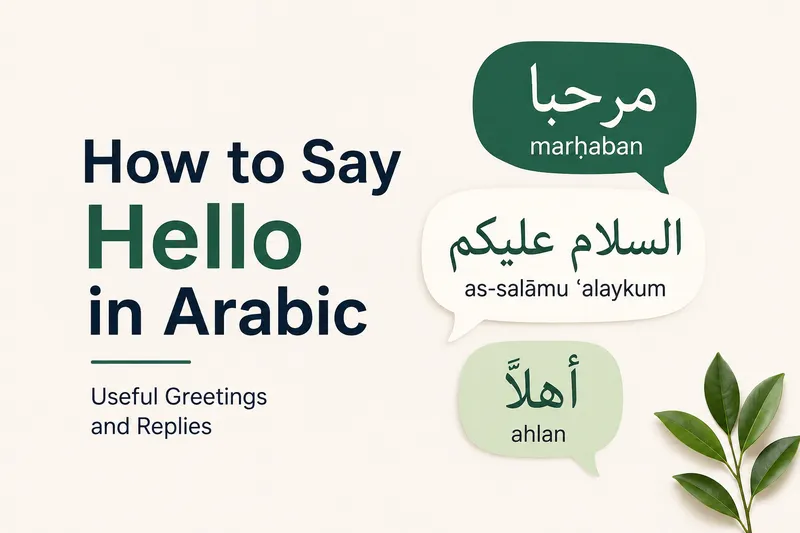
There are several ways to say hello in Arabic, but two greetings are especially useful for beginners:
مرحبًا — marḥaban — Hello
and:
السلام عليكم — as-salāmu ʿalaykum — Peace be upon you
مرحبًا (marḥaban) is a straightforward, widely understood way to say hello. السلام عليكم (as-salāmu ʿalaykum) is an extremely widespread traditional greeting whose literal meaning is peace be upon you.
But Arabic is spoken across many countries and communities, so there isn’t just one everyday greeting you’ll hear everywhere.
You’ll also encounter أهلاً (ahlan), time-specific greetings such as صباح الخير (ṣabāḥ al-khayr), and many regional expressions.
This guide will show you the most useful Arabic greetings, how to pronounce them, and — just as importantly — how to reply.
Table of Contents
Open Table of Contents
- How to Say Hello in Arabic: Quick Guide
- 1. مرحبًا — Marhaban — Hello
- How Do You Pronounce مرحبًا?
- 2. السلام عليكم — As-Salamu Alaykum
- 3. وعليكم السلام — The Reply to As-Salamu Alaykum
- 4. أهلاً — Ahlan — Hi / Hello
- 5. أهلاً وسهلاً — Ahlan wa-Sahlan
- 6. صباح الخير — Good Morning in Arabic
- 7. صباح النور — The Reply to Good Morning
- 8. مساء الخير — Good Evening in Arabic
- 9. مساء النور — The Reply to Good Evening
- 10. ألو — Hello on the Phone
- How Do You Say “How Are You?” in Arabic?
- How Do You Reply to “How Are You?”
- Modern Standard Arabic vs. Spoken Arabic Greetings
- Do People Say Marhaban Everywhere?
- Egyptian, Levantine, and Gulf Arabic Greetings
- How to Introduce Yourself After Saying Hello
- How to Say Goodbye in Arabic
- Common Mistakes When Saying Hello in Arabic
- The 5 Arabic Greetings to Learn First
- Arabic Greeting Mini-Conversation
- FAQ
- How do you say hello in Arabic?
- What does marhaban mean?
- What does as-salamu alaykum mean?
- How do you reply to as-salamu alaykum?
- How do you say hi in Arabic?
- How do you say good morning in Arabic?
- How do you say good evening in Arabic?
- Is marhaban formal or informal?
- Can non-Muslims say as-salamu alaykum?
- Is Arabic the same in every country?
- Final Thoughts
How to Say Hello in Arabic: Quick Guide
| Arabic | Transliteration | Meaning / use |
|---|---|---|
| مرحبًا | marḥaban | Hello |
| السلام عليكم | as-salāmu ʿalaykum | Peace be upon you |
| وعليكم السلام | wa ʿalaykum as-salām | Reply to as-salāmu ʿalaykum |
| أهلاً | ahlan | Hi / Hello |
| أهلاً وسهلاً | ahlan wa-sahlan | Welcome / Hello |
| صباح الخير | ṣabāḥ al-khayr | Good morning |
| صباح النور | ṣabāḥ an-nūr | Common reply to good morning |
| مساء الخير | masāʾ al-khayr | Good evening |
| مساء النور | masāʾ an-nūr | Common reply to good evening |
| ألو | alō | Hello on the phone |
If you only want one neutral Arabic word for hello, start with مرحبًا (marḥaban).
If someone greets you with السلام عليكم, learn its reply at the same time:
وعليكم السلام (wa ʿalaykum as-salām).
1. مرحبًا — Marhaban — Hello
One of the easiest Arabic greetings for beginners is:
مرحبًا
marḥaban
Hello
Marḥaban is widely understood across the Arabic-speaking world and is a useful neutral greeting to learn.
You can use it when:
- meeting someone
- greeting a stranger
- entering a shop
- talking to hotel staff
- starting a conversation
- introducing yourself
For example:
مرحبًا، اسمي سارة
Marḥaban, ismī Sārah.
Hello, my name is Sarah.
How Do You Pronounce مرحبًا?
مرحبًا is commonly transliterated:
marḥaban
The ḥ represents the Arabic letter ح, which doesn’t have an exact English equivalent.
Rather than replacing it with an English sound, listen to the Arabic pronunciation:
As a beginner, don’t worry if your pronunciation isn’t perfect immediately.
It is better to imitate a clear Arabic recording than to depend entirely on English-looking spellings.
2. السلام عليكم — As-Salamu Alaykum
One of the most important greetings you’ll encounter in Arabic is:
السلام عليكم
as-salāmu ʿalaykum
Its literal meaning is:
Peace be upon you.
The greeting is strongly associated with Islamic tradition and is used by Muslims far beyond Arabic-speaking countries. It is also deeply established in Arabic-speaking communities.
If someone says السلام عليكم to you, the key thing to know is the reply.
3. وعليكم السلام — The Reply to As-Salamu Alaykum
The standard response is:
وعليكم السلام
wa ʿalaykum as-salām
And peace be upon you.
So learn these two phrases as a pair:
A: السلام عليكم
B: وعليكم السلام
This is more useful than memorizing السلام عليكم by itself.
4. أهلاً — Ahlan — Hi / Hello
Another common greeting is:
أهلاً
ahlan
Depending on context, ahlan can correspond to:
Hi
Hello
or a warm expression of welcome.
It is short and useful, and you’ll encounter it frequently in Arabic greetings.
For a beginner, think of these three as your core options:
مرحبًا — marḥaban
السلام عليكم — as-salāmu ʿalaykum
أهلاً — ahlan
You don’t need to choose one phrase and ignore the others. Learn to recognize all three.
5. أهلاً وسهلاً — Ahlan wa-Sahlan
A warmer expression is:
أهلاً وسهلاً
ahlan wa-sahlan
You’ll often see it translated as:
Welcome
It can also function as a warm greeting.
You may hear أهلاً وسهلاً when someone welcomes you into a home, business, hotel, or other setting.
Instead of trying to translate every individual word, learn أهلاً وسهلاً as a complete expression.
6. صباح الخير — Good Morning in Arabic
To say good morning, use:
صباح الخير
ṣabāḥ al-khayr
A natural translation is:
Good morning.
The phrase literally contains صباح (ṣabāḥ), meaning morning, and الخير (al-khayr), associated with goodness or well-being.
But there’s something more interesting for learners: Arabic has a common response to this greeting.
7. صباح النور — The Reply to Good Morning
If someone says:
صباح الخير
you may reply:
صباح النور
ṣabāḥ an-nūr
نور (nūr) means light.
Rather than translating the phrase mechanically into English, learn this greeting-response pair:
A: صباح الخير
B: صباح النور
Listen to them one after the other:
Learning greetings together with their replies makes it much easier to handle an actual conversation.
8. مساء الخير — Good Evening in Arabic
Later in the day, another useful greeting is:
مساء الخير
masāʾ al-khayr
It means:
Good evening.
As with صباح الخير, there is a common reply built around نور (nūr) — light.
9. مساء النور — The Reply to Good Evening
A common response to مساء الخير is:
مساء النور
masāʾ an-nūr
So another useful pair is:
A: مساء الخير
B: مساء النور
You don’t have to use a time-specific greeting every time. مرحبًا remains a useful general-purpose hello.
10. ألو — Hello on the Phone
When answering the phone, you may hear:
ألو
alō
This is similar in function to saying hello? when answering a phone call in English.
It’s useful to recognize, but it isn’t the first greeting you need for face-to-face conversations.
For ordinary beginner conversations, prioritize:
مرحبًا
السلام عليكم
أهلاً
How Do You Say “How Are You?” in Arabic?
After saying hello, you may want to ask:
كيف حالك؟
kayfa ḥāluka / kayfa ḥāluki
How are you?
Here’s an important feature of Arabic: the form and pronunciation can depend on the gender of the person you’re addressing.
In Modern Standard Arabic, the ending is commonly pronounced differently when speaking to a man or a woman:
كيف حالكَ؟ — kayfa ḥāluka? — to a man
كيف حالكِ؟ — kayfa ḥāluki? — to a woman
Without vowel marks, both may appear as:
كيف حالك؟
Spoken dialects also have their own everyday ways of asking how someone is doing.
For now, كيف حالك؟ is a useful form to recognize.
How Do You Reply to “How Are You?”
A simple answer is:
بخير شكراً
bi-khayr shukran
Fine, thank you.
You may also hear:
الحمد لله
al-ḥamdu lillāh
This literally expresses praise to God and is extremely common in many Arabic-speaking communities when talking about how things are going.
A simple exchange might therefore be:
A: مرحبًا
Hello.
B: أهلاً
Hi.
A: كيف حالك؟
How are you?
B: بخير شكراً
Fine, thank you.
Modern Standard Arabic vs. Spoken Arabic Greetings
This is one of the most important things for beginners to understand.
Arabic is not spoken identically everywhere.
Modern Standard Arabic, often abbreviated MSA, is the standardized variety you’ll encounter in formal writing, news, education, and many learning materials.
Everyday conversation, however, usually takes place in regional varieties of Arabic.
These include, among others:
- Egyptian Arabic
- Levantine Arabic
- Gulf Arabic
- Iraqi Arabic
- Maghrebi varieties
- Sudanese Arabic
And there is variation within those broad groups too.
This means two things can be true at once:
- A phrase can be correct and widely understood Arabic.
- Native speakers may normally use a different expression in casual conversation where they live.
That’s why this guide emphasizes widely understood greetings while also helping you recognize that real spoken Arabic varies.
Do People Say Marhaban Everywhere?
مرحبًا (marḥaban) is widely understood, which makes it excellent for beginners.
But that doesn’t mean every Arabic speaker uses marḥaban as their most frequent casual greeting.
Depending on the country, dialect, age, and situation, you may hear other forms more often.
For example, أهلاً (ahlan) is extremely useful:
And السلام عليكم crosses many regional boundaries:
For a beginner, recognition is more important than trying to sound as if you come from a particular region immediately.
Egyptian, Levantine, and Gulf Arabic Greetings
Once you begin listening to native speakers, you’ll quickly notice that conversational Arabic differs from textbook MSA.
Rather than trying to memorize dozens of regional greetings immediately, start by recognizing the broad pattern.
Egyptian Arabic
In Egypt, you’ll hear familiar greetings such as:
السلام عليكم
and:
أهلاً
alongside distinctly Egyptian conversational expressions.
Levantine Arabic
Across places such as Lebanon, Syria, Jordan, and Palestine, أهلاً is common, and spoken conversations contain many forms characteristic of Levantine Arabic.
Gulf Arabic
Across Gulf countries, السلام عليكم is especially useful to recognize, alongside local greeting expressions and pronunciation patterns.
The important lesson isn’t that each region has exactly one greeting.
It’s that Arabic has substantial regional variation, so you should learn a dialect based on where you plan to travel, live, work, or communicate once you move beyond the basics.
How to Introduce Yourself After Saying Hello
After greeting someone, one of the easiest things to say is:
اسمي سارة
ismī Sārah
My name is Sarah.
The useful pattern is:
اسمي + your name
اسمي means my name is.
So you could begin:
مرحبًا، اسمي سارة
Hello, my name is Sarah.
The audio text remains punctuation-free:
Another useful expression is:
تشرفت بلقائك
tasharraftu biliqāʾik
It conveys the idea of:
Pleased to meet you.
Don’t worry about learning an entire introduction on your first day.
A simple:
مرحبًا
followed by:
اسمي…
already gives you a practical starting point.
How to Say Goodbye in Arabic
A widely useful way to say goodbye is:
مع السلامة
maʿa as-salāmah
It is commonly translated as:
Goodbye.
Another expression you may encounter is:
إلى اللقاء
ilā al-liqāʾ
See you / Until we meet again.
For a beginner, you could therefore learn:
مرحبًا — hello
and:
مع السلامة — goodbye
as a useful pair.
Common Mistakes When Saying Hello in Arabic
Assuming Arabic Has Only One Word for Hello
There isn’t a single greeting that replaces every English use of hi and hello.
You’ll encounter:
مرحبًا
السلام عليكم
أهلاً
and many regional expressions.
Start with a few high-frequency greetings rather than trying to force every situation into one translation.
Forgetting the Reply to السلام عليكم
If you learn:
السلام عليكم
learn this at the same time:
وعليكم السلام
Greeting-response pairs are much more useful in real conversations than isolated words.
Assuming Modern Standard Arabic Is Everyday Spoken Arabic
MSA is enormously useful and widely understood, but everyday spoken Arabic varies by region.
Don’t be surprised if the Arabic you hear in Cairo sounds different from what you hear in Beirut, Amman, Dubai, or Casablanca.
Ignoring Arabic Sounds That Don’t Exist in English
Arabic contains consonants that English does not.
For example, transliteration systems often use characters such as ḥ and ʿ to represent Arabic sounds.
English approximations can help you recognize a word, but don’t let them replace listening practice.
Use the audio in this article and imitate the Arabic directly.
Trying to Learn Every Dialect at Once
You don’t need to.
Begin with widely understood greetings.
Once you know which Arabic-speaking region matters most to you, you can start focusing on its spoken variety.
The 5 Arabic Greetings to Learn First
If the whole article feels like too much, start with these five.
مرحبًا
marḥaban
Hello
السلام عليكم
as-salāmu ʿalaykum
Peace be upon you
وعليكم السلام
wa ʿalaykum as-salām
And peace be upon you
صباح الخير
ṣabāḥ al-khayr
Good morning
مساء الخير
masāʾ al-khayr
Good evening
Once these feel familiar, add أهلاً, صباح النور, مساء النور, and كيف حالك.
Arabic Greeting Mini-Conversation
Here’s a short conversation using several expressions from this guide.
A: السلام عليكم
Peace be upon you.
B: وعليكم السلام
And peace be upon you.
A: كيف حالك؟
How are you?
B: بخير شكراً
Fine, thank you.
Even this small amount of Arabic is enough to recognize and participate in a basic greeting exchange.
FAQ
How do you say hello in Arabic?
One straightforward way to say hello in Arabic is:
مرحبًا — marḥaban
Another extremely widespread greeting is السلام عليكم (as-salāmu ʿalaykum), meaning peace be upon you.
What does marhaban mean?
مرحبًا (marḥaban) means hello and is widely understood across the Arabic-speaking world.
What does as-salamu alaykum mean?
السلام عليكم (as-salāmu ʿalaykum) means peace be upon you.
It is a traditional Islamic greeting and is widely used in Arabic-speaking communities.
How do you reply to as-salamu alaykum?
Reply:
وعليكم السلام
wa ʿalaykum as-salām
It means and peace be upon you.
How do you say hi in Arabic?
أهلاً (ahlan) is one useful way to express hi or hello.
مرحبًا (marḥaban) is another widely understood option.
How do you say good morning in Arabic?
Say:
صباح الخير
ṣabāḥ al-khayr
A common reply is صباح النور (ṣabāḥ an-nūr).
How do you say good evening in Arabic?
Say:
مساء الخير
masāʾ al-khayr
A common reply is مساء النور (masāʾ an-nūr).
Is marhaban formal or informal?
Marḥaban is a widely understood neutral greeting and can work in many situations.
However, actual greeting choices vary by country, dialect, community, and context.
Can non-Muslims say as-salamu alaykum?
As-salāmu ʿalaykum is an Islamic greeting, but it is also part of everyday linguistic life in many Arabic-speaking communities.
If you’re uncertain about the social setting, مرحبًا (marḥaban) is an easy neutral greeting to use.
Is Arabic the same in every country?
No.
Modern Standard Arabic provides a shared standardized form, while everyday spoken Arabic varies considerably across regions.
Egyptian, Levantine, Gulf, Iraqi, Maghrebi, and other varieties can differ in pronunciation, vocabulary, and everyday expressions.
Final Thoughts
If you’re learning how to say hello in Arabic, begin with:
مرحبًا
marḥaban — hello
Then learn the important greeting-response pair:
السلام عليكم
وعليكم السلام
From there, add أهلاً, صباح الخير, صباح النور, مساء الخير, and مساء النور.
The key is not to memorize dozens of greetings at once. Learn a few expressions you can recognize immediately, listen to how they’re pronounced, and then pay attention to the spoken Arabic used in the region that matters to you.
مع السلامة!