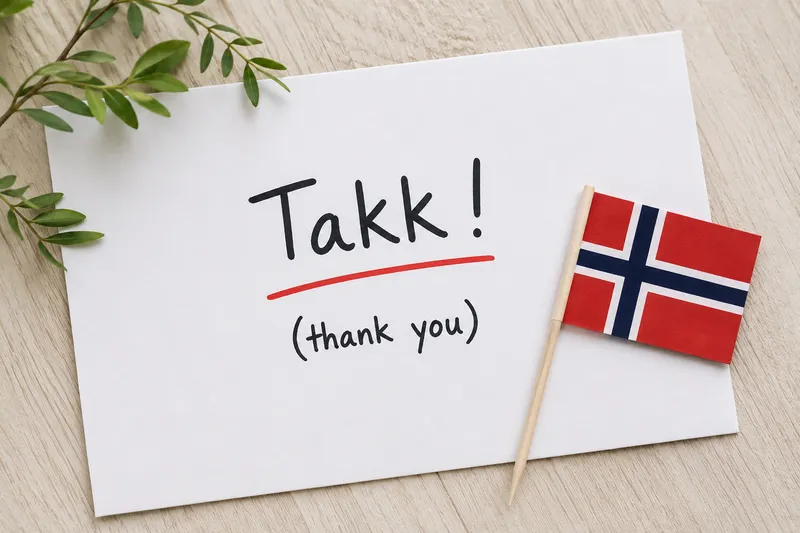
The simplest way to say thank you in Norwegian is takk.
Takk works in many of the same situations as English thanks or thank you. You can use it when someone gives you something, helps you, serves you at a café, or does you a favor.
If you want to sound more appreciative, say tusen takk, which means thank you very much or thanks a lot.
Those two expressions will cover most everyday situations, but Norwegian has several other useful ways to express gratitude.
How to Say Thank You in Norwegian: Quick Guide
| Norwegian | English | When to use it |
|---|---|---|
| Takk | Thank you / Thanks | Almost any everyday situation |
| Tusen takk | Thank you very much | When you want to show more gratitude |
| Mange takk | Many thanks / Thanks a lot | Warm or slightly more emphatic thanks |
| Takk skal du ha | Thank you / Thanks a lot | Directly thanking someone |
| Takk for hjelpen | Thanks for the help | After someone helps you |
| Takk for maten | Thanks for the food | After a meal |
| Takk for i dag | Thanks for today | At the end of time spent together |
| Takk for sist | Thanks for last time | When meeting someone again |
| Ja, takk | Yes, please | Politely accepting something |
| Nei, takk | No, thank you | Politely declining something |
Let’s look at how these expressions are actually used.
1. Takk — Thank You
Takk is the most important Norwegian word for saying thank you.
It is short, natural, and extremely versatile.
You might say takk when:
- someone holds a door for you
- a waiter brings your coffee
- someone gives you directions
- a friend gives you a gift
- someone answers your question
For example:
Her er kaffen din. — Here’s your coffee.
Takk! — Thank you!
You don’t need a longer or more formal expression for ordinary situations. If you’re just starting to learn basic Norwegian words, takk should be one of the first words you memorize.
How do you pronounce takk?
The word is spelled almost as simply as it sounds, but pay attention to the final kk.
Listen to it rather than relying only on an English approximation:
Keep the vowel short and the final k crisp.
2. Tusen takk — Thank You Very Much
When a simple takk doesn’t feel strong enough, use tusen takk.
Literally, tusen means a thousand, so the phrase could be understood literally as “a thousand thanks.”
In normal usage, however, it simply means:
Thank you very much.
or:
Thanks a lot.
For example, if someone goes out of their way to help you:
Tusen takk for hjelpen!
Thank you very much for the help!
Tusen takk is useful because it sounds appreciative without requiring an elaborate sentence.
3. Mange takk — Many Thanks
Another way to express stronger gratitude is mange takk.
It literally means many thanks.
You may encounter it in both speech and writing. For beginners, however, takk and tusen takk are usually the two expressions worth learning first.
Think of mange takk as another option when you want to emphasize your appreciation.
4. Takk skal du ha — Thank You / Thanks a Lot
A longer expression you may hear is:
Takk skal du ha.
Word-for-word translations don’t work particularly well here. In natural English, it can simply mean:
Thank you.
or:
Thanks a lot.
It directly addresses the person you are thanking and can sound warmer or more emphatic than a quick takk.
As a beginner, you don’t need to replace takk with this phrase. Learn to recognize it first, then start using it when it feels natural.
5. Takk for hjelpen — Thanks for the Help
Norwegian frequently uses the useful pattern:
takk for + noun
It means:
thanks for + noun
One of the most useful examples is takk for hjelpen:
It means:
Thanks for the help.
Use it after someone gives you directions, solves a problem for you, carries something, explains something, or helps you in another way.
You can make the gratitude stronger with:
Tusen takk for hjelpen!
That’s a very useful sentence to remember when traveling in Norway.
6. Takk for maten — Thanks for the Food
After someone prepares a meal for you, you may hear or use:
Takk for maten.
It literally means:
Thanks for the food.
This is especially useful when you’re a guest in someone’s home.
Instead of simply saying takk, you’re specifically thanking the host for the meal.
7. Takk for i dag — Thanks for Today
At the end of a day, meeting, activity, class, or time spent together, you can say:
Takk for i dag.
Literally:
Thanks for today.
A natural English interpretation might be:
Thanks for today.
Thanks for a nice day.
or simply a friendly way of acknowledging the time you’ve spent together before leaving.
This is a good example of why learning complete phrases is often more useful than translating individual words.
8. Takk for sist — A Very Norwegian Expression
Here’s an expression that can initially seem unusual to English speakers:
Takk for sist.
Literally, it is something like:
Thanks for last time.
You can use it when meeting someone again to acknowledge the last time you were together.
Imagine you had dinner with Norwegian friends on Saturday and meet one of them again a few days later. You might say:
Hei! Takk for sist!
It doesn’t need to mean that the other person did you a specific favor. It can simply acknowledge your previous time together.
This is one of those expressions worth learning as a complete phrase rather than trying to construct it word by word.
9. Ja, takk — Yes, Please
Takk isn’t used only after receiving something. It can also help you politely accept an offer.
Say:
Ja, takk.
This means:
Yes, please.
For example:
Vil du ha kaffe?
Would you like coffee?
Ja, takk.
Yes, please.
This is an important difference to notice. English uses please, while Norwegian can naturally use takk in this kind of polite acceptance.
10. Nei, takk — No, Thank You
To politely decline something, say:
Nei, takk.
It means:
No, thank you.
For example:
Vil du ha mer kaffe?
Would you like more coffee?
Nei, takk.
No, thank you.
It’s simple, polite, and useful in restaurants, shops, homes, and everyday conversations.
How to Say “Thank You for…” in Norwegian
Once you know takk for, you can build several useful expressions.
| Norwegian | English |
|---|---|
| Takk for hjelpen | Thanks for the help |
| Takk for maten | Thanks for the food |
| Takk for gaven | Thanks for the gift |
| Takk for kaffen | Thanks for the coffee |
| Takk for invitasjonen | Thanks for the invitation |
| Takk for besøket | Thanks for the visit |
| Takk for en hyggelig kveld | Thanks for a lovely evening |
| Takk for alt | Thanks for everything |
The pattern is straightforward:
Takk + for + what you’re thanking someone for
For example:
Takk for gaven.
Thanks for the gift.
Or:
Takk for alt.
Thanks for everything.
Learning this pattern gives you much more flexibility than memorizing a single translation of “thank you.”
How Do You Reply to Thank You in Norwegian?
If someone says takk to you, one useful reply is:
Selv takk.
It can mean:
You’re welcome.
Thank you, too.
or:
Likewise.
The exact English translation depends on the situation.
For example:
Takk for en hyggelig kveld!
Thanks for a lovely evening!
Selv takk!
Thank you, too!
Another expression you may encounter is:
Bare hyggelig.
In a response to thanks, it conveys the idea of:
You’re welcome.
or:
My pleasure.
Don’t worry about choosing the perfect response every time. Understanding selv takk and bare hyggelig already gives you useful options for everyday conversation.
Takk vs. Tusen Takk: What’s the Difference?
The difference is mostly the strength of the gratitude.
Takk is your everyday default:
Tusen takk expresses stronger appreciation:
A useful beginner rule is:
| Situation | Good choice |
|---|---|
| Someone hands you your coffee | Takk |
| Someone holds the door | Takk |
| A stranger gives you directions | Takk |
| Someone spends time helping you | Tusen takk |
| Someone gives you a thoughtful gift | Tusen takk |
| Someone solves a difficult problem for you | Tusen takk |
There isn’t a rigid rule. Tone and context matter too.
Is “Takk” Formal or Informal?
One advantage of takk is that you don’t need separate beginner phrases for formal and informal situations.
You can use takk with:
- friends
- family
- strangers
- shop staff
- restaurant staff
- coworkers
- teachers
- people you’ve just met
That makes it one of the safest and most useful Norwegian words to learn.
If you want to show stronger appreciation, simply use tusen takk or add what you’re thankful for:
Tusen takk for hjelpen.
Bokmål, Nynorsk, and Norwegian Dialects
Norwegian has two official written standards: Bokmål and Nynorsk. Norway also has extensive dialect variation, so spoken Norwegian can sound quite different depending on where you are.
Fortunately, takk is useful across Norway.
Both Bokmålsordboka and Nynorskordboka list takk, and both also document expressions such as mange takk and forms of selv/sjølv takk.
For a beginner, there is no need to learn a different way of saying thank you for every Norwegian dialect.
Start with:
Takk.
Tusen takk.
Takk for hjelpen.
You’ll be understood.
Common Mistakes When Saying Thank You in Norwegian
Don’t make every thank-you overly complicated
You don’t need a long phrase every time someone does something small for you.
Often:
Takk!
is exactly what you need.
Don’t translate English “please” word for word in every situation
English speakers use please constantly, but Norwegian politeness doesn’t always map word-for-word onto English.
For example, when accepting an offer:
Ja, takk.
is a natural expression to learn as a whole.
Don’t pronounce Norwegian entirely from English spelling rules
Norwegian spelling is relatively approachable, but English approximations can still teach you the wrong vowel length or consonant sound.
Use the audio examples in this guide and imitate the entire phrase rather than memorizing an English-looking pronunciation.
You can also use our Norwegian pronunciation tool to practice individual Norwegian words and sounds.
The 5 Norwegian Thank-You Phrases to Learn First
You don’t need to memorize every expression on this page immediately.
If you’re a beginner, start with these five:
Takk
Thank you / Thanks
Tusen takk
Thank you very much
Takk for hjelpen
Thanks for the help
Ja, takk
Yes, please
Nei, takk
No, thank you
Once those feel automatic, add expressions such as takk for maten, takk for sist, and selv takk.
FAQ
How do you say thank you in Norwegian?
The standard way to say thank you in Norwegian is takk.
It works in most everyday situations.
How do you say thank you very much in Norwegian?
Say tusen takk.
It literally contains the word for thousand, but naturally means thank you very much or thanks a lot.
What does takk mean in Norwegian?
Takk expresses gratitude and corresponds to English thanks or thank you.
It also appears in many expressions, including takk for hjelpen (thanks for the help), ja takk (yes, please), and nei takk (no, thank you).
What does tusen takk mean?
Tusen takk literally translates as a thousand thanks and is naturally understood as thank you very much.
How do you respond to takk?
One useful response is selv takk, which can mean you’re welcome, thank you too, or likewise, depending on context.
You may also hear bare hyggelig, which can function like you’re welcome or my pleasure.
How do you say thanks for the help in Norwegian?
Say:
Takk for hjelpen.
For stronger gratitude, say tusen takk for hjelpen.
How do you say no thank you in Norwegian?
Say nei, takk.
How do you say yes please in Norwegian?
Say ja, takk.
What does takk for sist mean?
Takk for sist literally means something like thanks for last time. It is used when you meet someone again and acknowledge the last occasion when you spent time together.
Is takk formal or informal?
Takk works in both informal and more formal everyday situations. You can use it with friends, strangers, coworkers, service staff, and many other people.
Final Thoughts
If you remember only one word from this guide, make it:
Takk.
It is the simplest and most versatile way to say thank you in Norwegian.
When you want to express more gratitude, upgrade it to:
Tusen takk!
From there, the pattern takk for… lets you say exactly what you’re thankful for: takk for hjelpen, takk for maten, takk for gaven, and many more.
If you’re building your Norwegian vocabulary from the beginning, continue with our guide to basic Norwegian words for travel and daily life, where you’ll find useful greetings, numbers, travel expressions, and everyday vocabulary.
Lykke til!