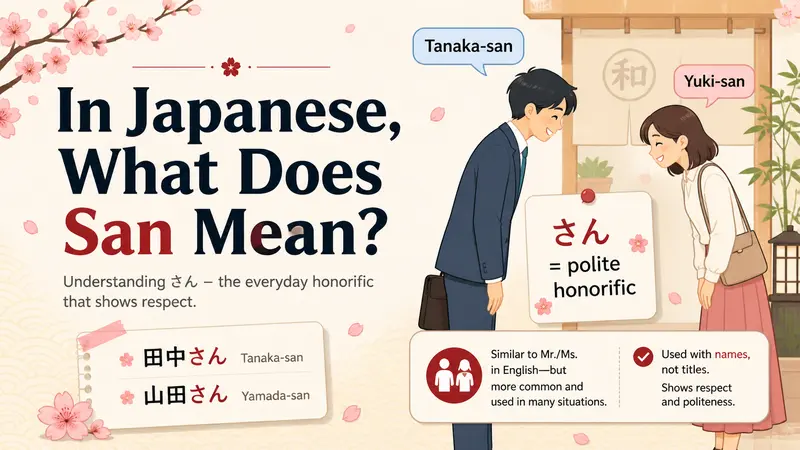
If you have asked in Japanese what does san mean, the shortest useful answer is this:
-san (さん) is a polite honorific added after a person’s name.
It is one of the most common and safest ways to address someone in Japanese. It shows respect and politeness, but it is not exactly the same as English words like Mr., Ms., or Mrs.
That is the basic meaning.
But the full answer is a little more interesting, because san is simple in one way and tricky in another. It is easy to hear, easy to recognize, and very common. At the same time, it does not map perfectly onto English titles.
If you are also building your beginner Japanese basics, our guide to Japanese Basic Phrases is a useful next step.
The short answer
In everyday Japanese, -san is an honorific suffix placed after a name.
Examples:
- Tanaka-san
- Yamada-san
- Keiko-san
It is commonly used in conversation, and it works for men and women, younger and older people, especially when you want to sound polite without sounding too formal.
What does san mean in English?
This is where many learners get confused.
People often translate -san as:
- Mr.
- Ms.
- Mrs.
- Miss
That translation is useful at a beginner level, but it is not exact.
The reason is that -san is attached after a name, and Japanese uses it more broadly than English uses titles. It can sound polite, neutral, friendly, or respectful depending on the situation.
So:
- Mr. Tanaka is not a bad beginner translation for Tanaka-san
- but Tanaka-san does not behave exactly like Mr. Tanaka
How san is used in Japanese
The most common pattern is:
name + san
Examples:
- Sato-san
- Mika-san
- Suzuki-san
You will usually hear this:
- at work
- at school
- with neighbors
- with customers
- with people you do not know well
Is san formal or informal?
It is best described as polite and neutral.
It is not as formal as very respectful honorifics like -sama, but it is more polite than calling someone by name alone.
That is why -san is often the safest choice for learners. If you are unsure which honorific to use, -san is usually much safer than using no honorific at all.
Do you use san with first names or last names?
Both are possible.
In many situations, Japanese speakers use -san after the family name:
- Tanaka-san
- Kobayashi-san
But -san can also appear after a given name, especially if the relationship is slightly closer or the setting makes first names more natural.
For learners, the main point is simple:
name + san is the important pattern.
Should you use san for yourself?
No.
This is one of the clearest rules.
Do not add -san to your own name when talking about yourself. It sounds arrogant or unnatural.
So these are natural:
- Watashi wa Mika desu.
- Mika desu.
But this is not natural for self-introduction:
- Mika-san desu.
Can san be used with family words?
Yes, very often.
Japanese commonly uses -san in family words such as:
- otōsan = father
- okāsan = mother
- onēsan = older sister
- onīsan = older brother
This is one reason learners sometimes hear san so often in Japanese. It is not only attached to personal names.
Can san be used with jobs or stores?
Sometimes, yes.
You may hear -san attached to certain occupations or shop-related words in daily Japanese. That does not mean you can freely attach -san to every noun, but it does show that -san is broader than a simple English-style title.
What is the difference between san and chan?
This is one of the first contrasts learners notice.
- -san is polite and neutral
- -chan is more affectionate, cute, intimate, or childlike
You can often use -san safely with many people. You cannot do that with -chan.
What is the difference between san and kun?
Another common comparison is:
- -san = polite, broad, neutral
- -kun = usually more casual, often used for boys, younger males, or subordinates depending on context
Again, -san is usually the safer option for learners.
Does san only mean the honorific?
Not always.
This is an important language point.
In the honorific sense, さん is the polite suffix we have been discussing.
But in Japanese, the sound san can also appear as the reading of completely different kanji in other words. For example:
- 三 can be read san in compounds
- 山 can be read san in words such as 富士山 (Fujisan)
So if someone asks, “What does san mean in Japanese?”, the right answer depends on context.
Sometimes it means the honorific suffix.
Sometimes it is just the reading of another word.
FAQ
In Japanese, what does san mean?
Most commonly, -san is a polite honorific suffix added after a person’s name. It shows respect and politeness.
Does san mean Mr. or Ms.?
Sometimes that is the easiest translation, but it is not exact. -san is broader and more flexible than English titles.
Can I use san for myself?
No. Do not use -san for yourself.
Is san used for both men and women?
Yes. -san is commonly used for both men and women.
Does san always mean the honorific?
No. Sometimes san is just the reading of another word or kanji, such as 山 in 富士山.
Final thoughts
So, in Japanese, what does san mean?
Most of the time, it means a polite honorific suffix placed after a name.
That is the answer most learners need first.
But the fuller answer is even more useful: -san is polite, common, gender-neutral, and broader than English titles like Mr. or Ms. It is one of the safest name forms in Japanese, which is why learners hear it everywhere. At the same time, the sound san can also appear in other Japanese words, so context still matters.
If you want to keep building practical Japanese after this, How to Say Thank You in Japanese fits naturally with this topic because it also helps you understand politeness in everyday speech.
That is exactly why this tiny word matters so much in Japanese.