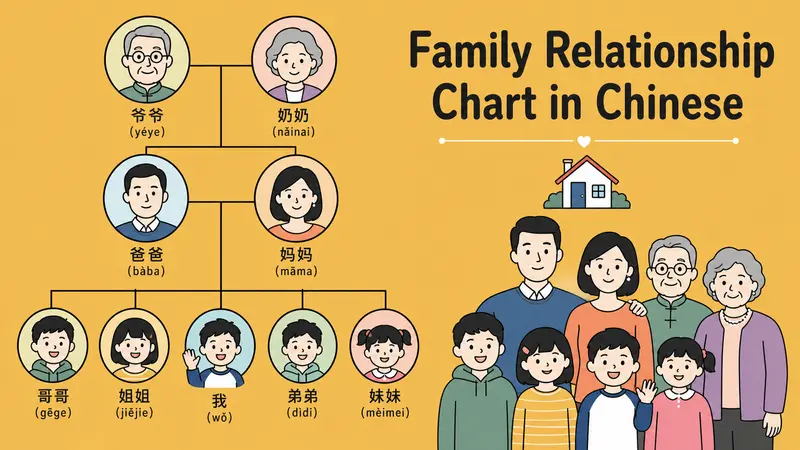
Chinese family words can feel surprisingly detailed at first.
A simple English word like uncle, aunt, or cousin often splits into several different terms in Mandarin. The word changes depending on which side of the family the person is on, whether that person is older or younger, and sometimes whether the relative is male or female.
That is why a clear family relationship chart in Chinese is so useful.
In this guide, you will find the main Mandarin family terms arranged in a way that is easier to understand, with Chinese characters, pinyin, English meanings, and pronunciation support. The goal is not to throw a giant list at you, but to help you see the pattern behind the chart.
Table of Contents
Open Table of Contents
- Why Chinese family words feel harder than English
- Immediate family in Chinese
- Brothers and sisters in Chinese
- Grandparents in Chinese
- Father’s side relatives in Chinese
- Mother’s side relatives in Chinese
- A quick visual family relationship chart in Chinese
- Cousins in Chinese
- In-laws in Chinese
- Family tree chart by relationship logic
- Common mistakes learners make
- A simple way to study the Chinese family chart
- The fastest way to understand the system
- FAQ
- Final thoughts
Why Chinese family words feel harder than English
The biggest difference is that Mandarin family terms are more exact.
For example, English uses:
- uncle
- aunt
- cousin
Mandarin often wants more detail.
Instead of one word for uncle, Chinese may ask:
- Is he your father’s older brother?
- your father’s younger brother?
- your mother’s brother?
Those are not the same word in Chinese.
That is why Chinese family vocabulary feels dense at first. It is not random. It is more precise.
Immediate family in Chinese
Start here first.
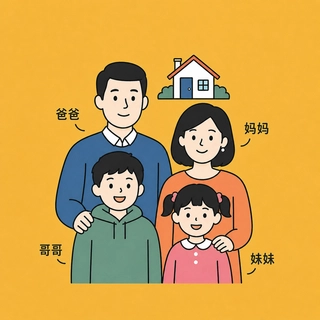
| English | Chinese | Pinyin | Pronunciation |
|---|---|---|---|
| family | 家庭 | jiā tíng | |
| father | 爸爸 / 父亲 | bà ba / fù qīn | |
| mother | 妈妈 / 母亲 | mā ma / mǔ qīn | |
| parents | 父母 | fù mǔ | |
| husband | 丈夫 | zhàng fu | |
| wife | 妻子 | qī zi | |
| son | 儿子 | ér zi | |
| daughter | 女儿 | nǚ ér | |
| child | 孩子 | hái zi | |
| children | 孩子们 / 子女 | hái zi men / zǐ nǚ |
For beginners, 爸爸 and 妈妈 are the most useful everyday words.
Brothers and sisters in Chinese
Mandarin separates older and younger siblings very clearly.
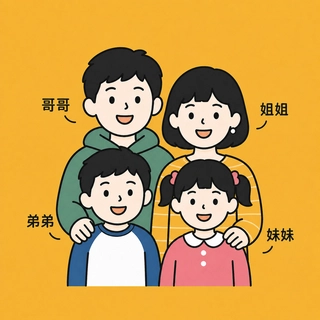
| English | Chinese | Pinyin | Pronunciation |
|---|---|---|---|
| older brother | 哥哥 | gē ge | |
| younger brother | 弟弟 | dì di | |
| older sister | 姐姐 | jiě jie | |
| younger sister | 妹妹 | mèi mei | |
| siblings | 兄弟姐妹 | xiōng dì jiě mèi |
This is one of the first places where English and Chinese differ sharply.
English says:
- brother
- sister
Chinese often asks:
- older or younger?
Grandparents in Chinese
These are also split by side of the family.
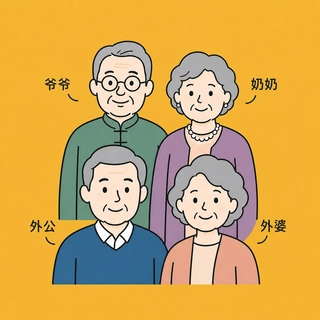
| English | Chinese | Pinyin | Pronunciation |
|---|---|---|---|
| paternal grandfather | 爷爷 | yé ye | |
| paternal grandmother | 奶奶 | nǎi nai | |
| maternal grandfather | 外公 / 姥爷 | wài gōng / lǎo ye | |
| maternal grandmother | 外婆 / 姥姥 | wài pó / lǎo lao | |
| grandparents | 祖父母 / 外祖父母 | zǔ fù mǔ / wài zǔ fù mǔ |
A learner note:
- 爷爷 / 奶奶 are your father’s parents
- 外公 / 外婆 are your mother’s parents
That difference matters a lot in Mandarin family vocabulary.
Father’s side relatives in Chinese
This is where the chart starts to expand.
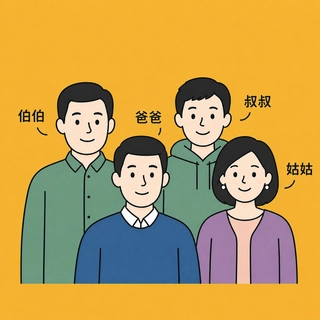
Father’s brothers and sisters
| English | Chinese | Pinyin | Pronunciation |
|---|---|---|---|
| father’s older brother | 伯伯 | bó bo | |
| father’s younger brother | 叔叔 | shū shu | |
| father’s sister | 姑妈 / 姑姑 | gū mā / gū gu | |
| father’s older brother’s wife | 伯母 | bó mǔ | |
| father’s younger brother’s wife | 婶婶 | shěn shen | |
| father’s sister’s husband | 姑父 | gū fu |
Notice how even your father’s brothers split into two words:
- 伯伯 = older than your father
- 叔叔 = younger than your father
That is a classic example of how Chinese family terms become more exact than English ones.
Mother’s side relatives in Chinese
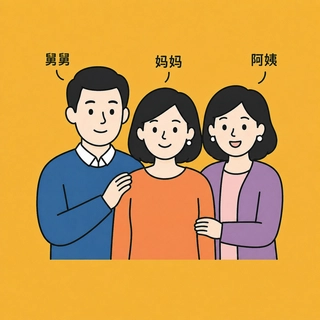
Mother’s brothers and sisters
| English | Chinese | Pinyin | Pronunciation |
|---|---|---|---|
| mother’s brother | 舅舅 | jiù jiu | |
| mother’s brother’s wife | 舅妈 / 舅母 | jiù mā / jiù mǔ | |
| mother’s sister | 阿姨 / 姨妈 | ā yí / yí mā | |
| mother’s sister’s husband | 姨父 / 姨丈 | yí fu / yí zhàng |
For many beginners, this is easier than the father’s side because the mother’s brother usually stays 舅舅, and the mother’s sister is usually 阿姨 in everyday speech.
Also, 阿姨 is often used more broadly in daily life for an older woman, not only a real maternal aunt.
A quick visual family relationship chart in Chinese
Here is the simplest structure to remember:
Your parents
- 爸爸 = father
- 妈妈 = mother
Your grandparents
- 爷爷 / 奶奶 = father’s parents
- 外公 / 外婆 = mother’s parents
Your father’s siblings
- 伯伯 = father’s older brother
- 叔叔 = father’s younger brother
- 姑姑 = father’s sister
Your mother’s siblings
- 舅舅 = mother’s brother
- 阿姨 = mother’s sister
This small chart covers a huge part of real conversation.
Cousins in Chinese
This is the section that makes many learners stop and stare.
English uses one word:
- cousin
Chinese often uses different words depending on the family branch.
The easiest beginner explanation
There are two very important characters:
- 堂 = usually for cousins from your father’s brother’s line
- 表 = usually for cousins from your mother’s side, or your father’s sister’s line
Then age and gender can also matter.
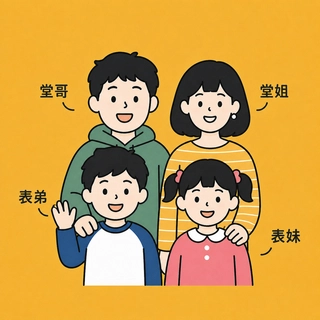
Common cousin terms
| English | Chinese | Pinyin | Pronunciation |
|---|---|---|---|
| older male cousin (father’s brother’s son) | 堂哥 | táng gē | |
| younger male cousin (father’s brother’s son) | 堂弟 | táng dì | |
| older female cousin (father’s brother’s daughter) | 堂姐 | táng jiě | |
| younger female cousin (father’s brother’s daughter) | 堂妹 | táng mèi | |
| older male cousin (other cousin lines) | 表哥 | biǎo gē | |
| younger male cousin (other cousin lines) | 表弟 | biǎo dì | |
| older female cousin (other cousin lines) | 表姐 | biǎo jiě | |
| younger female cousin (other cousin lines) | 表妹 | biǎo mèi |
For most learners, this is the best short rule:
- 堂 cousins = father’s brother’s children
- 表 cousins = mother’s side cousins and father’s sister’s children
That rule is not the entire traditional system, but it is the most useful working shortcut for modern learners.
In-laws in Chinese
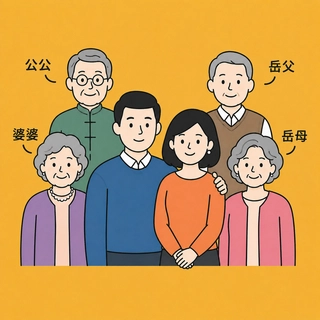
If you want a fuller family relationship chart in Chinese, these are useful too.
| English | Chinese | Pinyin | Pronunciation |
|---|---|---|---|
| father-in-law | 岳父 / 公公 | yuè fù / gōng gong | |
| mother-in-law | 岳母 / 婆婆 | yuè mǔ / pó po | |
| son-in-law | 女婿 | nǚ xu | |
| daughter-in-law | 儿媳妇 / 媳妇 | ér xí fu / xí fu | |
| older brother-in-law | 大伯子 / 姐夫 | dà bó zi / jiě fu | |
| younger brother-in-law | 小叔子 / 妹夫 | xiǎo shū zi / mèi fu | |
| older sister-in-law | 嫂子 | sǎo zi | |
| younger sister-in-law | 弟妹 | dì mèi |
This area can get complicated quickly, so beginners usually do not need to memorize all of it right away.
Family tree chart by relationship logic
If you want the chart in a more memory-friendly format, use this:
Same generation
- 哥哥 = older brother
- 弟弟 = younger brother
- 姐姐 = older sister
- 妹妹 = younger sister
- 堂哥 / 堂姐 / 堂弟 / 堂妹 = father’s brother’s children
- 表哥 / 表姐 / 表弟 / 表妹 = other common cousin lines
Parent generation
- 爸爸 = father
- 妈妈 = mother
- 伯伯 = father’s older brother
- 叔叔 = father’s younger brother
- 姑姑 = father’s sister
- 舅舅 = mother’s brother
- 阿姨 = mother’s sister
Grandparent generation
- 爷爷 / 奶奶 = father’s parents
- 外公 / 外婆 = mother’s parents
When you group it this way, the system feels much less overwhelming.
Common mistakes learners make
1. Using one Chinese word for all uncles
English uses uncle, but Chinese does not.
- 伯伯
- 叔叔
- 舅舅
- 姑父
These are not interchangeable.
2. Forgetting older vs younger
Chinese often changes the word depending on age order.
- 哥哥 vs 弟弟
- 姐姐 vs 妹妹
3. Treating all cousins the same
English says cousin for everyone. Chinese often does not.
4. Trying to memorize the full chart in one sitting
This almost always fails.
It is better to learn:
- immediate family first
- grandparents second
- father’s side third
- mother’s side fourth
- cousins last
A simple way to study the Chinese family chart
A good order is:
- learn parents and siblings
- learn grandparents
- learn father’s side relatives
- learn mother’s side relatives
- learn cousin logic with 堂 and 表
That order works much better than trying to learn one giant list randomly.
The fastest way to understand the system
Before you study the full chart, remember these four ideas:
1. Immediate family is easy
Words like mother, father, older brother, and younger sister are simple and common.
2. Chinese cares about older vs younger
For siblings and many relatives, older and younger are different words.
3. Chinese cares about the father’s side and the mother’s side
This matters especially for uncles, aunts, and cousins.
4. “Cousin” is not just one word
Chinese often uses different cousin terms depending on the branch of the family.
If you understand those four points, the chart below will make much more sense.
FAQ
Why is the family relationship chart in Chinese so complicated?
Because Mandarin family words are more specific than English ones. Chinese often marks family side, age order, and gender more clearly.
What is the difference between 堂 and 表 in Chinese?
A useful learner rule is:
- 堂 for your father’s brother’s children
- 表 for your mother’s side cousins and your father’s sister’s children
How do you say aunt in Chinese?
There is not just one word. Common ones include:
- 姑姑 = father’s sister
- 阿姨 = mother’s sister
How do you say uncle in Chinese?
There is not just one word. Common ones include:
- 伯伯 = father’s older brother
- 叔叔 = father’s younger brother
- 舅舅 = mother’s brother
Final thoughts
At first glance, a family relationship chart in Chinese can look intimidating.
But the system becomes much easier when you understand what Chinese is really doing. It is not trying to confuse you. It is simply giving more family detail than English usually does.
Start with your immediate family. Then learn grandparents. Then separate the father’s side and the mother’s side. After that, the cousin system starts to make more sense too.
That is when Chinese family vocabulary stops feeling like a wall and starts feeling like a pattern.