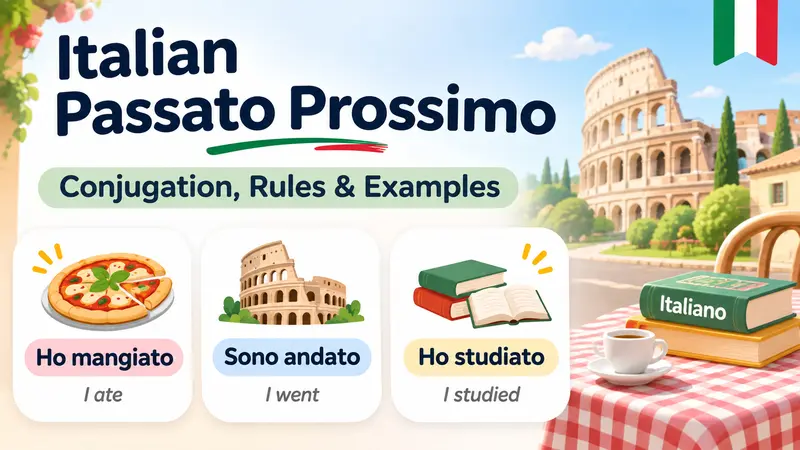
If you want to talk about what you did yesterday, where you went last weekend, or what you ate for dinner, you need to understand the Italian passato prossimo.
The passato prossimo is one of the most commonly used past tenses in everyday Italian. It allows you to describe completed actions and past experiences.
For example:
Ho mangiato una pizza. — I ate a pizza.
Sono andato a Roma. — I went to Rome. (male speaker)
Abbiamo visitato Firenze. — We visited Florence.
The basic structure is straightforward:
Present tense of avere or essere + past participle
However, choosing the correct auxiliary verb and forming the past participle can be confusing at first.
This guide explains the rules step by step, including regular and irregular verbs, agreement with essere, reflexive verbs, and common mistakes.
You’ll also find everyday examples and exercises to help you use the tense confidently.
Table of Contents
Open Table of Contents
- What Is Passato Prossimo in Italian?
- How to Form Passato Prossimo
- Regular Past Participles in Italian
- Essere vs. Avere in Passato Prossimo
- Past Participle Agreement With Essere
- Common Irregular Past Participles
- Passato Prossimo With Reflexive Verbs
- Negative Sentences in Passato Prossimo
- How to Ask Questions in Passato Prossimo
- Common Time Expressions With Passato Prossimo
- Passato Prossimo vs. Imperfetto
- Everyday Conversations Using Passato Prossimo
- Common Passato Prossimo Mistakes
- Mistake 1: Using Avere Instead of Essere
- Mistake 2: Forgetting Gender Agreement
- Mistake 3: Using an Incorrect Irregular Participle
- Mistake 4: Adding Agreement Where It Is Not Needed
- Mistake 5: Forgetting the Auxiliary
- Mistake 6: Using Avere With Reflexive Verbs
- Mistake 7: Assuming Every Movement Verb Uses Essere
- Mistake 8: Translating English Past Tenses Word for Word
- Passato Prossimo Practice Exercises
- Exercise Answers
- Frequently Asked Questions
- What is passato prossimo in Italian?
- How do you form passato prossimo?
- When do you use essere in passato prossimo?
- When do you use avere in passato prossimo?
- What are the endings for regular past participles?
- Is passato prossimo the same as the English present perfect?
- What is the difference between passato prossimo and imperfetto?
- Do all movement verbs use essere?
- Does the past participle always agree with the subject?
- Is passato prossimo used in everyday Italian?
- Final Thoughts
What Is Passato Prossimo in Italian?
The passato prossimo is a compound past tense used to describe completed actions and events.
In English, it can correspond to either the simple past or the present perfect, depending on context.
For example:
Ho studiato italiano ieri. — I studied Italian yesterday.
Hai mai visitato Venezia? — Have you ever visited Venice?
Although prossimo literally means “near” or “next,” the passato prossimo is not restricted to events that happened recently.
You can use it to describe something that happened yesterday, last year, or many years ago.
For example:
Ho visitato Roma dieci anni fa.
I visited Rome ten years ago.
The important idea is that the action is presented as a completed event.
When Do Italians Use Passato Prossimo?
The passato prossimo is commonly used for:
- Completed actions in the past.
- Events that happened at a specific time.
- Past experiences.
- Sequences of completed events.
- Changes or events presented as completed.
Examples:
| Italian | English |
|---|---|
| Ho comprato un libro. | I bought a book. |
| Siamo arrivati ieri. | We arrived yesterday. |
| Hai visto quel film? | Have you seen that movie? |
| Ho perso le chiavi. | I lost my keys. |
| Sono nato nel 1990. | I was born in 1990. (male speaker) |
In everyday conversation, mastering the passato prossimo allows you to talk about a wide range of past experiences.
How to Form Passato Prossimo
The passato prossimo consists of two parts:
Auxiliary verb + past participle
The auxiliary is either:
- Avere — to have.
- Essere — to be.
The auxiliary is conjugated in the present tense, while the main verb appears as a past participle.
Example With Avere
Mangiare — to eat
| Subject | Passato prossimo | English |
|---|---|---|
| Io | ho mangiato | I ate |
| Tu | hai mangiato | You ate |
| Lui / Lei | ha mangiato | He / She ate |
| Noi | abbiamo mangiato | We ate |
| Voi | avete mangiato | You ate |
| Loro | hanno mangiato | They ate |
Notice that mangiato remains unchanged in this basic construction.
Only the auxiliary verb changes according to the subject.
Example With Essere
Andare — to go
| Subject | Passato prossimo | English |
|---|---|---|
| Io | sono andato / andata | I went |
| Tu | sei andato / andata | You went |
| Lui | è andato | He went |
| Lei | è andata | She went |
| Noi | siamo andati / andate | We went |
| Voi | siete andati / andate | You went |
| Loro | sono andati / andate | They went |
With essere, the past participle normally agrees with the subject in gender and number.
For example:
Marco è andato a Milano.
Marco went to Milan.
Giulia è andata a Milano.
Giulia went to Milan.
Marco e Luca sono andati a Milano.
Marco and Luca went to Milan.
Giulia e Anna sono andate a Milano.
Giulia and Anna went to Milan.
We’ll explore this agreement rule in more detail below.
Regular Past Participles in Italian
To form the passato prossimo, you first need to know how to create a past participle.
For regular Italian verbs, the ending depends on the infinitive.
| Infinitive ending | Past participle ending | Example |
|---|---|---|
| -are | -ato | parlare → parlato |
| -ere | -uto | credere → creduto |
| -ire | -ito | dormire → dormito |
Regular -ARE Verbs
For regular verbs ending in -are, remove -are and add -ato.
Examples:
| Infinitive | Past participle | English |
|---|---|---|
| parlare | parlato | spoken |
| mangiare | mangiato | eaten |
| lavorare | lavorato | worked |
| studiare | studiato | studied |
| comprare | comprato | bought |
Example:
Ho parlato con Maria. — I spoke with Maria.
Regular -ERE Verbs
For regular verbs ending in -ere, remove -ere and add -uto.
Examples:
| Infinitive | Past participle | English |
|---|---|---|
| credere | creduto | believed |
| ricevere | ricevuto | received |
| vendere | venduto | sold |
| temere | temuto | feared |
Example:
Ho ricevuto un messaggio. — I received a message.
Be careful: many common -ere verbs have irregular past participles.
For example, prendere becomes preso, not prenduto.
Regular -IRE Verbs
For regular verbs ending in -ire, remove -ire and add -ito.
Examples:
| Infinitive | Past participle | English |
|---|---|---|
| dormire | dormito | slept |
| finire | finito | finished |
| capire | capito | understood |
| sentire | sentito | heard / felt |
| partire | partito | left / departed |
Example:
Ho dormito bene. — I slept well.
Notice that partire uses essere as its auxiliary:
Sono partito presto.
I left early. (male speaker)
This brings us to one of the most important passato prossimo rules.
Essere vs. Avere in Passato Prossimo
One of the biggest challenges for Italian learners is deciding whether to use essere or avere.
Both auxiliary verbs are common, but they are not interchangeable.
When to Use Avere
Most Italian verbs use avere in the passato prossimo.
This includes most transitive verbs — verbs that take a direct object — and many intransitive verbs.
Examples:
| Infinitive | Passato prossimo | English |
|---|---|---|
| mangiare | ho mangiato | I ate |
| leggere | ho letto | I read |
| comprare | ho comprato | I bought |
| vedere | ho visto | I saw |
| dormire | ho dormito | I slept |
| lavorare | ho lavorato | I worked |
| parlare | ho parlato | I spoke |
Examples:
Ho comprato una macchina nuova. — I bought a new car.
Abbiamo guardato un film ieri sera. — We watched a movie last night.
A useful starting rule is that verbs with a direct object generally use avere.
However, do not assume that every verb without a direct object uses essere.
For example, dormire, lavorare, and parlare normally use avere.
When to Use Essere
Many intransitive verbs describing movement, arrival, departure, or a change of state use essere.
Common examples include:
| Infinitive | Passato prossimo | English |
|---|---|---|
| andare | sono andato/a | I went |
| arrivare | sono arrivato/a | I arrived |
| partire | sono partito/a | I left |
| entrare | sono entrato/a | I entered |
| uscire | sono uscito/a | I went out |
| tornare | sono tornato/a | I returned |
| nascere | sono nato/a | I was born |
| diventare | sono diventato/a | I became |
| rimanere | sono rimasto/a | I remained |
| morire | sono morto/a | I died |
Examples:
Siamo arrivati in ritardo. — We arrived late.
Maria è partita questa mattina. — Maria left this morning.
Sono tornato a casa alle otto. — I returned home at eight. (male speaker)
Important: Not Every Movement Verb Uses Essere
A common beginner mistake is assuming that all verbs describing movement use essere.
That is not correct.
For example:
Ho camminato per due ore.
I walked for two hours.
Ho nuotato in piscina.
I swam in the pool.
Ho viaggiato molto.
I traveled a lot.
These verbs normally use avere.
The meaning of movement alone is not a reliable way to determine the auxiliary.
For some verbs, the auxiliary also changes depending on whether the verb is used transitively or intransitively.
For beginners, the most practical approach is to learn each common verb together with its auxiliary.
Instead of memorizing only:
andare — to go
Memorize:
andare → sono andato/a
This makes it easier to form correct sentences later.
Past Participle Agreement With Essere
When the passato prossimo uses essere, the past participle normally agrees with the subject.
The four common endings are:
| Ending | Gender and number |
|---|---|
| -o | Masculine singular |
| -a | Feminine singular |
| -i | Masculine or mixed plural |
| -e | Feminine plural |
Consider the verb arrivare.
| Subject | Italian | English |
|---|---|---|
| Marco | Marco è arrivato. | Marco arrived. |
| Giulia | Giulia è arrivata. | Giulia arrived. |
| Marco e Luca | Marco e Luca sono arrivati. | Marco and Luca arrived. |
| Giulia e Anna | Giulia e Anna sono arrivate. | Giulia and Anna arrived. |
Listen to the difference:
Does Avere Require Agreement?
In the basic passato prossimo construction with avere, the past participle usually stays unchanged.
For example:
Marco ha mangiato.
Marco ate.
Giulia ha mangiato.
Giulia ate.
Marco e Giulia hanno mangiato.
Marco and Giulia ate.
However, there are important exceptions involving direct-object pronouns.
For example:
Hai visto Maria?
Have you seen Maria?
Sì, l’ho vista.
Yes, I’ve seen her.
Here, vista agrees with the feminine singular direct-object pronoun la, shortened to l’.
This is a more advanced agreement rule. For now, remember that the participle generally stays unchanged with avere when there is no preceding direct-object pronoun requiring agreement.
Common Irregular Past Participles
Not every Italian verb follows the regular -ato, -uto, or -ito patterns.
Many frequently used verbs have irregular past participles.
These are worth learning early because they appear constantly in everyday conversations.
| Infinitive | Past participle | English |
|---|---|---|
| fare | fatto | done / made |
| dire | detto | said |
| vedere | visto | seen |
| prendere | preso | taken |
| scrivere | scritto | written |
| leggere | letto | read |
| mettere | messo | put |
| aprire | aperto | opened |
| chiudere | chiuso | closed |
| chiedere | chiesto | asked |
| rispondere | risposto | answered |
| perdere | perso | lost |
| decidere | deciso | decided |
| scegliere | scelto | chosen |
| bere | bevuto | drunk |
| essere | stato | been |
| rimanere | rimasto | remained |
| nascere | nato | born |
| morire | morto | died |
| venire | venuto | come |
Examples With Irregular Past Participles
Ho fatto i compiti. — I did my homework.
Hai visto il mio telefono? — Have you seen my phone?
Ho scritto una lettera. — I wrote a letter.
Abbiamo preso il treno. — We took the train.
Sono stato a Napoli. — I have been to Naples. (male speaker)
Notice that essere uses essere as its auxiliary:
Sono stato / stata — I was / I have been.
A useful learning strategy is to memorize irregular participles in complete phrases rather than as isolated words.
For example:
- fare → ho fatto
- vedere → ho visto
- prendere → ho preso
- scrivere → ho scritto
- venire → sono venuto/a
This helps you remember both the participle and the correct auxiliary.
Passato Prossimo With Reflexive Verbs
Italian reflexive verbs use essere in compound tenses, including the passato prossimo.
If you have already studied Italian reflexive verbs, you’ll recognize forms such as:
- svegliarsi — to wake up
- alzarsi — to get up
- lavarsi — to wash oneself
- vestirsi — to get dressed
- addormentarsi — to fall asleep
The passato prossimo follows this structure:
Reflexive pronoun + essere + past participle
For example:
Mi sono svegliato.
I woke up. (male speaker)
Mi sono svegliata.
I woke up. (female speaker)
Conjugation of Svegliarsi
| Subject | Passato prossimo |
|---|---|
| Io | mi sono svegliato/a |
| Tu | ti sei svegliato/a |
| Lui | si è svegliato |
| Lei | si è svegliata |
| Noi | ci siamo svegliati/e |
| Voi | vi siete svegliati/e |
| Loro | si sono svegliati/e |
Examples:
Mi sono svegliato alle sette. — I woke up at seven. (male speaker)
Giulia si è alzata presto. — Giulia got up early.
Ci siamo divertiti molto. — We had a lot of fun. (masculine or mixed group)
Remember that the past participle normally agrees with the subject because the auxiliary is essere.
Negative Sentences in Passato Prossimo
To make a negative sentence, place non before the auxiliary verb.
The structure is:
Subject + non + auxiliary + past participle
Examples:
Non ho capito la domanda. — I didn’t understand the question.
Non siamo andati al cinema. — We didn’t go to the cinema.
Non ho mangiato niente. — I didn’t eat anything.
With reflexive verbs, non comes before the reflexive pronoun:
Non mi sono svegliato presto.
I didn’t wake up early. (male speaker)
How to Ask Questions in Passato Prossimo
Italian does not normally require a separate auxiliary equivalent to English did when forming past-tense questions.
In many cases, you can use the same word order as a statement and change your intonation.
For example:
Hai mangiato?
Did you eat?
Hai studiato ieri?
Did you study yesterday?
Sei andato a Roma?
Did you go to Rome? (addressing a male)
You can also use Italian question words.
| Question word | Meaning | Example |
|---|---|---|
| Quando | When | Quando sei arrivato? |
| Dove | Where | Dove sei andato? |
| Cosa / Che cosa | What | Cosa hai mangiato? |
| Perché | Why | Perché hai chiamato? |
| Chi | Who | Chi hai incontrato? |
| Come | How | Come hai fatto? |
Examples:
Cosa hai mangiato ieri? — What did you eat yesterday?
Dove sei andato domenica? — Where did you go on Sunday? (addressing a male)
Quando avete finito il lavoro? — When did you finish work?
Common Time Expressions With Passato Prossimo
Time expressions help explain when an action happened.
Here are some useful expressions:
| Italian | English |
|---|---|
| ieri | yesterday |
| ieri sera | last night |
| stamattina | this morning |
| la settimana scorsa | last week |
| il mese scorso | last month |
| l’anno scorso | last year |
| due giorni fa | two days ago |
| un’ora fa | an hour ago |
| già | already |
| non ancora | not yet |
| mai | ever / never, depending on context |
| appena | just |
Examples:
Ho studiato ieri sera.
I studied last night.
Siamo partiti due giorni fa.
We left two days ago.
Hai già mangiato?
Have you eaten already?
Non ho ancora finito.
I haven’t finished yet.
Non sono mai stato in Sicilia.
I’ve never been to Sicily. (male speaker)
The passato prossimo can describe both recent and distant past events.
The tense does not automatically tell you exactly when an action happened. Time expressions and context provide that information.
Passato Prossimo vs. Imperfetto
Italian has more than one commonly used past tense.
Two especially important ones are:
- Passato prossimo
- Imperfetto
They describe past situations from different perspectives.
The passato prossimo often presents an event as completed.
The imperfetto commonly describes habitual actions, ongoing situations, background circumstances, or descriptions in the past.
Compare:
Ieri ho studiato italiano.
Yesterday I studied Italian.
Quando ero piccolo, studiavo italiano ogni giorno.
When I was little, I studied Italian every day.
The first sentence describes a completed event.
The second describes a repeated activity during a past period.
Another example:
Ho mangiato quando Maria è arrivata.
I ate when Maria arrived.
Mangiavo quando Maria è arrivata.
I was eating when Maria arrived.
The difference is important.
In the first sentence, the eating is presented as a completed event associated with Maria’s arrival.
In the second, the eating was already in progress when Maria arrived.
Quick Comparison
| Passato prossimo | Imperfetto |
|---|---|
| Completed past events | Ongoing past situations |
| Individual events | Habitual past actions |
| Events in a sequence | Background descriptions |
| What happened | What was happening / used to happen |
This is a useful introductory distinction, but the choice between the two tenses also depends on context and how the speaker presents the event.
For now, focus on becoming comfortable with the passato prossimo before studying the imperfetto in greater depth.
Everyday Conversations Using Passato Prossimo
Let’s see how the passato prossimo appears in natural situations.
Conversation 1: Talking About Yesterday
A: Cosa hai fatto ieri?
What did you do yesterday?
B: Ho lavorato tutto il giorno.
I worked all day.
A: E la sera?
And in the evening?
B: Ho guardato un film.
I watched a movie.
Conversation 2: Talking About Travel
A: Sei mai stato a Firenze?
Have you ever been to Florence? (addressing a male)
B: Sì, ci sono stato l’anno scorso.
Yes, I went there last year.
A: Ti è piaciuta?
Did you like it?
B: Sì, mi è piaciuta molto.
Yes, I liked it a lot.
Conversation 3: At a Restaurant
A: Avete già ordinato?
Have you ordered already?
B: Sì, abbiamo ordinato due pizze.
Yes, we ordered two pizzas.
A: Avete preso anche qualcosa da bere?
Did you order anything to drink as well?
B: Sì, abbiamo preso dell’acqua.
Yes, we ordered some water.
Conversation 4: Talking About the Weekend
A: Dove siete andati nel fine settimana?
Where did you go over the weekend?
B: Siamo andati al mare.
We went to the seaside.
A: Vi siete divertiti?
Did you have fun?
B: Sì, ci siamo divertiti moltissimo.
Yes, we had a great time.
These conversations illustrate how the passato prossimo is used to discuss ordinary experiences.
Common Passato Prossimo Mistakes
Even intermediate learners sometimes make mistakes with auxiliary verbs, irregular participles, and agreement.
Here are some of the most common errors.
Mistake 1: Using Avere Instead of Essere
❌ Ho andato a Roma.
✅ Sono andato a Roma.
Andare normally uses essere in the passato prossimo.
Mistake 2: Forgetting Gender Agreement
❌ Maria è arrivato.
✅ Maria è arrivata.
With essere, the participle normally agrees with the subject.
Mistake 3: Using an Incorrect Irregular Participle
❌ Ho prenduto il treno.
✅ Ho preso il treno.
Prendere has the irregular past participle preso.
Mistake 4: Adding Agreement Where It Is Not Needed
❌ Maria ha mangiata una pizza.
✅ Maria ha mangiato una pizza.
In this basic construction with avere, mangiato remains unchanged.
Mistake 5: Forgetting the Auxiliary
❌ Ieri mangiato una pizza.
✅ Ieri ho mangiato una pizza.
The passato prossimo requires an auxiliary verb.
Mistake 6: Using Avere With Reflexive Verbs
❌ Mi ho svegliato presto.
✅ Mi sono svegliato presto.
Reflexive verbs use essere in the passato prossimo.
Mistake 7: Assuming Every Movement Verb Uses Essere
❌ Sono camminato per un’ora.
✅ Ho camminato per un’ora.
Camminare normally uses avere.
Mistake 8: Translating English Past Tenses Word for Word
❌ Ho stato a Roma.
✅ Sono stato a Roma.
The Italian verb essere uses essere as its auxiliary.
Remember that English translations alone cannot always tell you which Italian auxiliary to choose.
Passato Prossimo Practice Exercises
Test your understanding with these exercises.
Try answering before checking the solutions.
Exercise 1: Complete the Sentences
Fill in the correct passato prossimo form.
- Ieri io ______ (mangiare) una pizza.
- Maria ______ (andare) al supermercato.
- Noi ______ (vedere) un film.
- Luca e Marco ______ (arrivare) tardi.
- Tu ______ (finire) i compiti?
- Giulia ______ (svegliarsi) alle sette.
- Voi ______ (comprare) il pane?
- Anna e Sofia ______ (partire) ieri.
Exercise 2: Choose Essere or Avere
Choose the correct auxiliary.
- Io ______ dormito bene.
- Lei ______ uscita presto.
- Noi ______ parlato con Marco.
- Loro ______ tornati a casa.
- Tu ______ scritto un messaggio.
- Giulia ______ diventata insegnante.
Exercise 3: Correct the Mistakes
Find and correct the mistakes.
- Ho andato al cinema.
- Maria è arrivato ieri.
- Abbiamo veduto un film.
- Mi ho alzato presto.
- Sono lavorato tutto il giorno.
- Giulia ha mangiata una pizza.
Exercise 4: Translate Into Italian
Translate the following sentences.
- I ate pasta yesterday.
- We went to Rome.
- She wrote a letter.
- Did you see the movie?
- I woke up early.
- They arrived late. (all-female group)
Exercise Answers
Exercise 1
- Ho mangiato una pizza.
- Maria è andata al supermercato.
- Noi abbiamo visto un film.
- Luca e Marco sono arrivati tardi.
- Tu hai finito i compiti?
- Giulia si è svegliata alle sette.
- Voi avete comprato il pane?
- Anna e Sofia sono partite ieri.
Exercise 2
- Ho dormito bene.
- Lei è uscita presto.
- Noi abbiamo parlato con Marco.
- Loro sono tornati a casa.
- Tu hai scritto un messaggio.
- Giulia è diventata insegnante.
Exercise 3
- Sono andato/a al cinema.
- Maria è arrivata ieri.
- Abbiamo visto un film.
- Mi sono alzato/a presto.
- Ho lavorato tutto il giorno.
- Giulia ha mangiato una pizza.
Exercise 4
- Ho mangiato la pasta ieri.
- Siamo andati/e a Roma.
- Ha scritto una lettera.
- Hai visto il film?
- Mi sono svegliato/a presto.
- Sono arrivate in ritardo.
Frequently Asked Questions
What is passato prossimo in Italian?
The passato prossimo is a compound past tense used to describe completed actions, events, and past experiences.
It is formed using the present tense of avere or essere followed by a past participle.
How do you form passato prossimo?
Use:
Avere or essere + past participle
For example:
Ho mangiato. — I ate.
Sono arrivato. — I arrived. (male speaker)
When do you use essere in passato prossimo?
Essere is used with many intransitive verbs, including andare, arrivare, partire, and tornare, as well as reflexive verbs.
The past participle normally agrees with the subject in gender and number.
When do you use avere in passato prossimo?
Most Italian verbs use avere, including most transitive verbs and many intransitive verbs.
Examples include mangiare, parlare, dormire, and lavorare.
What are the endings for regular past participles?
The regular patterns are:
- -are → -ato
- -ere → -uto
- -ire → -ito
For example:
- parlare → parlato
- credere → creduto
- dormire → dormito
Is passato prossimo the same as the English present perfect?
Not exactly.
Italian passato prossimo can correspond to both the English simple past and present perfect.
For example:
Ho mangiato.
Depending on context, this can mean “I ate” or “I have eaten.”
What is the difference between passato prossimo and imperfetto?
The passato prossimo commonly presents completed past events.
The imperfetto commonly describes habitual actions, ongoing situations, or background circumstances in the past.
The correct choice depends on how the speaker presents the action and its context.
Do all movement verbs use essere?
No.
Some movement verbs, such as andare and arrivare, use essere.
Others, including camminare, nuotare, and viaggiare, normally use avere.
Does the past participle always agree with the subject?
No.
With essere, the past participle normally agrees with the subject.
With avere, it usually remains unchanged, although agreement rules apply in certain constructions involving direct-object pronouns.
Is passato prossimo used in everyday Italian?
Yes.
The passato prossimo is widely used in everyday spoken Italian to discuss completed actions and past experiences.
It is one of the most useful past tenses for beginner and intermediate learners.
Final Thoughts
The Italian passato prossimo is an essential tense for talking about completed actions and past experiences.
The most important rules to remember are:
- Passato prossimo = avere or essere + past participle.
- Regular past participles commonly end in -ato, -uto, or -ito.
- Most verbs use avere, but many intransitive verbs and all reflexive verbs use essere.
- With essere, the past participle normally agrees with the subject.
- Common irregular participles, such as fatto, visto, preso, and scritto, need to be memorized.
Start with a few useful verbs and practice describing your daily experiences.
What did you eat yesterday? Where did you go last weekend? What did you do this morning?
Answering simple questions like these is an effective way to make the passato prossimo part of your everyday Italian.