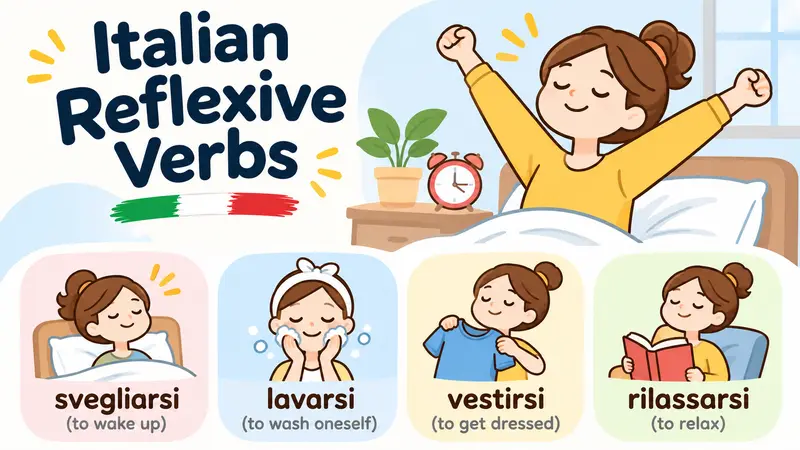
From waking up in the morning to getting dressed and going to bed, Italian reflexive verbs describe many of the things we do every day.
You might already recognize expressions like mi chiamo (my name is), mi sveglio (I wake up), or mi diverto (I have fun).
What makes these expressions different from ordinary Italian verbs?
The answer lies in small pronouns such as mi, ti, si, ci, and vi, which work together with the verb.
Once you understand how these pronouns work, conjugating reflexive verbs becomes much easier.
In this guide, you’ll learn the essential grammar rules, discover 20 common Italian reflexive and pronominal verbs, listen to their pronunciation, and practice using them in everyday conversations.
Table of Contents
Open Table of Contents
- What are reflexive verbs in Italian?
- How to recognize Italian reflexive verbs
- Italian reflexive pronouns
- How to conjugate Italian reflexive verbs
- 20 common Italian reflexive verbs with pronunciation
- 1. Svegliarsi — To wake up
- 2. Alzarsi — To get up
- 3. Lavarsi — To wash oneself
- 4. Vestirsi — To get dressed
- 5. Pettinarsi — To comb one’s hair
- 6. Truccarsi — To put on makeup
- 7. Radersi — To shave
- 8. Prepararsi — To get ready
- 9. Sedersi — To sit down
- 10. Riposarsi — To rest
- 11. Rilassarsi — To relax
- 12. Addormentarsi — To fall asleep
- 13. Chiamarsi — To be called
- 14. Divertirsi — To have fun
- 15. Sentirsi — To feel
- 16. Arrabbiarsi — To get angry
- 17. Preoccuparsi — To worry
- 18. Annoiarsi — To get bored
- 19. Innamorarsi — To fall in love
- 20. Accorgersi — To notice or realize
- Reflexive vs. non-reflexive verbs in Italian
- Describing your daily routine in Italian
- Reflexive verbs with body parts
- How to form negative sentences with reflexive verbs
- How to ask questions with reflexive verbs
- Italian reflexive verbs with modal verbs
- Italian reflexive verbs in the past tense
- Reflexive and reciprocal verbs: What’s the difference?
- Real-life conversations using Italian reflexive verbs
- Common mistakes with Italian reflexive verbs
- Mistake 1: Forgetting the reflexive pronoun
- Mistake 2: Using the wrong reflexive pronoun
- Mistake 3: Forgetting to conjugate the verb
- Mistake 4: Putting non in the wrong position
- Mistake 5: Using avere in the passato prossimo
- Mistake 6: Forgetting past participle agreement
- Mistake 7: Overusing possessive adjectives with body parts
- Mistake 8: Translating every reflexive pronoun literally
- Practice exercises: Italian reflexive verbs
- Exercise answers
- How to memorize Italian reflexive verbs
- Frequently asked questions
- What are reflexive verbs in Italian?
- What are the six reflexive pronouns in Italian?
- How do you identify a reflexive verb in Italian?
- What is the difference between svegliare and svegliarsi?
- Where do Italian reflexive pronouns go?
- Do Italian reflexive verbs use essere or avere?
- Is mi chiamo a reflexive verb?
- What is the difference between mi sveglio and mi alzo?
- Can reflexive verbs be used with modal verbs?
- Are all Italian verbs ending in -si truly reflexive?
- Final thoughts
What are reflexive verbs in Italian?
A reflexive verb typically describes an action that the subject performs on themselves.
For example:
Lavo il cane.
I wash the dog.
Mi lavo.
I wash myself.
In the first sentence, the action is directed toward the dog.
In the second sentence, the action is directed back toward the person performing it.
The pronoun mi expresses this reflexive relationship.
However, not every Italian verb that uses a reflexive pronoun describes a literal action performed on oneself.
Some express changes of state, emotions, personal experiences, or reciprocal actions.
For example:
- svegliarsi — to wake up
- arrabbiarsi — to get angry
- divertirsi — to have fun
- incontrarsi — to meet each other
These constructions are commonly taught together because they use the same set of pronouns.
How to recognize Italian reflexive verbs
In their infinitive form, Italian reflexive verbs end in -si.
Compare these ordinary verbs with their reflexive forms:
| Ordinary verb | Reflexive verb | Meaning of reflexive form |
|---|---|---|
| lavare | lavarsi | to wash oneself |
| svegliare | svegliarsi | to wake up |
| alzare | alzarsi | to get up |
| vestire | vestirsi | to get dressed |
| preparare | prepararsi | to get ready |
| sedere | sedersi | to sit down |
| chiamare | chiamarsi | to be called |
| rilassare | rilassarsi | to relax |
The reflexive infinitive is formed by removing the final -e of the ordinary infinitive and adding -si.
For example:
- lavare → lavar + si → lavarsi
- vestire → vestir + si → vestirsi
- sedere → seder + si → sedersi
This produces three common reflexive infinitive endings:
| Ending | Example |
|---|---|
| -arsi | lavarsi |
| -ersi | sedersi |
| -irsi | vestirsi |
Just like ordinary Italian verbs, reflexive verbs can belong to the -ARE, -ERE, or -IRE conjugation groups.
Italian reflexive pronouns
Before learning how to conjugate reflexive verbs, you need to understand the reflexive pronouns.
Italian uses six main forms:
| Subject pronoun | Reflexive pronoun | Approximate English equivalent |
|---|---|---|
| io | mi | myself |
| tu | ti | yourself |
| lui / lei | si | himself / herself / itself |
| noi | ci | ourselves |
| voi | vi | yourselves |
| loro | si | themselves |
The English equivalents help explain literal reflexive actions, but they are not always translated directly.
For example:
Mi lavo.
I wash myself.
Mi sveglio.
I wake up.
Mi diverto.
I have fun.
Although all three sentences use mi, only the first naturally includes “myself” in English.
Where do reflexive pronouns go?
With a normally conjugated verb in the present tense, the reflexive pronoun comes before the verb.
The basic pattern is:
Subject + reflexive pronoun + conjugated verb
For example:
- Io mi sveglio.
- Tu ti svegli.
- Lei si sveglia.
- Noi ci svegliamo.
- Voi vi svegliate.
- Loro si svegliano.
Italian speakers frequently omit subject pronouns because the verb ending already indicates who performs the action.
As a result, Mi sveglio alle sette is often more natural than Io mi sveglio alle sette, unless the speaker wants to emphasize the subject.
How to conjugate Italian reflexive verbs
Conjugating a reflexive verb involves three steps:
- Identify the ordinary infinitive form.
- Conjugate the verb according to the subject and tense.
- Add the corresponding reflexive pronoun.
Let’s start with three common verbs in the present tense.
Lavarsi — To wash oneself (-ARE)
The ordinary infinitive underlying lavarsi is lavare.
| Subject | Conjugation |
|---|---|
| io | mi lavo |
| tu | ti lavi |
| lui / lei | si lava |
| noi | ci laviamo |
| voi | vi lavate |
| loro | si lavano |
Mi lavo le mani.
I wash my hands.
Both the reflexive pronoun and the verb ending change according to the subject.
Sedersi — To sit down (-ERE)
The verb sedersi comes from sedere and has some irregular present-tense forms.
| Subject | Conjugation |
|---|---|
| io | mi siedo |
| tu | ti siedi |
| lui / lei | si siede |
| noi | ci sediamo |
| voi | vi sedete |
| loro | si siedono |
Mi siedo vicino alla finestra.
I sit down near the window.
Notice that the reflexive pronouns follow the usual pattern even though the verb itself has irregular forms.
Vestirsi — To get dressed (-IRE)
The ordinary infinitive underlying vestirsi is vestire.
| Subject | Conjugation |
|---|---|
| io | mi vesto |
| tu | ti vesti |
| lui / lei | si veste |
| noi | ci vestiamo |
| voi | vi vestite |
| loro | si vestono |
Mi vesto prima di uscire.
I get dressed before going out.
Reflexive verbs with -isc-
Some -IRE reflexive verbs follow the conjugation pattern that adds -isc- to certain present-tense forms.
One example is innervosirsi, meaning “to get nervous.”
| Subject | Conjugation |
|---|---|
| io | mi innervosisco |
| tu | ti innervosisci |
| lui / lei | si innervosisce |
| noi | ci innervosiamo |
| voi | vi innervosite |
| loro | si innervosiscono |
Mi innervosisco prima degli esami.
I get nervous before exams.
The reflexive pronoun does not change the underlying conjugation rules of the verb.
If you’re unfamiliar with Italian verb endings, start with our guide to the Italian present tense.
20 common Italian reflexive verbs with pronunciation
The following verbs are particularly useful for describing daily routines, personal habits, feelings, and social interactions.
Listen to each infinitive and practice using it in a complete sentence.
1. Svegliarsi — To wake up
Mi sveglio alle sette.
I wake up at seven.
2. Alzarsi — To get up
Mi alzo presto ogni mattina.
I get up early every morning.
3. Lavarsi — To wash oneself
Mi lavo la faccia.
I wash my face.
4. Vestirsi — To get dressed
Mi vesto in cinque minuti.
I get dressed in five minutes.
5. Pettinarsi — To comb one’s hair
Mi pettino davanti allo specchio.
I comb my hair in front of the mirror.
6. Truccarsi — To put on makeup
Si trucca prima di uscire.
She puts on makeup before going out.
7. Radersi — To shave
Mi rado ogni mattina.
I shave every morning.
8. Prepararsi — To get ready
Mi preparo per andare al lavoro.
I get ready to go to work.
9. Sedersi — To sit down
Ci sediamo vicino alla porta.
We sit down near the door.
10. Riposarsi — To rest
Mi riposo dopo pranzo.
I rest after lunch.
11. Rilassarsi — To relax
Mi rilasso ascoltando musica.
I relax by listening to music.
12. Addormentarsi — To fall asleep
Mi addormento verso mezzanotte.
I fall asleep around midnight.
13. Chiamarsi — To be called
Mi chiamo Marco.
My name is Marco.
14. Divertirsi — To have fun
Ci divertiamo molto insieme.
We have a lot of fun together.
15. Sentirsi — To feel
Mi sento bene oggi.
I feel good today.
16. Arrabbiarsi — To get angry
Si arrabbia facilmente.
He or she gets angry easily.
17. Preoccuparsi — To worry
Mi preoccupo per il futuro.
I worry about the future.
18. Annoiarsi — To get bored
Mi annoio quando non ho niente da fare.
I get bored when I have nothing to do.
19. Innamorarsi — To fall in love
Si innamora di una ragazza italiana.
He or she falls in love with an Italian girl.
20. Accorgersi — To notice or realize
Mi accorgo subito dell’errore.
I notice the mistake immediately.
Unlike lavarsi, the verb accorgersi does not describe a literal action performed on oneself.
It is a pronominal verb whose meaning and construction should be learned together.
Reflexive vs. non-reflexive verbs in Italian
Some Italian verbs can be used with or without a reflexive pronoun.
Adding the pronoun can change who receives the action or even change the meaning of the verb.
Lavare vs. lavarsi
Lavo la macchina.
I wash the car.
Mi lavo.
I wash myself.
Svegliare vs. svegliarsi
Sveglio mio figlio alle sette.
I wake my son up at seven.
Mi sveglio alle sette.
I wake up at seven.
Alzare vs. alzarsi
Alzo la mano.
I raise my hand.
Mi alzo dalla sedia.
I get up from the chair.
Vestire vs. vestirsi
Vesto mio figlio.
I dress my son.
Mi vesto.
I get dressed.
Chiamare vs. chiamarsi
Chiamo Luca.
I call Luca.
Mi chiamo Luca.
My name is Luca.
Sentire vs. sentirsi
Sento un rumore.
I hear a noise.
Mi sento stanco.
I feel tired.
Here is a quick comparison:
| Ordinary verb | Reflexive or pronominal form |
|---|---|
| lavare — to wash | lavarsi — to wash oneself |
| svegliare — to wake someone up | svegliarsi — to wake up |
| alzare — to raise | alzarsi — to get up |
| vestire — to dress someone | vestirsi — to get dressed |
| chiamare — to call | chiamarsi — to be called |
| sentire — to hear or sense | sentirsi — to feel |
Learning both forms together helps you understand how Italian verbs express different relationships between the subject and the action.
Describing your daily routine in Italian
Reflexive verbs are especially common when Italians talk about their daily routines.
Imagine describing a typical working day.
In the morning — La mattina
Mi sveglio alle sette.
I wake up at seven.
Mi alzo subito.
I get up immediately.
Mi lavo la faccia.
I wash my face.
Mi vesto e faccio colazione.
I get dressed and have breakfast.
In the afternoon — Il pomeriggio
Pranzo verso l’una.
I have lunch around one.
Mi riposo un po’.
I rest for a little while.
Poi torno al lavoro.
Then I return to work.
In the evening — La sera
Mi rilasso dopo cena.
I relax after dinner.
Vado a letto alle undici.
I go to bed at eleven.
Mi addormento verso mezzanotte.
I fall asleep around midnight.
Notice that a natural daily routine combines both reflexive and ordinary verbs.
Not every personal activity requires a reflexive construction.
For more examples of how to describe your daily schedule, see our guide to telling time in Italian.
Reflexive verbs with body parts
When describing actions involving your own body, Italian frequently uses a reflexive pronoun together with a definite article.
English typically uses a possessive adjective instead.
Compare:
| English | Italian |
|---|---|
| I wash my hands. | Mi lavo le mani. |
| I wash my face. | Mi lavo la faccia. |
| I brush my teeth. | Mi lavo i denti. |
| I comb my hair. | Mi pettino i capelli. |
| I dry my hair. | Mi asciugo i capelli. |
Consider this sentence:
Mi lavo i denti.
I brush my teeth.
The pronoun mi already indicates whose teeth are involved.
Therefore, Italian naturally uses i denti, rather than i miei denti, in this context.
Compare:
Mi lavo le mani.
I wash my hands.
Ti lavi le mani.
You wash your hands.
Si lava le mani.
He or she washes their hands.
The body-part expression stays the same, while the reflexive pronoun changes.
Possessive adjectives can still appear when ownership needs to be emphasized or contrasted, but they are unnecessary in these ordinary expressions.
To learn more about expressing ownership, read our guide to Italian possessive adjectives.
How to form negative sentences with reflexive verbs
Making a reflexive sentence negative is straightforward.
Place non before the reflexive pronoun.
The structure is:
Non + reflexive pronoun + conjugated verb
For example:
Mi sveglio presto.
I wake up early.
Non mi sveglio presto.
I don’t wake up early.
Here are some additional examples:
Non mi sento bene.
I don’t feel well.
Non ti preoccupi mai.
You never worry.
Non si arrabbia facilmente.
He or she doesn’t get angry easily.
Non ci annoiamo.
We don’t get bored.
Non si alzano presto.
They don’t get up early.
Remember that non comes before the reflexive pronoun, not between the pronoun and the verb.
How to ask questions with reflexive verbs
Italian does not require a special auxiliary verb to form ordinary present-tense questions.
You can often keep the same word order and change your intonation.
For example:
Ti senti bene.
You feel well.
Ti senti bene?
Do you feel well?
You can also use Italian question words.
Come ti chiami?
What’s your name?
A che ora ti svegli?
What time do you wake up?
Come ti senti oggi?
How do you feel today?
Perché ti preoccupi?
Why are you worried?
Quando vi riposate?
When do you rest?
Dove ci incontriamo?
Where shall we meet?
In each example, the reflexive or reciprocal pronoun remains next to the conjugated verb.
For more question patterns, see our guide to Italian question words.
Italian reflexive verbs with modal verbs
Reflexive verbs frequently appear with modal verbs such as:
- potere — can, to be able to
- dovere — must, to have to
- volere — to want
When a modal verb is followed by a reflexive infinitive, the reflexive pronoun generally has two possible positions.
It can appear before the conjugated modal verb or attach to the following infinitive.
With dovere
Mi devo svegliare presto.
Devo svegliarmi presto.
Both mean:
I have to wake up early.
With volere
Mi voglio riposare.
Voglio riposarmi.
Both mean:
I want to rest.
With potere
Ti puoi sedere qui.
Puoi sederti qui.
Both mean:
You can sit here.
When the pronoun attaches to the infinitive, it must match the subject.
For example:
| Subject | Example |
|---|---|
| io | Devo prepararmi. |
| tu | Devi prepararti. |
| lui / lei | Deve prepararsi. |
| noi | Dobbiamo prepararci. |
| voi | Dovete prepararvi. |
| loro | Devono prepararsi. |
Both pronoun positions are common and grammatically correct.
As a beginner, you can practice whichever structure feels easier, while learning to recognize both.
Italian reflexive verbs in the past tense
So far, we’ve focused primarily on the present tense.
However, reflexive verbs are also frequently used in the past.
In the Italian passato prossimo, reflexive verbs use the auxiliary verb essere, not avere.
The basic structure is:
Reflexive pronoun + essere + past participle
For example:
Mi sveglio alle sette.
I wake up at seven.
Mi sono svegliato alle sette.
I woke up at seven.
In the second sentence, sono is the appropriate form of essere, and svegliato is the past participle.
Past participle agreement
Because reflexive verbs use essere in the passato prossimo, their past participles agree with the subject in gender and number.
Compare:
| Subject | Example |
|---|---|
| Masculine singular | Mi sono svegliato. |
| Feminine singular | Mi sono svegliata. |
| Masculine or mixed plural | Ci siamo svegliati. |
| Feminine plural | Ci siamo svegliate. |
Past-tense conjugation of svegliarsi
| Subject | Passato prossimo |
|---|---|
| io | mi sono svegliato/a |
| tu | ti sei svegliato/a |
| lui / lei | si è svegliato/a |
| noi | ci siamo svegliati/e |
| voi | vi siete svegliati/e |
| loro | si sono svegliati/e |
Here are some everyday examples:
Mi sono svegliato tardi.
I woke up late. (Masculine singular)
Mi sono svegliata tardi.
I woke up late. (Feminine singular)
Ci siamo divertiti molto.
We had a lot of fun.
Si è arrabbiata ieri.
She got angry yesterday.
Si sono addormentati presto.
They fell asleep early.
For now, focus on remembering the auxiliary essere and the agreement of the past participle.
If you need to review auxiliary verbs, see our guide to essere vs. avere.
Reflexive and reciprocal verbs: What’s the difference?
Italian also uses reflexive pronouns to express reciprocal actions.
A reciprocal action happens between two or more people.
In English, these expressions often contain “each other” or “one another.”
For example:
Marco e Giulia si abbracciano.
Marco and Giulia hug each other.
Ci incontriamo ogni sabato.
We meet each other every Saturday.
Si telefonano ogni giorno.
They call each other every day.
Common verbs used in reciprocal constructions include:
| Italian | English |
|---|---|
| incontrarsi | to meet each other |
| salutarsi | to greet or say goodbye to each other |
| abbracciarsi | to hug each other |
| baciarsi | to kiss each other |
| conoscersi | to know or get to know each other |
| aiutarsi | to help each other |
The pronouns used are the same as those found in reflexive constructions.
However, the meaning depends on the relationship between the people performing the action.
Compare:
Mi lavo.
I wash myself.
Ci aiutiamo.
We help each other.
The first describes a reflexive action, while the second naturally describes a reciprocal action.
In some sentences, context is necessary to distinguish the two meanings.
Real-life conversations using Italian reflexive verbs
Let’s explore how these verbs appear in natural everyday conversations.
Conversation 1: Talking about morning routines
A: A che ora ti svegli di solito?
What time do you usually wake up?
B: Mi sveglio alle sette.
I wake up at seven.
A: Ti alzi subito?
Do you get up immediately?
B: No, mi alzo verso le sette e un quarto.
No, I get up around a quarter past seven.
Notice how svegliarsi and alzarsi describe two different actions.
You can wake up without immediately getting out of bed.
Conversation 2: Introducing yourself
A: Ciao! Come ti chiami?
Hi! What’s your name?
B: Mi chiamo Sofia. E tu?
My name is Sofia. And you?
A: Mi chiamo Luca. Piacere!
My name is Luca. Nice to meet you!
B: Piacere!
Nice to meet you!
The verb chiamarsi is one of the first pronominal verbs most Italian learners encounter.
Conversation 3: Talking about feelings
A: Come ti senti oggi?
How do you feel today?
B: Mi sento un po’ stanca.
I feel a little tired.
A: Ti riposi questo pomeriggio?
Are you going to rest this afternoon?
B: Sì, voglio rilassarmi un po’.
Yes, I want to relax a little.
Conversation 4: Making plans with friends
A: Dove ci incontriamo stasera?
Where shall we meet tonight?
B: Ci incontriamo davanti al cinema.
Let’s meet in front of the cinema.
A: A che ora?
At what time?
B: Alle otto. Ci vediamo dopo!
At eight. See you later!
Both incontrarsi and vedersi are used reciprocally in this conversation.
Ci vediamo! is an extremely common informal expression when saying goodbye.
Common mistakes with Italian reflexive verbs
Reflexive verbs can be challenging at first, especially for English speakers.
Here are some common mistakes to avoid.
Mistake 1: Forgetting the reflexive pronoun
Incorrect: Sveglio alle sette.
Correct: Mi sveglio alle sette.
If you want to say that you wake up, use svegliarsi.
Without the reflexive pronoun, svegliare means to wake someone or something up.
Mistake 2: Using the wrong reflexive pronoun
Incorrect: Io ti sveglio alle sette.
Correct: Io mi sveglio alle sette.
The first sentence is grammatically possible, but it means “I wake you up at seven.”
If you mean “I wake up at seven,” the pronoun must be mi.
Mistake 3: Forgetting to conjugate the verb
Incorrect: Mi svegliarsi alle sette.
Correct: Mi sveglio alle sette.
The reflexive pronoun alone is not enough.
The verb must also be conjugated according to the subject.
Mistake 4: Putting non in the wrong position
Incorrect: Mi non sento bene.
Correct: Non mi sento bene.
In a negative sentence, non comes before the reflexive pronoun.
Mistake 5: Using avere in the passato prossimo
Incorrect: Mi ho svegliato alle sette.
Correct: Mi sono svegliato alle sette.
Reflexive verbs use essere as their auxiliary in the passato prossimo.
Mistake 6: Forgetting past participle agreement
Incorrect for a female speaker: Mi sono svegliato presto.
Correct for a female speaker: Mi sono svegliata presto.
The past participle must agree with the subject.
Mistake 7: Overusing possessive adjectives with body parts
Less natural in an ordinary context: Mi lavo le mie mani.
More natural: Mi lavo le mani.
Italian generally uses a definite article with body parts when the reflexive pronoun already indicates possession.
Mistake 8: Translating every reflexive pronoun literally
Italian: Mi diverto.
Unnatural translation: I entertain myself.
Natural translation: I have fun.
Some Italian pronominal verbs have meanings that cannot be understood through a direct word-for-word translation.
Learn these verbs as complete expressions.
Practice exercises: Italian reflexive verbs
Test your understanding of reflexive pronouns, conjugation, and sentence structure.
Exercise 1: Choose the correct reflexive pronoun
Complete each sentence with mi, ti, si, ci, or vi.
- Io ______ sveglio alle sette.
- Tu ______ alzi presto.
- Marco ______ veste in fretta.
- Noi ______ divertiamo insieme.
- Voi ______ riposate dopo pranzo.
- Loro ______ addormentano tardi.
Exercise 2: Conjugate the reflexive verb
Complete each sentence with the correct present-tense form of the verb in parentheses.
- Io ______ alle otto. (svegliarsi)
- Tu ______ molto presto. (alzarsi)
- Lei ______ prima di uscire. (truccarsi)
- Noi ______ dopo cena. (rilassarsi)
- Voi ______ vicino alla finestra. (sedersi)
- Loro ______ molto. (divertirsi)
Exercise 3: Translate into Italian
Translate the following sentences.
- I wake up at seven.
- I wash my hands.
- What’s your name?
- We have fun together.
- I don’t feel well.
- I want to rest.
- Where shall we meet?
- She gets angry easily.
Exercise 4: Correct the mistakes
Find and correct the error in each sentence.
- Io si sveglio alle sette.
- Tu ti alzarsi presto.
- Mi non sento bene.
- Noi si divertiamo molto.
- Lei si è svegliato tardi.
- Mi ho addormentato presto.
Exercise 5: Choose the correct verb
Choose the most appropriate verb from the two options.
1. I wake up at seven.
A. svegliare
B. svegliarsi
2. I wash the car.
A. lavare
B. lavarsi
3. My name is Marco.
A. chiamare
B. chiamarsi
4. I raise my hand.
A. alzare
B. alzarsi
5. I feel tired.
A. sentire
B. sentirsi
Exercise answers
Exercise 1
- mi
- ti
- si
- ci
- vi
- si
Exercise 2
- mi sveglio
- ti alzi
- si trucca
- ci rilassiamo
- vi sedete
- si divertono
Exercise 3
- Mi sveglio alle sette.
- Mi lavo le mani.
- Come ti chiami?
- Ci divertiamo insieme.
- Non mi sento bene.
- Voglio riposarmi.
- Dove ci incontriamo?
- Si arrabbia facilmente.
For question 6, Mi voglio riposare is also correct.
Exercise 4
- Io mi sveglio alle sette.
- Tu ti alzi presto.
- Non mi sento bene.
- Noi ci divertiamo molto.
- Lei si è svegliata tardi.
- Mi sono addormentato presto.
For question 6, a female speaker would say Mi sono addormentata presto.
Exercise 5
- B — svegliarsi
- A — lavare
- B — chiamarsi
- A — alzare
- B — sentirsi
How to memorize Italian reflexive verbs
Rather than memorizing long conjugation charts, try connecting reflexive verbs to activities you already perform every day.
Step 1: Learn five essential verbs
Start with these five:
- svegliarsi — to wake up
- alzarsi — to get up
- lavarsi — to wash oneself
- vestirsi — to get dressed
- addormentarsi — to fall asleep
These verbs form a basic framework for describing your daily routine.
Step 2: Practice with different subjects
Choose a single verb and change the subject.
For example:
Mi sveglio.
I wake up.
Ti svegli.
You wake up.
Si sveglia.
He or she wakes up.
Ci svegliamo.
We wake up.
Repeat the process until the reflexive pronouns become familiar.
Step 3: Describe your own day
Try saying five sentences about your daily routine without reading from a textbook.
For example:
Mi sveglio alle sette.
Mi alzo subito.
Mi lavo i denti.
Mi vesto.
Mi rilasso dopo cena.
Replace the times and activities with details from your own life.
Step 4: Practice asking questions
Turn your statements into questions.
Mi sveglio alle sette.
A che ora ti svegli?
Mi sento bene.
Come ti senti?
This helps you move beyond memorized vocabulary and begin using reflexive verbs in conversations.
Step 5: Gradually introduce the past tense
Once you are comfortable with the present tense, practice describing what you did yesterday.
Mi sveglio alle sette.
I wake up at seven.
Ieri mi sono svegliato alle sette.
Yesterday, I woke up at seven.
By practicing the same familiar verbs in different tenses, you’ll develop a stronger understanding of Italian sentence structure.
Frequently asked questions
What are reflexive verbs in Italian?
Italian reflexive verbs typically describe actions that the subject performs on themselves.
They use reflexive pronouns such as mi, ti, si, ci, and vi.
Examples include lavarsi, vestirsi, and pettinarsi.
Other verbs, such as divertirsi and accorgersi, use the same pronoun forms without necessarily expressing a literal reflexive action.
What are the six reflexive pronouns in Italian?
The six subject-based reflexive pronoun forms are:
- mi
- ti
- si
- ci
- vi
- si
The pronoun si is used for both the third-person singular and third-person plural.
How do you identify a reflexive verb in Italian?
In the infinitive, reflexive verbs generally end in -si.
For example:
- lavarsi
- svegliarsi
- vestirsi
- divertirsi
This ending also appears in other pronominal verbs that are commonly taught alongside reflexive verbs.
What is the difference between svegliare and svegliarsi?
Svegliare means to wake someone up.
Svegliarsi means to wake up.
For example:
Sveglio mio figlio.
I wake my son up.
Mi sveglio.
I wake up.
Where do Italian reflexive pronouns go?
With most normally conjugated indicative verbs, reflexive pronouns appear before the verb.
For example:
Mi sveglio.
Ti vesti.
Si rilassa.
They can also attach to infinitives, as in svegliarmi, vestirti, and rilassarsi.
Other constructions, such as affirmative commands, follow their own pronoun-placement rules.
Do Italian reflexive verbs use essere or avere?
In the passato prossimo, Italian reflexive verbs use essere.
For example:
Mi sono svegliato.
I woke up.
Ci siamo divertiti.
We had fun.
The past participle also agrees with the subject in gender and number.
Is mi chiamo a reflexive verb?
Mi chiamo is the first-person singular form of chiamarsi.
It uses the same pronouns as reflexive verbs and means “my name is” or “I am called.”
For example:
Mi chiamo Anna.
My name is Anna.
What is the difference between mi sveglio and mi alzo?
Mi sveglio means “I wake up.”
Mi alzo means “I get up.”
You can wake up and remain in bed before getting up.
For example:
Mi sveglio alle sette e mi alzo alle sette e mezza.
I wake up at seven and get up at half past seven.
Can reflexive verbs be used with modal verbs?
Yes.
For example:
Devo svegliarmi presto.
Mi devo svegliare presto.
Both mean “I have to wake up early.”
The reflexive pronoun can generally attach to the infinitive or appear before the conjugated modal verb.
Are all Italian verbs ending in -si truly reflexive?
No.
Some describe literal reflexive actions, while others express reciprocal actions, emotions, changes of state, or meanings associated with a particular pronominal verb.
For example, lavarsi, incontrarsi, arrabbiarsi, and accorgersi all use reflexive-type pronouns, but they express different kinds of actions or experiences.
Final thoughts
Italian reflexive verbs may seem unfamiliar at first, but they follow a consistent grammatical pattern.
The key is to remember three essential rules:
- Choose the reflexive pronoun that matches the subject.
- Conjugate the verb according to the subject and tense.
- Use essere when forming the passato prossimo of reflexive verbs, with the appropriate past participle agreement.
Start with familiar daily activities such as waking up, getting dressed, washing your hands, and relaxing after work.
Instead of memorizing isolated verb forms, practice expressions such as mi sveglio, mi preparo, mi sento bene, and mi diverto.
As these expressions become part of your everyday vocabulary, using Italian reflexive verbs will gradually feel natural.