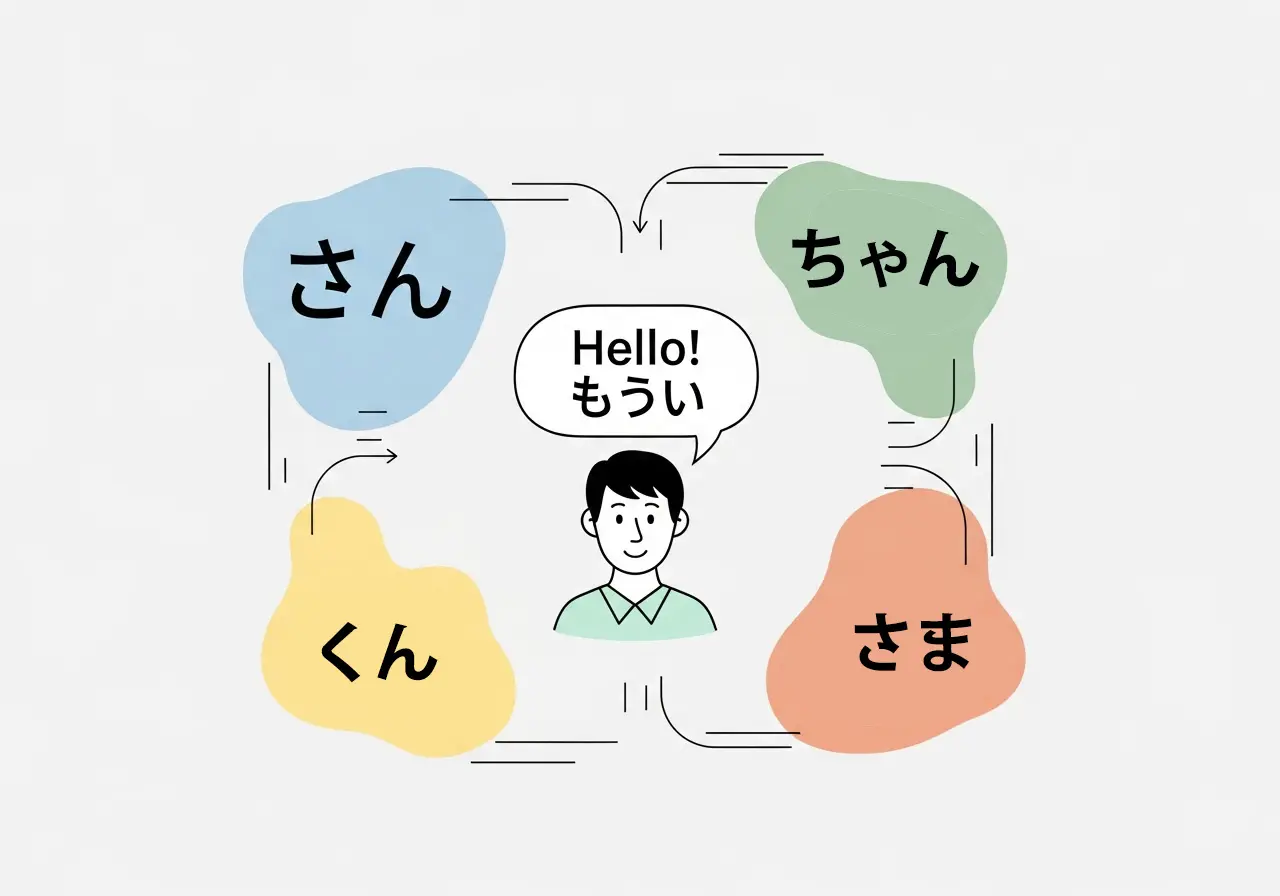
If you are learning Japanese, you will quickly notice something important:
People do not usually call each other by name alone.
Instead, Japanese often adds a small ending after a name, such as -san, -chan, or -kun. These endings are called honorifics. They may look small, but they carry a lot of meaning. They can show respect, closeness, age difference, social role, or emotional tone.
That is why honorifics matter so much. They are not just “extra words.” They help Japanese sound more natural and socially aware.
This guide is for beginners who want a practical answer to one question:
Which Japanese honorific should I actually use?
We will keep it simple, people-first, and useful for real life. If you are still building your foundation, this works especially well alongside our guides to the best way to learn Japanese and essential Japanese grammar rules.
What are Japanese honorifics
Japanese honorifics are short titles or endings added after a person’s name.
For example:
- Tanaka-san
- Yuki-chan
- Haruto-kun
- Suzuki-sensei
In English, learners sometimes compare them to words like Mr., Ms., or teacher, but that comparison is only partly useful. Japanese honorifics do more than show politeness. They also show relationship. As Britannica’s Japanese language overview explains, Japanese marks the speaker’s attitude toward both the listener and the person being talked about.
For learners, the main goal is not to memorize every title at once. It is to avoid sounding too direct, too casual, or too familiar by mistake.
That is the key idea to remember:
Honorifics are about respect and relationship, not only grammar.
The safest default is san
If you only learn one honorific first, learn -san.
This is the safest and most useful default for beginners.
You can think of -san as a polite, neutral ending that works in many situations. It is often used with classmates, coworkers, neighbors, customers, and people you do not know very well. The Japan Foundation’s Marugoto teacher notes describe -san as the general respectful option learners should recognize early.
Examples:
- Sato-san
- Yamada-san
- Mika-san
Why san matters so much
Many beginners worry about choosing the “perfect” honorific.
In real life, the better beginner habit is simpler:
When you are not sure, use -san.
That choice will sound much safer than using no honorific at all.
Example
Tanaka-san wa doko desu ka.
“Where is Mr./Ms. Tanaka?”
Mika-san, arigatou.
“Thank you, Mika.”
If you want more everyday polite expressions to pair with this, see our guide to how to say thank you in Japanese.
Chan feels cute, warm, or affectionate
-chan is softer and more affectionate than -san.
It is often used for:
- small children
- close female friends
- cute nicknames
- family members in warm or playful speech
- sometimes pets or fictional characters
Examples:
- Hana-chan
- Momo-chan
- Yui-chan
Important beginner note
Many learners first notice -chan in anime and start using it too quickly.
That can sound strange.
-chan is not a general polite ending. It suggests closeness, softness, or affection. If you use it with someone you do not know well, it may sound too familiar.
Example
Aya-chan wa kawaii ne.
“Aya-chan is cute, isn’t she?”
That sounds natural between people who are close. It does not sound like the safest default for a stranger.
Kun is common with boys and younger males, but context matters
-kun is often used for:
- boys
- male students
- younger male coworkers
- junior staff
- sometimes girls in certain school or workplace situations
Examples:
- Taro-kun
- Ken-kun
- Aoki-kun
The simple beginner rule
For beginners, this is the easiest way to think about -kun:
- common for boys
- common from seniors to juniors
- not your safest default with strangers
That last point matters.
Many learners hear -kun often in dramas, anime, or school settings and think it is just another normal name ending. But unlike -san, it depends more on relationship and hierarchy.
Example
A teacher might say:
Yuta-kun, kotae wa wakarimasu ka.
“Yuta-kun, do you know the answer?”
That sounds natural in a school setting.
Sama is much more respectful
-sama is more formal and respectful than -san.
You will often see it in:
- customer service
- business writing
- formal letters
- hotel or restaurant language
- certain set phrases
Examples:
- okyakusama = honored guest / customer
- Tanaka-sama
- minasama = everyone, in a very polite tone
Beginner tip
You usually do not need to actively use -sama in daily conversation as a beginner. But you should recognize it when you hear it or see it.
It often appears in service language, announcements, emails, and formal writing.
Sensei is not only for school teachers
Many learners first translate sensei as “teacher.” That is a useful starting point, but the word is broader than that.
Sensei is used for people in respected expert roles, especially:
- school teachers
- professors
- doctors
- some artists
- some lawyers and other professionals
Examples:
- Suzuki-sensei
- Kimura-sensei
Real-life learner tip
If someone is your doctor or your teacher, sensei is often more natural than using -san.
Example
Sensei, shitsumon ga arimasu.
“Teacher/Doctor, I have a question.”
Senpai is different from a normal name ending
Senpai means an older or more senior person in a school, club, or workplace setting.
It is not always attached like -san or -chan. Sometimes it works more like a title.
Examples:
- Tanaka-senpai
- Senpai, chotto ii desu ka.
It usually refers to someone with more experience than you in the same group.
Simple way to understand it
- senpai = senior
- kohai = junior
As a beginner, you do not need to use these every day, but you should know them because they appear often in Japanese media and real social settings.
When not to use an honorific
This is just as important as knowing which one to use.
1. Do not usually use an honorific for yourself
In Japanese, people normally do not attach -san or another honorific to their own name in normal conversation.
That sounds unnatural.
Wrong:
- Watashi wa Kent-san desu.
Natural:
- Watashi wa Kento desu.
2. Be careful with dropping honorifics
Calling someone with no honorific at all can sound very close, very casual, or even rude depending on the relationship.
Among close friends or family, dropping the honorific can be normal. But as a beginner, removing it too early is one of the easiest ways to sound off. The Japan Foundation’s Marugoto notes also point out that dropping an honorific usually happens only between people who are very close.
3. Do not assume anime usage is always safe in real life
Anime often exaggerates personality and relationships.
That is why honorifics in anime are useful to notice, but not always safe to copy directly.
A character calling everyone -chan may sound cute in a show. In real life, it may sound overly familiar.
If you want more beginner-friendly real-world Japanese, our post on Japanese basic phrases is a better model than copying anime speech directly.
Common mistakes beginners make
Mistake 1. Using chan too quickly
Many learners like -chan because it sounds cute and memorable.
But in real life, it is not the safest choice. If you are not close to the person, it can sound too familiar.
Mistake 2. Forgetting that san is enough
Some learners think -san sounds boring and want to use something more “native.”
Actually, choosing -san correctly is one of the most natural beginner habits you can build.
Mistake 3. Dropping honorifics because English does not use them much
In English, using someone’s bare first name is often friendly.
In Japanese, the same move does not always feel friendly. Sometimes it feels too direct.
Mistake 4. Treating honorifics like exact translations
- -san is not exactly “Mr.”
- -chan is not exactly “little”
- -kun is not exactly “boy”
Those rough translations can help at first, but they are not the full picture. Relationship matters more than literal translation.
Mini-dialogues you can actually use
1. Safe classroom style
A: Tanaka-san wa kyou kimasu ka.
“Is Tanaka-san coming today?”
B: Hai, Tanaka-san wa ato de kimasu.
“Yes, Tanaka-san will come later.”
2. Talking to a teacher
A: Sensei, kore wa dou iu imi desu ka.
B: Ii shitsumon desu ne.
A: “Teacher, what does this mean?”
B: “That is a good question.”
3. Close, friendly tone
A: Yuki-chan, genki?
B: Un, genki da yo.
A: “Yuki-chan, how are you?”
B: “Yeah, I’m good.”
This sounds warm and close, not neutral and general.
A simple beginner strategy that works
If you want the practical rule, here it is:
Use this order
- Use -san by default
- Learn to recognize -chan and -kun
- Use sensei for teachers and doctors
- Notice -sama and senpai, even if you do not use them much at first
- Do not drop honorifics too early
That strategy will keep you safe in most beginner situations.
If you are still building an overall study system, our roundup of the best Japanese learning apps can help you pair culture topics like this with speaking, listening, and reading practice.
Why honorifics matter for sounding natural
A lot of beginners focus on vocabulary first.
That makes sense.
But honorifics are one of the fastest ways to sound more natural because they affect the tone of the whole sentence. Even if your grammar is simple, using the right honorific makes your Japanese feel more socially aware.
That matters because Japanese is not only about what you say.
It is also about how you position yourself toward the other person.
Honorifics help you do that.
Quick recap
Here is the simplest summary:
- -san = safest default
- -chan = cute, affectionate, close
- -kun = common for boys or juniors
- -sama = very respectful, formal
- sensei = teacher, doctor, respected expert
- senpai = senior person in your group
If you remember only one rule from this guide, remember this:
When in doubt, use -san.
Final thoughts
Japanese honorifics can feel intimidating at first because they seem small, but they carry a lot of social meaning.
The good news is that beginners do not need to master every nuance immediately.
You just need a good starting point.
That starting point is not trying to sound fancy.
It is not copying anime blindly.
It is not searching for the most special title.
It is learning the safest natural choice, noticing the common patterns, and slowly becoming more aware of how relationships are expressed in Japanese.
That is how honorifics stop feeling confusing and start feeling useful.
And once that happens, your Japanese begins to sound not only more correct, but more human.