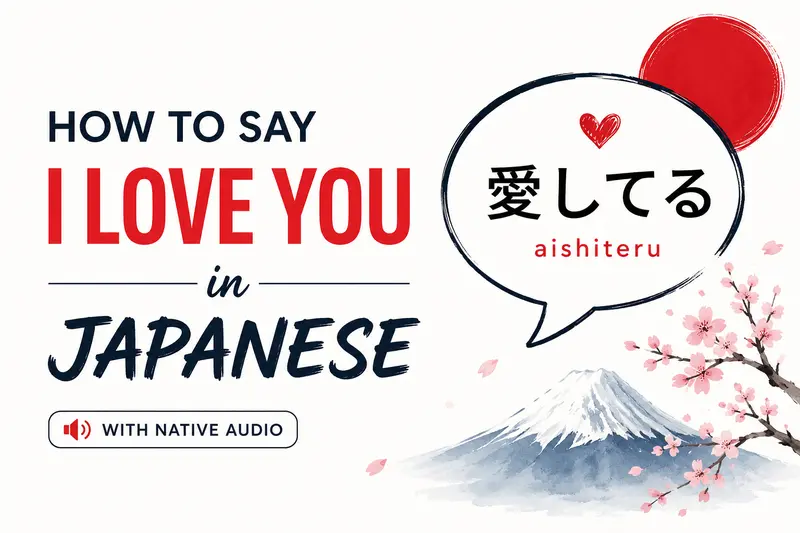
TL;DR
The most direct way to say “I love you” in Japanese is:
愛してる (aishiteru)
However, this isn’t the phrase most Japanese people use every day.
In real life, you’ll hear these expressions much more often:
| Japanese | Meaning | Commonness |
|---|---|---|
| 愛してる | I love you | ⭐⭐ |
| 大好きです | I love you / I really like you | ⭐⭐⭐⭐ |
| 好きです | I like you (often romantic) | ⭐⭐⭐⭐⭐ |
If you’re learning Japanese for travel, relationships, anime, or conversation, 好きです is usually the safest and most natural place to start.
How do you say “I love you” in Japanese?
If you search online, you’ll almost always find the same answer:
愛してる (aishiteru)
While that’s technically correct, it doesn’t tell the whole story.
Unlike English, Japanese speakers don’t usually say “I love you” frequently.
Many long-term couples rarely say 愛してる at all.
Instead, they often express affection through everyday actions or choose softer phrases that sound more natural.
That’s why understanding when to use each expression is just as important as knowing how to say it.
In this guide, you’ll learn:
- the most common ways to express love,
- when each phrase feels natural,
- pronunciation with native-quality audio,
- common mistakes learners make,
- and the cultural differences that surprise many foreigners.
Which phrase should you use?
Here’s a quick guide before we dive into the details.
| Situation | Best expression |
|---|---|
| First romantic confession | 好きです |
| Dating someone | 大好きです |
| Married couple | 愛してる |
| Anime-style dramatic confession | 愛してる |
| Texting your partner | 大好き ❤️ |
| Talking about favorite food | 大好き |
Notice that 愛してる appears much less often than many learners expect.
For most real-life situations, Japanese speakers naturally choose 好き or 大好き instead.
愛してる (Aishiteru)
This is the closest direct translation of “I love you.”
It’s also the strongest romantic expression in Japanese.
Because it’s so emotionally powerful, native speakers usually reserve it for very special moments.
For example:
- marriage proposals,
- wedding anniversaries,
- deeply emotional conversations,
- or scenes in movies and television dramas.
Unlike English, casually saying 愛してる every day may sound overly dramatic.
Many Japanese couples express love in quieter ways instead.
Pronunciation
愛してる
Try listening several times before repeating it aloud.
Focus on copying the rhythm rather than translating each individual character.
Example
愛してる。
I love you.
This simple sentence can carry enormous emotional weight in Japanese.
Sometimes a single 愛してる says more than a long conversation.
好きです (Suki desu)
This is probably the most important phrase in this article.
Although 好きです literally means “I like you,” its meaning depends entirely on the situation.
When confessing your feelings to someone, 好きです often means:
“I like you.”
or
“I have romantic feelings for you.”
Native speakers immediately understand the romantic meaning from the context.
That’s why many Japanese people choose 好きです instead of the much stronger 愛してる.
If you’re making your first romantic confession in Japanese, this is usually the expression you’ll hear most often.
Example
あなたが好きです。
I like you.
Depending on the situation, this can also be understood as:
“I love you.”
大好きです (Daisuki desu)
If 好きです isn’t quite strong enough, many Japanese speakers naturally choose 大好きです.
The prefix 大 (dai) means “big” or “great.”
Adding it makes your feelings much stronger while still sounding warmer and more natural than 愛してる.
For this reason, 大好き is extremely common in everyday Japanese.
You’ll hear it between couples, family members, close friends, and even when talking about hobbies or favorite foods.
Example
君が大好きです。
I love you very much.
Compared with 愛してる, this sounds affectionate, sincere, and much more common in everyday conversation.
So…which one sounds the most natural?
If you only remember one thing from this article, remember this:
| Expression | Literal meaning | Naturalness |
|---|---|---|
| 好きです | I like you | ⭐⭐⭐⭐⭐ |
| 大好きです | I really like / love you | ⭐⭐⭐⭐ |
| 愛してる | I love you | ⭐⭐ |
For most learners, 好きです and 大好きです are the expressions you’ll actually use and hear far more often than 愛してる.
Casual ways to say “I love you”
Once you’re close to someone, conversations usually become less formal.
Instead of saying the full 好きです or 大好きです, native speakers often shorten these expressions.
好き (Suki)
Simply dropping です makes the phrase sound much more casual.
It’s commonly used between:
- couples
- close friends (non-romantic context depends on situation)
- classmates
- teenagers
Because Japanese relies heavily on context, 好き may simply mean “I like you,” or it may clearly express romantic feelings.
大好き (Daisuki)
This is one of the most common affectionate expressions you’ll hear.
Unlike 愛してる, it doesn’t sound overly dramatic.
Japanese speakers use it for:
- romantic partners
- family members
- children
- pets
- favorite food
- favorite hobbies
For example:
ラーメンが大好き!
“I love ramen!”
Notice that 大好き isn’t limited to romance.
The surrounding context tells listeners what kind of love you’re talking about.
好きだ (Suki da)
This version sounds firmer and more masculine.
You’ll often hear it in:
- anime
- Japanese dramas
- movies
- romantic confession scenes
Although women can certainly say 好きだ, 好きです generally sounds softer and more polite.
Real conversations
Instead of memorizing isolated words, practice complete conversations.
That’s much closer to how you’ll actually use Japanese.
First confession
A
好きです。
“I like you.”
B
私も好きです。
“I like you too.”
Long-term couple
A
愛してる。
“I love you.”
B
私も。
“Me too.”
Notice how natural Japanese conversations are often very short.
Native speakers usually don’t repeat unnecessary words.
Why Japanese people rarely say “I love you”
This surprises many learners.
In English-speaking countries, couples often say:
“I love you.”
every day.
In Japan, that’s much less common.
Many happily married couples may rarely say 愛してる, yet still have very strong relationships.
Instead, affection is often communicated through everyday actions.
Examples include:
- preparing your favorite meal,
- remembering small details about your day,
- bringing an umbrella when it rains,
- waiting for you after work,
- buying your favorite snack,
- making bentō for you,
- checking whether you’ve arrived home safely.
These actions often carry the same emotional meaning as saying “I love you.”
This cultural difference explains why many Japanese learners are surprised when they don’t hear 愛してる very often in real conversations.
Anime isn’t always real life
Many learners first encounter Japanese through anime.
That’s perfectly fine—but it’s important to remember that anime often exaggerates emotional language.
For example, dramatic confession scenes frequently include:
愛してる!
or
好きだ!
These moments are designed to create emotional impact.
In everyday life, however, many Japanese people would choose softer expressions such as 好きです or 大好き.
Watching anime is a great way to improve your listening skills, but it’s equally important to learn which expressions are common in everyday conversations.
That’s one of the biggest differences between textbook Japanese, anime Japanese, and real spoken Japanese.
Common situations: Which phrase should you use?
If you’re still unsure which expression sounds the most natural, this quick guide can help.
| You want to… | Best expression | Why |
|---|---|---|
| Confess your feelings to someone | 好きです | The most natural and common choice. |
| Tell your spouse you deeply love them | 愛してる | Very strong and deeply emotional. |
| Tell your boyfriend or girlfriend you love them | 大好き / 大好きです | Warm, affectionate, and common. |
| Tell your child you love them | 大好きだよ | Loving and natural. |
| Say you love sushi | 寿司が大好き! | Common for favorite things. |
| Say you love Japan | 日本が大好きです。 | Natural when talking about interests or places. |
As a beginner, you’ll probably use 好きです and 大好きです much more often than 愛してる.
Common mistakes learners make
Saying 愛してる too often
Many English speakers translate every “I love you” directly into 愛してる.
That’s one of the biggest mistakes beginners make.
Because 愛してる is so emotionally strong, saying it too frequently can sound unnatural.
When in doubt, 好きです or 大好きです is usually the safer choice.
Thinking 好き only means “like”
Yes, 好き literally means “like.”
But language isn’t just about dictionaries.
If someone says:
好きです。
during a romantic confession, every native speaker understands the romantic meaning.
Always pay attention to the situation rather than translating word by word.
Learning from anime alone
Anime is fantastic for motivation.
But remember:
Characters often speak dramatically because they’re telling a story.
Real-life Japanese conversations are usually much quieter and more subtle.
Try balancing anime with podcasts, YouTube interviews, TV shows, and conversations with native speakers.
Frequently asked questions
Is 愛してる stronger than 好きです?
Yes.
愛してる expresses deep, long-lasting romantic love and is one of the strongest declarations of affection in Japanese.
好きです is softer and is the phrase most commonly used when confessing romantic feelings.
Do Japanese couples really say “I love you”?
Some do.
Many don’t.
Japanese culture generally places greater emphasis on showing affection through everyday actions than through frequent verbal declarations.
That doesn’t mean relationships are less loving—it simply reflects a different way of expressing care.
Can I say 大好き to a friend?
Yes.
Context matters.
You can say 大好き to close friends, family members, children, pets, or when talking about things you enjoy.
For example:
猫が大好きです。
“I love cats.”
Can women say 好きだ?
Yes.
Although 好きだ is often portrayed as sounding more masculine in anime and dramas, women may also use it depending on their personality and the situation.
For learners, 好きです is generally the safest and most versatile expression.
What’s the difference between 愛 and 恋?
Both words relate to love, but they aren’t identical.
- 愛 (ai) usually refers to deep, lasting love and affection.
- 恋 (koi) often refers to romantic attraction, longing, or being in love with someone.
As you continue learning Japanese, you’ll notice both words appear frequently in songs, novels, and films, each carrying a slightly different emotional nuance.
Final thoughts
Learning how to say “I love you” in Japanese isn’t just about memorizing one phrase.
It’s about understanding the culture behind the language.
While 愛してる is the closest direct translation, it’s not the expression you’ll hear most often in everyday life.
For many situations:
- 好きです feels natural.
- 大好きです sounds warm and affectionate.
- 愛してる is reserved for deeply emotional moments.
By choosing the right phrase for the right situation, you’ll sound much more natural—and better understand how Japanese people express affection in real life.
As you continue learning Japanese, remember that pronunciation matters just as much as vocabulary. Listen to the native audio throughout this guide, repeat each phrase aloud, and don’t be afraid to imitate the rhythm and intonation.
Language is more than words—it’s how those words are spoken.
Further reading
Ready to learn more everyday Japanese? These beginner-friendly guides will help you build practical vocabulary and communicate more naturally.
- Japanese Basic Phrases: Essential Expressions for Beginners — Learn the most useful Japanese phrases for daily conversations.
- Hello in Japanese Language: A Complete Guide — Discover different ways to say hello depending on the time, setting, and level of formality.
- How to Say Thank You in Japanese — Master polite and casual ways to express gratitude.
- Good Morning in Japanese: Meaning, Usage & Variations — Learn natural morning greetings used by native speakers.
- Yes in Japanese Language: Complete Guide — Go beyond hai and discover how Japanese people actually say “yes” in different situations.
- No in Japanese Language: Meaning, Usage, and Examples — Understand polite ways to disagree or decline without sounding rude.