TL;DR
Learning the most common Polish greetings goes a long way when visiting Poland or speaking with Polish friends.
Here are the expressions you’ll hear most often:
| Polish | English | Situation |
|---|---|---|
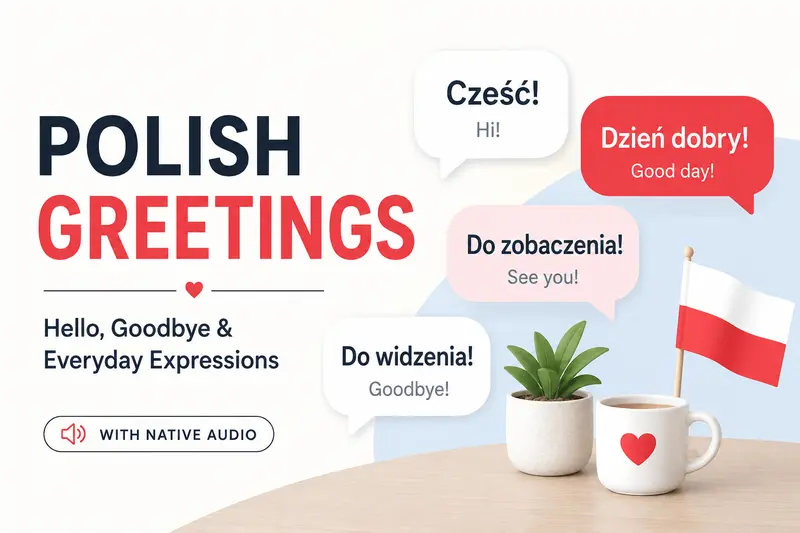
| Cześć | Hi / Hello | Casual |
| Dzień dobry | Good day / Hello | Polite |
| Witam | Welcome | Host or presenter |
| Do widzenia | Goodbye | Polite |
| Do zobaczenia | See you | Casual or polite |
| Dobranoc | Good night | Before going to bed |
If you’re just getting started, remember these three phrases:
- Cześć for friends.
- Dzień dobry for most everyday situations.
- Do widzenia when saying goodbye politely.
Table of Contents
Open Table of Contents
- Polish greetings you’ll use every day
- Quick greeting cheat sheet
- How to say hello in Polish
- Cześć
- Dzień dobry
- Witam
- Which greeting sounds the most natural?
- How to say goodbye in Polish
- Do widzenia
- Do zobaczenia
- Cześć
- Time-based greetings
- Dobry wieczór
- Dobranoc
- Real conversations
- Formal vs. casual greetings
- A cultural tip
- Common mistakes learners make
- Frequently asked questions
- Final thoughts
- References
Polish greetings you’ll use every day
One of the easiest ways to sound more natural in Polish is to greet people appropriately.
Unlike some languages, Polish has different greetings depending on:
- how well you know the other person,
- whether the situation is formal or informal,
- and sometimes even the time of day.
The good news is that you don’t need to memorize dozens of expressions.
With just a handful of greetings, you’ll be able to handle most everyday conversations confidently.
In this guide, you’ll learn:
- the most common ways to say hello and goodbye,
- when each greeting sounds natural,
- native pronunciation with audio,
- common mistakes learners make,
- and a few cultural tips that will help you make a great first impression.
Quick greeting cheat sheet
If you’re in a hurry, this table shows exactly which greeting to use.
| Situation | Best expression |
|---|---|
| Meeting a friend | Cześć |
| Meeting a teacher or colleague | Dzień dobry |
| Entering a shop | Dzień dobry |
| Leaving work | Do widzenia |
| Saying goodbye to friends | Cześć or Do zobaczenia |
| Going to bed | Dobranoc |
Don’t worry if these expressions look unfamiliar right now—we’ll explain each one with pronunciation, examples, and usage below.
How to say hello in Polish
Polish has several ways to say “hello,” and the right greeting depends on who you’re speaking to and the situation.
The right greeting depends on who you’re talking to and the situation.
Let’s start with the three expressions you’ll hear most often.
Cześć
Cześć is the most common informal greeting in Polish.
It’s similar to saying “Hi” or “Hey” in English and is used with:
- friends,
- classmates,
- family members,
- and people around your own age.
Because it’s casual, avoid using Cześć in formal situations, such as speaking with a professor, an older stranger, or someone you’ve just met in a professional setting.
Example
Cześć!
Hi!
A single Cześć! is perfectly natural when greeting a friend.
Interestingly, Cześć can also be used to say “Bye!” in casual conversations, much like “See ya!” in English.
Dzień dobry
If you only remember one formal greeting, make it Dzień dobry.
Although it’s often translated as “Good morning” or “Good day,” native Polish speakers use it much more broadly.
You’ll hear Dzień dobry when:
- entering a shop,
- meeting your teacher,
- greeting a coworker,
- speaking with hotel staff,
- talking to someone you don’t know well.
For most visitors to Poland, Dzień dobry is the safest and most useful greeting.
Example
Dzień dobry!
Good day! / Hello!
You’ll hear this greeting throughout the day, especially from the morning until the early evening.
When in doubt, Dzień dobry is almost always the right choice.
Witam
Witam literally means “Welcome.”
Unlike Cześć or Dzień dobry, it isn’t a general greeting that everyone should use.
Instead, it’s typically said by someone who is welcoming guests or introducing an event.
For example:
- a hotel receptionist,
- a TV presenter,
- the host of a meeting,
- or someone welcoming visitors into their home.
Because of this, learners shouldn’t use Witam as a replacement for “hello” when meeting someone for the first time.
Example
Witam wszystkich!
Welcome, everyone!
This expression sounds natural when addressing a group, but not when greeting someone as an ordinary guest.
Which greeting sounds the most natural?
If you’re still wondering which greeting to choose, here’s a simple rule:
| Greeting | Best used with | Naturalness |
|---|---|---|
| Cześć | Friends and family | ⭐⭐⭐⭐⭐ |
| Dzień dobry | Almost everyone | ⭐⭐⭐⭐⭐ |
| Witam | Guests or an audience | ⭐⭐⭐ |
For most learners, Cześć and Dzień dobry are the two greetings you’ll use every day.
How to say goodbye in Polish
Just like there are several ways to say hello, Polish also has different expressions for saying goodbye.
The right choice depends on how formal the situation is and how well you know the other person.
Let’s start with the most common farewell.
Do widzenia
Do widzenia is the standard polite way to say “Goodbye.”
You’ll hear it everywhere in Poland, including:
- shops,
- restaurants,
- hotels,
- offices,
- schools,
- and public services.
If you’re unsure which farewell to use, Do widzenia is always a safe choice.
Example
Do widzenia!
Goodbye!
It’s polite, friendly, and appropriate in almost every formal situation.
Do zobaczenia
Do zobaczenia literally means “Until we see each other again.”
In natural English, it’s closest to:
- “See you.”
- “See you later.”
People often use it when they expect to meet again soon.
It’s suitable for both casual and polite situations.
Example
Do zobaczenia jutro!
See you tomorrow!
Cześć
One interesting feature of Polish is that Cześć works both as:
- Hi!
- Bye!
This is very similar to Italian Ciao.
Among friends, it’s perfectly natural to greet someone with Cześć! and leave with exactly the same word.
Time-based greetings
Some Polish greetings depend on the time of day.
Learning these expressions will help you sound even more natural.
Dobry wieczór
Dobry wieczór means “Good evening.”
Use it when meeting someone in the evening, whether you’re entering a restaurant, arriving at a hotel, or visiting someone’s home.
Example
Dobry wieczór!
Good evening!
Unlike Dzień dobry, this greeting is reserved specifically for the evening.
Dobranoc
Many beginners make the mistake of using Dobranoc when arriving somewhere at night.
That’s not how native speakers use it.
Dobranoc means “Good night,” and it’s said when someone is going to sleep or when you’re leaving late in the evening.
Think of it as ending the day rather than beginning a conversation.
Example
Dobranoc!
Good night!
Real conversations
Rather than memorizing individual words, practice complete conversations.
This will help you feel much more confident when speaking Polish.
Meeting a new colleague
A
Dzień dobry!
Hello!
B
Dzień dobry!
Hello!
Meeting a friend
A
Cześć!
Hi!
B
Cześć!
Hi!
Leaving the office
A
Do widzenia!
Goodbye!
B
Do widzenia!
Goodbye!
Saying goodbye to friends
A
Do zobaczenia!
See you!
B
Cześć!
Bye!
Formal vs. casual greetings
Choosing the right level of formality is just as important as choosing the right words.
| Greeting | Casual | Polite |
|---|---|---|
| Cześć | ✅ | ❌ |
| Dzień dobry | ❌ | ✅ |
| Witam | ⚠️ Only when welcoming guests | ⚠️ |
| Do widzenia | ❌ | ✅ |
| Do zobaczenia | ✅ | ✅ |
| Dobry wieczór | ❌ | ✅ |
| Dobranoc | ✅ | ✅ |
When you’re visiting Poland, using a polite greeting with strangers is always appreciated.
Once someone invites you to speak more casually, expressions like Cześć will feel much more natural.
A cultural tip
Polish people generally appreciate polite greetings, especially when entering small businesses, cafés, or local shops.
It’s common to say Dzień dobry when you walk in, even if you’re only browsing.
Likewise, saying Do widzenia before you leave is considered friendly and respectful.
These small habits help create a positive first impression and show respect for local customs.
You don’t need perfect pronunciation to be appreciated—making the effort to greet people in Polish is often enough to earn a smile.
Common mistakes learners make
Even simple greetings can cause confusion when you’re learning a new language.
Here are a few common mistakes—and how to avoid them.
Using Cześć in formal situations
Because Cześć is so common, some beginners use it with everyone.
However, it’s best reserved for:
- friends,
- classmates,
- close coworkers,
- and family members.
If you’re speaking with someone older, a teacher, a hotel receptionist, or a stranger, Dzień dobry is usually the better choice.
When in doubt, it’s safer to be slightly more polite than too casual.
Using Witam as a general greeting
Many online translators list Witam as another way to say “hello.”
While that’s technically true, native speakers don’t usually use it when meeting someone in everyday conversation.
Instead, Witam is typically used by:
- a host welcoming guests,
- a presenter opening an event,
- or someone greeting an audience.
If you’re simply saying hello to someone, choose Dzień dobry or Cześć instead.
Saying Dobranoc when arriving
This is one of the most common beginner mistakes.
Although Dobranoc translates to “Good night,” it’s a farewell—not a greeting.
For example:
❌ Arriving at a restaurant at 8:00 p.m.
Dobranoc.
✅ Natural greeting
Dobry wieczór.
Use Dobranoc only when someone is leaving for the night or going to sleep.
Frequently asked questions
What’s the most common way to say hello in Polish?
For informal situations, Cześć is the most common greeting.
For polite situations, Dzień dobry is the standard greeting you’ll hear throughout Poland.
Can Cześć mean both “hello” and “goodbye”?
Yes.
Just like the Italian word Ciao, Cześć is commonly used for both greeting and saying goodbye among friends.
The meaning is clear from the context.
Is Dzień dobry only used in the morning?
No.
Although it’s often translated as “Good morning” or “Good day,” Polish speakers use Dzień dobry throughout most of the daytime.
It’s appropriate from the morning until the early evening.
Later in the evening, people switch to Dobry wieczór.
Should I shake hands when greeting someone in Poland?
In formal situations, a handshake is common, especially in business settings or when meeting someone for the first time.
Among friends and family, greetings are usually more relaxed and depend on the relationship.
When you’re unsure, simply saying Dzień dobry with a smile is always a good start.
Which Polish greetings should beginners learn first?
If you’re just beginning to learn Polish, start with these four expressions:
- Cześć
- Dzień dobry
- Do widzenia
- Dobranoc
With these phrases alone, you’ll be able to handle most everyday greetings and farewells.
Final thoughts
Learning Polish greetings is one of the fastest ways to feel more confident when speaking the language.
While there are many expressions, you don’t need to memorize all of them at once.
For everyday conversations, remember these simple rules:
- Cześć for friends and family.
- Dzień dobry for polite situations.
- Do widzenia when saying goodbye.
- Dobranoc before going to bed.
As you continue learning Polish, try listening to the native audio throughout this guide and repeat each greeting aloud. Paying attention to pronunciation and rhythm will help you sound more natural and understand spoken Polish more easily.
Once you’re comfortable with these greetings, you’ll find it much easier to start conversations, travel confidently, and continue building your Polish vocabulary.