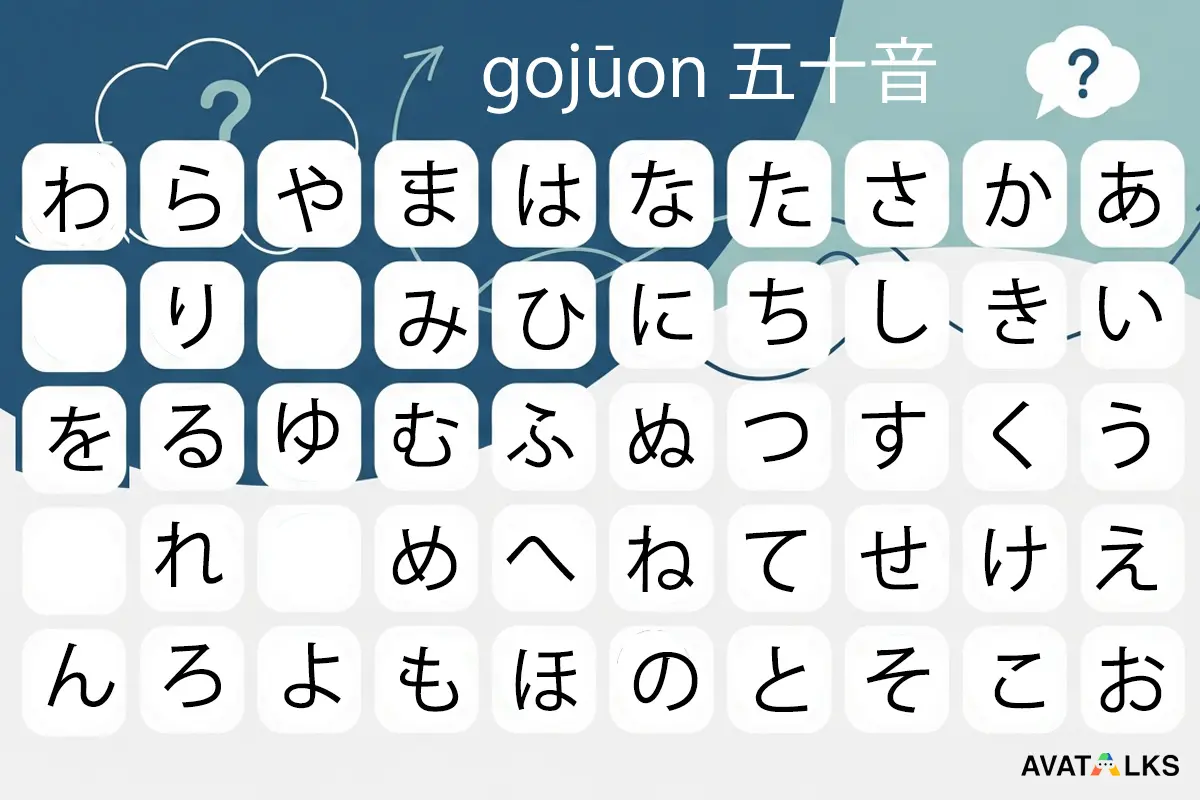
If you are learning Japanese kana, the gojūon order is one of the most useful things to understand early.
A lot of beginners memorize kana as separate symbols:
- あ
- い
- う
- え
- お
- then maybe か
- then maybe き
- and so on
That works for a while, but it often feels slow and messy.
The moment kana starts feeling much easier is usually the moment you stop seeing it as a pile of symbols and start seeing it as a sound grid.
That grid is the gojūon.
Once you learn it, you can:
- practice by row
- understand kana patterns faster
- find words more easily in charts and dictionaries
- and build much stronger recall for both hiragana and katakana
TL;DR
The gojūon (五十音) is the standard sound order for Japanese kana.
It organizes kana by:
- rows like か き く け こ
- and vowel columns like あ か さ た な
Why it matters:
- it gives kana a clear structure
- it helps with dictionary order
- it supports grammar explanations
- and it makes practice much faster
The best way to learn it is:
- rows first
- then columns
- then random recall
What is the gojūon?
The word gojūon literally means something like fifty sounds.
In practice, it refers to the standard Japanese kana order used for:
- hiragana charts
- katakana charts
- dictionaries
- language textbooks
- keyboard layouts
- and grammar explanations
The gojūon is not just a chart. It is the basic map of Japanese kana.
That is why it matters so much.
If you already know a little kana, learning the gojūon helps organize what you know. If you are still near the beginning, it gives you a much cleaner way to learn from the start.
If you want the bigger kana roadmap too, Learn Japanese Kana fits naturally with this topic.
How the gojūon is organized
The gojūon is built from:
- five vowel columns
- and a set of consonant rows
The vowels are always:
- a
- i
- u
- e
- o
That gives you the pattern behind rows like:
- か き く け こ
- さ し す せ そ
- た ち つ て と
This is one reason the chart is so useful: once you understand the pattern, kana stops feeling random.
The core hiragana gojūon table
| a | i | u | e | o | |
|---|---|---|---|---|---|
| あ | い | う | え | お | |
| k | か | き | く | け | こ |
| s | さ | し | す | せ | そ |
| t | た | ち | つ | て | と |
| n | な | に | ぬ | ね | の |
| h | は | ひ | ふ | へ | ほ |
| m | ま | み | む | め | も |
| y | や | ゆ | よ | ||
| r | ら | り | る | れ | ろ |
| w | わ | を | |||
| ん |
This is the core pattern beginners should learn first.
Important beginner note
The chart is called gojūon, but modern Japanese does not literally have a perfect 50-sound table in everyday kana use.
That is normal. You do not need to worry about the historical details first. Just learn the pattern that modern learners actually use.
Katakana follows the same order
One of the best things about learning the gojūon is this:
Hiragana and katakana follow the same sound order.
That means once you understand the structure once, you can reuse it.
So:
- あ い う え お matches
- ア イ ウ エ オ
And:
- か き く け こ matches
- カ キ ク ケ コ
This makes katakana much less overwhelming than it first appears.
If you want to build those two systems separately, How to Practice Hiragana and Learn Katakana are good companion posts.
Why the gojūon matters so much
A lot of learners think the chart is only for memorization.
It is more useful than that.
1. It makes kana easier to remember
When you learn by pattern, your brain can group sounds into families:
- か き く け こ
- さ し す せ そ
- た ち つ て と
That is much easier than trying to remember each symbol alone.
2. It helps with dictionary and lookup order
Japanese dictionaries and indexes often use gojūon order.
That means words are often grouped according to this same sound map.
So even if you are using modern digital tools, understanding the order still helps.
3. It makes grammar explanations clearer
Japanese grammar often refers to:
- rows
- sound groups
- and vowel shifts
If you understand the gojūon, explanations like:
- ka-row
- a-column
- or sound changes by row
become much easier to follow.
Rows and columns: the two ways to practice
The smartest way to practice gojūon is to use both:
- rows
- and columns
But do not start with both equally.
Start with rows
This is the best first step.
Example row practice
- あ い う え お
- か き く け こ
- さ し す せ そ
- た ち つ て と
Why rows help:
- they match how beginners usually learn
- they build rhythm
- they are easier to chant
- they help you recognize sound families quickly
Add columns later
After rows feel familiar, practice by vowel columns too.
Example column practice
- あ か さ た な は ま や ら わ
- い き し ち に ひ み り
- う く す つ ぬ ふ む ゆ る
- え け せ て ね へ め れ
- お こ そ と の ほ も よ ろ を
Why columns help:
- they strengthen your vowel awareness
- they help with grammar explanations
- they improve lookup and chart navigation
- they make the whole system feel more complete
The best practice sequence
If you are wondering how to actually learn the kana order gojūon, this sequence works well:
Step 1: Learn the vowel row first
- あ い う え お
Step 2: Add one consonant row at a time
For example:
- か き く け こ
- then さ し す せ そ
- then た ち つ て と
Step 3: Review old rows before adding new ones
Do not just keep adding.
Step 4: Start column review after a few rows feel stable
This prevents the chart from becoming only a horizontal memory.
Step 5: Finish with random recall
That is where recognition becomes real recall.
A 14-day gojūon plan that actually works
You do not need an extreme bootcamp.
Fifteen focused minutes a day is enough if you stay consistent.
Days 1–2
Learn:
- あ い う え お
- か き く け こ
Days 3–4
Add:
- さ し す せ そ
- た ち つ て と
Days 5–6
Add:
- な に ぬ ね の
- は ひ ふ へ ほ
Days 7–8
Add:
- ま み む め も
- や ゆ よ
Days 9–10
Add:
- ら り る れ ろ
- わ を ん
Days 11–12
Practice:
- full row reading
- first column review
- weak kana only
Days 13–14
Practice:
- full chart
- mixed row and column review
- random recall
- speed reading
That is enough to make the structure feel much more automatic.
A simple 15-minute daily routine
Here is a practical daily drill:
Minutes 1–5
Read 1–2 rows out loud repeatedly
Minutes 6–10
Write those same rows by hand
Minutes 11–13
Do one column scan slowly
Minutes 14–15
Test yourself randomly on 5–10 kana
This is much better than staring at a full chart and hoping your memory improves.
Common mistakes learners make
1. Memorizing kana only randomly
Random review has value, but if it is your only method, the system stays blurry.
2. Forgetting the vowel order
Japanese vowels are:
- a i u e o
not English-style alphabet thinking.
This matters a lot.
3. Learning hiragana and katakana as two unrelated systems
They are different symbol sets, but the order is the same.
4. Ignoring rows and columns completely
Then grammar and reference charts feel harder later.
A quick note about missing cells
Learners often ask why some spots in the chart are blank.
For example:
- there is や, ゆ, よ
- but not the full five-symbol row like many others
This is normal.
You do not need to “fix” the chart in your head. Just learn the real modern pattern as it appears.
That is enough for practical Japanese study.
Gojūon vs iroha
You may also hear about iroha order, which is an older traditional sequence.
For modern learners, the important point is simple:
- gojūon = the standard practical kana order you should learn first
- iroha = older cultural sequence you may notice later
So if your goal is learning Japanese efficiently, focus on gojūon.
How to make gojūon stick in memory
The best memory tricks are usually simple.
1. Learn the row initials
Think:
- A
- K
- S
- T
- N
- H
- M
- Y
- R
- W
Then add the vowel pattern across them.
2. Say the rows rhythmically
Rows are easier to remember when they sound like a pattern, not a list.
3. Write while saying the sound
This links:
- eye
- hand
- ear
- and voice
4. Mix slow review with speed practice
You want both:
- accurate recognition
- and fast recall
Practice with Avatalks
A good way to turn the gojūon into active memory is:
- practice one row at a time
- repeat the same sounds aloud
- add writing
- then switch to random recall
You can do that with the kana tool here:
FAQ
What does gojūon mean?
It refers to the standard Japanese kana order used in charts, dictionaries, and learning materials.
Should I learn rows or columns first?
Rows first. Columns are very useful later, but rows are easier for early memory.
Does katakana use the same order?
Yes. Katakana follows the same sound order as hiragana.
Is gojūon important for grammar?
Yes. It helps a lot with sound grouping, verb explanations, and general kana organization.
Do I need to memorize the full chart perfectly at once?
No. Learn it row by row, then strengthen it with column review and random recall.
Final advice
The kana order gojūon is useful because it turns Japanese kana from a memorization problem into a pattern.
That changes everything.
Instead of thinking:
- “I have to memorize dozens of separate symbols”
you start thinking:
- “I know the sound grid, and these kana live inside it”
That is a much stronger way to learn.
So if this still feels difficult, keep the method simple:
- learn one row
- review one old row
- scan one column
- test yourself randomly
Do that for two weeks, and the gojūon will start feeling like a real system instead of a chart you keep forgetting.