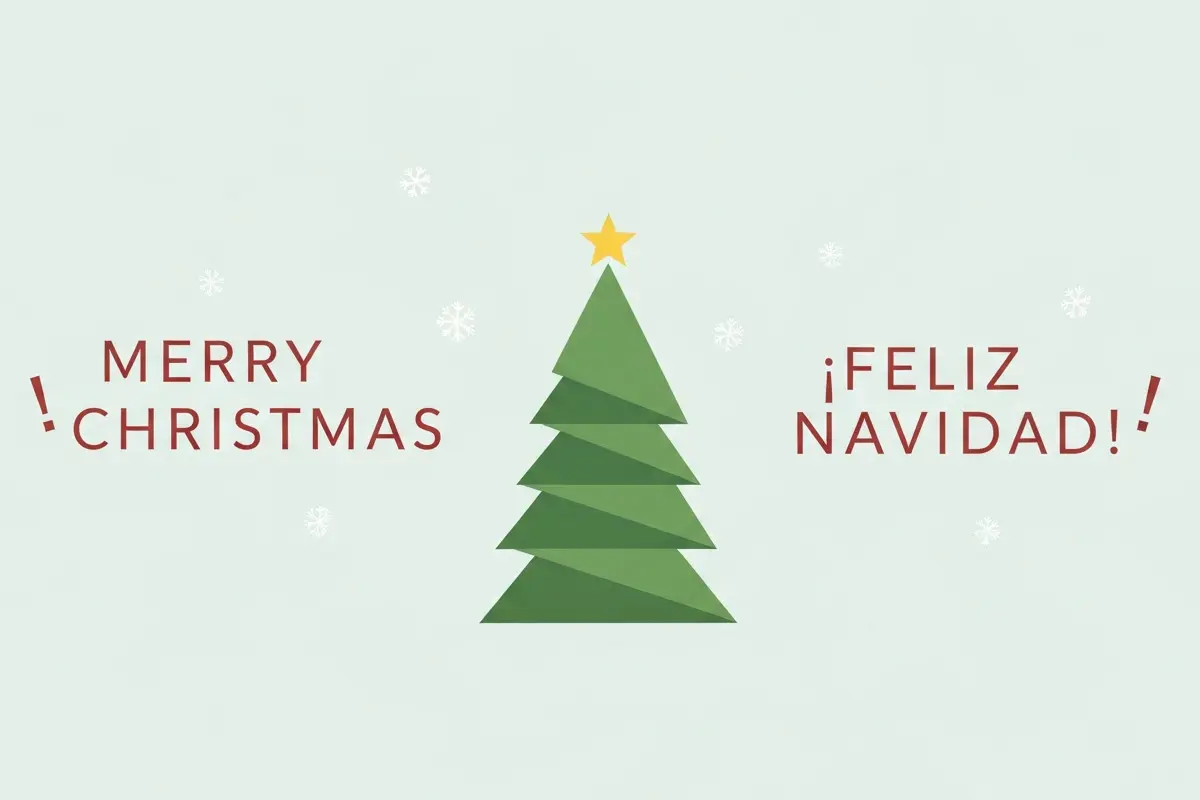
If you want to say Merry Christmas in Spanish, the main phrase is very simple:
¡Feliz Navidad!
That is the standard greeting used across the Spanish-speaking world.
The part learners usually need help with is not the translation itself. It is the smaller details:
- how to pronounce it
- how to write it correctly
- whether there are more formal versions
- and what people actually say in messages, cards, and real conversation
This guide keeps those answers clear and practical.
TL;DR
- Merry Christmas in Spanish is ¡Feliz Navidad!
- It works across Spain and Latin America.
- Spanish normally uses opening and closing exclamation marks: ¡ !
- Felices fiestas is also common, but it means Happy holidays, not exactly Merry Christmas.
- For Christmas and New Year together, say Feliz Navidad y Feliz Año Nuevo.
How do you say Merry Christmas in Spanish?
The standard phrase is:
¡Feliz Navidad!
This is the version you can safely use:
- in conversation
- in texts
- in holiday cards
- in emails
- in captions
- in social media posts
If you only remember one phrase from this page, make it this one.
What does Feliz Navidad mean literally?
Word by word, it means:
- feliz = happy
- Navidad = Christmas
Spanish uses feliz where English often uses merry in holiday greetings.
So even though English speakers expect “merry,” the natural Spanish phrase is still:
Feliz Navidad
This same pattern shows up in other common greetings too. If you want more examples, our post on happy new year in Spanish fits naturally with this one.
How do you pronounce Feliz Navidad?
A simple pronunciation guide is:
feh-LEES nah-vee-DAD
You can break it into parts:
-
Feliz
-
Navidad
A few quick tips help:
- feliz ends with a clear s sound
- the stress in Navidad falls on the last syllable
- the final d is softer than in English
If Spanish vowels still feel tricky, our guide on how to pronounce Spanish vowels can help.
Do you need exclamation marks in Spanish?
Yes. In standard Spanish writing, the full form is:
¡Feliz Navidad!
Spanish uses:
- an opening exclamation mark ¡
- and a closing exclamation mark !
That is the grammatically correct written form.
In casual texting, some people may drop the opening mark, but if you want the proper version, use both.
Are there other ways to say Merry Christmas in Spanish?
Yes. ¡Feliz Navidad! is the main phrase, but you will also see a few common alternatives.
| Spanish phrase | English meaning | Tone |
|---|---|---|
| ¡Feliz Navidad! | Merry Christmas | standard, universal |
| Felices fiestas | Happy holidays | more general, inclusive |
| Que tengas una feliz Navidad | I hope you have a merry Christmas | warm, personal |
| Feliz Navidad y Feliz Año Nuevo | Merry Christmas and Happy New Year | common on cards and messages |
| Bendiciones en esta Navidad | Blessings this Christmas | more religious |
These are all natural, but ¡Feliz Navidad! is still the simplest and most useful one to know first.
Is Felices fiestas the same as Merry Christmas?
Not exactly.
Felices fiestas means:
Happy holidays
It is broader than Feliz Navidad.
People use it when:
- they want to sound more inclusive
- they are greeting someone during the whole holiday season
- they want a phrase that covers both Christmas and New Year
So:
- Feliz Navidad = Christmas specifically
- Felices fiestas = holiday season more generally
How do you say “Merry Christmas and Happy New Year” in Spanish?
The most common version is:
Feliz Navidad y Feliz Año Nuevo
One important detail:
- Año must include the ñ
That letter matters a lot:
- año = year
- ano = anus
So if you write the full holiday greeting, do not forget the tilde.
How formal is Feliz Navidad?
It is one of those phrases that works almost everywhere.
You can say it:
- to friends
- to family
- to neighbors
- to coworkers
- to customers
- in professional emails
That makes it easy to use.
If you want a slightly more polished or professional tone, you can also say:
- Les deseo una feliz Navidad
- Te deseo una feliz Navidad y un próspero Año Nuevo
But for most situations, ¡Feliz Navidad! is already enough.
When do people say Merry Christmas in Spanish?
Spanish speakers usually start using Christmas greetings:
- during December
- especially in the days leading up to December 24 and 25
- and often through the end of the holiday season
It is also very common to combine Christmas and New Year greetings in late December.
There is no need to overthink the timing. If it is clearly Christmas season, ¡Feliz Navidad! sounds natural.
Christmas traditions in Spanish-speaking countries
The greeting stays the same, but traditions can vary by country.
A few common ones include:
- family dinners on Nochebuena (December 24)
- midnight celebrations
- music and large family gatherings
- gift traditions that continue into early January in some places
In Spain, Día de Reyes on January 6 is especially important in the holiday season.
That is one reason greetings like Felices fiestas or Feliz Navidad y Feliz Año Nuevo can stay useful beyond December 25 itself.
Real examples you can use
Simple greeting
¡Feliz Navidad!
Warm message
¡Feliz Navidad! Espero que pases unas fiestas muy bonitas.
Family message
Feliz Navidad para ti y tu familia.
Professional message
Les deseamos una feliz Navidad y un próspero Año Nuevo.
Social caption
¡Feliz Navidad a todos!
Common mistakes learners make
1. Forgetting Spanish punctuation
The full standard version starts with ¡
2. Thinking Felices fiestas means exactly Merry Christmas
It does not. It is broader and more neutral.
3. Overcomplicating the phrase
You do not need a long sentence. ¡Feliz Navidad! already sounds natural.
4. Misspelling Año in the combined greeting
If you write Christmas and New Year together, keep the ñ in Año Nuevo.
FAQ
Is Feliz Navidad used in every Spanish-speaking country?
Yes. It is standard and widely understood everywhere Spanish is spoken.
Can I use Feliz Navidad in texts and social media?
Yes. It works perfectly in texts, WhatsApp, emails, captions, and cards.
Is Felices fiestas more polite?
Not really more polite, just broader and more inclusive.
Can I say Feliz Navidad after December 25?
Yes, especially during the holiday season and in end-of-year greetings.
What is the safest phrase to remember?
¡Feliz Navidad!
Final thoughts
If you want the most useful and natural way to say Merry Christmas in Spanish, the phrase to remember is simple:
¡Feliz Navidad!
It is correct, widely used, easy to remember, and works in almost every situation.
And if you want to extend it for late December, the natural next step is:
Feliz Navidad y Feliz Año Nuevo