Here’s a quick test.
If you walk into a store in Japan and tell the clerk, “I’m an otaku,” will they smile… or will it get awkward?
That’s exactly why people search otaku meaning. The word shows up everywhere online, but real-life usage is more nuanced than “anime nerd.” In Japanese, otaku can be neutral, joking, or a little critical—depending on tone and the relationship.
In this guide, we’ll translate the word the way people actually use it: what it literally means, how it evolved, and how to talk about hobbies in Japanese without sounding intense by accident.
TL;DR
- Otaku generally means a person with very intense interests, often in anime, manga, games, or tech.
- In Japan, it can sound more like “hardcore/obsessive fan,” and it can carry a negative vibe depending on tone.
- Outside Japan, “otaku” is often used more proudly, closer to anime fan / fandom identity.
- If you’re not sure, use a softer phrase like “I’m really into ___” instead of labeling someone “an otaku.”
- Best rule: self-labeling is safer than tagging someone else.
Otaku meaning in plain English
Most modern English usage boils down to:
Otaku = someone who’s deeply obsessed with a hobby (often Japanese pop culture).
Merriam-Webster describes otaku as someone with obsessive interests (commonly [anime] and manga).
Wikipedia also frames it as a subculture tied to consuming interests—especially anime, manga, video games, cosplay, and related hobbies.
That’s the general meaning.
The practical question is: Does it sound positive or negative?
And the answer is: it depends on context.
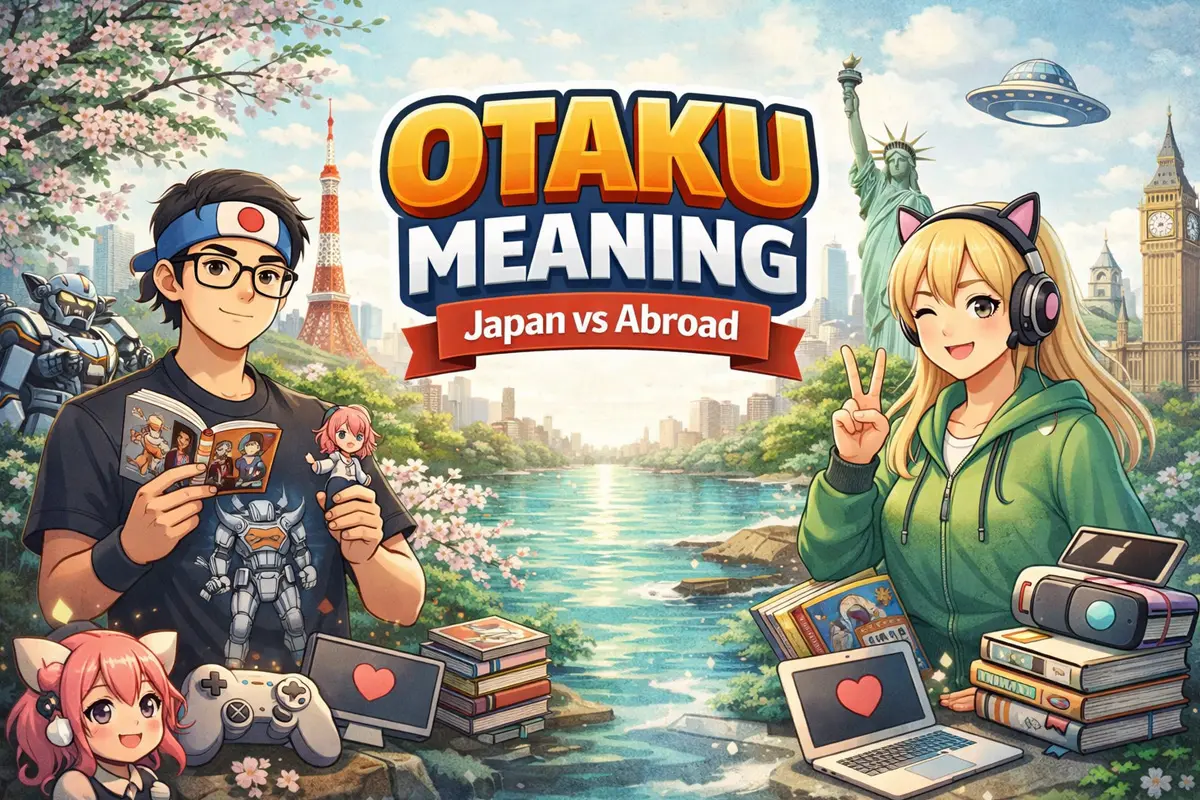
What “otaku” means in Japan vs outside Japan
In Japan 🇯🇵
In Japan, “otaku” can mean “a person who’s really into something,” but it often carries a flavor of:
- “a bit too into it”
- “socially intense”
- “deep in the rabbit hole”
That doesn’t mean it’s always insulting. It just means it’s a label that can feel stronger than “fan.”
Also: in Japanese usage, it’s not limited to anime. You’ll hear categories like “train otaku,” “camera otaku,” “idol otaku,” etc.
If your entry point is anime specifically, you’ll notice that fandom vocabulary often overlaps with character tropes too. For a quick, beginner-friendly rundown of the most common archetypes (and what people actually mean when they say them), see: Anime Character Types Explained: Tsundere, Yandere, Kuudere, and More.
Outside Japan 🌍
In English-speaking fandoms, “otaku” often becomes a community identity, like:
- anime lover
- convention regular
- collector
- someone who knows the deep lore
It’s often used with pride, especially online.
Is “otaku” a compliment or an insult?
A simple way to think about it:
- Self-labeling (“I’m an otaku”) → usually fine, often proud.
- Labeling someone else (“You’re an otaku”) → risky, can sound like “you’re obsessed.”
In Japan especially, calling someone “otaku” can feel like you’re judging them. If you want to be safe, try:
- “You really know your stuff.”
- “You’re super into it.”
- “You’re a huge fan.”
Quick mini-guide: how Japanese fans actually say it
Here are a few natural patterns you’ll see in real Japanese:
-
オタクです。 (Otaku desu.)
“I’m an otaku.” (Self-label; can be casual or joking depending on tone) -
アニメが好きです。 (Anime ga suki desu.)
“I like anime.” (Safer, lighter) -
ガチで好き。 (Gachi de suki.)
“I seriously love it.” (Slangy/strong enthusiasm)
If you’re building Japanese from the ground up, it helps to learn phrases that let you express interest naturally (instead of relying on labels). This pairs well with: Japanese basic phrases
Where did the word “otaku” come from?
This is the part people often miss—and it’s why the word feels “different.”
“Otaku” is connected to お宅, a polite term related to “someone else’s home/household,” and it’s also used as a very formal, distant way of saying “you” in Japanese.
That “polite distance” became part of the stereotype: early fandom circles were known for using formal speech patterns with each other—so the label stuck.
Otaku vs weeb: not the same thing
These get mixed up constantly.
Otaku
- Can be neutral.
- Often means “hardcore fan.”
- Can apply to many hobbies.
Weeb (short for “weeaboo”)
- Often means “someone trying too hard to be Japanese.”
- Usually has a mocking tone in English internet culture.
If your goal is respectful language, “otaku” is usually the safer word—especially when someone uses it for themselves.
Types of otaku you’ll hear about
In real life, people often add the interest in front:
- アニメオタク (anime otaku)
- マンガオタク (manga otaku)
- ゲームオタク (game otaku)
- 鉄道オタク (train otaku)
- アイドルオタク (idol otaku)
This is one reason “otaku” can be useful: it’s a quick way to say “I’m deeply into ___.”
How to use “otaku” without sounding awkward
If you want to sound natural (and not like you learned the word from one meme), use these rules:
-
Use it to describe yourself first.
People accept self-labeling more easily. -
Add the category.
“I’m a game otaku” is clearer than “I’m an otaku.” -
Avoid using it as an insult.
Even if your friends joke about it, it doesn’t always land cross-culturally. -
In conversation, lead with what you like.
“I’m really into anime” is always safe.
At Avatalks, we’ve noticed that learners remember culture words like “otaku” best when they attach them to real scenarios (introducing hobbies, talking about favorite shows, meeting people with shared interests) rather than memorizing the term alone.
FAQ — Otaku meaning
Does “otaku” only mean anime fan?
No. Anime is common, but “otaku” can apply to many intense hobbies (games, trains, idols, tech).
Is it okay to call myself an otaku?
Usually yes—especially in English fandom spaces. In Japan, it depends on context, but self-labeling is still safer than labeling someone else.
Is “otaku” offensive in Japan?
It can be, depending on tone and relationship. It has had pejorative use historically, and some people still hear it as “too obsessed.”
What’s the difference between “otaku” and “geek”?
In English, “geek” can be broad and often positive. “Otaku” tends to imply deeper intensity and is culturally tied to Japanese fandom contexts.
Final thoughts
The simplest, most accurate “otaku meaning” is: a person who’s seriously, intensely into a hobby—often anime, manga, or games.
But the real skill is knowing the vibe:
- In Japan, it can feel like a strong label.
- Outside Japan, it often becomes a badge of fandom.
If you want to sound natural, talk about what you love first—then decide whether you want the label.