TL;DR
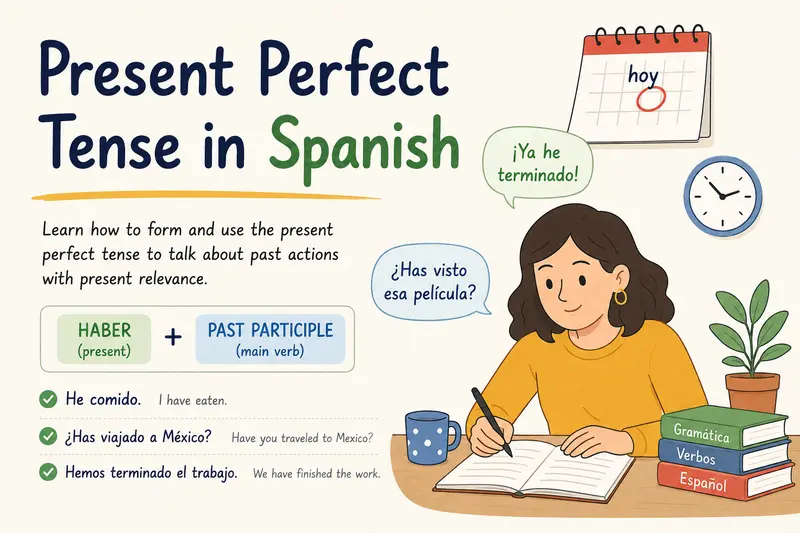
The present perfect tense in Spanish, called el pretérito perfecto compuesto, is formed with:
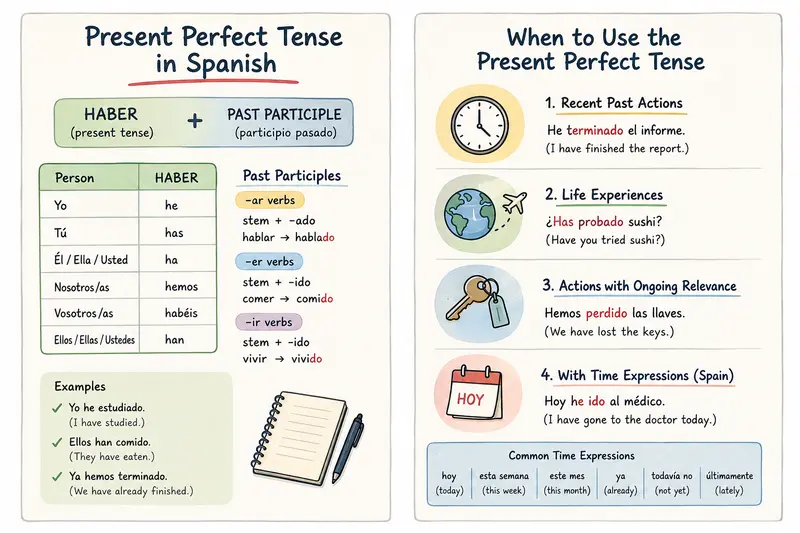
present tense of haber + past participle
For example:
- He hablado. — I have spoken.
- Has comido. — You have eaten.
- Hemos vivido aquí cinco años. — We have lived here for five years.
- ¿Has visto esta película? — Have you seen this movie?
The present-tense forms of haber are:
he, has, ha, hemos, habéis, han
Regular past participles usually end in:
- -ado for -ar verbs
- -ido for -er and -ir verbs
The present perfect often describes past actions connected to the present, experiences, recent events, and actions within a time period that is still continuing.
One important detail: its use differs somewhat between Spain and Latin America. In many parts of Latin America, speakers often use the simple preterite where speakers in Spain may prefer the present perfect.
What Is the Present Perfect Tense in Spanish?
The Spanish present perfect is a compound verb tense that connects a past event or experience with the present.
Its Spanish grammatical name is:
pretérito perfecto compuesto
You may also see it called simply:
pretérito perfecto
The basic structure is:
haber + past participle
For example:
He comido.
literally follows the same broad pattern as English:
I have eaten.
The auxiliary haber carries the person and number information, while the main verb appears as a past participle.
Compare:
- he hablado — I have spoken
- has hablado — you have spoken
- ha hablado — he/she has spoken
- hemos hablado — we have spoken
- han hablado — they have spoken
The participle hablado stays the same. What changes is haber.
How to Form the Spanish Present Perfect
The formula is simple:
Present tense of haber + past participle
For example:
haber + hablar → he hablado
haber + comer → has comido
haber + vivir → hemos vivido
The Real Academia Española lists the compound forms with the present of haber, such as he amado, has amado, ha amado, hemos amado, habéis amado, and han amado. (RAE – Spanish conjugation)
Haber Conjugation for the Present Perfect
You need only six forms of haber to build the present perfect.
| Subject | Haber | Example with hablar | English |
|---|---|---|---|
| yo | he | he hablado | I have spoken |
| tú | has | has hablado | you have spoken |
| él / ella / usted | ha | ha hablado | he/she/you have spoken |
| nosotros/as | hemos | hemos hablado | we have spoken |
| vosotros/as | habéis | habéis hablado | you all have spoken |
| ellos / ellas / ustedes | han | han hablado | they/you all have spoken |
A useful shortcut is to memorize:
he – has – ha – hemos – habéis – han
Once these six forms are automatic, forming the tense becomes much easier.
How to Form Spanish Past Participles
The second part of the present perfect is the past participle.
For regular verbs, forming it is straightforward.
-AR Verbs → -ADO
Remove -ar and add -ado.
| Infinitive | Past Participle | Meaning |
|---|---|---|
| hablar | hablado | spoken |
| estudiar | estudiado | studied |
| trabajar | trabajado | worked |
| visitar | visitado | visited |
| comprar | comprado | bought |
Examples:
- He hablado con Ana. — I have spoken with Ana.
- Hemos estudiado español. — We have studied Spanish.
- Han comprado una casa. — They have bought a house.
-ER Verbs → -IDO
Remove -er and add -ido.
| Infinitive | Past Participle | Meaning |
|---|---|---|
| comer | comido | eaten |
| beber | bebido | drunk |
| aprender | aprendido | learned |
| vender | vendido | sold |
Examples:
- He comido. — I have eaten.
- Has aprendido mucho. — You have learned a lot.
- Hemos vendido el coche. — We have sold the car.
-IR Verbs → -IDO
Remove -ir and add -ido.
| Infinitive | Past Participle | Meaning |
|---|---|---|
| vivir | vivido | lived |
| recibir | recibido | received |
| decidir | decidido | decided |
| salir | salido | gone out / left |
Examples:
- He vivido en Madrid. — I have lived in Madrid.
- Hemos recibido tu mensaje. — We have received your message.
- Ella ha decidido quedarse. — She has decided to stay.
Past Participles With Accent Marks
Some regular-looking participles need a written accent to keep the vowels in separate syllables.
Common examples include:
| Verb | Participle |
|---|---|
| leer | leído |
| creer | creído |
| oír | oído |
| traer | traído |
| caer | caído |
Examples:
- He leído ese libro. — I have read that book.
- ¿Has oído la noticia? — Have you heard the news?
- Ha traído comida. — He/She has brought food.
This is a small spelling detail, but it appears frequently in everyday Spanish.
Common Irregular Past Participles
Several high-frequency Spanish verbs have irregular participles that need to be memorized.
| Infinitive | Past Participle | English |
|---|---|---|
| abrir | abierto | opened |
| cubrir | cubierto | covered |
| decir | dicho | said |
| escribir | escrito | written |
| hacer | hecho | done / made |
| morir | muerto | died |
| poner | puesto | put |
| romper | roto | broken |
| ver | visto | seen |
| volver | vuelto | returned |
Examples:
- He abierto la puerta. — I have opened the door.
- Ella ha dicho la verdad. — She has told the truth.
- ¿Has hecho la tarea? — Have you done the homework?
- Hemos visto esa película. — We have seen that movie.
- Han vuelto a casa. — They have returned home.
Many verbs built from these verbs retain the irregular participle pattern.
For example:
- descubrir → descubierto
- devolver → devuelto
- componer → compuesto
When to Use the Present Perfect in Spanish
The present perfect has several common uses.
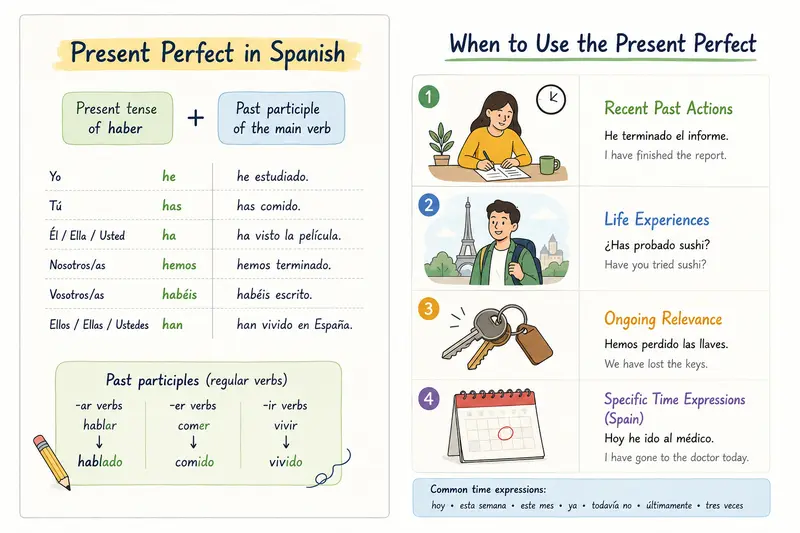
1. Past Actions Connected to the Present
Use it when something happened in the past but its result or relevance continues now.
He perdido las llaves.
“I have lost the keys.”
The important idea is not simply that the keys were lost at some time in the past. The result matters now: you don’t have them.
Another example:
Hemos terminado el trabajo.
“We have finished the work.”
The completed work is relevant to the present situation.
2. Life Experiences
The present perfect is frequently used to talk about experiences without saying exactly when they happened.
Examples:
- He estado en México. — I have been to Mexico.
- ¿Has probado paella? — Have you tried paella?
- Nunca hemos visto nieve. — We have never seen snow.
- ¿Has hablado con un famoso? — Have you ever spoken with a famous person?
The exact time is not important.
Compare:
He visitado Barcelona.
“I have visited Barcelona.”
with:
Visité Barcelona en 2024.
“I visited Barcelona in 2024.”
The second sentence gives a completed, specific past time, so the simple preterite is natural.
3. Actions During a Time Period That Is Still Continuing
The present perfect is especially common when the time period includes the present.
Examples:
- Esta semana he trabajado mucho. — I have worked a lot this week.
- Este mes hemos gastado demasiado. — We have spent too much this month.
- Hoy he hablado con María. — I have spoken with María today.
- Este año han viajado tres veces. — They have traveled three times this year.
The week, month, day, or year has not necessarily finished yet.
This usage is particularly common in Spain.
4. Recent Events
The present perfect can describe something that happened recently and remains relevant.
Examples:
- He terminado de comer. — I have finished eating.
- Acabo de hablar con ella. is another common way to express “I have just spoken with her.”
- El tren ha llegado. — The train has arrived.
However, regional usage matters here, which we’ll examine below.
5. Repeated Actions Up to the Present
Use the present perfect when an action has happened several times before now.
Examples:
- He visto esa película tres veces. — I have seen that movie three times.
- Hemos ido a España dos veces. — We have been to Spain twice.
- ¿Cuántas veces has visitado Madrid? — How many times have you visited Madrid?
Common Words Used With the Present Perfect
Certain adverbs and time expressions frequently appear with this tense.
| Spanish | English | Example |
|---|---|---|
| ya | already | Ya he comido. |
| todavía no / aún no | not yet | Todavía no he terminado. |
| nunca | never | Nunca he estado allí. |
| alguna vez | ever | ¿Has estado alguna vez en España? |
| últimamente | lately | Últimamente he trabajado mucho. |
| hasta ahora | until now / so far | Hasta ahora todo ha ido bien. |
| hoy | today | Hoy he estudiado español. |
| esta semana | this week | Esta semana hemos salido dos veces. |
| este mes | this month | Este mes he leído tres libros. |
| este año | this year | Este año hemos viajado mucho. |
Two especially useful patterns are:
ya + present perfect
and
todavía no + present perfect
For example:
Ya he terminado.
I have already finished.
Todavía no he terminado.
I haven’t finished yet.
Present Perfect in Spain vs. Latin America
This is one of the most important points for learners.
The present perfect exists throughout the Spanish-speaking world, but speakers do not always use it in exactly the same situations.
In Spain
Especially in much of Peninsular Spanish, the present perfect is commonly used for recent events or events within a time period that is still considered current.
For example:
Hoy he comido con Ana.
“Today I ate / have eaten with Ana.”
Esta mañana he hablado con Pedro.
“I spoke / have spoken with Pedro this morning.”
In Much of Latin America
In many Latin American varieties, the simple preterite is often preferred for completed past events even when they happened recently.
So a speaker may naturally say:
Hoy comí con Ana.
rather than:
Hoy he comido con Ana.
Similarly:
Esta mañana hablé con Pedro.
may be preferred over:
Esta mañana he hablado con Pedro.
This does not mean Latin American Spanish doesn’t use the present perfect. It does.
It remains natural for meanings such as experience or situations continuing up to the present:
Nunca he estado en España.
“I have never been to Spain.”
The important lesson is that the boundary between the present perfect and preterite varies by region. Usage references also note this Spain–Latin America difference. (Lawless Spanish – Present Perfect)
Present Perfect vs. Preterite in Spanish
This distinction causes a lot of confusion because English and Spanish do not divide the past in exactly the same way.
Here is a useful starting comparison.
| Present Perfect | Preterite |
|---|---|
| He hablado. | Hablé. |
| connects a past action with now | presents an action as completed in the past |
| often used for experience | often used with a finished past event |
| often appears with ya, todavía no, nunca, alguna vez | commonly appears with ayer, anoche, el año pasado |
| common in Spain with current time periods | widely used for completed events throughout the Spanish-speaking world |
Compare:
He visto esa película.
“I have seen that movie.”
The experience matters; no exact past time is given.
Now:
Vi esa película ayer.
“I saw that movie yesterday.”
Ayer identifies a finished past time, so the preterite is the natural choice.
Can You Use the Present Perfect With Ayer?
For beginners, the safest general rule is:
Avoid the present perfect with clearly finished past-time expressions such as ayer, la semana pasada, or el año pasado.
Use the preterite instead:
Ayer fui al médico.
“I went to the doctor yesterday.”
rather than learning:
Ayer he ido al médico.
Regional Spanish is more complex than this simple rule, and some Peninsular usage can extend the compound perfect into contexts that other varieties would express with the preterite. But for learners, treating ayer as a strong signal for the preterite will usually produce natural Spanish.
Present Perfect With Object Pronouns
Direct and indirect object pronouns go before haber.
Direct Object Pronouns
Lo he visto.
“I have seen it/him.”
La hemos comprado.
“We have bought it.”
Los han invitado.
“They have invited them.”
Indirect Object Pronouns
Te he enviado un mensaje.
“I have sent you a message.”
Le hemos explicado el problema.
“We have explained the problem to him/her.”
Both Pronouns Together
Te lo he dicho.
“I have told it to you / I have told you.”
The structure is:
pronoun(s) + haber + participle
Not:
he lo visto
Correct:
lo he visto
Where Do No, Ya, and Other Adverbs Go?
No
Put no before the auxiliary:
No he terminado.
“I haven’t finished.”
Ya
Ya commonly appears before the auxiliary:
Ya he comido.
“I have already eaten.”
Todavía no
Todavía no normally comes before haber:
Todavía no hemos llegado.
“We haven’t arrived yet.”
Nunca
Nunca can appear before the verb:
Nunca he probado eso.
“I have never tried that.”
These patterns are worth learning as complete chunks.
Does the Past Participle Agree With Gender or Number?
Not when it forms a compound tense with haber.
For example:
Ella ha comprado dos casas.
Not:
Ella ha compradas dos casas.
And:
Las hemos visto.
Not:
Las hemos vistas.
The participle stays unchanged:
comprado, visto, hecho, escrito
This differs from situations where a participle functions adjectivally.
For the present perfect, remember:
haber + invariant past participle
How to Make Questions
To ask a present-perfect question, you usually don’t need to change the verb structure.
Examples:
¿Has comido?
“Have you eaten?”
¿Han llegado?
“Have they arrived?”
¿Has visto esta película?
“Have you seen this movie?”
Question words can come before the construction:
¿Qué has hecho?
“What have you done?”
¿Dónde habéis estado?
“Where have you been?”
¿Cuántas veces has visitado España?
“How many times have you visited Spain?”
How to Make Negative Sentences
Put no before haber.
No he comido.
“I haven’t eaten.”
No hemos terminado.
“We haven’t finished.”
Ella no ha llamado.
“She hasn’t called.”
With todavía:
Todavía no han llegado.
“They haven’t arrived yet.”
Common Mistakes With the Spanish Present Perfect
1. Using Tener Instead of Haber
English uses have as the auxiliary, but Spanish does not use tener to form the present perfect.
Incorrect:
Tengo comido.
Correct:
He comido.
Use haber, not tener.
2. Conjugating Both Verbs
Only haber is conjugated.
Incorrect:
He comí.
Correct:
He comido.
The main verb must be in the past participle form.
3. Making the Participle Agree
Incorrect:
Ella ha escrita una carta.
Correct:
Ella ha escrito una carta.
The participle doesn’t change according to the subject.
4. Putting Object Pronouns After Haber
Incorrect:
He lo visto.
Correct:
Lo he visto.
Object pronouns go before the conjugated form of haber.
5. Separating Haber and the Participle Incorrectly
Spanish normally keeps haber + participle closely connected.
A useful learner pattern is:
pronoun/adverb + haber + participle
Examples:
Lo he visto.
Ya hemos terminado.
Nunca han viajado allí.
6. Overusing the Present Perfect for Finished Past Times
A phrase such as ayer or el año pasado usually points learners toward the preterite:
Ayer estudié español.
El año pasado viajamos a México.
Don’t simply translate every English “have + participle” or recent past event word-for-word without considering Spanish usage.
7. Ignoring Regional Differences
A sentence can be grammatically valid but sound more typical in Spain than in Latin America, or vice versa.
For example:
Hoy he comido temprano.
is very natural in Spain.
In many Latin American contexts:
Hoy comí temprano.
may be more natural.
Learning this difference will make your Spanish sound more authentic than memorizing one rigid rule for every country.
Present Perfect Conjugation Examples
Here is one regular -ar, -er, and -ir verb across all six persons.
Hablar — to speak
| Person | Present Perfect |
|---|---|
| yo | he hablado |
| tú | has hablado |
| él/ella/usted | ha hablado |
| nosotros/as | hemos hablado |
| vosotros/as | habéis hablado |
| ellos/ellas/ustedes | han hablado |
Comer — to eat
| Person | Present Perfect |
|---|---|
| yo | he comido |
| tú | has comido |
| él/ella/usted | ha comido |
| nosotros/as | hemos comido |
| vosotros/as | habéis comido |
| ellos/ellas/ustedes | han comido |
Vivir — to live
| Person | Present Perfect |
|---|---|
| yo | he vivido |
| tú | has vivido |
| él/ella/usted | ha vivido |
| nosotros/as | hemos vivido |
| vosotros/as | habéis vivido |
| ellos/ellas/ustedes | han vivido |
Notice that only haber changes.
20 Useful Present Perfect Examples
Here are practical sentences you can reuse in everyday Spanish.
- He terminado mi trabajo. — I have finished my work.
- Has aprendido mucho. — You have learned a lot.
- Ella ha llegado tarde. — She has arrived late.
- Hemos comprado comida. — We have bought food.
- Han vendido su casa. — They have sold their house.
- He visto esa película. — I have seen that movie.
- ¿Has estado en España? — Have you been to Spain?
- Nunca he probado eso. — I have never tried that.
- Ya hemos comido. — We have already eaten.
- Todavía no han llegado. — They haven’t arrived yet.
- He perdido mis llaves. — I have lost my keys.
- ¿Qué has hecho? — What have you done?
- Ella ha escrito tres mensajes. — She has written three messages.
- Hemos hablado con el profesor. — We have spoken with the teacher.
- ¿Habéis terminado? — Have you all finished?
- No he leído ese libro. — I haven’t read that book.
- Han vuelto a casa. — They have returned home.
- Esta semana he trabajado mucho. — I have worked a lot this week.
- Este año hemos viajado dos veces. — We have traveled twice this year.
- ¿Alguna vez has comido paella? — Have you ever eaten paella?
Present Perfect Practice Exercises
Try these before looking at the answers.
Exercise 1: Complete the Sentence
Use the correct form of haber plus the past participle.
- Yo ___ ___ (visitar) Madrid.
- Tú ___ ___ (comer) en ese restaurante.
- Ella ___ ___ (escribir) una carta.
- Nosotros ___ ___ (terminar) el trabajo.
- Ellos ___ ___ (volver) a casa.
- Usted ___ ___ (hacer) la tarea.
- Vosotros ___ ___ (ver) esta película.
- Mis amigos ___ ___ (llegar).
Exercise 2: Choose the Correct Form
- Yo (he / ha / han) hablado con María.
- Ellos (hemos / han / has) terminado.
- Tú (has / ha / he) visto la película.
- Nosotros (hemos / habéis / han) comido.
- Ella (ha / has / he) escrito un correo.
Exercise 3: Translate Into Spanish
- I have read the book.
- We have visited Madrid.
- Have you finished the homework?
- They have already eaten.
- She has never been to Mexico.
- I haven’t seen that movie yet.
Exercise Answers
Exercise 1
- he visitado
- has comido
- ha escrito
- hemos terminado
- han vuelto
- ha hecho
- habéis visto
- han llegado
Exercise 2
- he
- han
- has
- hemos
- ha
Exercise 3
- He leído el libro.
- Hemos visitado Madrid.
- ¿Has terminado la tarea?
- Ya han comido.
- Nunca ha estado en México.
- Todavía no he visto esa película.
Quick Present Perfect Cheat Sheet
| Rule | Example |
|---|---|
| haber + participle | he hablado |
| -ar → -ado | hablar → hablado |
| -er → -ido | comer → comido |
| -ir → -ido | vivir → vivido |
| pronoun before haber | lo he visto |
| negative before haber | no he terminado |
| participle doesn’t agree | ellas han escrito |
| ya = already | ya he comido |
| todavía no = not yet | todavía no he llegado |
| experiences | nunca he estado allí |
| current time period | esta semana he trabajado mucho |
If you remember this table, you already have the basic structure needed to start using the tense.
FAQ
What is the present perfect tense in Spanish?
The present perfect describes past actions or experiences that have a connection to the present. It is formed with the present tense of haber plus a past participle:
He hablado. — I have spoken.
What are the six forms of haber in the present perfect?
They are:
he, has, ha, hemos, habéis, han
For example:
he comido, has comido, ha comido, hemos comido, habéis comido, han comido
How do you form a past participle in Spanish?
For regular verbs:
- -ar → -ado
- -er → -ido
- -ir → -ido
Examples:
hablar → hablado
comer → comido
vivir → vivido
What are the most common irregular past participles?
Important irregular participles include:
abierto, dicho, escrito, hecho, muerto, puesto, roto, visto, vuelto
What is the difference between the present perfect and the preterite?
The present perfect generally connects a past action or experience with the present:
He visto esa película.
The preterite presents an event as completed in the past:
Vi esa película ayer.
Regional usage affects the exact boundary between the two.
Is the present perfect used differently in Spain and Latin America?
Yes.
In Spain, the present perfect is frequently used for recent events and events within current periods such as hoy or esta semana.
In much of Latin America, speakers often use the preterite in many of those same situations:
Hoy comí rather than Hoy he comido.
Both regions still use the present perfect, especially for experiences and actions connected to the present.
Can I use the present perfect with ayer?
For beginners, it is usually better to use the preterite with ayer:
Ayer fui al médico.
rather than:
Ayer he ido al médico.
Usage varies regionally, but this is a reliable learner rule.
Does the Spanish past participle change for gender?
Not when used with haber to form the present perfect.
Correct:
Ellas han escrito las cartas.
Not:
Ellas han escritas las cartas.
Where do object pronouns go?
Before haber:
Lo he visto.
Te lo he dicho.
How do I say “I have done” in Spanish?
Use:
He hecho.
Hacer has the irregular past participle hecho.
How do I say “Have you ever…?” in Spanish?
A common pattern is:
¿Alguna vez has + past participle…?
For example:
¿Alguna vez has visitado España?
“Have you ever visited Spain?”
Final Thoughts
The Spanish present perfect tense becomes much easier once you stop treating it as a long list of separate rules.
Remember the core formula:
haber + past participle
Then memorize:
he, has, ha, hemos, habéis, han
and the regular endings:
-ar → -ado
-er / -ir → -ido
After that, focus on the high-frequency irregular participles such as hecho, dicho, visto, escrito, puesto, vuelto, and practice the tense through real situations:
- experiences
- recent events
- results that matter now
- events within an unfinished time period
- sentences with ya, todavía no, and nunca
Finally, remember that real-world usage differs between Spain and Latin America. Learning that distinction will help you choose between the present perfect and preterite more naturally instead of translating directly from English.